A blog set out to explore, archive & relate plastic pollution happening world-wide, while learning about on-going efforts and solutions to help break free of our addiction to single-use plastics & sharing this awareness with a community of clean water lovers everywhere!
"Even
if we were to stop getting any plastic into the ocean tomorrow . . .
then these patches would continue to grow for at least another 500
years," he said.
"They would just grow and grow and grow because
of all the plastic we put in the ocean already that hasn't even
accumulated in these patches yet."
Here are 13 great ways that you can give back to the river you love
in 2013! Please feel free to share ideas with friends and colleagues,
and Happy New Year!
#1: Turn Parking Lots into Paradise
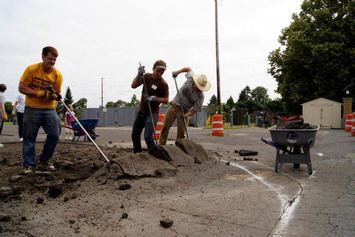
The folks at Depave
in Portland, Oregon hold regular work parties where community
volunteers can come and help turn unneeded pavement into rain gardens
and other community assets.
#2: Get the Junk Out!
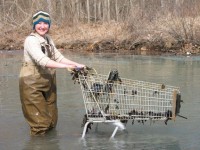
Rivers are not dumping grounds. But some people think so. Fortunately, many watershed groups organize regular community cleanups. Participate in a cleanup. If none are happening,
round up 5 friends, some trash bags, and make a Saturday morning out of it!
#3: Throw a Party on the River
-You may think about rivers often but you'd be surprised how many people forget about them entirely. So if you are hosting a
social gathering – a picnic, kids’ play dates, family reunion… propose to do it
at a riverside park. Our rivers need more people to know them and to love
them. Spread the word.
#4: Know Thy River
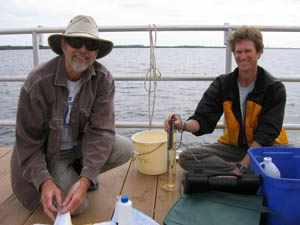
Become a
citizen water quality monitor! All over the U.S., hundreds of local
watershed groups operate volunteer monitoring programs and
anyone is welcome to join! Find a local group near you!
#5: Send Your Legislator Down the River
Our Partners at the Rock River Coalition in Wisconsin have an annual tradition of a float trip especially for elected officials that gives lawmakers a
firsthand look at -- and greater appreciation for -- our most important natural resource!
#6: Eat Less Water
A hamburger has a high water footprint
(roughly
1800 gallons per pound of beef), but if the water
used to raise the cow is mostly rain water and the water used to grow
soy is all irrigated, veggie burgers may not be a better option.
Fortunately, there's a "Water Footprint" website that can help you start to make the right choices!
#7: Put Your Money Where Your Passion Is
Talk is cheap. If you love rivers and are not supporting at least one river conservation group, please do so. You can donate to River Network and/or any one of several hundred local Partner organizations near you! There's still time for a 2012 tax deduction too. Every donation helps!
#8: Turn Out the Lights!
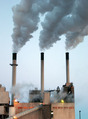
For
every gallon of water used in an average household, five times more
water (40,000 gallons each month) is used to provide that home with
electricity via hydropower turbines and fossil fuel power plants. You
can get a conservation Three-fer -- healthier rivers, fewer greenhouse
emissions and cleaner air -- by redoubling your energy conservation
efforts!
#9: Treasure Your Trees!
A two-foot diameter big leaf maple prevents nearly 2,000
gallons of stormwater and reduces CO2 by 600 pounds every year! Check
out the benefits of your own backyard trees at i-Tree Design and plant more if you can!
#10:Spout Off!
Disconnect
the downspouts from your gutter and let the rainwater filter naturally
into the ground. If drainage is an issue hook them back up to a rain
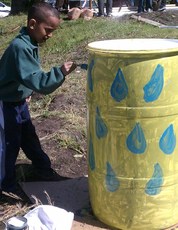
barrel (see photo at left) that will store the water for you to reuse
later! A couple of handy resources: “how
to install your rain barrel” video and a flyer on painting
your barrel.
#11: Check Your Brakes!
When you have to replace
your brake pads, request ones without copper. (Copper dust comes out when you
stop and flows into nearby streams, raising levels too toxic for fish) More info here.
#12: Meet Us in St. Louis!
If rivers are your passion and you've never been to River Rally,
make this the year! We'll be in St. Louis May 17-20. You'll get to
hobnob with hundreds of other river lovers, learn about rivers and how
to protect them, and enjoy some quality river time via one or more field
trips. Registration opens in January!
#13: Make Your Own River Resolution!
There are many other ways you can
help protect and restore rivers! Make your own resolution and if you
want to share it with others, post it on our Facebook page!
A student walks past a sculpture made of
empty water bottles on the University of Vermont campus. UVM has banned
the sale of bottled water. Toby Talbot/AP
When students at the University of Vermont
resume classes on the snow-covered Burlington campus Monday, something
will be missing: bottled water. UVM is the latest university to ban
on-campus sales of bottled water.
At one of UVM's recently
retrofitted refill stations, students fill up their reusable bottles
with tap water. For many of the 14,000 students and staff on this
campus, topping off their refillable bottles is an old habit.
"It's
much more convenient to fill up your water bottle at a water fountain
than to buy bottled water," says Mikayla McDonald, a recent graduate,
who a few years ago helped to launch the campaign that led to UVM's ban.
McDonald hopes it will reduce waste. But for her, it's not just about
changing behavior on campus.
"Bottled water is a symbol of our culture's obsession with commodifying things that should be public trust resources," she says.
In
that spirit, a few other American colleges have restricted or banned
the sale of bottled water to promote sustainability. But the University
of Vermont is the largest public institution to do so, and that
development disappoints beverage companies.
"I think they're
concerned because it's such a radical step," says lobbyist Andrew
MacLean, who represents local water and soft drink distributors in
Vermont. He agrees with the students' environmental goals, but he thinks
an outright ban restricts free choice and will ultimately fail.
"The
factors that will result in more materials getting out of landfills is
going to be a cooperative effort promoting strong recycling," he argues.
But
at least one New England town says recycling isn't enough to keep
plastic bottles out of its waste stream. Concord, Mass. — perhaps best
known for its role in the American Revolution — joined the student
movement this month, outlawing the sale of single-serve plastic water
bottles in its stores.
LOS ANGELES (AP) — Volunteers who patrol California
beaches for plastic, cigarette butts and other litter will be on the
lookout this winter for flotsam from last year's monstrous tsunami off
Japan's coast.
Armed with index-size cards, beachcombers will log water
bottles, buoys, fishing gear and other possessions that might have
sailed across the Pacific to the 1,100-mile shoreline.
The March 2011 disaster washed about 5 million tons of
debris into the sea. Most of that sank, leaving an estimated 1½ million
tons afloat. No one knows how much debris — strewn across an area three
times the size of the United States — is still adrift.
Tsunami flotsam already touched the Pacific Northwest
and Hawaii in 2012. The West Coast is bracing for more sightings in the
coming months as seasonal winds and coastal currents tend to drive
marine wreckage ashore.
Like the past winter, scientists expect the bulk of the
debris to end up in Alaska, Washington state, Oregon and British
Columbia. Last week, the Coast Guard spotted a massive dock that
possibly came from Japan on a wilderness beach in Washington state.
Given recent storm activity, Northern California could
see "scattered and intermittent" episodes, said Peter Murphy, a marine
debris expert at the National Oceanic and Atmospheric Administration,
which recently received a $5 million donation from Japan to track and
remove tsunami debris.
To prepare, state coastal regulators have launched a
cleanup project to document possible tsunami items that churn ashore.
Working with environmental groups, volunteers will scour beaches with a
checklist. It's like a typical beach cleanup, but the focus will be to
locate articles from Japan.
Until now, efforts in California have been haphazard.
The goal is to organize tsunami debris cleanups at least once every
season stretching from the Oregon state line to the Mexican border and
then posting the findings online.
Debris from Asia routinely floats to the United States.
It's extremely difficult to link something back to the Japanese tsunami
without a serial number, phone number or other marker.
Of the more than 1,400 tsunami debris sightings
reported to NOAA, the agency only traced 17 pieces back to the event,
including small fishing boats, soccer balls, a dock and a shipping
container housing a Harley-Davidson motorcycle with Japanese license
plates. No confirmed tsunami debris so far has reached California.
Even in the absence of a direct connection, California
coastal managers said it helps to know whether a beach is being covered
with more marine debris than usual.
"We want to get an idea of where to focus our efforts.
We have limited resources," said Eben Schwartz, marine debris program
manager at the California Coastal Commission, which heads the $50,000
NOAA-funded project. "If we see the problem is hitting the north coast
and not getting as far south as San Francisco, that tells us where to
focus."
In the summer, NOAA awarded $250,000 to five West Coast
states to help with tsunami debris removal. Alaska spent its share to
clean up a 25-mile stretch of beach before the weather turned too
bitter. Hawaii and Washington state have yet to dip into their funds.
Oregon racked up $240,000 to remove debris on beaches,
including a 66-foot dock that broke loose from the port of Misawa during
the tsunami and splashed ashore over the summer. Part of the tab —
$50,000 — was covered by NOAA.
Charlie Plybon, Oregon's regional manager at the
Surfrider Foundation, said the tsunami has raised beachgoers' awareness
about marine debris plaguing the world's coastlines. "There's a bit of
tsunami debris fever. It's like an Easter egg hunt," said Plybon, who
has been cleaning up the Oregon coast for more than a decade. "People
used to walk past debris. Now they want to be engaged."
Health experts have said debris arriving on the West
Coast is unlikely to be radioactive after having crossed thousands of
miles of ocean. Tsunami waves swamped a nuclear power plant and swept
debris into the ocean. The debris field, which once could be spotted
from satellite and aerial photos, has dispersed. More than 18,000
residents were killed or went missing.
Volunteer Julie Walters has combed Mussel Rock Beach
south of San Francisco for wreckage, but all that has turned up so far
are wave-battered boat parts and lumber of unknown origin.
If she did find an object with a direct link, "I would
find it quite intriguing that it made this incredible journey across the
Pacific," said Walters, a volunteer with the Pacifica Beach Coalition.
"It would also sadden me to think of the human tragedy."
Think island, think nature, think ocean, think tranquillity and think
pristine. Natural islands have always been escape destinations from the
concrete jungle chaos and pollution.
Now think again, think unnatural islands, think strewn litter over the
ocean, which eventually accumulate as floating marine trash. Who would
have thought we could create whole human-made waste catastrophes in the
far-off ocean? Plastic discarded in America may be carried for many
kilometres over the oceans.
Oceanic Conveyor Belt
Like our atmospheric currents, our oceans function as conveyor belts.
The conveyor belt work done by the oceans regulates our climatic
control. This role has been diminished by human-induced climate change,
this affects human, marine and land life-forms. Adding trash conveyance
to the equation, with extensive garbage being recklessly disposed of,
we are suffocating the oceans and inhibiting their role on the planet.
Trash Conveyance
The ocean currents move in certain patterns across the globe. Five grand oceans,
the Atlantic, Pacific, Indian, Southern and Arctic, they keep the
planet cool yet warm enough for our existence and move with strength in
an eight-shaped pattern, mixing, blending and moving things along.
Atmospheric convection (unequal solar heating causing horizontal and
vertical flows) and the earth's rotation are the major forces working on
ocean movement producing belts of wind that dominant the planet. Two
main wind-forms over the ocean are the trade winds and westerly winds.
The friction caused over the ocean surface results in ocean currents.
The Earth's rotation (Coriolis Effect) and the presence of scattered
continental landmasses, create a secondary wind-induced surface
movement, the Gyre Currents. There are five main Gyres working either
westward, eastward, poleward or equatorwards.
Gyres
may be seen as the secondary current force but they substantial impacts
over coastal temperatures, currents and wind storms. In addition, gyres
result in the slow movement of water allowing the trash to collect. The
points of convergence are where the deposition of trash occurs and
eventually build up to form floating trash islands.
Floating Waste Dumps
An area of concentration for waste over the ocean has been the 'Great Pacific Garbage Patch'
located between California and Hawaii. This patch arises from the North
Pacific Gyre. There other trash collection zones such as the Sargasso
Sea waste hotspot (in the Atlantic Ocean), the Western Pacific Garbage
Patch (off Japan's coastline) and the Indian Ocean Garbage Patch (only
discovered in 2010).
7 billion throw-away humans
We stand at a growing global population of 7 billion. Not only have
we overpopulated, but we have created a global society of waste
generators, unnecessary tonnage of fossil-fuel created plastic is
demanded in almost every product in our daily life, then we cast them
aside instead of reusing and recycling. Landfill sites are out of
capacity, land space for toxic dumps destroy wild-lands, vast quantities
of domestic garbage are disposed of along rivers, eventually finding
their way to the oceans and the obvious direct illegal disposals from
sea vessels.
Plastic Flotsam
Captain Charles Moore heading up a team of oceanic researchers
discovered that 90% of the floatsam in the Great Pacific Garbage Patch
is plastic. Plastic is a generic term referring to a range of human-made
petrochemical products. Plastic refers to bottled water containers,
caps on sodas drinks, plastic bags, bin-bags, take out containers, etc.
Plastics in general take a long time to degrade and therefore are
burden, but over land they degrade faster as opposed to in the ocean due
to temperature and algal growth on the plastic shielding solar rays.
However, plastics never fully degrade, they only become smaller
microplastics.
Threats to Marine Life
Plastic and other human generated solid waste are not only pollutants
based on their chemical composition but they are physical hazards to
wildlife. These hazards become evident when either ingested (choking
hazard) or physically debilitating a bird's movement. The consumed
pollutant also breaks down releasing toxic PCBs
into the sea animal's body. In addition to plastic, fish nets also trap
marine life. Marine animals become entangled in the nets and this can
lead to injury, starvation and death. Marine life-forms also suffer from
life-long disabilities from ocean garbage, namely, plastic bands
fitting over baby marine turtles that cause huge physiological deformity as the animal grows (see image below).
Source: Conservation Report, 2009
If we change our wasteful consumption, unnecessary production of new
plastic products, dumping waste, we may save innumerable lives, they may
not all be human, but we are responsible for them and all things living
on the planet.
Concord, Massachusetts has become one of the first
communities in the U.S. to ban the sale of single-serving plastic water
bottles.
According to the Associated Press, the plastic bottle ban resulted from a three-year campaign by local activists. The activists pushed to reduce waste and fossil fuel use.
Octogenarian Jean Hill lead the charge,
telling The New York Times in a 2010 interview, "The bottled water
companies are draining our aquifers and selling it back to us." She
declared, “I’m going to work until I drop on this."
The campaign Ban the Bottle claims that
"It takes 17 million barrels of oil per year to make all the plastic
water bottles used in the U.S. alone. That's enough oil to fuel 1.3
million cars for a year." Their website also states: "In 2007, Americans
consumed over 50 billion single serve bottles of water. With a
recycling rate of only 23%, over 38 billion bottles end up in
landfills."
The Town of Concord's website describes the bylaw,
stating "It shall be unlawful to sell non-sparkling, unflavored
drinking water in single-serving polyethylene terephthalate (PET)
bottles of 1 liter (34 ounces) or less in the Town of Concord on or
after January 1, 2013."
There is an exemption for an "emergency
adversely affecting the availability and/or quality of drinking water to
Concord residents."
The first offense results in a warning, the second in a $25 fine, and the third (and each following offense) in a $50 fine. Concord's Health Division staff are in charge of enforcing the ban.
Not
everyone is happy with the ban. WHDH reports that some businesses are
also working around it by selling larger bottles, since the rule only
focuses on smaller ones. Local Jenny Fioretti voiced one concern
to the news group: “Towns are close enough that people can walk two
minutes and go get it from Acton or Bedford. It doesn't really help I
don't think."
In a previous interview with Concord Conserves, Hill acknowledged
the challenges, but added, "what I'm trying to do with this Bylaw is to
increase the barriers to buying single-serve bottled water because in
order to help people change, you need to put policies in place that
steer them away from buying bottled water and toward considering the
many other good alternatives... I hope that other towns will consider
taking action too."
Clarification: Language has been amended in this article to correct
an inconsistency with regard to how businesses are responding to the
ban.
On Wednesday, Nov. 14,
the people of Brookline picked a side in what has become a high-stakes
war with fronts around the world. Their allies in the fight: an
international movement of activists dedicated to the eradication of a
global menace. Their enemy: the plastic bag.
As of December 2013, cashiers at supermarkets and other large
retailers in Brookline will no longer be allowed to provide disposable
polyethylene bags to their customers at checkout, under threat of a
punishing fine. Instead they’ll use bags made from compostable or marine
degradable material, including paper, or encourage customers to bring
reusable bags from home. The ban puts Brookline at the vanguard of the
anti-plastic-bag movement, which has succeeded in getting similar
ordinances passed in San Francisco and Los Angeles, as well as in China,
India, and South Africa. It also represents what is arguably the
biggest victory the movement has yet seen on the East Coast.
Over the past 30 years, the plastic shopping bag has become a potent
symbol of human consumption and carelessness. Flapping from trees,
blowing against fences, bobbing squalidly in waterways, bags seem both
insignificant and indestructible, an encapsulation of humankind’s fatal
attachment to minor conveniences. According to one estimate, Americans
use 100 billion plastic bags per year. It’s a number that horrifies
environmentalists, who are concerned about the fossil fuels they’re made
from and who calculate that each bag will continue to haunt the earth,
before decomposing, for hundreds of years.
But there’s another way to see the plastic bag, and a reason to think
a little harder about where the problem with it actually lies. To its
fans in the plastics industry, and there are many, the supermarket
shopping bag—or “T-shirt bag,” as it’s known in the business—is a
triumph of cost-effective engineering. Weighing just a fraction of an
ounce, it has convenient handles, water-resistant walls, and an
astonishing ability to carry up to 2,000 times its own weight. From this
point of view, the bag is a runaway success that has simply outpaced
our ability to contain it.
“The polyethylene plastic bag is a miracle of technology to me,” said
Diana Twede, a professor at the School of Packaging at Michigan State
University and the co-editor of the journal Packaging Technology and
Science. “I’m a fan of packaging history, and people in history would
not be able to believe that you could make such a strong, light, thin
type of material that would actually do some work.”
There’s a special irony to the fact that the latest skirmish in the
plastic bag wars has erupted in Massachusetts, given that the bags’
origins can be traced to the work of engineers from communities such as
Woburn and Gloucester—and that one of the intellectual nerve centers of
the plastics industry is located at the University of Massachusetts
Lowell.
“The state of Massachusetts was like the Silicon Valley of plastics,
in a lot of regards,” said Mark Steele, the CEO of Gloucester
Engineering, a company that designed some of the earliest
plastic-bag-making machines in the 1960s.
For Steele, there is something sad about the people of Brookline
launching an attack on a technology so intimately tied to their own
local history. But as supporters of the ban prepare to make the case for
a statewide ordinance—Marblehead Representative Lori Ehrlich has vowed
to raise it on the floor of the Massachusetts Legislature in
January—it’s unlikely that an appeal to regional pride is going to give
them any pause. The plastic bag is both bigger and smaller than any one
place, after all. And in many ways, that is the heart of the problem.
*** There was a time when
grocers would pack their customers’ purchases in paper cones, tying
them at the bottom with a piece of string. Some took a different route,
and spent their evenings gluing bags together out of paper. Everything
changed in 1883, when a Philadelphia inventor by the name of Charles
Stilwell patented an automatic paper bag machine that not only produced
paper bags on its own, but fitted them with a square-shaped bottom that
made it possible for baggers to stand them upright, leaving both their
hands free for loading. Over time, customers came to expect that when
they bought apples, or laundry detergent, or even a few pencils, they’d
get a bag as well.
As paper sacks became a fixture at grocery store checkout lines
across the United States, the seeds of their downfall were being sown
here in Massachusetts, where a formidable plastics industry began to
take root in the 1960s. As engineers discovered ways to make plastic
thinner, stronger, and easier to produce in bulk, the material started
being used to make trash bags, dry-cleaning bags, and packaging for
bread. “The phones would be ringing off the hook with people wanting to
buy bag-making machines,” said Bill Bode of Gloucester Engineering,
which sold the machines to local manufacturers in Salem, Lynn, and
Peabody, as well as to out-of-state companies like Union Carbide and
Mobil Chemical.
moodboard/Corbis
Plastic bags in a tree.
Grocery bags were the next big market, and plastics makers came up
with a design that included handles, giving them a distinct advantage
over their paper counterparts. Ironically, plastics advocates like to
point out, the introduction of plastic supermarket bags in the late
1970s was initially seen as a boon to the environment because they
didn’t require any trees to be cut down. But customers were unimpressed:
The material felt flimsy and the bags slumped over when placed in the
trunk of a car. Perhaps for this reason, plastic bags first gained a
foothold in cities, because the handles made them appealing to people
who had to walk home—as opposed to drive—and then climb stairs to get to
their apartments. But by the mid 1980s, the tide began to turn all over
the country; by 1986, disposable plastic bags were said to account for
fully a quarter of the market.
By that time, round one of the bag wars was well underway, with the
paper industry waging an aggressive public relations campaign, with
representatives giving quotes to newspapers about how the paper bag
ought to be seen as a token of American culture, alongside the flag and
apple pie. More practical concerns were raised as well. A spokesman for
the International Paper Co. said in 1983: “We’ve heard from grocers who
say people complained of plastic bags bumping into their legs.”
None of this proved to be enough to hold back the plastic bag, which
wove its way into the American household. Though they never came to be
seen as classy—high-end retailers mostly stuck with paper—disposable
plastic bags became a fact of life. People realized that you could
always use a few bags around the house, whether to contain dirty diapers
and dog poop, or carry wet swimsuits from the beach, or line
wastebaskets, or pack lunch for work.
But perhaps the biggest reason for the success plastic bags have
enjoyed in the United States—by 1996, they made up about 80 percent of
the market—has been their low cost, with some estimating that paper bags
cost four times as much to produce. This is in part because of the
minuscule amount of raw material required to make a plastic bag, but
it’s also because they take up less space, meaning you need a lot fewer
trucks and fuel to transport them. That difference translates to massive
savings for retailers: As long as shoppers expect a fresh bag every
time they buy something, a big chain of supermarkets can end up saving
hundreds of thousands of dollars per year by supplying them with plastic
instead of paper.
Today, environmentalists estimate that the world consumes a trillion
disposable plastic bags every year. So extraordinary is the plastic
bag’s success that the Guinness Book of World Records has named it “the
most ubiquitous consumer item in the world.”
*** The anti-plastic-bag
movement scored its first big victory in 2002, when officials in
Bangladesh banned them because they were found to be clogging storm
drains and causing floods. That same year, Ireland tried to stem its
litter problem by imposing a tax on plastic bags, leading to a dramatic
reduction in their use. As people began to realize just how many plastic
bags were out there—and how uniquely suited they were to fly through
the air, float out to sea, and sit in landfills for centuries—the
movement gained momentum. Bans and tax programs were implemented around
the world over the course of the following decade, including in Asia,
Europe, and Africa. In 2007, San Francisco became the first American
city to enact a ban; it was followed shortly thereafter by Los Angeles
and, earlier this year, by Seattle.
These measures have been met with extreme resistance from the
plastics industry, as well as some packaging experts, like Michigan
State’s Diana Twede. “People think the paper bag is environmentally
friendly because it looks like nature and it comes from a tree,” said
Twede. In reality, she added, “You’ve got all kinds of energy that goes
into making a tree into a paper bag—lots more energy than it takes to
make a plastic bag out of petrochemicals.” The bans we’ve seen passed
around the world, and now in Brookline, said Donna Dempsey, a
spokeswoman for a trade group called the American Progressive Bag
Alliance, are nothing but “feel-good legislation which has not worked to
reduce litter.”
It’s perfectly true, as people in the plastics industry remind us,
that plastic bags are reusable, recyclable, and take up very little
space. But it’s also true that they’re so cheap, and so profuse—think of
buying a toothbrush and watching as the cashier double-bags it—that we
don’t really treat them as objects we need to think about. “If my
household is any indication, probably about 10 percent of them get
reused at most,” said Twede. “It’s too bad more of them aren’t
recycled....But they’re so cheap and so thin that it feels like they’re
not worth recycling.”
Or, as Robert Malloy of UMass Lowell put it, “They’re a problem because people can afford to throw them away.”
The trajectory of the plastic bag, in this light, should perhaps be
seen as a cautionary tale: It’s possible to build a tool too ideally
suited to our needs. A ban on plastic bags is not an indictment of the
bags themselves; as Clint Richmond, one of the Brookline residents who
pushed for the new law, said, “This is not a ‘bags are evil’ thing.”
Rather, it’s an admission that if an object is sufficiently cheap,
effective, and plentiful, we simply cannot resist abusing it.



 For
every gallon of water used in an average household, five times more
water (40,000 gallons each month) is used to provide that home with
electricity via hydropower turbines and fossil fuel power plants. You
can get a conservation Three-fer -- healthier rivers, fewer greenhouse
emissions and cleaner air -- by redoubling your energy conservation
efforts!
For
every gallon of water used in an average household, five times more
water (40,000 gallons each month) is used to provide that home with
electricity via hydropower turbines and fossil fuel power plants. You
can get a conservation Three-fer -- healthier rivers, fewer greenhouse
emissions and cleaner air -- by redoubling your energy conservation
efforts!