A blog set out to explore, archive & relate plastic pollution happening world-wide, while learning about on-going efforts and solutions to help break free of our addiction to single-use plastics & sharing this awareness with a community of clean water lovers everywhere!
Showing posts with label Ocean Gyres. Show all posts

Wednesday, November 4, 2015

Plastic trash found floating in far Arctic waters

Bremerhaven, Germany (dpa) - An international research team has found that plastic trash littering the world's oceans is now even floating in Arctic waters.


The marine trash survey, by Germany’s Helmholtz Centre for Polar and Marine Research (AWI) and Belgium’s Laboratory for Polar Ecology, was one of the first conducted north of the Arctic Circle.

In July 2012 a research team led by AWI biologist Melanie Bergmann looked for floating trash in the Fram Strait, between eastern Greenland and Norway’s Svalbard archipelago, from the German polar research vessel Polarstern and by helicopter.

A total of 31 pieces of trash were spotted over a distance of 5,600kilometres. Bergmann noted, however, that the team could only make out the larger pieces, "therefore our numbers are probably an underestimate.

"Results of the survey were published on the online portal of the Switzerland-based scientific journal Polar Biology. In a previous study, Bergmann concluded that the density of plastic, glass and other types of litter on the Fram Strait seabed was 10 to 100 times higher than at the surface - and increasing.

Although it’s unclear how the floating trash made it so far north, Bergmann said it might have come from a trash vortex forming in the Barents Sea north of Norway and Russia, which is thought to be fed by the densely populated coastal regions of Northern Europe.

Trash vortices form when floating pieces of plastic are caught up in large, circling ocean currents and then pulled toward the centre.

Besides the one in the Barents Sea, the AWI said, there are five other known marine trash vortices around the world.

Another possible cause of the Arctic trash is receding Arctic sea ice due to global warming, allowing fishing trawlers and cruise liners to operate - and leave litter - farther north.

The researchers said the floating trash posed a threat particularly to seabirds, which feed on surface prey. Plastic has already been found in the stomachs of indigenous seabirds and Greenland sharks.

Monday, October 5, 2015

We Can Solve the Ocean Plastic Problem

 Published in the Huffington Post by Andreas Merkel - Oct. 1, 2015

Today, Ocean Conservancy released a major report: Stemming the Tide-Land-based strategies for a plastic-free ocean. We think it's a big deal. It squarely addresses one of our biggest worries: the avalanche of plastic that cascades into the ocean every year.

It's getting really bad. Practically every kind of animal, from plankton to whales, is now contaminated by plastic. It's in the birds, in the turtles, in the fish. At the current rate, we could have 1 ton of plastics for every 3 tons of fish by 2025.

This is nobody's plan. It's not the plan of the plastics industry, it's not the plan of the consumer goods industry and it's certainly not the plan for those of us who love and need the ocean. Nobody wants this.

The problem is born on land. Most of the plastic originates in rapidly industrializing countries whose waste management infrastructure is lagging behind. This is a typical phase of development that all countries go through. The problem is simply that the enormous utility of plastic, combined with the explosive economic growth of Asia and Africa, combine to yield an enormous flow of unmanaged plastic waste into the ocean.

The majority of plastic waste ending up in dumps and in waterways is composed of thin films used in grocery bags and food packaging. This type of material is very low value after it is discarded and there is little economic incentive to pick it up. Blown or washed into the ocean, it breaks apart, and becomes the "microplastic" that is so easily mistaken by animals for tasty zooplankton. These microplastics are ubiquitous, found everywhere from the equator to the poles, and it is a real and rapidly growing problem.

By comparison, the famous ocean gyres, or "garbage patches", which are considered to be the most concentrated areas of plastic in the ocean, contain only a small percentage (< 3 percent) of all plastics entering the ocean.

So what to do? We are fortunate, in a sense, that the plastic flow into the ocean is quite concentrated. Only five Asian countries account for the majority of the flow. Within these countries, there are a limited number of cities, rivers and watershed that really matter. We know where we need to go.

In these places, we need to first concentrate on the basics: the safe collection, transportation and storage of plastic waste. By optimizing the waste hauling system, increasing collection rates to 80 percent and advancing waste treatment and conversion technologies in these five countries alone, we could cut the flow of plastic into the ocean by 45% by 2025.

Stemming the Tide lays out in detail how the various elements of the solution have to come together, what they cost and who needs to be involved. This is clearly a solvable problem, but it will require the cooperation of many groups: industry, cities, national governments, multi-lateral organizations, banks, NGOs.

Together, we need to create the conditions that make it possible for investors and entrepreneurs to invest in integrated waste management solutions.

This is a classic example of a global problem with local solutions. The good news is that the global community is becoming very concerned about the ocean plastic problem. We can concentrate global expertise and resources on local problems, greatly accelerating the rate at which the fundamental waste management infrastructure is built.

Ocean Conservancy created the Trash Free Seas Alliance® (Alliance) specifically to focus these global resources on the right local problems. It consists of NGOs, corporations and scientists that have come together to create pragmatic, real-world solutions focused on the measurable reduction of ocean plastics.

Stemming the Tide is a signature initiative of the Alliance with support from the American Chemistry Council, The Coca-Cola Company, the Dow Chemical Company, REDISA and WWF, and was advised by a broad set of experts from the industrial, finance and waste management realms.

For the Alliance, this report is only the end of the beginning: it is the start of a global effort to turbo-charge the development of ocean-smart waste management infrastructure in the places that really matter.

See Haunting Art Made From Plastic Trash in the Ocean


Published in Ryot.org by Veronica An - Sept. 30, 2015
Indra's Cloud
Indra's Cloud (Anne Percoco, 2009/Creative Commons)

If you’ve ever wondered where the plastic trash you tossed ends up, look no further than your local gyre. These slow moving patches of ocean water are created by wind patterns and the Earth’s rotation and act as catch-all’s for ocean debris. Gyres are indicators for global pollution and paint a startling picture about how our consumption habits impact the planet.

The North Pacific Gyre is about twice the size of the United States and contains thousands of tons of plastic and microplastic waste. Not only does this unsightly floating landfill impact the marine ecosystem, but microplastics often end up in the bellies of marine animals who mistake the colorful bits of indigestible material for food.

According to World Watch, 10–20 million tons of plastic end up in the oceans each year. But with numbers that large, it can be hard to fathom what that really means. A group of artists at the Anchorage Museum in Alaska set out to explore the complex relationship between humans and the oceans. Gyre: The Plastic Ocean is shows the visual impact of consumerism and the haunting legacy of plastic.

The exhibition is no on view at the USC Fisher Museum of Art from September 2 through November 21, 2015. These beautiful and slightly disturbing art works provide a haunting portrait of consumption habits.
Given the ongoing drought in Los Angeles, Gyre takes on a slightly ironic tone.

In a parched city, the exhibition is intent on starting a discussion about the ocean. Ariadni Liokatis, the curator at the USC Fisher Museum of Art, describes the exhibition as timely and relevant to the state’s current situation. “It fits into the larger discussion of environmental issues in Los Angeles. In recent years, we have developed a greater consciousness of environmental degradation and have launched citywide clean up initiatives and the ban on plastic bags,” she told Ryot.org in an interview.

From photographs to mixed media sculptures, each work in the exhibition showcases the artist’s unique strengths. Artists from across the world added their voice to the discussion on pollution; some works whispered and others shouted but everyone had some thing important to say.

The artists used found plastic objects and ample stores of ingenuity to create something beautiful and through provoking. “I love the way everyone’s personal stories, creativity and expertise have been entwined to present such a distressing topic in a most informative, concise and visually appealing way,” Sue Ryan told Ryot.org in an interview.

Her piece, Ghost Dog, is her first life-sized dog sculpture that she created from discarded fishing nets. The sculpture invites wonder but leaves the viewer with a sense of unease.

Many works in the exhibition had hidden surprises. At first glance, Karen Larsen’s Preservations look like quaint mason jars filled with seashells and sand. But, on closer examination, the piece takes on a more sinister feel. Instead of holding seashells from a memorable day at the beach, the jars contain bits of plastic sorted by color and size.

Following in this ironic tone is Max Liboiron’s Seaglobe. This meticulously crafted snow globe contains a distopic ocean seascape create from plastics collected in New York City.

Cynthia Minet’s Beasts of Burden makes a strong environmental statement in the form of life-sized mixed media animal sculptures. Minet assembles recognizable pieces of plastic into animal sculptures, illuminated by colored LED lights from the inside. These beasts illuminated an entire room with their multihued glow. Minet’s plastic animals posed a silent but very real question about the legacy plastic leaves behind.

Artist, Diana Cohen, described plastic as an ambiguous material. “At this point, I have a love/hate relationship with my primary material,” she told Ryot.org in an interview. Plastic represents all the wonderful innovations of mankind…plastic represents the future! But what kind of future?”

Gyre is a though-provoking exhibition that gives new life to a persistent, plastic problem and implores us to rethink out habits. Art has the amazing power to draw viewers in and give them a new lens through which they can view the world.

“You look at these deceptively beautiful artworks and, upon taking a closer look, you realize how challenging the material is, how serious and critical of a subject matter is being addressed in the exhibition,” Liokatis told Ryot.org in an interview.

Now the only question is how we can change the devastating state of our oceans.

Thursday, August 27, 2015

Researchers Map Plastic Debris in Pacific Ocean

Published in Voice of America News Blog by Rick Pantaleo - August 24th, 2015
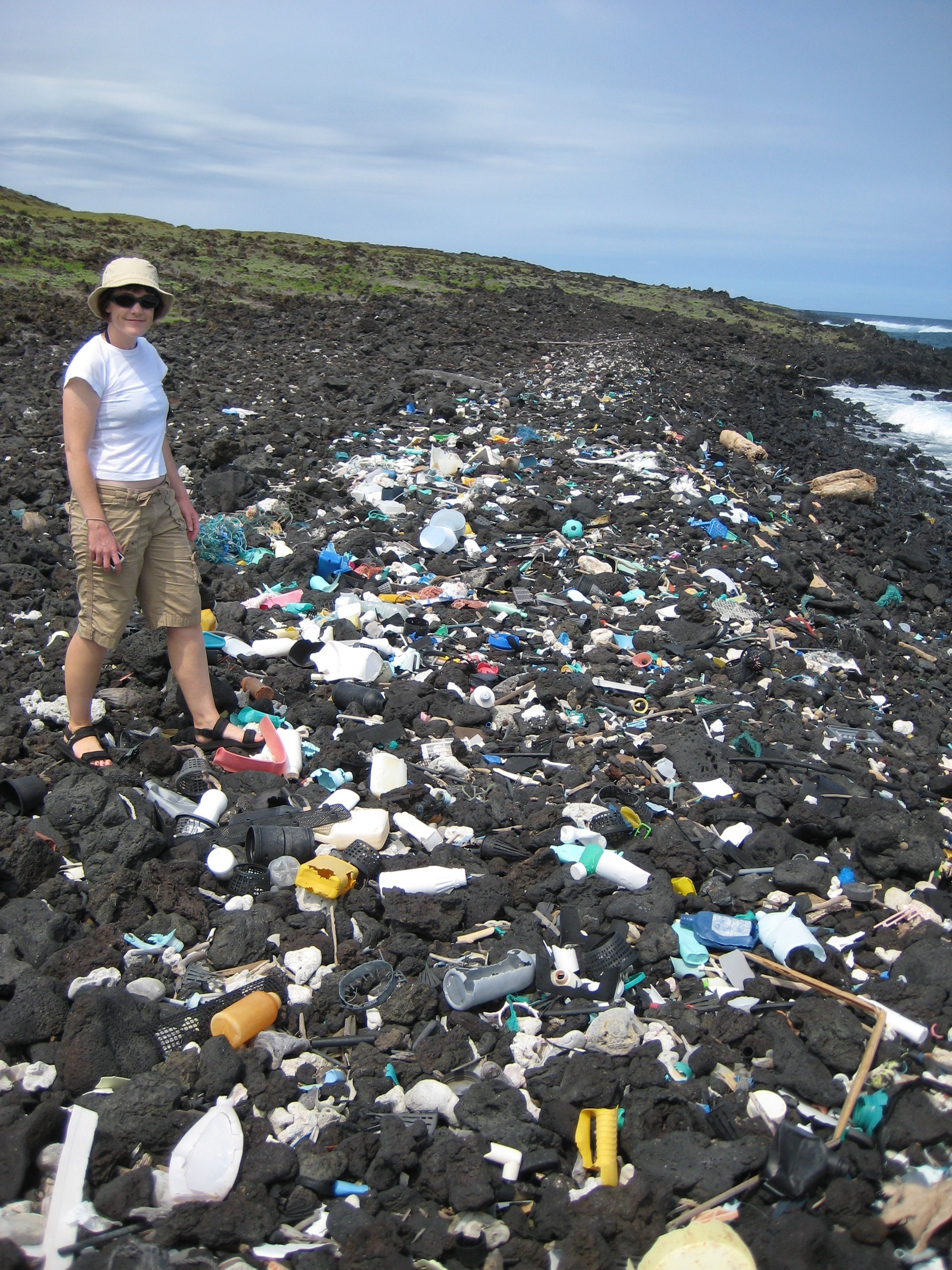
Plastic ocean debris littering Hawaiian shoreline. Hawaii is located near the center of the North Pacific gyre where debris tends to concentrate. (NOAA)

A team of volunteers, sailing in a flotilla of some thirty vessels, has successfully completed its month long research expedition through the western portion of the infamous Great Pacific Ocean Garbage Patch.

The first group of boats from the 30 vessel fleet, along with the Ocean Starr, a former NOAA research vehicle which served as the expedition’s “mother ship”, ended their journey when they sailed into in the port of San Francisco on Sunday, 8/23/15.

The Dutch environmental organization founded by Boylan Slat, called the Ocean Cleanup conducted its Mega Expedition Reconnaissance Mission through the massive collection of marine debris so that it could gather data to find out how much plastic is actually floating in the Pacific Ocean.

Nearly 8 million tons of plastic, mostly from land enters the ocean every year said a recent study.

Researchers say that portions of this huge collection of plastic, along with other forms of marine debris, gathers in five areas of the world’s oceans where the currents meet called the gyres.

A 2014 study found that currently there are at least 5.25 trillion pieces of plastic floating in the oceans with about third of it concentrated in the Great Pacific Garbage Patch.

The impacts of plastic pollution include harm to the environment, economy and human health.
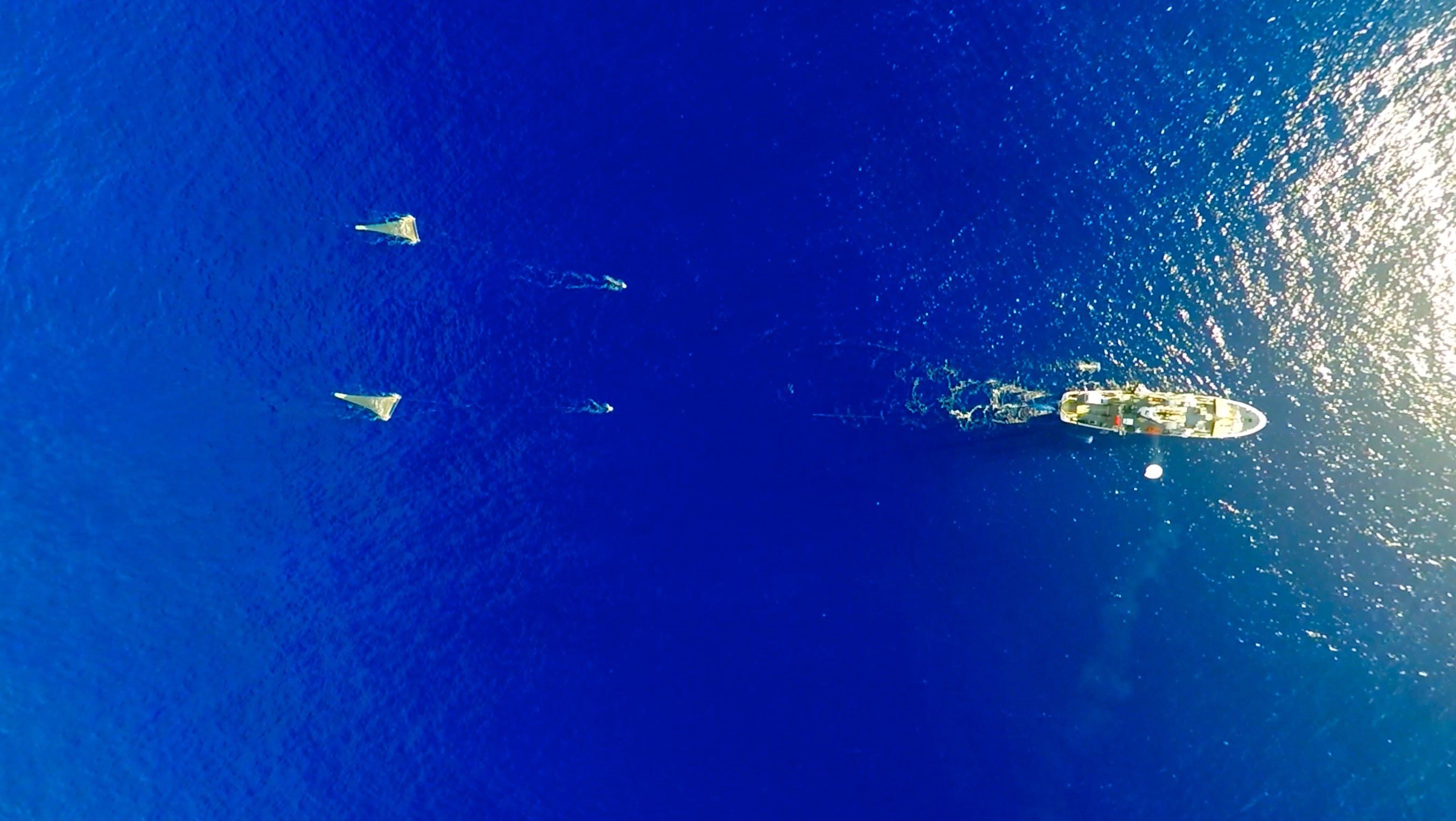
The Ocean Cleanup's Mega Expedition mothership R/V Ocean Starr is shown here deploying the two 6 meter-wide ‘mega nets’, two ‘manta trawls’, and its survey balloon with camera at the center of the Great Pacific Garbage Patch. ((C) The Ocean Cleanup/Skyframes)
The Ocean Cleanup’s Mega Expedition mothership R/V Ocean Starr is shown here deploying the two 6 meter-wide ‘mega nets’, two ‘manta trawls’, and its survey balloon with camera at the center of the Great Pacific Garbage Patch. ((C) The Ocean Cleanup/Skyframes)

About one million seabirds and one-hundred thousand marine mammals die every year due to plastic pollution, according to a 1997 study.

Toxic chemicals that are found in and can be amplified by the plastic pollutants enter the human daily diet through fish and other edible sea creatures who consume plastic polluted food.

Health effects that have been tied to these food borne chemicals include cancer, birth defects, immune system problems, and childhood developmental issues.

The Ocean Cleanup group plans to use the gathered data to create the first high-resolution map of plastic in the Pacific as well as to help in the preparation for the organization’s large scale ocean cleanup project that’s planned for 2020.

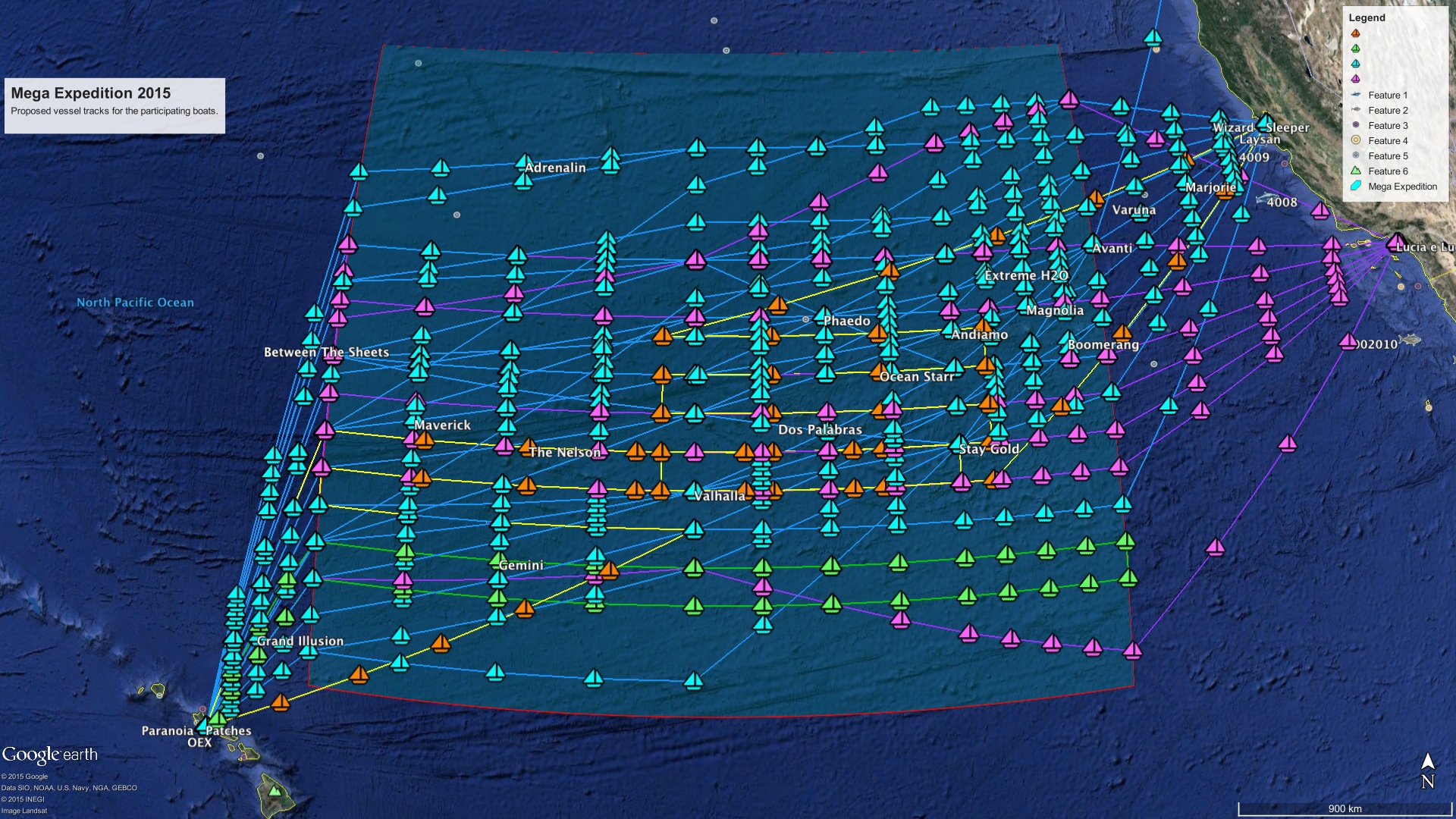
The thirty vessels sailed in parallel with each other over a 3.6 million square kilometer course in the Pacific Ocean. Over the month long period, the boats made around fifty crossings between the U.S. West Coast and Hawaii to conduct surveys on the amount of plastic they came across.
Map showing the 50 transects the Mega Expedition will perform based on routing information provided by the skippers before they left port.   Copyright: The Ocean Cleanup ((C) The Ocean Cleanup/Lys-Anne Sirks)
Map showing the 50 transects the Mega Expedition will perform based on routing information provided by the skippers before they left port.

Copyright: The Ocean Cleanup ((C) The Ocean Cleanup/Lys-Anne Sirks)

The expedition used a variety of measurement techniques to gather data.  Each of the boats towed a trawling net so that they could sample some of the smaller debris floating in the ocean. They tallied the larger pieces of debris with a special smart phone application called “The Ocean Cleanup survey app.”

To study large objects like ghost nets – fishing nets lost or left in the ocean – and debris from the 2011 Japanese Tsunami, the researchers also used an aerial camera system and giant nets that were aboard the Ocean Starr mothership.

According to a report from the Associated Press, most of the trash found by the expedition, including a one ton fishing net, were in medium to large pieces.

Rick Pantaleo
Rick Pantaleo maintains the Science World blog and writes stories for VOA’s web and radio on a variety of science, technology and health topics. He also occasionally appears on various VOA programs to talk about the latest scientific news. Rick joined VOA in 1992 after a 20 year career in commercial broadcasting.

Tuesday, August 25, 2015

Ship returns after monthlong study of plastic garbage in Pacific Ocean

Published on mlive by The Associated Press on August 24, 2015 
 
SAN FRANCISCO — Far away from California's coast, where the Pacific Ocean currents swirl, the blue of the sea was replaced by fishing nets, buckets, buoys, laundry baskets and unidentifiable pieces of plastic that floated past the Ocean Starr, a ship carrying a team of scientists and volunteers gathering data on plastic garbage.
 
"We were surrounded by an endless layer of garbage," sad Serena Cunsolo, an Italian marine biologist who works for The Ocean Cleanup. "It was devastating to see."
 
Cunsolo, 28, was one of a team of 15 researchers and volunteers aboard the Ocean Starr who a month ago set out from San Francisco to study the plastic waste as part of the "Mega Expedition," a major step in the organization's effort to eventually clean up what's known as the Great Pacific Garbage Patch.
 
The 171-foot mother ship, carrying massive white bags filled with plastic garbage, returned on Sunday to San Francisco along with two sailing boats with volunteers who helped collect the garbage samples.
 
Most of the trash they found, including a 1-ton fishing net, is medium to large-sized pieces, as opposed to confetti-like plastic shards that can easily enter the food chain after being eaten by small fish and birds and are extremely difficult to clean up, said Boyan Slat, who founded The Ocean Cleanup and has developed a technology that he says can start removing the garbage by 2020.
 
"It was a good illustration of why it is such an urgent thing to clean up because if we don't clean it up soon then we'll give the big plastic time to break into smaller and smaller pieces," Slat said.

Volunteer crews on 30 boats have been measuring the size and mapping the location of tons of plastic waste floating between the West Coast and Hawaii that according to some estimates covers an area twice the size of Texas.

Slat said the group will publish a report of its findings by mid-2016 and after that they hope to test out a 1-mile barrier to collect garbage near Japan. The ultimate goal is the construction of a 60-mile barrier in the middle of the Pacific.

The expedition was sponsored by The Ocean Cleanup, an organization founded by Slat, a 21-year-old innovator from the Netherlands who has envisioned using long-distance floating barriers that will attach to the seabed with an anchoring system used by oil-drilling rigs. The devices will target ocean currents full of waste and skim garbage from the surface while aquatic life and the currents themselves pass underneath.

He first became passionate about cleaning the oceans of plastic while diving in the Mediterranean Sea five years ago. "I was diving in Greece and realized that there were more plastic bags than fish, and I wondered why can't we clean this up," Slat said.

After dropping out of university after his first six months, Slat dedicated his life to developing the technology the group will start testing next year.

He decided to launch a kickstarter campaign and raised 2 million euros (about $ 2.27 million) that helped to launch his organization thanks to the success of a 2012 Ted Talk he gave about his idea that was viewed more than 2 million times. Soon, his innovative solution got the attention of major philanthropists in Europe and Silicon Valley, including Salesforce.com CEO Marc Benioff, who are helping pay for the data-gathering efforts and the technology's development.

The Pacific expedition, which will end in mid-September, will gather data that will be more extensive than what has been collected in the past 40 years. It also will give a better estimate of the how much plastic waste is in the Pacific Ocean, Slat said.

The boaters are using GPS and a smartphone app to search for and record the plastic. They take samples and ship them to the Netherlands, where the plastics are counted and recorded.

The Great Pacific Garbage Patch was discovered by Charles J. Moore in 1997 as he returned home from the Transpacific Yacht Race, which starts in Los Angeles and ends in Honolulu.

Monday, August 24, 2015

Watch the ocean's five islands of garbage form over the last 35 years


Published in Gizmodo by Casey Chan
Watch the ocean's five islands of garbage form over the last 35 years1
The ocean is filled with alien-looking creatures, a lot of natural beauty and a crap ton of garbage. There is so much garbage in the ocean that fully formed patches of our filth have spawned. In this fascinating visualization, NASA reveals how the ocean’s 5 islands of garbage came to be. You can see the swirling pattern of the ocean cause a natural graviation of garbage to each other as they settle down in different parts of the world.
We start with data from floating, scientific buoys that NOAA has been distributing in the oceans for the last 35-year represented here as white dots. Let’s speed up time to see where the buoys go...

...If we let all of the buoys go at the same time, we can observe buoy migration patterns. The number of buoys decreases because some buoys don’t last as long as others. The buoys migrate to 5 known gyres also called ocean garbage patches.

Wednesday, September 10, 2014

Math Might Help Nail Oceans' Plastic 'Garbage Patch' Polluters

Published in NBC News by

Who's flushing plastic pollution into the oceans, creating tiny time bombs that kill fish, birds and sea turtles ingesting what they think is food? That question has been around since 1997, when the "Great Pacific Garbage Patch" was discovered, and a new mathematical model could provide the tool needed to track down the culprits.

The model shows that pollution can cross what scientists thought were boundaries between oceans and especially its five gyres — large circular currents that are now known to trap floating debris in what have been dubbed garbage patches. Most of that trash is not even visible: It's tiny plastic pellets floating at or just below the surface. 

"The breaking of the geographic ocean boundaries should shift the way people think of where oceans begin and end," modeler and mathematician Gary Froyland told NBC News. "The interactions that we've shown between the different oceans shows that no ocean is isolated and that local effects can have impacts far from the source." 

Large Garbage Patch Floating in the Pacific Ocean

Froyland and two colleagues at the University of New South Wales in Sydney, Australia, described their model in a paper published Tuesday in the peer-reviewed journal Chaos

The work builds off an earlier, but less sophisticated, online tool (adrift.org.au) that allows users to project how plastic pollution travels in ocean currents. 

The trio's math comes from a field known as ergodic theory, which has been used to study interconnectedness — think complex systems like the Internet, or even humanity. 

For their model, the team divided the entire ocean into seven regions whose waters mix very little. Their projections tracked well with existing ocean circulation models and refined those to the point where they found that parts of the Pacific and Indian oceans are actually most closely coupled to the south Atlantic, while part of the Indian Ocean really belongs in the South Pacific. 

A follow-up study will look at how porous those boundaries are. "We first wanted to see where the boundaries are, the next step is to study the amount of plastic crossing these boundaries," said Erik van Sebille, an oceanographer with the team.
Image:  Andres Cozar Cabanas published a study last July showing where plastic debris has been found in the five gyres

Scientist Andres Cozar Cabanas published a study last July showing where plastic debris has been found in the five gyres around the world.
Scientists not involved in the modeling welcomed the tool. 

"I could imagine using their model to generate hypotheses about the likely source regions of debris in each of the 'garbage patches' that could be tested with on-the-ground sampling in these coastal regions," said Kara Lavender Law, an oceanographer with the Sea Education Association in Woods Hole, Mass. 

"We already know that once debris leaves a harbor or coastline it is fairly quickly carried to the open ocean to these subtropical accumulation zones," she adds, "but what we might not have guessed is that debris in the accumulation zones may have originated from the next ocean basin over." 

For Spanish marine ecologist Andres Cozar Cabanas, who published a study last July that mapped plastic ocean debris across the globe, the model shows that plastic pollution "is a global issue that can be effectively addressed only … at a global level." 

That's exactly how the Aussie trio want the tool to be used. "At a political level," says Froyland, "the realization that even the garbage patches exchange garbage may make governments realize that 'we're all in it together,' hopefully producing some global action."
 

NOAA Marine Debris Program
Marine debris accumulation locations in the North Pacific Ocean.

More about Ocean Gyres:

The vastness of the oceans had once lulled mankind into a false sense of safety with little knowledge that the capacity of oceans to take garbage and refuse is not infinite. The plastics have compounded the problem still further. Plastic pollution in the oceans is killing fish, birds and sea turtles. The great Pacific Garbage Patch was discovered in 1997 and the question, who’s flushing all the plastic pollution into the oceans?

The great Pacific Garbage is a collection of marine debris located in the North Pacific Ocean. The high-pressure area between the U.S. states of Hawaii and California is the precipitating factor for the Pacific Garbage phenomenon. The area lies in then centre of the North Pacific Subtropical Gyre, which is a circular ocean currents which has been formed by Earth wind patterns and the forces created by the rotation of Earth. The middle of the gyre is very calm. The circular motion of the Gyre pulls in the debris into the center. A similar garbage patch exists in the Atlantic Ocean, in the North Atlantic Gyre.

Thursday, September 4, 2014

California bans plastic bags, Miami Beach bans styrofoam containers

California, long known for its progressive stance on the environment, took a major step forward in solidifying this position as the California State Senate finalized its approval of the legislation on Friday, August 29, 2014. The measure is now being moved forward to Gov. Jerry Brown awaiting his signature.

The Senate bill SB-270 Solid Waste: Single-use Carryout Bags would begin the phasing out of single use plastic bags. Beginning July 1, 2015, stores that have a specified amount of sales or retail floor space would be prohibited from providing their customer a single-use plastic bag. The stores would only be allowed to provide a paper bag at a cost of not less than 10 cents.

In the next phase of implementation, starting on July 1, 2016, the bill would additionally impose these prohibitions and requirements on convenience food stores, foodmarts, and entities engaged in the sale of a limited line of goods, or goods intended to be consumed off premises, and that hold a specified license with regard to alcoholic beverages. There are additional considerations and requirements regarding reusable bags and recycling efforts included in the bill's language.

Precedents such as these should be recognized and applauded for taking concrete measures to address over consumption, the increase of landfills and plastic oceans.

Plastic oceans also known as gyers are an increasing concern as they degrade water quality and have a direct impact on the health of marine wildlife. A gyre, a naturally occurring vortex of wind and currents, rotate in a clockwise direction in the northern hemisphere and counter-clockwise in the southern hemisphere creating a whirlpool effect where marine plastic debris collects. There are 5 major gyres in the oceans worldwide, one of the largest is the North Pacific Gyre, also known as the Great Pacific Garbage Patch, estimated to be twice the size of Texas and swirls in the Pacific Ocean roughly between the coast of California and Hawaii.

Plastic bags, with a potential life of one hundred years, never fully decompose instead breaking into smaller and smaller pieces mistaken by the marine wildlife to be food. While their stomachs may be full, lacking in nutritional content, the health of our wildlife is severely compromised often resulting in death.

Even paper bags which seem to be a better environmental choice, are environmentally comprised in production utilizing chemicals and processes that are not environmentally beneficial. There are compostable plastic and paper bags, however, to be truly effective, recycling centers must have the type of facilities that allow for the bags to decompose. These are not always available.

Miami Beach also set a precedent on July 27, 2014 banning all styrofoam containers at all city parks, events, buildings and sidewalk cafes. These had already been banned from their beaches. Facing a fine of $100, tourists as well can be ticketed. The styrofoam ban by Miami Beach is a first for the state of Florida. It is hoped that this will be the beginning of a trend that will be matched by all the cities in the state.

Styrofoam, like plastic bags, essentially never decomposes but rather continues to break down into smaller and smaller pieces polluting water ways and compromising the health of our wildlife. According to the EPA in a publication, "Marine Litter - Trash that Kills", it goes into more detail regarding the crisis of plastic and our environment.

Kudos to California and Miami Beach for taking steps in the right direction!

California Senate bill SB-270 Solid Waste: Single-use Carryout Bags

Thursday, July 17, 2014

First of Its Kind Map Reveals Extent of Ocean Plastic

 
     Published in National Geographic July 15, 2014 by Laura Parker

When marine ecologist Andres Cozar Cabañas and a team of researchers completed the first ever map of ocean trash, something didn't quite add up.

Their work, published this month in the Proceedings of the National Academy of Sciences, did find millions of pieces of plastic debris floating in five large subtropical gyres in the world's oceans.

But plastic production has quadrupled since the 1980s, and wind, waves, and sun break all that plastic into tiny bits the size of rice grains. So there should have been a lot more plastic floating on the surface than the scientists found.

"Our observations show that large loads of plastic fragments, with sizes from microns to some millimeters, are unaccounted for in the surface loads," says Cozar, who teaches at the University of Cadiz in Spain, by e-mail. "But we don't know what this plastic is doing.

The plastic is somewhere—in the ocean life, in the depths, or broken down into fine particles undetectable by nets."

What effect those plastic fragments will have on the deep ocean—the largest and least explored ecosystem on Earth—is anyone's guess. "Sadly," Cozar says, "the accumulation of plastic in the deep ocean would be modifying this enigmatic ecosystem before we can really know it."

But where exactly is the unaccounted-for plastic? In what amounts? And how did it get there?

"We must learn more about the pathway and ultimate fate of the 'missing' plastic," Cozar says.

Plastic, Plastic Everywhere
One reason so many questions remain unanswered is that the science of marine debris is so young. Plastic was invented in the mid-1800s and has been mass produced since the end of World War II. In contrast, ocean garbage has been studied for slightly more than a decade.

"This is new mainly because people always thought that the solution to pollution was dilution, meaning that we could turn our head, and once it is washed away—out of sight, out of mind," says Douglas Woodring, co-founder of the Ocean Recovery Alliance, a Hong Kong-based charitable group working to reduce the flow of plastic into the oceans.

The North Pacific Garbage Patch, a loose collection of drifting debris that accumulates in the northern Pacific, first drew notice when it was  discovered in 1997 by adventurer Charles Moore as he sailed back to California after competing in a yachting competition.

A turning point came in 2004, when Richard Thompson, a British marine biologist at Plymouth University, concluded that most marine debris was plastic.

Research on marine debris is also complicated by the need to include a multidiscipline group of experts, ranging from oceanographers to solid-waste-management engineers.

"We are at the very early stages of understanding the accounting," says Kara Lavender Law, an oceanographer at the Sea Education Association, based in Cape Cod, Massachusetts.  "If we think ten or a hundred times more plastic is entering the ocean than we can account for, then where is it? We still haven't answered that question.

"And if we don't know where it is or how it is impacting organisms," she adds, "we can't tell the person on the street how big the problem is."

Law, along with Thompson, is one of 22 scientists researching marine debris for the National Center for Ecological Analysis and Synthesis at the University of California, Santa Barbara. The group is grappling with some of these questions and plans to publish a series of papers later this year.
One of the most significant contributions made by Cozar's team, says Law, was data collected in the Southern Hemisphere: "I can't tell you how rare that is."

New Maps Document Floating Plastic Trash

Tens of thousands of tons of plastic garbage float on the surface waters in the world's oceans, according to researchers who mapped giant accumulation zones of trash in all five subtropical ocean gyres. Ocean currents act as "conveyor belts," researchers say, carrying debris into massive convergence zones that are estimated to contain millions of plastic items per square kilometer in their inner cores.
Map shows plastic debris in surface water of world's oceans. Created in-house by Jamie Hawk (Ryan Morris).
NG STAFF, JAMIE HAWK. SOURCE: ANDRÉS COZAR, UNIVERSITY OF CÁDIZ, SPAIN
 
One Answer
Cozar's team was part of the Malaspina expedition of 2010, a nine-month research project led by the Spanish National Research Council to study the effects of global warming on the oceans and the biodiversity of the deep ocean ecosystem. 

Originally Cozar was assigned to study small fauna living on the ocean surface. But when tiny plastic fragments kept turning up in water samples collected by the expedition scientists, Cozar was reassigned to assess the level of plastic pollution.

The two-ship expedition spent nine months circumnavigating the world. But Cozar also used data gathered by four other ships that had traveled to the polar regions, the South Pacific, and the North Atlantic to complete the map.

The team analyzed 3,070 water samples. "One of the most striking observations was the conspicuous presence of plastic in the surface samples, even thousands of kilometers from the continents," he says. "The plastic garbage patch in the South Atlantic Gyre was one of the most striking."

See how scientists and artists have gathered and studied ocean debris to put the problem of trash into perspective.
 
Cozar says that one answer to the missing-plastic mystery is that some of the tiniest bits of plastic are being consumed by small fish, which live in the murky mesopelagic zone, 600 feet to 3,300 feet (180 to 1,000 meters) below the surface. 

Little is known about these mesopelagic fish, Cozar says, other than that they're abundant. They hide in the darkness of the ocean to avoid predators and swim to the surface at night to feed.

"We found plastics in the stomachs of the fishes collected during Malaspina's circumnavigation," he says. "We are working on this now."

One of the most common mesopelagic fish is the lantern fish, which lives in the central ocean gyres and is the main link in the tropical zone between plankton and marine vertebrates. Because lantern fish serve as a primary food source for commercially harvested fish, including tuna and swordfish, any plastic they eat ends up in the food chain.

"There are signs enough to suggest that plankton-eaters, the small fishes, are important conduits for plastic pollution and associated contaminants," Cozar says. "If this assumption is confirmed, the impacts of a man-sustained plastic pollution could extend over the ocean predators on a large scale."

Follow Laura Parker on Twitter

Every single ocean has a massive swirling plastic garbage patch

Published in Vox.com by Brad Plumer on July 14, 2014
The Great Pacific Garbage Patch is one of many areas in the ocean where marine debris naturally concentrates because of ocean currents. National Oceanic and Atmospheric Administration
What happens to our plastic bottles and lids and containers after we throw them out? This turns out to be something of a scientific mystery.

there are 35,000 tons of plastic floating in the ocean — and more may be hiding elsewhere
We know that the vast majority of plastic trash ends up in landfills, just sitting there and taking thousands of years to degrade. A smaller fraction gets recycled (about 9 percent in the United States).

But another large portion finds its way into the oceans, either by people chucking litter directly into the sea or by storm-water runoff carrying plastic debris to the coasts. One conservative estimate suggests that at least 1 million tons of plastic has entered the ocean since the 1970s.

Now here's the catch: We still don't know where all that ocean plastic actually went. Scientists have recently identified massive swirling garbage patches in each of the world's oceans that contain up 35,000 tons of plastic.

But those patches account for less than 1 percent of the plastic thought to be in the oceans — and no one quite knows where the other 99 percent went. One possibility is that fish are eating the rest of the plastic and it's somehow entering the food chain. But no one quite knows for sure.

Every ocean has a massive plastic garbage patch

Plastic_concentrations
Concentrations of plastic debris in surface waters of the global ocean. Colored circles indicate mass concentrations (legend on top right). The map shows average concentrations in 442 sites (1,127 surface net tows. Cozar et al, 2014.

Perhaps you've heard of the Great Pacific garbage patch — a giant patch of trash that's accumulated in a swirling subtropical gyre in northern Pacific Ocean.*

There are at least five giant floating garbage patches

Well, it turns out that there are at least five of these floating garbage patches around the world. That's according to a recent study in The Proceedings of the National Academies of Sciences, led by Andres Cózar of the Universidad de Cadiz and informed by the results of a 2010 circumnavigation cruise.

These garbage patches aren't visible from space — or even, necessarily, from a passing boat — since most of the plastic is bobbing just beneath the surface, and most of the particles are smaller than 1 centimeter in diameter. Over time, the plastic bits get broken down into ever smaller pieces as they get battered by waves and degraded by the sun.

But these garbage patches are massive, collectively holding some 7,000 to 35,000 tons of plastic in all. The patch in the North Pacific was by far the biggest — containing about one-third of all the floating plastic found. (Much of the plastic debris from eastern China, for instance, collects here.)

And yet, what was most surprising to researchers was that these plastic garbage patches weren't big enough. Conservative estimates had suggested that there should be millions of tons of plastic in the oceans. But these subtropical gyres only contained up to 35,000 tons.

In particular, there seemed to be much less plastic smaller than 1 millimeter in diameter than expected. 

So where did the rest of the plastic go?

99% of the plastic in the ocean is missing — where did it go?

14052480385_8c9c8c6663_k

In the PNAS paper, the authors offer a couple of possible explanations for why they didn't find nearly as much floating plastic as they expected. The most troubling is that fish and other organisms are eating all the plastic:

One possibility is that plankton and fish are eating the plastic

1) Maybe the plastic is washing back ashore. The problem with this hypothesis is that most of the missing plastic was less than 1 millimeter in diameter. It's unclear why only smaller bits would have washed up ashore.

2) Perhaps the plastic somehow breaks down into really, really tiny, undetectable pieces. This is possible, although the authors note that "there is no reason to assume that the rate of solar-induced fragmentation increased since the 1980s."

3) Maybe small organisms are growing on some of the plastic bits, causing them to get heavier and sink deeper into the ocean. This is also plausible, although the authors note that studies have found that when these plastic pieces sink, the organisms on them typically die and the plastic bobs back up to the surface.

4) Plankton and fish are eating the plastic. This one's a more plausible hypothesis. After all, the tiny plastic bits that seem to have vanished are small enough to be eaten by zooplankton, who are known to munch on plastic. The authors also argue that mesopelagic fish beneath the surface may be eating a lot of plastic too — and, perhaps, pooping it out down to the ocean bottom. This needs further testing though.

Assuming fish are eating all that plastic and it's entering the food chain, it's still unclear how dangerous that is. Obviously some marine organisms, like seabirds, can get digestive problems (and can die) if they eat large pieces of plastic. But what about very tiny pieces?

There's some evidence that toxic chemicals can cling to plastic in the ocean and accumulate — but there's still scant research on how much harm this might actually do as it passes through the food chain.

5) It's accumulating in the ice caps. Meanwhile, a separate recent study in Earth's Future suggested that a great deal of microplastic is accumulating in the polar ice caps. As sea ice forms and expands, the argument goes, it essentially "scavenges" the plastic from the seawater. This, too, might be part of the story.

6) Perhaps we're overestimating how much trash goes into the oceans. Of course, it's also possible that the estimates of how much plastic is entering the oceans in the first place are wrong. The seminal work on this was done by the National Academy of Sciences way back in the 1970s. That may need to be revisited.

Either way, something doesn't add up — the current numbers suggest that the vast majority of plastic trash in the ocean is vanishing, and no one seems to know where it went.

Further reading: Dianna Parker of NOAA's Marine Debris Program talks about possible ways to clean up the Great Pacific Garbage Patch.

Dutch student tackles environmental catastrophe with 'Ocean Cleanup' project


Boyan Slat has invented a concept that could remove nearly half of the plastic in the Great Pacific Garbage Patch in the next decade — and he’s not even 20 years old yet.
photo courtesy of The Ocean Cleanup
Boyan Slat (Photo courtesy of The Ocean Cleanup)

Slat, 19, has dedicated thousands of hours to working with a team comprised of more than 100 individuals who are working to prove the feasibility of Boyan’s concept: The Ocean Cleanup.

Temporarily quitting his aerospace engineering study, he has focused his efforts completely on continuing to develop a plastic collection and capture method that is not only innovative, but also financially beneficial.

“The ocean is not only important in terms of housing most of Earth’s biodiversity. It is essential as a food source, and also for the global economy,” Boyan said in an e-mail.

“The clean-up operation we developed is certainly more cost effective than the billions spent on a yearly basis in order to pay for damaged ships, the loss of biodiversity, and the clean-up of beaches,” he said.

While scuba diving in Greece, Slat was frustrated with the fact that there was more plastic than fish under the water. When he returned home, Boyan set to work, recruiting more than 70 authors for his feasibility research.

Throughout this journey, he has been recognized as one of Intel’s 20 Most Promising Young Entrepreneurs Worldwide (Intel EYE50), as well as awarded Best Technical Design at the Delft University of Technology. He also earned the second place spot for the iSea sustainable innovation award, granted by the Dutch Ministry of Infrastructure and the Environment.

Though Slat is making unbelievable progress in both ideology and creation of feasibility research, the war on plastic is far from over. It has barely just begun.

Researchers now know that gyres, which are giant ocean current vortices, are the final resting place for the carelessly discarded water bottles and plastic bags that countless people fail to recycle.

“The North Pacific gyre is by far the most polluted of the gyres, and this is the location where we plan to implement the system after we’ve done successfully completed testing,” Slat said.

“In total, five gyres have been identified where the plastic concentrates. We have several other potential locations for the pilots in mind at this moment, but no decision has been made yet. For now we would like to focus on the start of pilot testing once we have generated sufficient funding.”

Slat believes that attention from both the government and the public will make his concept a reality, and that funding can be found.

“Although we’ve now shown we can clean up almost half the pacific garbage patch in 10 years, we should also make sure no more plastic enters the ocean in the first place,” said Slat. “For this, awareness is the most important part.”

He continued, saying: “To accomplish awareness, we need attention from both the governments and the public. Governments can support this by rules and regulations, but of course, also by release funding in order to clean up the mess we’ve made so far.

“However, everybody can support. This is why we started a crowd funding initiative.”
To learn more about Slat’s innovative initiative, visit www.TheOceanCleanup.com.

Tuesday, July 1, 2014

Teacher discovers discarded plastic Twinkie crate from KC on remote island beach in Australia


Published in the Fox4KC June 24, 2014, by Matt Stewart

KANSAS CITY, Mo. — You may not immediately connect the Missouri River with Marine Biology, but after a day on the river approximately 20 students will be able to tell you – what we do locally can affect marine wildlife an ocean away.

Students collected trash along the Missouri River on Tuesday. If not intercepted, the trash would most likely make its way down river and possibly out to the ocean. The cleanup and learning day comes in connection with the Missouri Department of Conservation and the Healthy Rivers Partnership.

Instructor Leslie Mallinson told FOX 4′s Matt Stewart she found a plastic Twinkie crate from Kansas City while cleaning a remote tropical island beach in Australia.

See more of their interviews below.