A blog set out to explore, archive & relate plastic pollution happening world-wide, while learning about on-going efforts and solutions to help break free of our addiction to single-use plastics & sharing this awareness with a community of clean water lovers everywhere!
Showing posts with label The Great Lakes. Show all posts

Monday, December 28, 2015

Scientists Alarmed as Tiny Plastic Ends up in Lakes

 Published in the Toledo Blade by Tom Henry / Nov. 2, 2015

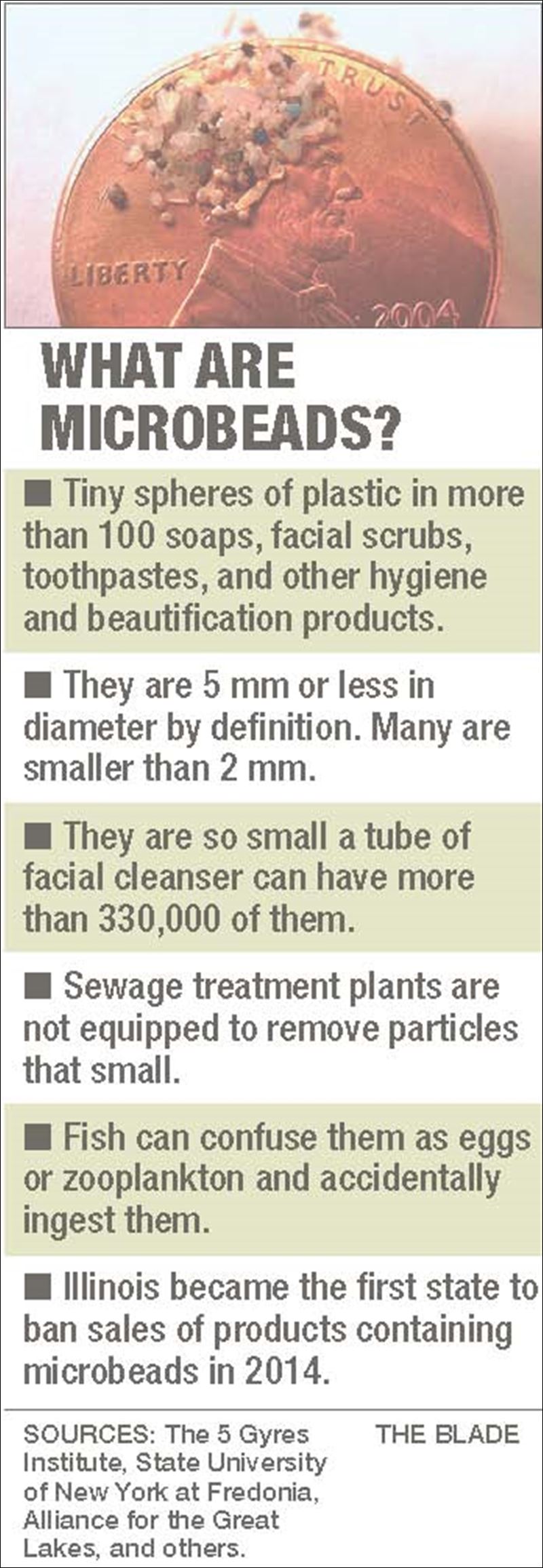
Tiny bits of plastic known as microbeads are emerging as one of the more troubling forms of pollution in the Great Lakes, especially Lake Ontario and Lake Erie.

So small that they pass undetected through sewage treatment plants, microbeads are part of the larger issue of plastic that has plagued oceans worldwide for years. Biologists fear that microbeads — which are ingested by fish that mistake them for eggs or zooplankton — could lead to a long-term impact on the Great Lake’s $7 billion fish industry and ultimately work their way into the human food chain.

Microbeads differ from traditional plastic litter in that they’re manufactured for more than 100 different varieties of soaps, facial scrubs, toothpastes, and similar hygiene and personal care items in response to a preference by consumers for better exfoliants to scrub away dirt and germs.

But that’s not the only source of them. They’re also found in some clothing, such as fleece.

Barely large enough to be seen by the human eye, microbeads are by definition no bigger than 5 millimeters in diameter and usually less than 2 millimeters. They’re small enough that dozens of them could occupy a human fingertip or cover a penny; a tube of facial cleanser has about 330,000 of them.

Microplastics, on the other hand, are fragments of soda bottles and shards of other plastic items.
Humans unknowingly rinse most microbeads down the drain, ultimately flowing into rivers and streams that flow into larger bodies of water.

Research on them is still in its infancy.

In a statement to The Blade, the U.S. Environmental Protection Agency recognizes problems associated with the general issue of plastic pollution, but said there “are no EPA regulations addressing microplastics or microbeads under the agency’s statutory authorities.”

The Ohio EPA does not regulate them, agency spokesman Heidi Griesmer said.
“The science is catching up to the policy here,” according to Marc Gaden, spokesman for the Ann Arbor-based Great Lakes Fishery Commission, which is comprised of fish industry policymakers from each of the eight Great Lakes states.

But while stating the commission is eager “to find out the extent of the risk,” Mr. Gaden also said microbead pollution simply “doesn’t pass the basic sniff test of Great Lakes stewardship.”

Jeff Tyson, Lake Erie fisheries program manager for the Ohio Department of Natural Resources, agreed.

“That’s primarily because there isn’t a lot of research out there,” Mr. Tyson said. “It’s not that there’s inconclusive research. It’s just not out there.”

What little research that has been done to date — mostly by the State University of New York at Fredonia and the University of Michigan — has gained a lot of traction.

In a report issued last April by the New York State Attorney General’s Office, Sherri “Sam” Mason, a SUNY Fredonia chemistry professor, collaborated with Jennifer Nalbone, an environmental scientist in that office, to assess how wastewater treatment plants are not equipped to filter out microbeads.

According to Ms. Mason, each of the 34 facilities studied had some form of plastic in their treated effluent, whether it was plastic fibers, fragments, or pellets.

“Every facility we looked at had plastic coming out of it,” she said.

Their report shows 25 of the 34 had microbeads.
“Treatment plants are not designed to remove microbeads from the wastewater stream, and treatments potentially effective at removing microbeads are unproven.

Even if effective treatment technologies are found to be available, the potential cost and time necessary to retrofit wastewater treatment plants with such technology is likely to be substantial,” the report states.

In an interview with The Blade, Ms. Mason said her lab — using open lake water highly filtered by fine mesh screens between 2012 and 2014 — found Lake Ontario to be the No. 1 spot in the Great Lakes region for microbeads and Lake Erie to be No. 2.

That was not a surprise, given the population densities along those shorelines and the fact that microbeads are light and buoyant.

They are believed to migrate from the Upper Lakes down to Lake Erie and Lake Ontario with water that flows out to the St. Lawrence Seaway, and from there into the Atlantic Ocean.
Scientists want to know how much microbeads have become part of the fish diet and what it may be doing to them.

One theory is that in addition to the petrochemicals of plastic itself, the material may be absorbing free-flowing pesticides and other chemicals in the water.

They don’t dissolve or break down, at least not for years.

“In our waters, microbeads persist for decades, acting as sponges for toxic chemical pollutants,” another report issued by the New York State Attorney General’s Office said. “Mistaken for food by aquatic organisms, microbeads serve as a pathway for pollutants to enter the food chain and contaminate the fish and wildlife we eat.”

Although Ms. Mason’s research is preliminary — so fresh it has not been written up, peer-reviewed, or published yet — she said all 25 fish species her team has studied to date have plastics in them.

So did double-crested cormorants, which eat a lot of fish.

“Every single species has had plastic in it,” she said.

Microbeads present an extra challenge because of their size.

“Smaller pieces of plastic are harder to control,” Ms. Mason said. “We could actually be eating plastic when we have fish frys on Fridays.”

In response to growing concerns, several manufacturers have voluntarily taken microbeads out of their products.

Illinois became the first state to ban sales of such products in 2014.

Several other states have followed suit or are in the process of considering bans, including Ohio and Michigan.

In Ohio, Senate Bill 193, introduced earlier this year by Ohio senators Mike Skindell (D., Lakewood) and Randy Gardner (R., Bowling Green) calls for a ban on sales of anti-bacterial soaps, hand soaps, bar soaps, liquid soaps, body washes, lotions, moisturizers, facial and body cleansers, facial masks, exfoliating facial scrubs, sunscreens, acne products, shampoos, conditioners, toothpastes, shaving creams and gels, and foot-care products that contain microbeads.

The bill was assigned to the Ohio Senate Energy and Natural Resources committee on Sept. 17.

Experienced fishermen such as Paul Pacholski, Lake Erie Charter Boat Association president, worry that microbeads will clog fish intestines.

Groups such as the Alliance for the Great Lakes urge manufacturers to use crushed almonds, oatmeal, or pumice as natural exfoliants.

In testimony before a U.S. House subcommittee on May 15, Molly Flanagan, the alliance’s vice president of policy, urged members of Congress to pass a federal ban on microbeads.

“We have enough issues we’re facing now,” Mr. Pacholski said. “It’s a vanity product that has no other purpose than a slightly better facial scrub.”

Contact Tom Henry at: thenry@theblade.com, 419-724-6079, or via Twitter @ecowriterohio.

Read more at http://www.toledoblade.com/local/2015/11/02/Scientists-alarmed-as-tiny-plastic-turns-up-in-lakes-could-harm-fish.html#bBdecs3O88KMdpyT.99

Tuesday, December 9, 2014

Microfiber is polluting our oceans. Let’s stop it!

Microfiber is polluting our oceans. Let's stop it!

Microfiber, the fabric used to make synthetic clothing, is a major contributor to ocean plastic pollution. Here’s how you can help stop it.


We talked not too long ago about plastic microbeads polluting the Great Lakes and harming marine life. It turns out this isn’t the only way that our fashion and beauty choices are connected to plastic pollution. A 2011 study found that plastic microfiber from clothing is a major contributor to ocean plastic pollution.

A 2011 study might sound like old news, but as Derek Markham at Treehugger points out, “unfortunately, [this issue] doesn’t seem to have gotten any traction in the industry or in the media since then.” That means there’s still work to do.

Every time we put our synthetic clothing through the wash, we send around 1900 pieces of plastic microfiber down the drain. Those microscopic pieces of plastic make their way through our sewage systems and eventually into the ocean. While 1900 pieces of microscopic anything isn’t much, this adds up when you consider how much of our clothing is made from synthetic materials. For some of us, everything we send into the wash contains at least some microfiber.

This is an issue that we can’t solve by buying second hand, because so much second hand clothing is made from synthetic fibers, too.

So, how can we stop the stream of microfiber into our oceans?

Sticking to natural materials is a good place to start. Organic cotton, hemp, and linen are all good options. When you’re shopping, keep an eye out for fabrics that don’t look totally natural. Sateen cotton is a good example. That sine on sateen fabric comes from – you guessed it – plastic.

Unfortunately, finding the clothing you want made from natural materials isn’t always easy. That’s why the real area where we need to see a change isn’t in consumer habits. It’s at the industry level. But as consumers, we have powerful voices! The folks at Story of Stuff have launched a campaign aimed at one of the leading ethical sportswear companies: Columbia Sportswear.

The petition asks Columbia to “Become an industry leader by researching how to make clothing that doesn’t pollute our oceans with plastic!”

If you want to get heard on this issue, you can sign the petition here. You can also contact your favorite clothing manufacturer and tell them that you’re concerned about microfibers. The petition page links to a Greatist list of sportswear companies that might be most open to our voices on the microfiber issue.

Image Credit: Washing Machine photo via Shutterstock

Thursday, April 17, 2014

Plastic Pollution in the Great Lakes: What’s Happening and What Can Be Done


From the Pacific Ocean garbage patch to litter at our local parks, plastic pollution has become a major problem facing the environment. As the weather warms up and you step outside to visit your favorite park or walk down your street, you have probably witnessed first-hand the amount of plastics that end up in the environment.

Plastic pollution, from the common plastic bag (see here) to the tiny microbeads found in face wash (see here), is impacting the water quality of the Great Lakes and its inhabitants.

What exactly happens when these plastics end in up in the largest surface freshwater system in the world? And what about the plastics you don’t see when you visit the Lakes? Learn the answers to these questions in a webinar hosted by the Alliance for the Great Lakes on April 29th at 1:00 pm which will feature innovative research being done across the Great Lakes on plastic pollution.

Right here on Lake Erie, Dr. Sherri A. Mason, Associate Professor in the Department of Chemistry and Biochemistry at SUNY Fredonia, has led the first-ever survey for plastic pollution within the open waters of the Great Lakes.

Her research has found high concentrations of tiny plastic particles in the lakes, including microbeads from personal care products. These “microplastics” may absorb toxins that threaten fish and other wildlife. And over on Lake Michigan, Dr. Timothy Hoellein, Assistant Professor in the Department of Biology at Loyola University Chicago, has been analyzed the type and amount of trash collected by Adopt-a-Beach™ volunteers at five beaches in four states.

His data looks at where litter comes from and how it can inform strategies to keep plastics and other trash out the Great Lakes. Both of these researchers will be presenting the findings on a live webinar on Tuesday, April 29, at 1 pm Eastern Time. Please visit www.greatlakesevents.webex.com for more information on this webinar.

But what if you already know the challenges these plastics pose and are ready to take action? Each year volunteers across the Great Lakes participate in marine debris collection and beach health assessments to not only collect plastic but track where and what debris they are finding.

Long standing seasonal events like the Buffalo Niagara Riverkeeper Shoreline Sweeps (coming up on April 26th) and the Great Lakes Beach Sweep (September 20th) have engaged citizens for years but if you would like to help gather marine debris and data throughout the year, the Alliance for the Great Lakes will be hosting an Introductory Training in the Adopt-a-Beach™ program on April 16th at 6:00 pm Woodlawn Beach.

Adopt-a-Beach™ is a year round program where volunteers visit their favorite Great Lakes beaches and shorelines to conduct litter collection and monitoring and perform a citizen science beach health assessment. The data they gather is then entered into an online database for analysis and shared with beach health officials.

With marine debris, plastic pollution, and poor water quality as major issues facing Great Lakes ecosystems and habitats, Adopt-a-Beach™ offers citizens an opportunity to take an active role in finding solutions to these problem throughout the year. Volunteers come out in groups of all sizes from individuals to school groups to business and community organizations. For more information, please visit www.greatlakesadopt.org.

Research and citizen action like this can make a difference. As we have seen with the proposed legislation on banning the use of microbeads, change can happen. Learn more about this issue and how you can become a part of that change by joining the webinar on the 29th or an Adopt-a-Beach training!

Nate Drag, New York Outreach Coordinator, Alliance for the Great Lakes, ndrag@greatlakes.org, 716-261-9393.

Tuesday, October 8, 2013

Plastic waste threatens lakes as well as oceans


Lake Garda  
Researchers found levels of plastics in Lake Garda similar to those in marine environments
Pollution with plastic waste is not confined to the oceans but poses a growing threat to lakes as well.

That is the view of researchers who found significant concentrations of the substance in Italy's Lake Garda.

They say the levels are similar to those found in samples taken from marine beach sediments.

They are concerned that these tiny plastic particles are accumulating in freshwater species and are "likely" to get into the food chain.

The research is published in the journal, Current Biology.

"It is, I think, a problem all over Europe and maybe all over the world”  Prof Christian Laforsch University of Bayreuth
 
The problem of large amounts of plastic polluting the world's oceans has been well documented in recent years. 

As well as bigger pieces that can choke sea creatures when ingested, there is an equally serious issue with very small fragments called micro-plastics.

But research on the problems caused by plastic in lakes has been lacking.

Danger on the shore This new study looked at Lake Garda, a large, sub-alpine body of water. The researchers found significant concentrations of plastic in sediment samples. On the north shore they found around 1,000 larger particles per square metre and 450 micro-plastic particles in the same area.

"We were surprised," lead author Prof Christian Laforsch from the University of Bayreuth told BBC News.
particles in crustacean 
Freshwater crustaceans from Lake Garda were found to have micro-plastic particles in their digestive tracts
 
"We have similar amounts of plastic particles in the sediment of the lake's ecosystem as we find in marine ecosystems."

Chemicals found in plastics can be poisonous, can damage endocrine systems or in some cases cause cancers.

They can also transport dangerous organic pollutants into clean environments like lakes.

Landfill to lake Previous research on fish and other marine creatures has shown that these species tend to accumulate tiny plastic fragments into their tissue. Prof Laforsch worries that this is happening in Lake Garda and elsewhere.

"What we show is that filter feeders and sediment feeders and organisms that feed on the surface layer of the lake, all swallow these plastic particles mistaking them for food.

"There might be impacts when it affects the hormone system, they could become sterile for example. It could also be, that when fish are feeding on these organisms they accumulate these particles also in their tissue."

The problem is being caused by human use of plastic materials say the researchers.

Apart from water sports, and tourist and fishing boats, the main sources of waste entering Lake Garda were discarded plastic products and debris which may originate from landfill sites.

plastic art 
An art exhibit made up from pieces of plastic found in the marine environment
 
The scientists are also concerned that the discovery of significant amounts of plastic in lake environments could have implications for human populations as the waters are often used for drinking and for agriculture.

And they argue that, as in the seas, plastic pollution is likely to be widespread in freshwater bodies.

"There is nothing particular about Lake Garda," said Prof Laforsch.

"We are testing in Bavaria and it looks pretty much the same. It is, I think, a problem all over Europe and maybe all over the world."

Follow Matt on Twitter.

More on This Story

Related Stories

Monday, August 12, 2013

Masses of plastic particles found in Great Lakes

By JOHN FLESHER, AP Environmental Writer | July 29, 2013 | posted in the Houston Chronicle
Photo By Courtesy 5gyres.org, Carolyn Box

In this 2012 photo provided by 5gyres.org is a sample collected in eastern Lake Erie showing tiny bits of plastic on a penny. Scientists discovered masses of floating plastic particles in Lakes Superior, Huron and Erie last year. This summer, they’re widening the search to Lakes Michigan and Ontario. They are trying to determine whether fish are eating the particles, which may come from city wastewater, and passing them up the food chain to humans.
 
TRAVERSE CITY, Mich. (AP) — Already ravaged by toxic algae, invasive mussels and industrial pollution, the Great Lakes now confront another potential threat that few had even imagined until recently: untold millions of plastic litter bits, some visible only through a microscope.

Scientists who have studied gigantic masses of floating plastic in the world's oceans are now reporting similar discoveries in the lakes that make up nearly one-fifth of the world's fresh water. They retrieved the particles from Lakes Superior, Huron and Erie last year. This summer, they're widening the search to Lakes Michigan and Ontario, skimming the surface with finely meshed netting dragged behind sailing vessels.

"If you're out boating in the Great Lakes, you're not going to see large islands of plastic," said Sherri Mason, a chemist with State University of New York at Fredonia and one of the project leaders. "But all these bits of plastic are out there."

Experts say it's unclear how long "microplastic" pollution has been in the lakes or how it is affecting the environment. Studies are under way to determine whether fish are eating the particles.

The newly identified hazard is the latest of many for a Great Lakes fish population that has been hammered by natural enemies like the parasitic sea lamprey, which nearly wiped out lake trout, and man-made contamination. Through it all, the fishing industry remains a pillar of the region's tourist economy. Until the research is completed, it won't be clear whether the pollution will affect fishing guidelines, the use of certain plastics or cities that discharge treated wastewater into the lakes.

Scientists have already made a couple startling finds. The sheer number of plastic specks in some samples hauled from Lake Erie, the shallowest and smallest by volume, were higher than in comparable samples taken in the oceans.

Also, while it's unknown where the ocean plastic came from, microscopic examination of Great Lakes samples has produced a smoking gun: many particles are perfectly round pellets. The scientists suspect they are abrasive "micro beads" used in personal care products such as facial and body washes and toothpaste.

They're so minuscule that they flow through screens at waste treatment plants and wind up in the lakes, said Lorena Rios Mendoza, a chemist with the University of Wisconsin-Superior. At the urging of scientists and advocates, some big companies have agreed to phase them out.

During a meeting of the American Chemical Society in April, Rios reported the team had collected up to 1.7 million tiny particles last year in Lake Erie, which acts as something of a "sink" because it receives the outflow from the three lakes to the north — Superior, Michigan and Huron.

Mason said preliminary samples indicate "Lake Ontario is as contaminated as Lake Erie, if not more so."

The Great Lakes are no stranger to ecological calamity. Zebra and quagga mussels have destabilized food chains, and ravenous Asian carp are poised to invade. Runaway algae blooms that had been stamped out a generation ago have returned. Dozens of harbors and river mouths are fouled with toxic waste.

Now, researchers are stepping up efforts to determine how much damage the plastic could do. Mason and Rios are working with the 5 Gyres Institute, a nonprofit group based in Los Angeles that has called attention to sprawling masses of plastic in the oceans.

While Mason searches Lake Michigan for more plastic, Rios is poking through fish innards for plastic fragments. In ocean environments, fish and birds are known to feed on microplastics, apparently mistaking them for fish eggs.

A more complicated question is whether the particles are soaking up toxins in the water, potentially contaminating fish that eat them — and sending them up the food chain.

Rios said lab examination had detected two potentially harmful compounds in the Lake Erie plastic debris: PAHs, which are created during incineration of coal or oil products; and PCBs, which were used in electrical transformers and hydraulic systems before they were banned in 1979. Both are capable of causing cancer and birth defects.

Everyone agrees the best way to avoid environmental damage from plastics is to keep them out of the water in the first place. Eriksen's group has urged makers of personal care products to stop using microbeads. Procter & Gamble and Johnson & Johnson have announced phaseout plans. L'Oreal says it won't develop new products with microbeads.

For anglers who regularly feast on salmon, perch and other delicacies from the lakes' depths, the most common reaction to the microplastic scare is a resigned shrug. They're used to warnings against overindulging on fish because of mercury, PCBs and other contaminants.

"I think people aren't going to be really worried about it until more research is done to see just what we're dealing with," said Ron Dohm, president of the Grand Traverse Area Sport Fishing Association in northern Michigan. "You look in the waters and you see all those cigarette butts — the fish eat them, too."
___
Follow John Flesher on Twitter at http://twitter.com/JohnFlesher

Friday, July 5, 2013

Plastic pollution a problem in the Great Lakes


Posted July 2, 2013 by Sharon Hill in WindsorStar.com

Microbeads from samples in the eastern half of Lake Erie. (Courtesy of Marcus Eriksen) 
Microbeads from samples in the eastern half of Lake Erie. (Courtesy of Marcus Eriksen)
Tiny bits of plastic found in cosmetic products from toothpaste to body washes are posing a growing pollution threat to the Great Lakes, according to researchers.

The first survey of plastic pollution in the Great Lakes discovered spots in Lake Erie with more than 450,000 plastic particles per square kilometre, double what similar surveys have found in oceans, the study’s principal investigator Sherri Mason said Tuesday.

“We’re plasticizing our water,” said Mason, an associate chemistry professor at the State University of New York’s College at Fredonia, N.Y.

The research, which was done from the Flagship Niagara, a reconstructed flagship of the 1813 Battle of Lake Erie, found plastic microbeads in surface water samples last year from lakes Superior, Huron and Erie. Mason was on the Detroit River in May conducting more research. The study has been submitted to a marine pollution journal but is not published yet.

Mason said they were collecting bits of plastic less than a millimeter in size in fine netting dragged behind the boat. The majority of the particles appear as spherical balls when seen under a microscope.

Microbeads come from all sorts of personal care products and give a creamy feel to cosmetics and lotions.

Mason did the study with the 5 Gyres Institute which researches plastic pollution in oceans and has a campaign against microbeads.

Marcus Eriksen, the institute’s executive director and the lead author of the study, said microbeads are the same size and color as many kinds of fish eggs and absorb chemicals such as DDT, PCBs and flame retardants in our lakes. This could allow a path for pollutants to enter the food chain, he said.

“There could easily be billions of microplastic particles in the Great Lakes system,” Ericksen said via email Tuesday.

The campaign to get consumers to stop using products with microbeads and to get manufacturers to stop making them has prompted Unilever, Body Shop and Johnson & Johnson to say they will discontinue using them by 2015, Eriksen said. Those companies could be joined by 2017 by Proctor & Gamble.

The amounts found by the researchers ranged from 600 plastic particles per square kilometer to 460,000 per square kilometre. The larger amounts were found in Lake Erie near Erie, Penn., across from Long Point. Near Essex County, researchers found about 6,000 plastic particles per square kilometre.

More research is being done to determine what type of plastic they are finding and if it is being found in fish. More samples will be taken in Lake Ontario in July and Lake Michigan in August.

Mason said product labels may identify microbeads or micro abrasives. Microbeads can also show up as polypropylene or polyethylene on the label, she said.

Some products use natural abrasives such as apricot seeds, almonds or cocoa beans, Mason said.

Plastic microbeads aren’t being directly studied by the International Joint Commission but they are on scientists’ radar, said John Nevin, the public affairs adviser at the IJC Great Lakes Regional Office in Windsor.

The IGC has been collecting research on the impact of personal care products since 2007 and it would be good to have more research on the plastic, he said.

Plastic microbeads are not found in drinking water since they cannot get past the finer filters, Nevin said.

While you may have heard of the great Pacific garbage patch of trash in the ocean, these microbeads are the next big marine debris concern, said Kirk Havens, a researcher at the Virginia Institute of Marine Science, the graduate school of marine science for the William and Mary College.

Havens is testing a biodegradable polymer that could be eaten by bacteria as a replacement for the plastic.

He said the non-degradable plastic microbeads which can be ten to a few hundred microns in size, like dust or a miniscule flake of cayenne pepper, are in many cosmetic products. They go on the skin smoothly, feel creamy and are good for filling in wrinkles, Havens said. But they never really go away and we keep adding them to our lakes.

“You don’t really want to know all the things they are in,” he said listing toothpaste, sunscreen, lip gloss, eyeliner, shampoo, deodorant, soaps and exfoliating creams.

Wednesday, October 31, 2012

The Great Lakes have some of world’s most concentrated plastic pollution

Posted in greatlakeseco.org on Oct. 29, 2012

State University of New York researchers studied plastic pollution in the Great Lakes this summer aboard the US Brig Niagara, discovering deposits of plastic in greater concentrations than recorded anywhere else on earth. Photo from Bill Edwards.

Plastic pollutants circulate in pockets of the Great Lakes at concentrations higher than any other body of water on Earth, according to a recent State University of New York study.

The study is the first to look at plastic pollutants in the Great Lakes. It is part of a larger global endeavor to understand the origin and prevalence of plastic pollution in water and was conducted with the Los Angeles-based 5 Gyres Institute.

“We had two samples in Lake Erie that we just kept going back and rechecking the data, because the count, the number of plastic particles in the sample, was three times greater than any sample collected anywhere in the entire world,” SUNY chemistry professor and project lead Sherri Mason said.

Mason’s team of 20 students embarked this summer aboard the US Brig Niagara, the rebuilt flagship that won the Battle of Lake Erie during the War of 1812. Beginning in Lake Superior, for three weeks in July the team sailed south through Lake Huron and into Lake Erie, collecting water samples as they traveled.
Twenty-one samples were collected with a net trailing from the vessel. The net’s mesh was a mere 333 micrometres, or 0.013 inch, wide.


They found the least plastic in Lake Superior, with the concentrations increasing as they sailed south. That’s because water flows south from Lake Superior through Lake Huron and into lakes Erie and Ontario. The water carries plastics from one lake to the next, compounding the concentration each time, Mason said.
That her team found plastic pollution was unsurprising to Mason or anyone involved with the project. But they were surprised by the volume of plastic, and even more by the kind of plastic they found.

The net Mason and her team trailed from the Niagara to collect their samples. Photo from Bill Edwards.

“The reigning kind of thinking is that plastic moves from the land to the ocean through rivers and lakes, and that it gets smaller as it goes through erosion,” Mason said, “We thought we would find bigger pieces in the lakes than in the ocean, but we didn’t really. The vast majority of what we found was really, really small.”


Most of what the team found was what Mason refers to as microplastics, pieces less than 5 millimeters wide. Such fragments are much smaller than those Mason’s team expected to recover.


Why larger pieces were not more common baffles researchers.


“You don’t find microplastic in the ocean like we did in the lakes,” Mason said. “Somewhere in between there it disappears, and we want to know where it’s going.”


Mason and her colleagues think that the microplastics could be washing up on beaches, or that it may be entering the food chain if consumed by microorganisms or fish. “There’s this uncertainty right now, so one of the next things we have to do is get out on a boat and look at the food chain to see if the plastic shows up,” Mason said.

If plastic gets into the food chain, it presents a serious human health threat, Mason said. According to her research and those of her colleagues, many non-plastic pollutants, known as persistent organic pollutants or POPs, latch onto plastics in the water, which could then be consumed by aquatic life with a variety of consequences.

Beads of microplastic collected from Lake Erie by Mason and her team. Photo from Marcus Eriksen.

“All those chemicals leach from the plastic into the fat of the fish,” Mason said. “This has both direct ways of harming the fish, such as lining their intestines and interfering with their ability to absorb nutrients from food, and indirect ones.


“The fish may not immediately die, but they could remain toxic, and that’s really scary. If the plastics and chemicals are moving into the food chain, they’re moving into us.”

The dangers of plastic in the aquatic ecosystem is recognized by both scientists and the plastics industry. According to the American Chemistry Council, a national trade association representing a multitude of chemistry firms, including plastic manufacturers, any human debris is potentially destructive to the lakes.

“Discarded or littered items, of any material, whether plastic, paper, steel, or aluminum, doesn’t belong in the marine ecosystem,” said Allyson Wilson, a council spokesperson.  “Litter can absolutely pose a threat to marine life when animals get entangled, trapped or mistake plastics for food”

Wilson added, however, that microplastics like those found by Mason could be less harmful than many fear. “This is an emerging area of research, and we’re all committed to better understanding microplastic’s effects on the marine environment,” she said. Some research indicates that persistent organic pollutants may bond so tightly to the plastic that they cannot be separated and digested by the fish.

Wilson noted that the Food and Drug Administration requires health and safety inspections of commercial fish catches, and that the Environmental Protection Agency regulates drinking water and requires water treatment facilities to filter particles from the water.

Much further study of plastic in the Great Lakes is necessary before concerns over it can be dismissed, Mason said. Her study plays into the larger goals of the 5 Gyres Institute, an environmental group that studies the causes and impacts of plastic pollution in the oceans, specifically in the five subtropical gyres. A gyre is a large area of rotating ocean currents in which plastics accumulate.

Having studied each of the five gyres, the institute is now turning its attention inland toward the source of the pollution.


“Most plastics that end up in the ocean start out on land,” said Marcus Eriksen, co-founder of 5 Gyres. “This project is us going upstream from the oceans and trying to trace them back to their origins.”

Great Lakes pollution has global consequences, Eriksen said.

“The gyres we study account for about 25 percent of the planet’s surface, and they draw pollution from all over the world, including the Great Lakes. They’re covered in a thin layer of plastic soup,” he said.

It would be a waste of time and money to try to clean up all the plastic in the gyres, he said. Identifying and reducing that pollution at its sources upstream is the only way to reduce it.


That’s why Mason and her team conducted the study this summer.  Next summer, they aim to continue their work by sailing Lake Michigan.

“No amount of plastic in the lakes is acceptable,” Mason said. “The best cure is to find ways to reduce plastic use. We’re all part of the problem, and that means we’re all part of the solution. If we change our consumer habits, we change what’s in the water.”