A blog set out to explore, archive & relate plastic pollution happening world-wide, while learning about on-going efforts and solutions to help break free of our addiction to single-use plastics & sharing this awareness with a community of clean water lovers everywhere!
Showing posts with label California Studies. Show all posts

Tuesday, October 13, 2015

Styrofoam-eating worms could be the answer to plastic waste crisis

Published in LiveMint, Oct. 5, 2015 by Preetha Banerjee
 
Study reveals how a species of mealworm can consume and also digest this plastic-like material

According to a 2012 report by Global Industry Analysts, plastic consumption is to reach 297.5 million tonnes by 2015. Photo: Ramesh Pathania/Mint
According to a 2012 report by Global Industry Analysts, plastic consumption is to reach 297.5 million tonnes by 2015. Photo: Ramesh Pathania/Mint 
 
New Delhi: Remember the white, light-weight foam cups and plates you threw away after one use at the house-party? Mealworms, which are actually beetle larvae, were served the same styrofoam for dinner and they gorged on it!

Researchers at Stanford University have come up with a new study co-authored by Wei-Min Wu, a senior research engineer at the university that reveals how a species of mealworm can consume and also digest this plastic-like material, universally deemed as the necessary evil, bringing us very close to solving the global plastic waste problem.

And the problem is gargantuan in a country like India with its masses of plastic waste generated every day.

In 2012, the Supreme Court had said that plastic poses a threat more serious than the atom bomb for the next generation after two Andhra Pradesh-based NGOs reported that 30-60 kg of plastic bags had been recovered from the stomachs of cows who confuse plastic bags for food.

Though India had banned plastic bags below 20 µm in thickness, way back in 2002, to prevent them from clogging the drains and choking the rivers, according to a CPCB (Central Pollution Control Board) report released early this year, plastic waste generation in 60 cities of India is over 15,342 tonnes per day.

And there is literally nothing we can do with this waste.
Enter mealworms.

What happened in the lab:
100 mealworms ate between 34 and 39 milligrams of Styrofoam—about the weight of a small pill—every day and converted about half of it into carbon dioxide, as they would with any food source.

The best part is that within 24 hours, they excreted the remaining plastic after converting them into biodegraded fragments which appeared to be safe to be used as soil for crops.

The take away— mealworms can survive healthily on a diet of Styrofoam!

Is this a first?
No, waxworms have shown the way.

Earlier researches have shown the larvae of Indian mealmoths have microorganisms in their guts that can biodegrade polyethylene, a plastic used in products such as garbage bags.

But Styrofoam in particular was thought to be non-biodegradable and more hazardous for the environment and hence the new findings are valuable.

“There’s a possibility of really important research coming out of bizarre places,” said Craig Criddle, a professor of civil and environmental engineering who supervises plastics research by Wu and others at Stanford, as quoted in Stanford News Service that broke the news. “Sometimes, science surprises us. This is a shock.”

What’s next?
Another area of research could involve searching for a marine equivalent of the mealworm to digest plastics, Criddle said. Plastic waste is a particular concern in the ocean, where it fouls habitat and kills countless seabirds, fish, turtles and other marine life.

Here are some shocking figures on plastic waste generation that will make us like these worms even more:

• In 2013, Americans generated about 254 million tonnes of trash and plastics comprise about 13% of that, according to the United States Environmental Protection Agency.

• According to a 2012 report by Global Industry Analysts, plastic consumption is to reach 297.5 million tonnes by 2015. And why not? Plastic is almost unbreakable, lightweight, flexible, moisture resistant and doesn’t pinch your pocket.

• Plastic garbage accumulating in sea and choking marine life is a growing concern with eight million tonnes of plastic trash ending up in the ocean in 2010 as per a new study.

If these slimy worms can put a stop to this unmanageable trouble, we won’t cringe

Monday, October 12, 2015

California joins six other states in banning plastic microbeads

Published in BioTechin.Asia by Laxmi Iyer on  

California state has followed Illinois and five other states including Colorado, Indiana, Maine, Maryland and New Jersey in banning plastic microbeads. Illinois was the first to ban microbeads in June 2014. Governor Jerry Brown of California signed the legislation on Thursday that bans these tiny abrasives used in exfoliators and other personal care products.

(Read More: Water pollution due to microbeads: a major problem in today’s world)

“We’re obviously incredibly excited,” said Stiv Wilson, director of campaigns at the nonprofit group the Story of Stuff Project. “We just passed a very simple ban on plastic microbeads without any loopholes.”

The consumer products industry had objected to certain aspects of the bill, arguing that it was overly restrictive and did not allow companies to come up with environmentally friendly alternatives. The California rules include a prohibition against biodegradable microbeads, which other states with similar legislation allow.

Lisa Powers, a spokeswoman for the Personal Care Products Council, said in an email that the industry trade group had taken a neutral position on the bill.

Microbeads look like tiny dots suspended in cleansers and other toiletries. Manufacturers including Johnson & Johnson and Procter & Gamble advertise their exfoliating power, particularly in face and body scrubs.

But when consumers rinse these products off, the microbeads gets flushed into sinks and sewage from where they enter the ocean and pollute them. Billions of microbeads have the same effect as grinding up plastic water bottles and dumping them into the ocean, environmentalists say.

These are harmful and are capable of affecting our aquatic ecosystems and human health. Microbeads look similar to fish eggs- especially their size, so aquatic organisms and birds mistake it for food and consume them. And when we consume these fishes and birds, they get passed onto us through the food chain.

Awareness on this issue is on the rise, and this is a step in the right direction.

Source: NewYork Times


Monday, October 5, 2015

Hey waiter, this fish tastes like plastic!


A significant amount of synthetic clothing fibers have been found inside fish caught off the Northern California coast and ending up on local dinner plates, according to a new study by environmental scientists at UC Davis.

About a quarter of the 64 fish purchased at fish markets in Half Moon Bay and Princeton and analyzed for the study turned out to have bits of synthetic clothing in their guts, said lead researcher Chelsea Rochman, of the UC Davis School of Veterinary Medicine.

The study, published Thursday in the journal of Scientific Reports, came on the heels of research by the San Francisco Estuary Institute that found the surface of San Francisco Bay to be heavily contaminated with plastic microbeads from cosmetics and plastic fibers from clothing.

In the UC Davis study, scientists randomly bought locally-caught fish at markets and dissected their guts at a laboratory in Davis. Plastic clothing fibers were found in the guts of about one-fourth of the smelt, anchovy, rockfish, bass, salmon, sanddab, cod and oysters.

Inadequate filtering by home laundry users and sewage treatment plants is suspected of being the source of the contamination, Rochman said.

“This shows we have a waste management problem that is coming back to haunt us,” Rochman said.
Plastic fibers, Rochman said, were only one of many contaminants that get inside fish and were probably less hazardous than mercury, PCBs and other known fish contaminants.

“This study doesn’t make me afraid of eating fish,” said Rochman, a fish fan who dined on oysters twice last week. “The health benefits outweigh the hazards of my being contaminated with microplastics.”

The scientists also analyzed fish purchased at a market in Indonesia and found that they were contaminated with plasic debris fragments but not with synthetic fibers.

A study released Wednesday by the San Francisco Estuary Insitute found that the San Francisco Bay is hundreds of times more contaminated than the Great Lakes with small plastic particles from cosmetics and synthetic clothing.

The report also found the small microbeads and other pollutants are gobbled up by fish, whose guts contain far more of the toxic stuff than their fellow Great Lakes fish.

In January, researchers took water samples from different spots in San Francisco Bay and analyzed the results. They found that the waters of the South Bay contained 2.6 million microplastic particles of 5 millimeters or smaller per square mile, compared with 285,000 in Lake Erie, 13,000 in Lake Superior and 7,800 in Lake Huron.

The two studies were released shortly after the California legislature passed a bill to regulate microplastics in cosmetics. That bill is awaiting action by the governor.

Steve Rubenstein is a San Francisco Chronicle staff writer. E-mail: SRubenstein@sfchronicle.com Twitter: @SteveRubeSF

Tuesday, August 11, 2015

5 Gyres - Not Just Skimming the Surface

A couple’s crusade against ocean plastic attacks a vast problem from multiple angles.

Not just skimming the surface
Anna Cummins and Marcus Eriksen, co-founders of 5 Gyres, search the world for plastic particles the size of a grain of sand. [Image credit: JoAnna Klein]
 
Published in Science Line by JoAnna Klein | August 9, 2015
 
In 1997, Captain Charles Moore was sailing from Hawaii back to the mainland when he found himself in a sea of floating debris the size of Texas. Some of the bobbing plastic was so big that Moore could spot it from the deck of his boat, though most was much smaller. The Great Pacific Garbage Patch, as it became known, was the consequence of a gyre — a vortex of swirling ocean currents that sucked floating debris into its core.


Soon, that same gyre would seduce Marcus Eriksen and Anna Cummins.

Eriksen and Cummins met at a birthday party for Captain Moore in 2007 and got engaged while cruising the Garbage Patch with him. They turned their growing fascination with plastic into a crusade to remove it from the world’s oceans.

They used cash gifts from their 2009 wedding — he wore a recycled plastic tux, she a plastic gown — to incorporate 5 Gyres, a small non-profit that has since grown into a well-funded group with partners around the world that embarks on research expeditions across four oceans.

Today, the group focuses on correcting public misunderstanding about the diffuse nature of the problem — they prefer to call it plastic smog instead of a garbage patch — and promoting innovative solutions, such as tougher manufacturing laws and greener products.

“Charlie Moore started it, and they took it to a different level,” says Chelsea Rochman about Eriksen and Cummins, who first brought attention to the ocean plastic problem through Moore’s The Algalita Marine Research Foundation. Now a marine ecologist at The University of California, Davis, Rochman got her research start in 2009 exploring The Great Pacific Garbage Patch.

Eriksen, a Gulf War veteran, became interested in the environment after witnessing hundreds of burning oil wells in Kuwait. He was drifting down the Mississippi River on a handmade raft made of plastic debris when he heard about Moore’s discovery in 2004.

Around the same time, Cummins first heard Moore speak while she was conducting bilingual education and environmental outreach for a California non-profit. Both ended up sailing separately with Algalita.

When the pair finally met, the natural next step was the formation of 5 Gyres, their own non-profit to clean up all of the ocean’s gyres. At first the group focused on understanding the scope of the problem.

“In the beginning, it was just a scrappy NGO doing science,” says Cummins.

Setting sail on its first expedition in January 2010, the group relied in part (and still does) on contributions from donors, or “ambassadors” who each paid up to $8,500 for a spot on the boat. During their trips they survey the ocean for plastic debris, quantify how much they find and sometimes bring on extra people for other research. On occasion, Cummins plays the fiddle.

5 Gyres had split from Algalita to take its environmental advocacy global. And after a few well-publicized trips, Eriksen and Cummins started attracting corporate sponsors such as Patagonia, Kleen Kanteen, and even the American Chemistry Council, which lobbies for the chemical industry.

Today, 5 Gyres is deeply involved in advocacy as well as science. They now have a $600,000 annual budget supported by 32 corporate backers and a small army of grassroots activists. Prominent climate activist Bill McKibben is one of the group’s scientific advisors.

By 2014, 5 Gyres had made 16 global expeditions and collected data from 1,571 locations. Based on the data from those voyages, Eriksen concluded in a 2014 PLOS-One study that there are at least 5.65 billion pieces of plastic floating atop the Earth’s oceans. He says that’s more than 250,000 metric tons of plastic, roughly equivalent to a stack of waster bottles stretching all the way to the moon and back — twice.
cummins2
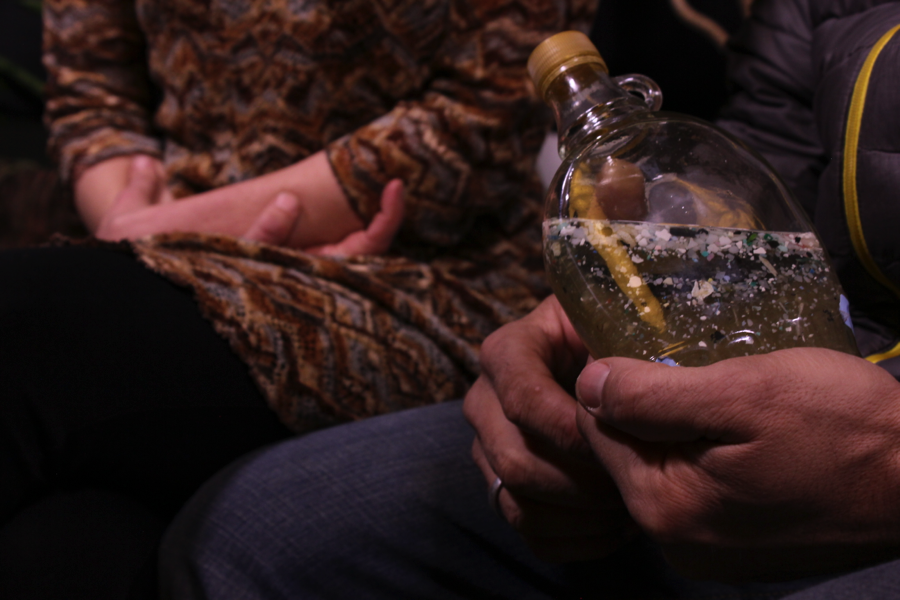
Marcus Eriksen holds a bottle of microplastics skimmed off the ocean surface. Each sample takes hours to collect and contains thousands of tiny plastic particles. [Image credit: JoAnna Klein]

Ranging from the size of a boat to the size of a grain of sand, these pieces of plastic degrade, fragment, sink or collect in ocean currents and travel the world as tiny, toxic particles. “There are no patches of trash sitting in the ocean,” according to Eriksen. “I think its more appropriate to call it a smog, where you get this fine, particulate substance that becomes globally distributed throughout the water column in all dimensions.”

He thinks that California’s experience with airborne smog may be instructive in fighting microplastic pollution. In the 1970’s, some of the early ideas for addressing smog in California focused on sucking it up with vacuums. But soon attention shifted to the source of the emissions, and engineers designed better mufflers and cleaner smokestacks.

Eriksen and Cummins hope that reframing the “garbage patch” as a “plastic smog” will convince people to focus on land-based preventative solutions rather than trying to clean up debris after it’s in the ocean.

With 288 million tons of plastic produced worldwide in 2012, and 4.8 to 12.7 million tons entering the ocean in 2010, trying to remove plastics from the world’s oceans would be like mopping up water from an eternally gushing faucet.

The problem is so vast that Eriksen acknowledges “there is no silver bullet.” But he thinks progress is possible by hitting three targets: individuals, companies and government.

Individuals, he says, can reduce consumption, recycle what they can and clean up plastic before it reaches the ocean. Industries can design marine biodegradable products and encourage the use of glass alternatives with return programs where bottles serve as discount coupons for the consumer’s next purchase.

As for government, pressure from 5 Gyres and other groups has led 18 states to pass or propose legislation limiting the use of microbeads, the granular particles found in some cosmetics and cleaning products.

These tiny plastics are small enough to pass through filters in the water system, flush into waterways and ultimately end up in the bellies of marine animals. Concern over microplastic toxicity and its potential harm throughout the food chain is gaining momentum in research groups and environmental agencies around the world.

The smaller the plastic, the bigger the concern, explained Anna-Marie Cook of the U.S. Environmental Protection Agency. She says the tiny bits act like sponges, sopping up environmental chemicals such as flame retardants and pesticides.

Rochman, the UC-Davis ecologist, says she’s found microplastics in all sorts of marine life. Animals eat them and their tissues absorb the chemicals — in some cases, causing signs of endocrine disruption and behavior problems.

As concern about the problem spreads, 5 Gyres plans to expand its 16-member staff of scientists, educators, writers and artists. “We are growing our reach to be a citizen science hub for plastic pollution activists worldwide,” says Eriksen.

5 Gyres is collaborating with artist Alejandro Duran, who has attracted attention for his plastic installations on the Yucatan coast. Eriksen, also a sculptor, joined Moore at the Atlanta Science Festival on a panel about plastic, art and advocacy this March.

After their daughter Avani (whose name means Earth in Italian) was born in 2012, Eriksen and Cummins have been focusing on educating children. Their most recent expedition culminated in an international youth summit in the Bahamas.

Tuesday, May 26, 2015

California Assembly votes to ban plastic microbeads

If approved by the California Senate, the ban would forbid the sale of soaps, creams with the tiny plastic beads


The California State Assembly on Friday passed the nation’s toughest ban on plastic microbeads, the gritty synthetic particles used in a slew of personal care products as an exfoliant.

The bill now heads to the state Senate where a similar measure was defeated by a single vote last year. A new ballot in the chamber could take place this summer.

Environmentalists have been lobbying for the ban, saying the minuscule beads — usually smaller than 1 millimeter in diameter — generate an estimated 38 tons of plastic pollution that goes through wastewater treatment plants and into rivers and oceans.

Californians Against Waste, a nonprofit group that is part of a coalition calling for the ban, says scientists estimate that 471 million plastic microbeads are released into San Francisco Bay every day, and that there can be more than 300,000 microbeads in one jar of facial cleanser.

That environmental group also cites studies that show that microplastics have been found in fish stomachs. Sea creatures can mistake beads for eggs and ingest them, as well as the toxins attached to them. People, in turn, eat the fish, passing on those chemicals all the way up the food chain.

“If a manufacturer tried to dump 40 tons of plastic pollution into the ocean, they would be arrested and fined for violating the Clean Water Act.” said Mark Murray, executive director of Californians Against Waste. “But these cosmetic and soap makers are doing the same thing on a daily basis with billions of plastic microbeads washed down millions of drains. Enough is enough.”

California also approved a ban on plastic bags that us scheduled to go into effect next year.

Several states, including Illinois, Colorado and New Jersey, have passed microbeads bans but the laws still allow for biodegradable substitutes. Environmentalists, including groups such as 5 Gyres that fight against plastic pollution in waterways, say there is no such thing yet.

Personal products giants, such as Johnson & Johnson and Procter & Gamble, have begun phasing out microbeads in their products and are working on cost-efficient alternatives. Natural exfoliants — apricot pits, walnut shells and sand — are often more expensive.

Democratic state Assemblymember Richard Bloom said given the other options for companies, there’s no reason why the synthetic exfoliants should be allowed.

“Toxic microbeads are accumulating in our rivers, lakes and oceans at alarmingly high levels,” he said. “Continuing to use these harmful and unnecessary plastics when natural alternatives are widely available is simply irresponsible and will only result in significant cleanups costs to taxpayers who will have to foot the bill to restore our already limited water resources and ocean health.”

Consumers who want to know if their personal grooming products contain microbeads should look for polyethylene or polypropylene on the labels.

Wednesday, May 20, 2015

Plastic pollution: California lawmakers to vote on banning 'microbeads' from personal care products


Published 05/17/2015 in Mercury News by Paul Rogers
File: A sample of "microbeads" collected in eastern Lake Erie is shown on the face of a penny.
File: A sample of "microbeads" collected in eastern Lake Erie is shown on the face of a penny. (AP)
They are in soaps, cosmetics, shampoos, even toothpaste. Tiny pieces of plastic -- most no bigger than a pencil dot -- called "microbeads" are designed to do everything from help exfoliate skin to whiten teeth.

But they are pouring by the billions into oceans, rivers and bodies of water like San Francisco Bay, scientists say, contaminating the environment and wildlife as people rinse and wash, sending the microbeads down drains and through sewage treatment plants, which aren't designed to filter them.
On Monday, state lawmakers in Sacramento are scheduled to vote on the nation's strictest ban on microbeads, prohibiting them in all personal care products starting Jan. 1, 2020.


"It's almost like confetti, like small grains of plastic sand," said Mark Murray, executive director of Californians Against Waste, an environmental group supporting the ban.
"We shouldn't be adding these plastics to our environment. We're just pouring them into the oceans."


The bill, AB 888, by Assemblyman Richard Bloom, D-Santa Monica, is virtually identical to a similar bill that Bloom wrote last year. That measure, AB 1699, passed the California Assembly easily last May, and then died in the state Senate amid industry opposition when Republicans came out broadly against it and Democrats wavered.


This year, the chemical and cosmetics industry has so far kept a lower profile. But lobbyists working with the Personal Care Products Council and the California Manufacturers & Technology Association have been pushing for an exemption to allow biodegradable plastics to remain legal.
Earlier this year, the industry won that loophole when lawmakers in New Jersey and Colorado banned microbeads but allowed biodegradable plastic. The governor of Illinois signed a law last year with the same guidelines.
 
Lisa Powers, a spokeswoman for the Personal Care Products Council, a Washington, D.C., group that represents companies that manufacture cosmetics, sunscreen, toothpaste and other items, did not respond Sunday when asked for the industry's position on California's bill.
Last year, the council opposed the bill, as did the California Chamber of Commerce, Grocery Manufacturers Association and other industry groups.

"Plastic microbeads are used in cosmetic and personal care products because of their safe and effective exfoliating properties," the Personal Care Products Council said in a statement last summer. "However, many personal care products companies have voluntarily committed to discontinue formulating with plastic microbeads in cleansing products in favor of other viable alternatives despite the uncertainty associated with the science.

"We urge policymakers to work with all sectors of the business community as they seek to eliminate plastic waste in our waterways and to identify effective and realistic solutions."

Supporters of the California ban say there are already lots of products for sale with natural alternatives, such as apricot shells and cocoa beans, and that they do not want to allow biodegradable plastics. Those plastics simply break into tiny pieces and are not consumed by microorganisms and decomposed as part of the natural food chain, particularly in cold ocean waters, they note. Also, there are no scientific standards in the other state laws to specifically define what "biodegradable" means.

"We are loathe to include an exemption for a plastic product that we can't define," said Bloom. "We are hoping that California will model a better approach that can be adopted by other states."

Tiny bits of plastic have been found in high concentrations in the Great Lakes, the Los Angeles River and the Pacific Ocean where, according to some studies, they outnumber plankton. Scientists say the plastic also absorbs contaminants such as pesticides and PCBs, which then are accumulated in fish when they eat the bits, mistaking them for fish eggs, plankton and other natural materials. People who eat the affected fish also can be exposed to the chemicals.

In January, scientists skimmed the water surface over nine large areas of San Francisco Bay. They found between 14,000 and 440,000 plastic particles, including microbeads, per square kilometer -- an area of about 250 football fields, said Rebecca Sutton, a senior scientist with the San Francisco Estuary Institute, a research organization based in Richmond.

"It's a persistent substance, and organisms like fish are trying to ingest it," Sutton said. "And you've got chemical contaminant issues. This is a preventable type of pollution, and it's certainly not something we could encourage to have in the bay."

Supporters of the bill include the California Association of Sanitation Agencies, Sierra Club California, the cities of Palo Alto and San Francisco, the East Bay Municipal Utility District, Breast Cancer Fund and the Surfrider Foundation.

Last August, Crest announced that although microbeads have been found safe by the FDA, the company would be phasing them out of its toothpastes by March, 2016. Responding to consumer concerns, Johnson & Johnson also said it will be removing microbeads from its products by 2017.

Bloom said consumers who don't want to buy products containing microbeads should look on the labels for ingredients like polyethylene and polypropylene.

"It's exactly like food," he said. "We have to be more conscientious about reading labels. These products are listed. The more educated people are about what's in their products, the healthier we will be."

Paul Rogers covers resources and environmental issues. Contact him at 408-920-5045. Follow him at Twitter.com/PaulRogersSJMN.

Monday, March 23, 2015

Ban Microbeads in California

Take Action to Tip The Scales
Let's Ban Microbeads in California!
The 5 Gyres Institute has come a long way since we began sailing the high seas on a mission to document the emerging global plastic crisis.  In the last 5 years, we have sailed over 50,000 miles, collected more than four hundred ocean surface samples, published several peer reviewed scientific papers documenting our findings, and helped launch a national movement to ban microbeads from personal care products like facial scrubs and toothpaste. 

Your support right now will help 5 Gyres tip the scales in favor of the planet and win the battle to Ban Microbeads in California. A win against microbeads in California will help pave the way toward legislative wins across the country.


The movement has caught fire. In the last few months, 18 states across the country - from Hawaii to Maine - have introduced legislation to ban microbeads. Were building upon the tremendous efforts of our partners at The Plastic Soup Foundation, who first galvanized European audiences to take this issue on. Just last week, a federal bill was introduced in congress. But major players in the cosmetics industry are spending big bucks to introduce language that allows bioplastics to replace current plastic beads. Without adequate testing and oversight, 5 Gyres and our coalition partners are wary of bioplastics - unless they are proven beyond any shadow of doubt to break down into before they reach the ocean.   

With research emerging daily highlighting the devastating effects of plastic on marine life - from starving coral reefs to poisoning fish that humans consume - it's clear that we need to act now to stop plastic pollution at the source, before it ever has a chance to reach the oceans.

That's why in California we have teamed up with Assembly Member Richard Bloom (D - Santa Monica) and a coalition of leading environmental groups to introduce the most comprehensive ban in the country. Over the next several months, 5 Gyres will be working to educate lawmakers and citizens about the dangers of microplastic pollution, build grassroots support in key districts, and pass responsible policies with one objective: to keep plastic off of our faces and out of our oceans.

We have a momentous battle ahead - and the stakes could not be higher. What happens in 2015 in legislatures across the country will determine the fate of billions of microbeads and accordingly, our oceans. Join us in our last stand to ban the bead and protect the oceans that we cherish, and the marine life that calls them home.

Support our work to protect the oceans from microplastic pollution by making a contribution today.

Sincerely,
The 5 Gyres Team
donate button

Tuesday, January 20, 2015

Ocean Life Faces Mass Extinction, Broad Study Says

A team of scientists, in a groundbreaking analysis of data from hundreds of sources, has concluded that humans are on the verge of causing unprecedented damage to the oceans and the animals living in them.

“We may be sitting on a precipice of a major extinction event,” said Douglas J. McCauley, an ecologist at the University of California, Santa Barbara, and an author of the new research, which was published on Thursday in the journal Science.

But there is still time to avert catastrophe, Dr. McCauley and his colleagues also found. Compared with the continents, the oceans are mostly intact, still wild enough to bounce back to ecological health.

“We’re lucky in many ways,” said Malin L. Pinsky, a marine biologist at Rutgers University and another author of the new report. “The impacts are accelerating, but they’re not so bad we can’t reverse them.”

Scientific assessments of the oceans’ health are dogged by uncertainty: It’s much harder for researchers to judge the well-being of a species living underwater, over thousands of miles, than to track the health of a species on land. And changes that scientists observe in particular ocean ecosystems may not reflect trends across the planet.

Transplanted coral off Java Island, Indonesia. Great damage results from the loss of habitats like coral reefs, an analysis found. Credit Aman Rochman/Agence France-Presse — Getty Images
Dr. Pinsky, Dr. McCauley and their colleagues sought a clearer picture of the oceans’ health by pulling together data from an enormous range of sources, from discoveries in the fossil record to statistics on modern container shipping, fish catches and seabed mining. While many of the findings already existed, they had never been juxtaposed in such a way.

A number of experts said the result was a remarkable synthesis, along with a nuanced and encouraging prognosis.

“I see this as a call for action to close the gap between conservation on land and in the sea,” said Loren McClenachan of Colby College, who was not involved in the study.

There are clear signs already that humans are harming the oceans to a remarkable degree, the scientists found. Some ocean species are certainly overharvested, but even greater damage results from large-scale habitat loss, which is likely to accelerate as technology advances the human footprint, the scientists reported.

Coral reefs, for example, have declined by 40 percent worldwide, partly as a result of climate-change-driven warming.

Some fish are migrating to cooler waters already. Black sea bass, once most common off the coast of Virginia, have moved up to New Jersey. Less fortunate species may not be able to find new ranges. At the same time, carbon emissions are altering the chemistry of seawater, making it more acidic.

“If you cranked up the aquarium heater and dumped some acid in the water, your fish would not be very happy,” Dr. Pinsky said. “In effect, that’s what we’re doing to the oceans.”

Fragile ecosystems like mangroves are being replaced by fish farms, which are projected to provide most of the fish we consume within 20 years. Bottom trawlers scraping large nets across the sea floor have already affected 20 million square miles of ocean, turning parts of the continental shelf to rubble. Whales may no longer be widely hunted, the analysis noted, but they are now colliding more often as the number of container ships rises.

Mining operations, too, are poised to transform the ocean. Contracts for seabed mining now cover 460,000 square miles underwater, the researchers found, up from zero in 2000. Seabed mining has the potential to tear up unique ecosystems and introduce pollution into the deep sea.

The oceans are so vast that their ecosystems may seem impervious to change. But Dr. McClenachan warned that the fossil record shows that global disasters have wrecked the seas before. “Marine species are not immune to extinction on a large scale,” she said.

Until now, the seas largely have been spared the carnage visited on terrestrial species, the new analysis also found.

The fossil record indicates that a number of large animal species became extinct as humans arrived on continents and islands. For example, the moa, a giant bird that once lived on New Zealand, was wiped out by arriving Polynesians in the 1300s, probably within a century.

But it was only after 1800, with the Industrial Revolution, that extinctions on land really accelerated.

Humans began to alter the habitat that wildlife depended on, wiping out forests for timber, plowing under prairie for farmland, and laying down roads and railroads across continents.

Species began going extinct at a much faster pace. Over the past five centuries, researchers have recorded 514 animal extinctions on land. But the authors of the new study found that documented extinctions are far rarer in the ocean.

Before 1500, a few species of seabirds are known to have vanished. Since then, scientists have documented only 15 ocean extinctions, including animals such as the Caribbean monk seal and the Steller’s sea cow.

While these figures are likely underestimates, Dr. McCauley said that the difference was nonetheless revealing.

“Fundamentally, we’re a terrestrial predator,” he said. “It’s hard for an ape to drive something in the ocean extinct.”

Many marine species that have become extinct or are endangered depend on land — seabirds that nest on cliffs, for example, or sea turtles that lay eggs on beaches.

Still, there is time for humans to halt the damage, Dr. McCauley said, with effective programs limiting the exploitation of the oceans. The tiger may not be salvageable in the wild — but the tiger shark may well be, he said.

“There are a lot of tools we can use,” he said. “We better pick them up and use them seriously.”

Dr. McCauley and his colleagues argue that limiting the industrialization of the oceans to some regions could allow threatened species to recover in other ones. “I fervently believe that our best partner in saving the ocean is the ocean itself,” said Stephen R. Palumbi of Stanford University, an author of the new study.

The scientists also argued that these reserves had to be designed with climate change in mind, so that species escaping high temperatures or low pH would be able to find refuge.

“It’s creating a hopscotch pattern up and down the coasts to help these species adapt,” Dr. Pinsky said.

Ultimately, Dr. Palumbi warned, slowing extinctions in the oceans will mean cutting back on carbon emissions, not just adapting to them.

“If by the end of the century we’re not off the business-as-usual curve we are now, I honestly feel there’s not much hope for normal ecosystems in the ocean,” he said. “But in the meantime, we do have a chance to do what we can. We have a couple decades more than we thought we had, so let’s please not waste it.”

New Study Says Ocean Life is Facing Mass Extinction. Here’s What We Can do to Stop it

Published January 16, 2015 in OneGreenPlanet.org

Between man-made climate change, overfishing and pollution, we have done a significant amount of damage to the world’s oceans.

In the past 500 years, we have seen 15 different marine species go extinct (this is a minimum estimate) and the rise in the number of marine animals on the IUCN’s list of threatened and endangered species is telling us that we need to start doing something differently.

Douglas J. McCauley, an ecologist at the University of California, Santa Barbara, recently published a study in journal Science that only solidifies this fact. “We may be sitting on a precipice of a major extinction event,” McCauley tell the New York Times.

In the past 40 years alone we have seen 52 percent of the world’s wildlife disappear, mainly due to human actions. While McCauley’s statement falls in line with the belief that the world is experiencing its sixth period of mass extinction, it seems that there is still hope yet for ocean life.

Why? Plainly because humans haven’t really had that much influence on the oceans until modern times. On land, humans have been altering the ecosystem for tens of thousands of years, but the oceans have largely remained untouched.

This is not to say that we are in the clear though, McCauley’s study shows that if we don’t take action soon that this hopeful message will be lost for good. Humans have begun to industrialize our use of the ocean’s resources and as the result we have seen a great decrease in the number of large marine species – like whales and sharks – as well as declines in small marine animals. This causes a significant imbalance in ocean ecosystems.

McCauley points to bottom trawling as an example of how humans have industrialized the process of fishing. In bottom trawling, long, heavy nets are dropped to the depths of the ocean and dragged along the ocean floor, catching anything and everything in its path. This practice wipes out fish stocks and lowers the number of fish available to commercial fisheries.

To make up for this lack of fish, we’ve created the equivalent of factory fish farms. Seabed mining is also gaining popularity and the amount of plastic pollution dumped into the oceans is increasing. The more carbon we emit into the atmosphere, the more acidic the oceans get.

McCauley stresses that the oceans are vast, but marine species are not impervious to extinction. We have seen the impact of species extinction on terrestrial ecosystems … and it isn’t pretty. In the long run, the health of the oceans and the land environment is important to our own health.

The signs that we failed to learn from in the extinction of land species are being seen in the oceans and it is up to us to take them seriously. There are many things you can do to help protect the oceans.
  • First and foremost, cutting your own carbon footprint is the place to start. A great way to do this is to leave meat out of your diet. By doing this one simple thing, you can half your carbon footprint.
  • Second, seeing the damage commercial fisheries are causing to the oceans, the logical solution is to limit or completely eliminate your consumption of fish. If you don’t eat fish for a year, you can save 225 fish and 125 shellfish!
  • And finally, being mindful of the plastic pollution and other waste you produce in your everyday life is key to keeping the oceans trash-free. Replace all your disposables with reusable alternatives and check out this guide to grocery shop, waste-free.
We can all make minor changes to benefit the world’s oceans. There is still time to change the tide for the future of marine species, but this time shouldn’t be wasted!
Image source: Andrew K/Flickr

Tuesday, December 2, 2014

That Takeout Coffee Cup May Be Messing With Your Hormones

A new study suggests that whole classes of BPA-free plastics—including the kind in styrofoam—release estrogenic chemicals.


Most people know that some plastics additives, such as bisphenol A (BPA), may be harmful to their health. But an upcoming study in the journal Environmental Health finds that entire classes of plastics—including the type commonly referred to as styrofoam and a type used in many baby products—may wreak havoc on your hormones regardless of what additives are in them.
The study's authors tested 14 different BPA-free plastic resins, the raw materials used to make plastic products, and found that four of them released chemicals that mimic the female hormone estrogen. That's not surprising. As Mother Jones reported earlier this year, many BPA-free plastic goods—from baby bottles and sippy cups to food-storage containers—leach potentially harmful estrogenlike chemicals.

But until now, it wasn't clear what role the resins played. The new study suggests that sometimes the resins themselves are part of the problem, though additives such as dyes and antioxidants can make it worse.

In the case of polystyrene, the resin used in styrofoam and similar products, the authors tested 11 samples and consistently found estrogen seepage after exposure to intense steam or ultraviolet rays.

Styrofoam is a registered trademark of Dow. The company stresses that its product is used for crafts and building insulation, not food and beverage containers. ("There isn't a coffee cup, cooler, or packaging material in the world made from actual Styrofoam," according to Dow's website.)

But generic polystyrene foam, which most people call styrofoam anyway, is ubiquitous in the food services industry, where its found in everything from meat trays to takeout containers. Polystyrene resin—which the Environmental Protection Agency has labeled a suspected carcinogen—is also used to make hard plastic items, including utensils and toothbrushes.

The study also looked at three different types of Tritan—a novel plastic marketed as a safe, estrogen-free alternative to BPA-laden polycarbonate—and found that all of them leached estrogen-like chemicals.

That's bad news for consumers, given that hundreds of household products are made from Tritan. Below are some examples, with the caveat that not all of these finished products have been specifically tested for estrogenic effects:
  • CamelBak Eddy Kid's BPA-free water bottle
  • CamelBak Relay water filtering pitcher
  • Foogo by Thermos sippy cups
  • Hamilton Beach Multi-Blend blender
  • Nalgene BPA-free water bottles (color matters; see the chart below)
  • OXO Good Grips LockTop food-storage containers
  • Rubbermaid Hydration Chug bottles
  • Rubbermaid carafes
  • Rubbermaid Premier food-storage containers
  • Thermos Under Armour water bottles
  • Weil Baby bottles
  • Weil Baby sippy cups
  • Whole Foods bulk bins
The new paper was authored by University of California-Davis toxicologist Michael Denison, who coinvented a common cell-based test for estrogen-mimicking compounds, and by scientists from CertiChem, a commercial lab in Austin, Texas.

As part of the study, researchers  soaked plastics resins in a variety of common solvents and tested the chemicals that seeped out using a line of breast cancer cells (MCF-7) that proliferates in the presence of estrogen and a line of ovarian cancer cells (BG-1) that lights up when exposed to the female hormone.

The 200-plus samples of Tritan resins that were tested consistently leached estrogenlike chemicals after being exposed to a type of ultraviolet ray found in sunlight (UVA) and another kind that some parents use to sterilize baby bottles (UVC). In some cases, samples that hadn't even been exposed to UV light also seeped estrogenic compounds.

While the authors didn't identify the specific hormone-mimicking chemical (or chemicals) that leached from the resin, they tested one Tritan component—triphenyl phosphate (TPP)—and found it was estrogenic.

These findings are consistent with data collected by Tritan's manufacturer, Tennessee-based Eastman Chemical. In 2008, the company commissioned a study that used computer modeling to predict whether various Tritan ingredients could imitate estrogens, based on their chemical structures. It found that TPP was likely to be more estrogenic than BPA. As we previously reported:
Eastman, which never disclosed these findings to its customers, later commissioned another study, this one involving breast cancer cells. Again, the initial results appeared positive for estrogenic activity. In an email to colleagues, Eastman's senior toxicologist, James Deyo, called this an "oh shit moment."
The company now says that additional testing has determined that Tritan is not estrogenic, and insists that there is little risk of TPP leaching from Tritan containers because it breaks down during the manufacturing process. "We have no reason to expect TPP to be present in the product as supplied by Eastman," says Maranda Demuth, an Eastman spokeswoman.

But confidential documents the company filed with the US Food and Drug Administration list TPP as one of the "substances that may be present in food after contact with Tritan."

While the specific health effects of TPP are unknown, a 2012 literature review by a dozen prominent scientists found "substantial evidence" that estrogen-mimicking chemicals are harmful even at minute doses. BPA, the most studied of the lot, has been linked to myriad problems, including asthma, cancer, infertility, low sperm count, heart disease, and attention-deficit/hyperactivity disorder (ADHD).

In some cases, the effects appear to be handed down to the offspring of the person exposed.
Questions about Tritan's safety first arose in 2011, when CertiChem scientists and V. Craig Jordan, a well-known pharmacologist and Georgetown University professor, published a study in the National Institutes of Health journal Environmental Health Perspectives.

The group tested a wide variety of plastic products—including many made from Tritan—and found that most leached estrogenic compounds when exposed to conditions such as UV rays or heat from a microwave. These findings touched off a fierce battle pitting the $375 billion plastics industry against CertiChem and its founder, George Bittner, who is also a neurobiology professor at the University of Texas-Austin. From our earlier report:
The month after Bittner's study appeared, the American Chemistry Council contacted Chris Borgert, the former tobacco industry scientist who stymied the EPA's Endocrine Disruptor Screening Program. According to internal emails, the council and the Society of the Plastics Industry offered to pay him $15,000 to write a brief letter to the journal's editor refuting CertiChem's study…
At the same time, Eastman laid plans to sue CertiChem and PlastiPure for false advertising. Expecting that Bittner would lash out after being served papers, the company launched a preemptive PR blitz.
"By proactively promoting Tritan safety," an internal memo noted, "it will put PlastiPure in a position to have to prove Eastman wrong." The company also paid a scientist named Thomas Osimitz $10,000 to author a research paper on Tritan.
While Osimitz was ostensibly working independently, Deyo, the Eastman toxicologist, micromanaged the process, from designing the study to writing the introduction. Deyo's study design virtually guaranteed estrogenic activity wouldn't be found.
Specifically, Deyo chose a breed of rat that doesn't readily respond to synthetic estrogen. He also instructed the researchers to test only select Tritan ingredients, as opposed to Tritan itself. TPP, the chemical that had raised red flags, was not tested.

After publishing its findings in the summer of 2012, Eastman sued CertiChem and its sister company PlastiPure for false advertising, alleging that they were spreading false information to generate demand for their own services.

Despite evidence that the manufacturer's own studies found that Tritan may be estrogenic, Eastman won. A federal judge barred the labs from discussing their Tritan findings, except in scientific settings.

CertiChem has made good use of that exception. Earlier this year, it released a second study focusing on hard, clear, reusable plastic products—most of which leached estrogenic compounds after exposure to UV rays. And some Tritan products did so even before they were exposed to these stressors. The chart below shows the company's results for a sampling of products.

Are There Hormone-Altering Chemicals in Your Plastic Bottle?

Estrogenic activity before and after UV exposure
Product Type of plastic Before UV exposure After UV exposure
Baby bottles        
AVENT Polyethersulfone (PES) Not tested Positive
Born Free Polyethersulfone (PES) Not tested Positive
Green to Grow Polyethersulfone (PES) Negative Positive
Evenflo Tritan Not tested Positive
Weil Baby Tritan Negative Positive
Sippy cups        
CamelBak, blue* Tritan Positive Positive
Weil Baby Tritan Negative Positive
Water bottles        
CamelBak, black Tritan Not tested Positive
CamelBak, blue Tritan Not tested Positive
Nalgene, blue* Tritan Negative Positive
Nalgene, green* Tritan Negative Negative
Topas Cyclic Olefin Copolymer (COC) Negative Negative
Zeonor Cyclic Olefin Polymer (COP) Negative Negative
Other products        
Crate & Barrel wine glasses, red* Acrylic Positive Positive
Disposable cup Polystyrene (PS) Positive Not tested
Lock & Lock food containers Tritan Positive Positive
Clamshell takeout container* Polystyrene (PS) Positive Not tested

*Tested using BG-1 cells
Read about the methodology behind this chart.
Source: George D. Bittner, et al, Environmental Health
Chart by Jaeah Lee

The most recent study shows that the Tritan resin itself leaches estrogenlike chemicals, at least in a laboratory setting.

It's not all bad news, though. The paper also names a number of resins the authors found to be free of estrogenic compounds. These include PETG (polyethylene terephthalate, glycol-modified), which is sometimes used in food and beverage packaging, and two relatively new resins, COC (cyclic olefin copolymer) and COP (cyclo olefin polymer), which are often used by the medical industry.

But Bittner, the study's lead author, warns that even products made of those plastics aren't guaranteed to be safe, since many plastic additives are also estrogenic. "Manufacturers don't tell the public what additives they're using," he says. "And in most cases they're not testing them for estrogenic activity because they don't have to. This is a case in which the consumers are going to have to demand safer products. If they take a stand, they can produce a very quick change in the market. "