A blog set out to explore, archive & relate plastic pollution happening world-wide, while learning about on-going efforts and solutions to help break free of our addiction to single-use plastics & sharing this awareness with a community of clean water lovers everywhere!
Showing posts with label ACC. Show all posts

Tuesday, August 11, 2015

5 Gyres - Not Just Skimming the Surface

A couple’s crusade against ocean plastic attacks a vast problem from multiple angles.

Not just skimming the surface
Anna Cummins and Marcus Eriksen, co-founders of 5 Gyres, search the world for plastic particles the size of a grain of sand. [Image credit: JoAnna Klein]
 
Published in Science Line by JoAnna Klein | August 9, 2015
 
In 1997, Captain Charles Moore was sailing from Hawaii back to the mainland when he found himself in a sea of floating debris the size of Texas. Some of the bobbing plastic was so big that Moore could spot it from the deck of his boat, though most was much smaller. The Great Pacific Garbage Patch, as it became known, was the consequence of a gyre — a vortex of swirling ocean currents that sucked floating debris into its core.


Soon, that same gyre would seduce Marcus Eriksen and Anna Cummins.

Eriksen and Cummins met at a birthday party for Captain Moore in 2007 and got engaged while cruising the Garbage Patch with him. They turned their growing fascination with plastic into a crusade to remove it from the world’s oceans.

They used cash gifts from their 2009 wedding — he wore a recycled plastic tux, she a plastic gown — to incorporate 5 Gyres, a small non-profit that has since grown into a well-funded group with partners around the world that embarks on research expeditions across four oceans.

Today, the group focuses on correcting public misunderstanding about the diffuse nature of the problem — they prefer to call it plastic smog instead of a garbage patch — and promoting innovative solutions, such as tougher manufacturing laws and greener products.

“Charlie Moore started it, and they took it to a different level,” says Chelsea Rochman about Eriksen and Cummins, who first brought attention to the ocean plastic problem through Moore’s The Algalita Marine Research Foundation. Now a marine ecologist at The University of California, Davis, Rochman got her research start in 2009 exploring The Great Pacific Garbage Patch.

Eriksen, a Gulf War veteran, became interested in the environment after witnessing hundreds of burning oil wells in Kuwait. He was drifting down the Mississippi River on a handmade raft made of plastic debris when he heard about Moore’s discovery in 2004.

Around the same time, Cummins first heard Moore speak while she was conducting bilingual education and environmental outreach for a California non-profit. Both ended up sailing separately with Algalita.

When the pair finally met, the natural next step was the formation of 5 Gyres, their own non-profit to clean up all of the ocean’s gyres. At first the group focused on understanding the scope of the problem.

“In the beginning, it was just a scrappy NGO doing science,” says Cummins.

Setting sail on its first expedition in January 2010, the group relied in part (and still does) on contributions from donors, or “ambassadors” who each paid up to $8,500 for a spot on the boat. During their trips they survey the ocean for plastic debris, quantify how much they find and sometimes bring on extra people for other research. On occasion, Cummins plays the fiddle.

5 Gyres had split from Algalita to take its environmental advocacy global. And after a few well-publicized trips, Eriksen and Cummins started attracting corporate sponsors such as Patagonia, Kleen Kanteen, and even the American Chemistry Council, which lobbies for the chemical industry.

Today, 5 Gyres is deeply involved in advocacy as well as science. They now have a $600,000 annual budget supported by 32 corporate backers and a small army of grassroots activists. Prominent climate activist Bill McKibben is one of the group’s scientific advisors.

By 2014, 5 Gyres had made 16 global expeditions and collected data from 1,571 locations. Based on the data from those voyages, Eriksen concluded in a 2014 PLOS-One study that there are at least 5.65 billion pieces of plastic floating atop the Earth’s oceans. He says that’s more than 250,000 metric tons of plastic, roughly equivalent to a stack of waster bottles stretching all the way to the moon and back — twice.
cummins2
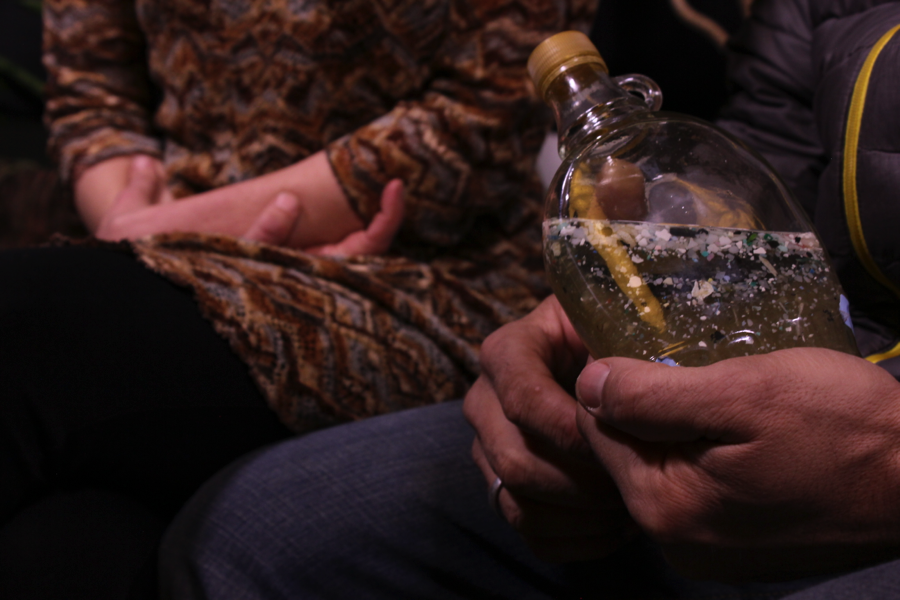
Marcus Eriksen holds a bottle of microplastics skimmed off the ocean surface. Each sample takes hours to collect and contains thousands of tiny plastic particles. [Image credit: JoAnna Klein]

Ranging from the size of a boat to the size of a grain of sand, these pieces of plastic degrade, fragment, sink or collect in ocean currents and travel the world as tiny, toxic particles. “There are no patches of trash sitting in the ocean,” according to Eriksen. “I think its more appropriate to call it a smog, where you get this fine, particulate substance that becomes globally distributed throughout the water column in all dimensions.”

He thinks that California’s experience with airborne smog may be instructive in fighting microplastic pollution. In the 1970’s, some of the early ideas for addressing smog in California focused on sucking it up with vacuums. But soon attention shifted to the source of the emissions, and engineers designed better mufflers and cleaner smokestacks.

Eriksen and Cummins hope that reframing the “garbage patch” as a “plastic smog” will convince people to focus on land-based preventative solutions rather than trying to clean up debris after it’s in the ocean.

With 288 million tons of plastic produced worldwide in 2012, and 4.8 to 12.7 million tons entering the ocean in 2010, trying to remove plastics from the world’s oceans would be like mopping up water from an eternally gushing faucet.

The problem is so vast that Eriksen acknowledges “there is no silver bullet.” But he thinks progress is possible by hitting three targets: individuals, companies and government.

Individuals, he says, can reduce consumption, recycle what they can and clean up plastic before it reaches the ocean. Industries can design marine biodegradable products and encourage the use of glass alternatives with return programs where bottles serve as discount coupons for the consumer’s next purchase.

As for government, pressure from 5 Gyres and other groups has led 18 states to pass or propose legislation limiting the use of microbeads, the granular particles found in some cosmetics and cleaning products.

These tiny plastics are small enough to pass through filters in the water system, flush into waterways and ultimately end up in the bellies of marine animals. Concern over microplastic toxicity and its potential harm throughout the food chain is gaining momentum in research groups and environmental agencies around the world.

The smaller the plastic, the bigger the concern, explained Anna-Marie Cook of the U.S. Environmental Protection Agency. She says the tiny bits act like sponges, sopping up environmental chemicals such as flame retardants and pesticides.

Rochman, the UC-Davis ecologist, says she’s found microplastics in all sorts of marine life. Animals eat them and their tissues absorb the chemicals — in some cases, causing signs of endocrine disruption and behavior problems.

As concern about the problem spreads, 5 Gyres plans to expand its 16-member staff of scientists, educators, writers and artists. “We are growing our reach to be a citizen science hub for plastic pollution activists worldwide,” says Eriksen.

5 Gyres is collaborating with artist Alejandro Duran, who has attracted attention for his plastic installations on the Yucatan coast. Eriksen, also a sculptorjoined Moore at the Atlanta Science Festival on a panel about plastic, art and advocacy this March.

After their daughter Avani (whose name means Earth in Italian) was born in 2012, Eriksen and Cummins have been focusing on educating children. Their most recent expedition culminated in an international youth summit in the Bahamas.

Friday, July 11, 2014

Bill would ban BPA in food packaging

Democrats in both chambers of Congress introduced legislation to ban from food packaging Bisephenol-A (BPA), a synthetic additive that has been linked to cancer, fetal development problems and infertility in large volumes.

Reps. Lois Capps (Calif.) and Grace Meng (N.Y.), along with Sen. Ed Markey (Mass.), said the bill would also encourage the development of alternatives to BPA, which is used in resins and plastics, and require a safety review of all substances currently used in food packaging.

“The dangers of BPA are well-documented, and we must do everything we can to ensure that both the factory workers who package food, and the people who consume our food, are safe,” Capps said in a statement.
 
“The Ban Poisonous Additives Act will help ensure that our factories and our entire food supply are free from this damaging chemical,” Markey said. “It’s time to ban BPA and move to safer alternatives.”

BPA has been in the spotlight in recent years, following a 2010 report on its harms from the Food and Drug Administration (FDA). Last year, the FDA concluded that BPA is safe in the small volumes that are used in food packaging.

In 2012, the FDA banned BPA from baby bottles and children’s cups, though manufacturers had already voluntarily stopped using the substance.

The American Chemistry Council, which represents the plastics industry, said the legislation is unnecessary and unwarranted.

“Sen. Markey has unfortunately chosen to reintroduce unnecessary legislation that ignores the expert analysis of government scientists at the U.S. Food and Drug Administration, which strongly supports the continued use of BPA in food-contact materials,” Steven Hentges, who leads the Chemistry Council’s group focusing on BPA.

Tuesday, March 11, 2014

The Scary New Evidence on BPA-Free Plastics

And the Big Tobacco-style campaign to bury it.

Photographs by Evan Kafka
Update (3/3/14): After this story went to press, the US Food and Drug Administration published a paper finding that BPA was safe in low doses. However, the underlying testing was done on a strain of lab rat known as the Charles River Sprague Dawley, which doesn't readily respond to synthetic estrogens, such as BPA. And, due to laboratory contamination, all of the animals—including the control group—were exposed to this chemical. Academic scientists say this raises serious questions about the study's credibility. Stay tuned for more in-depth reporting on the shortcomings of the FDA's most recent study.

Each night at dinnertime, a familiar ritual played out in Michael Green's home: He'd slide a stainless steel sippy cup across the table to his two-year-old daughter, Juliette, and she'd howl for the pink plastic one. Often, Green gave in. But he had a nagging feeling. As an environmental-health advocate, he had fought to rid sippy cups and baby bottles of the common plastic additive bisphenol A (BPA), which mimics the hormone estrogen and has been linked to a long list of serious health problems. Juliette's sippy cup was made from a new generation of BPA-free plastics, but Green, who runs the Oakland, California-based Center for Environmental Health, had come across research suggesting some of these contained synthetic estrogens, too.


He pondered these findings as the center prepared for its anniversary celebration in October 2011. That evening, Green, a slight man with scruffy blond hair and pale-blue eyes, took the stage and set Juliette's sippy cups on the podium. He recounted their nightly standoffs. "When she wins…every time I worry about what are the health impacts of the chemicals leaching out of that sippy cup," he said, before listing some of the problems linked to those chemicals—cancer, diabetes, obesity. To help solve the riddle, he said, his organization planned to test BPA-free sippy cups for estrogenlike chemicals.

The center shipped Juliette's plastic cup, along with 17 others purchased from Target, Walmart, and Babies R Us, to CertiChem, a lab in Austin, Texas. More than a quarter—including Juliette's—came back positive for estrogenic activity. These results mirrored the lab's findings in its broader National Institutes of Health-funded research on BPA-free plastics. CertiChem and its founder, George Bittner, who is also a professor of neurobiology at the University of Texas-Austin, had recently coauthored a paper in the NIH journal Environmental Health Perspectives. 

 It reported that "almost all" commercially available plastics that were tested leached synthetic estrogens—even when they weren't exposed to conditions known to unlock potentially harmful chemicals, such as the heat of a microwave, the steam of a dishwasher, or the sun's ultraviolet rays. According to Bittner's research, some BPA-free products actually released synthetic estrogens that were more potent than BPA.

Estrogen plays a key role in everything from bone growth to ovulation to heart function. Too much or too little, particularly in utero or during early childhood, can alter brain and organ development, leading to disease later in life. Elevated estrogen levels generally increase a woman's risk of breast cancer.

Estrogenic chemicals found in many common products have been linked to a litany of problems in humans and animals. According to one study, the pesticide atrazine can turn male frogs female. DES, which was once prescribed to prevent miscarriages, caused obesity, rare vaginal tumors, infertility, and testicular growths among those exposed in utero. Scientists have tied BPA to ailments including asthma, cancer, infertility, low sperm count, genital deformity, heart disease, liver problems, and ADHD. "Pick a disease, literally pick a disease," says Frederick vom Saal, a biology professor at the University of Missouri-Columbia who studies BPA.

BPA exploded into the headlines in 2008, when stories about "toxic baby bottles" and "poison" packaging became ubiquitous. Good Morning America issued a "consumer alert." The New York Times urged Congress to ban BPA in baby products. Sen. Dianne Feinstein (D-Calif.) warned in the Huffington Post that "millions of infants are exposed to dangerous chemicals hiding in plain view." Concerned parents purged their pantries of plastic containers, and retailers such as Walmart and Babies R Us started pulling bottles and sippy cups from shelves. Bills banning BPA in infant care items began to crop up in states around the country.

Today many plastic products, from sippy cups and blenders to Tupperware containers, are marketed as BPA-free. But Bittner's findings—some of which have been confirmed by other scientists—suggest that many of these alternatives share the qualities that make BPA so potentially harmful.
Those startling results set off a bitter fight with the $375-billion-a-year plastics industry.

The American Chemistry Council, which lobbies for plastics makers and has sought to refute the science linking BPA to health problems, has teamed up with Tennessee-based Eastman Chemical—the maker of Tritan, a widely used plastic marketed as being free of estrogenic activity—in a campaign to discredit Bittner and his research.

 The company has gone so far as to tell corporate customers that the Environmental Protection Agency (EPA) rejected Bittner's testing methods. (It hasn't.) Eastman also sued CertiChem and its sister company, PlastiPure, to prevent them from publicizing their findings that Tritan is estrogenic, convincing a jury that its product displayed no estrogenic activity. And it launched a PR blitz touting Tritan's safety, targeting the group most vulnerable to synthetic estrogens: families with young children. 

 "It can be difficult for consumers to tell what is really safe," the vice president of Eastman's specialty plastics division, Lucian Boldea, said in one web video, before an image of a pregnant woman flickered across the screen. With Tritan, he added, "consumers can feel confident that the material used in their products is free of estrogenic activity."

"A poison kills you," says biology professor Frederick vom Saal. "A chemical like BPA reprograms your cells and ends up causing a disease in your grandchild that kills him."
Eastman's offensive is just the latest in a wide-ranging industry campaign to cast doubt on the potential dangers of plastics in food containers, packaging, and toys—a campaign that closely resembles the methods Big Tobacco used to stifle scientific evidence about the dangers of smoking. Indeed, in many cases, the plastics and chemical industries have relied on the same scientists and consultants who defended Big Tobacco.

These efforts, detailed in internal industry documents revealed during Bittner's legal battle with Eastman, have sown public confusion and stymied US regulation, even as BPA bans have sprung up elsewhere in the world. They have also squelched debate about the safety of plastics more generally. All the while, evidence is mounting that the products so prevalent in our daily lives may be leaching toxic chemicals into our bodies, with consequences affecting not just us, but many generations to come.

The fight over the safety of plastics traces back to 1987, when Theo Colborn, a 60-year-old grandmother with a recent Ph.D. in zoology, was hired to investigate mysterious health problems in wildlife around the Great Lakes.

Working for the Washington, DC-based Conservation Foundation (now part of the World Wildlife Fund), she began collecting research papers. Before long, her tiny office was stacked floor to ceiling with cardboard boxes of studies detailing a bewildering array of maladies—cancer, shrunken sexual organs, plummeting fertility, immune suppression, birds born with crossed beaks and missing eyes. Some species also suffered from a bizarre syndrome that caused seemingly healthy chicks to waste away and die.

While the afflictions and species varied widely, Colborn eventually realized they had two factors in common: The young were hardest hit, and, in one way or another, all of the animals' symptoms were linked to the endocrine system, the network of glands that controls growth, metabolism, and brain function, with hormones as its chemical messengers. The system also plays a key role in fetal development. Colborn suspected that synthetic hormones in pesticides, plastics, and other products acted as "hand-me-down poisons," with parents' exposure causing affliction in their offspring.

Initially, her colleagues were skeptical. But Colborn collected data and tissue samples from far-flung wildlife populations and unearthed previously overlooked studies that supported her theory. By 1996, when Colborn copublished her landmark book Our Stolen Future, she had won over many skeptics. Based partly on her research, Congress passed a law that year requiring the EPA to screen some 80,000 chemicals—most of which had never undergone any type of safety testing—for endocrine-disrupting effects and report back by 2000.

Around this time, the University of Missouri's vom Saal, a garrulous biologist who previously worked as a bush pilot in Kenya, began studying the effects of synthetic estrogens on fetal mouse development.

The first substance he tested was BPA, a chemical used in clear, hard plastics, particularly the variety known as polycarbonate, to make them more flexible and durable. (It's also found in everyday items, from dental sealants and hospital blood bags to cash register receipts and the lining of tin cans.) Naturally occurring estrogens bind with proteins in the blood, limiting the amount that reaches estrogen receptors. But vom Saal found this wasn't true of BPA, which bypassed the body's natural barrier system and burrowed deep into the cells of laboratory mice.

Vom Saal suspected this would make BPA "a hell of a lot more potent" in small doses. Working with colleagues Susan Nagel and Wade Welshons, a professor of veterinary biology, he began testing the effects of BPA at amounts 25 times lower than the EPA's safety threshold.

In the late 1990s, they published two studies finding that male mice whose mothers were exposed to these low doses during pregnancy had enlarged prostates and low sperm counts. Even in microscopic quantities, it seemed, BPA could cause the kinds of dire health problems Colborn had found in wildlife. Before long, other scientists began turning up ailments among animals exposed to minute doses of BPA.

These findings posed a direct threat to plastics and chemical makers, which fought back using tactics the tobacco makers had refined to an art form. By the late 1990s, when tobacco companies agreed to drop deceptive marketing practices under a settlement agreement with 46 states, many of the scientists and consultants on the industry's payroll transitioned seamlessly into defending BPA.

Plastics and chemical interests worked closely with the Weinberg Group, which had run Big Tobacco's White Coat Project—an effort to recruit scientists to create doubt about the health effects of secondhand smoke.

Soon Weinberg, which bills itself as a "product defense" firm, was churning out white papers and lobbying regulators. It also underwrote a trade group with its own scientific journal, Regulatory Toxicology and Pharmacology, which published studies finding BPA was safe.

The industry also worked hand in glove with the Harvard Center for Risk Analysis, a think tank affiliated with the university's school of public health that has a history of accepting donations from corporations and then publishing research favorable to their products. In the early 1990s, its founder, John D. Graham—who was later tapped as George W. Bush's regulatory czar—lobbied to quash an EPA finding that secondhand smoke caused lung cancer, while soliciting large contributions from Philip Morris.
In 2001, as studies on BPA stacked up, the American Chemistry Council enlisted the center to convene a panel of scientists to investigate low-dose BPA. The center paid panelists $12,000 to attend three meetings, according to Fast Company. Their final report, released in 2004, drew on just a few industry-favored studies and concluded that the evidence that low-dose BPA exposure harmed human health was "very weak."

By this point, roughly 100 studies on low-dose BPA were in circulation. Not a single industry-funded study found it harmful, but 90 percent of those by government-funded scientists discovered dramatic effects, ranging from an increased breast cancer risk to hyperactivity. Four of the 12 panelists later insisted the center scrub their names from the report because of questions about its accuracy.

Chemical interests, meanwhile, forged deep inroads with the Bush administration, allowing them to covertly steer the regulatory process. For decades, the Food and Drug Administration has assured lawmakers and the public that BPA is safe in low doses. But a 2008 investigation by the Milwaukee Journal Sentinel revealed that the agency had relied on industry lobbyists to track and evaluate BPA research, and had based its safety assessment largely on two industry-funded studies—one of which had never been published or peer reviewed.

The panel the EPA appointed to develop guidelines for its congressionally mandated endocrine disruptor screening was also stocked with industry-backed scientists. It included Chris Borgert, a toxicology consultant who had worked closely with Philip Morris to discredit EPA research on secondhand smoke. He later served as the president of the International Society of Regulatory Toxicology and Pharmacology, the Weinberg Group-sponsored outfit, which met in the offices of a plastics lobbyist.

Members of the EPA panel say Borgert seemed determined to sandbag the process. "He was always delaying, always trying to confuse the issue," recalls one participant. And the screening approach the EPA settled on came straight from the industry's playbook. Among other things, the chemicals would be tested on a type of rat known as the Charles River Sprague Dawley—which, oddly, doesn't respond to synthetic hormones like BPA.

"Like the tobacco companies, they want to set up a standard of proof that is unreachable," says Stanton Glantz. "If they set the standard of proof, they've won the fight."
How best to test for estrogenic activity would become a key front in the fight over plastic safety. The American Chemistry Council joined forces with an unlikely ally, PETA, to fight large-scale chemical-safety testing on animals.

At the same time, Borgert and other industry-funded scientists made the case that the other common method for testing—using cells that respond in the presence of estrogen—did not necessarily tell us how a substance would affect animals or humans. In fact, a massive, ongoing NIH-run study has found that cell-based tests track closely with animal studies, which have accurately predicted the effects of synthetic estrogens, particularly DES and BPA, on humans.

Stanton Glantz, who directs the Center for Tobacco Control Research and Education at the University of California-San Francisco, argues the chemical industry's real aim in challenging specific testing methods is to undermine safety testing altogether. "Like the tobacco companies, they want to set up a standard of proof that is unreachable," he says. "If they set the standard of proof, they've won the fight."

During the height of the battle over BPA, vom Saal periodically traveled to Texas and huddled around the dining table with his old friend George Bittner, whose home overlooks a walnut grove on the outskirts of Austin. Bittner, who holds a Ph.D. in neuroscience from Stanford, is quirky and irascible.

But he has a brilliant mind for science and an interest in applying it to real-world problems—in his lab at UT-Austin, he had developed a nerve-regeneration technique that had helped crippled rats walk within days. And he had taken a keen interest in vom Saal's research on endocrine disruption. "It struck me as the most important public health issue of our time," Bittner told me when we met at his lab. "These chemicals have been correlated with so many adverse effects in animal studies, and they're so pervasive. The potential implications for human health boggle the mind."

In the late 1990s, Bittner—a squat, ruddy man with thinning red hair and Napoleon Dynamite glasses who had made a tidy sum investing in real estate and commodities—began mulling the idea of launching a private company that worked with manufacturers and public health organizations to test products for endocrine disruptors. He believed this approach could help raise awareness and break the regulatory logjam—while also reaping a profit.

In 2002, armed with a $91,000 grant from the National Institutes of Health, Bittner launched a pair of companies: CertiChem, to test plastics and other products for synthetic estrogens, and PlastiPure, to find or develop nonestrogenic alternatives. Bittner then enlisted Welshons to design a special test using a line of breast cancer cells, which multiply rapidly in the presence of estrogen. It features a robotic arm, which is far more precise than a human hand in handling microscopic material.
But before long Bittner began butting heads with Welshons and vom Saal. Bittner wanted the researchers to sign over the rights to the test Welshons had developed, while they insisted it belonged to the University of Missouri. Eventually, they had a bitter falling out. Welshons and vom Saal filed a complaint with the NIH, alleging that Bittner had misrepresented data from Welshons' lab in a brochure. (Bittner maintains that he merely excluded data from contaminated samples; the institute found no evidence of wrongdoing.)

Bittner, meanwhile, enlisted V. Craig Jordan, a pharmacology professor at Georgetown University with an expertise in hormones—he discovered a now-common hormone therapy that blocks the spread of breast cancer—to refine the testing protocol. By 2005, Bittner had opened a commercial lab in a leafy office park in Austin. He managed to attract some big-name clients, including Whole Foods, which hired CertiChem to advise it on endocrine-disrupting chemicals and test some of its products.

At this point, BPA was among the most studied chemicals on the planet. In November 2006, vom Saal and a top official at the National Institute of Environmental Health Sciences convened a group of 38 leading researchers from various disciplines to evaluate the 700-plus existing studies on the subject.

The group later issued a "consensus statement" that laid out some chilling conclusions: More than 95 percent of people in developed countries were exposed to levels of BPA that are "within the range" associated with health problems in animals, from cancer and insulin-resistant diabetes to early puberty. The scientists also found that there was "great cause for concern with regard to the potential for similar adverse effects in humans," especially given the steep uptick in these same disorders.

At the same time, a new body of research was finding that BPA altered animals' genes in ways that caused disease. For instance, it could switch off a gene that suppresses tumor growth, allowing cancer to spread. These genetic changes were passed down across generations. "A poison kills you," vom Saal explains. "A chemical like BPA reprograms your cells and ends up causing a disease in your grandchild that kills him."

Scientists were also uncovering links between endocrine-disrupting chemicals known as phthalates and health problems, including genital abnormalities and infertility in humans. These chemical additives were commonly found in soft, pliable plastics, such as those used in pacifiers and baby bottle nipples.

 In 2008, Congress passed a law banning six types of phthalates in children's products. As concerns about BPA hit the mainstream, Congress also launched an investigation into the industry's efforts to manipulate science and regulation, and a number of states proposed BPA bans.

In 2009, the BPA Joint Trade Association—which included the American Chemistry Council, Coca-Cola, and Del Monte, among others—gathered at the Cosmos Club, a members-only retreat in Washington, DC's Dupont Circle. According to meeting minutes leaked to the Milwaukee Journal Sentinel, the group explored messaging strategies, "including using fear tactics (e.g., 'Do you want to have access to baby food anymore?')." The "'holy grail' spokesperson," attendees agreed, was a "pregnant young mother who would be willing to speak around the country about the benefits of BPA."

Even as the industry crafted defensive talking points, some companies began offering BPA-free alternatives. But they often didn't bother testing them for other potentially toxic compounds or synthetic hormones. Nor did they have to: Under US law, chemicals are presumed safe until proven otherwise, and companies are rarely required to collect or disclose chemical-safety data.

Michael Green, the Center for Environmental Health director who worried about his daughter's sippy cup, says this results in a "toxic shell game": Corporations that come under pressure to root out toxins often replace them with untested chemicals, which sometimes turn out to be just as hazardous. "It's an unplanned science experiment we're doing on our families," Green told me when I visited him at his Bay Area home, where Juliette, now 5, was padding around in a pink princess costume.

One of the most popular BPA-free options, especially among companies catering to families and health-conscious consumers, was Tritan, a clear, sturdy, heat-resistant plastic that Eastman rolled out in 2007. (Eastman also produces the chemical that sullied the drinking water of 300,000 West Virginians in January.)

 A company founded by alternative medicine guru Dr. Andrew Weil launched a line of Weil Baby bottles made from Tritan, which it touted as "revolutionary" and "ultra-safe" material. Thermos began churning out Tritan sippy cups, decorated with Barbie and Batman. With more and more consumers demanding BPA-free products, Nalgene, CamelBack, Evenflo, Cuisinart, Tupperware, Rubbermaid, and many other companies also worked Tritan into their production lines.

Eastman, a $7 billion company that was spun off from Eastman Kodak in the 1990s, assured its corporate customers that it had done extensive safety testing on Tritan. But its methods were questionable.

According to internal Eastman documents, in 2008 Eastman signed a two-year contract with Sciences International, another product defense firm that had played a key role in the tobacco industry's scientific misinformation campaign. On Sciences' advice, Eastman then commissioned a study that used computer modeling to predict whether a substance contains synthetic estrogens, based on its chemical structure. The model suggested that one of Tritan's ingredients—triphenyl phosphate, or TPP—was more estrogenic than BPA.

Eastman, which never disclosed these findings to its customers, later commissioned another study, this one involving breast cancer cells. Again, the initial results appeared positive for estrogenic activity. In an email to colleagues, Eastman's senior toxicologist, James Deyo, called this an "oh shit moment."

Cell culture tests for estrogenic effects generally involve soaking plastic in alcohol or salt water, then exposing cells to various concentrations of the chemicals that seep out. After Deyo informed the lab that its findings must "be worded very well relative to the lack of" estrogenic activity, it issued a report that only counted data from the lowest concentrations—even though this violated the lab's testing guidelines, and made the results appear negative when they weren't. "The lab ignored its own criteria and misrepresented its findings," says Michael Denison, a professor of toxicology at the University of California-Davis who evaluated the document.
Eastman wasn't the only company testing Tritan. In 2009, Bittner's PlastiPure, which was searching for nonestrogenic alternatives to recommend to clients, began vetting products made with it and found that some had even more estrogenic activity than their BPA-laden counterparts. PlastiPure's CEO, Mike Usey, says CertiChem disclosed this to clients, but many chose Tritan anyway.
"It's an unplanned science experiment we're doing on our families," Michael Green says.
This was part of a broader pattern of indifference. According to Usey, hundreds of manufacturers—including most of the big baby bottle makers—contacted CertiChem to inquire about testing their BPA-free products for estrogenic chemicals, but few actually followed through. "Their position was: Until consumers are demanding nonestrogenic products, there's no reason to be an early adopter," Usey explains. "They want to delay as long as they can, because they know any transition will cost them." In some cases, manufacturers paid for testing, then never collected the findings. "They didn't want to know the results because there's liability in knowing," Usey says. "They're right in the sense that you don't want to know if you're not going to fix the problem."

Despite its "oh shit" findings, by 2010 Eastman began to produce marketing materials claiming that Tritan was free of all synthetic estrogens. One section of its website featured the tagline "Safety is our key ingredient" along with photos of smiling children eating and drinking out of plastic containers. The site claimed "third-party research" had shown Tritan to be free of estrogenic activity, but when corporate customers tried to verify this information, Eastman grew cagey.

In early 2010, Philips Avent, a top producer of baby bottles and sippy cups, inquired about having an outside lab run testing on Tritan. Eastman's senior chemist Emmett O'Brien fired off an email to colleagues, saying, "We need to [do] everything possible to convince the customer NOT to do EA [estrogenic activity] testing." Philips was persuaded. But, according to testimony from Eastman executives, that same year Nestlé vetted Tritan, and found it leached synthetic estrogen. (Frédérique Henry, a spokeswoman for Nestlé, acknowledges the company tested Tritan but denies the results were positive.) Nestlé has nevertheless continued using Tritan in some of its water bottles.

Bittner and Usey, meanwhile, decided to go public. "As long as the consumer demand wasn't there, product manufacturers felt we were selling them a problem rather than a solution," Usey explains. "We saw this as the only way forward." Bittner's companies, which have received more than $8 million in NIH funding, began working with Jordan, the Georgetown professor, on a paper for publication. In the fall of 2010, Usey attended the ABC Kids Expo, a children's product extravaganza in Las Vegas, and handed out flyers with a graph showing how various products that were marketed as nonestrogenic stacked up in CertiChem's tests. The most estrogenic among them, Weil Baby bottles, were made from Tritan. (The company referred Mother Jones to a press release on its website stating that it "remains confident that Tritan is safe.")

Soon Eastman's customers began inquiring about CertiChem's findings. For the most part, Eastman convinced them to disregard Bittner's claims. At one point, O'Brien met with Whole Foods executives. They were considering replacing their polycarbonate bulk food bins with ones made from Tritan, even though Bittner had previously informed them that the product was estrogenic.

According to a memo O'Brien later wrote, when the subject came up, he responded by attacking Bittner, whom he called "shady," and his test results, which he alleged were "very questionable." The Whole Foods executives later pressed O'Brien about the other tests carried out on Tritan.

The chemist claimed, falsely, that they were performed by independent scientists with no funding from Eastman and hadn't turned up any evidence that Tritan leached synthetic estrogens. Whole Foods—which declined to comment for this story—plowed ahead and installed Tritan bins in many of its 270 US stores.

Eastman refused to answer questions for this story, but it released a written statement saying that it had "paid the labs for their time and expertise and not for a particular conclusion," and remained "confident in the testing and safety of Tritan."

In March 2011, the Environmental Health Perspectives paper by Jordan and researchers from CertiChem and PlastiPure appeared online. They'd tested 455 store-bought food containers and storage products, including several made from Tritan. The results? Seventy-two percent leached synthetic estrogens. And every type of plastic commonly used in food packaging (polypropylene and polystyrene, for example) tested positive in some cases, which suggested there was no surefire way to avoid exposure.

Other scientists have also found evidence of estrogen-mimicking chemicals in BPA-free plastics. In 2009, two German environmental toxicologists tested PET, a plastic commonly used in water bottles, on a strain of mud snails that produce more embryos when exposed to synthetic estrogen. Snails reared in PET bottles produced twice as many as those reared in a glass culture dish.
These studies don't identify which estrogenic chemicals are leaching from BPA-free plastics, but many of these products are known to contain phthalates or bisphenol S (BPS), a chemical cousin of BPA that plastic makers frequently use in its place. Cell-culture tests suggest that BPA and BPS have similar effects.

In other cases, little may be known about the specific health effects of the chemicals involved, but a 2012 literature review by 12 prominent scientists found there is "substantial evidence" that endocrine-disrupting chemicals generally harm human health. "We know that there's a cost when we mess with the levels of these hormones in our bodies, regardless of how we do it," says the study's lead author, Laura Vandenberg, a professor of environmental health sciences at the University of Massachusetts-Amherst. "Even small changes early in life can alter brain and organ development and set us up for disease later on."

Every type of plastic commonly used in food packaging tested positive in some cases, which suggested there was no surefire way to avoid exposure.
The month after Bittner's study appeared, the American Chemistry Council contacted Chris Borgert, the former tobacco industry scientist who stymied the EPA's Endocrine Disruptor Screening Program. According to internal emails, the council and the Society of the Plastics Industry offered to pay him $15,000 to write a brief letter to the journal's editor refuting CertiChem's study, and to enlist another scientist to sign on. Their letter argued that CertiChem's findings were "unconvincing"; just because a substance behaved like estrogen in a culture dish didn't mean it would do so in animals or humans.
At the same time, Eastman laid plans to sue CertiChem and PlastiPure for false advertising.

 Expecting that Bittner would lash out after being served papers, the company launched a preemptive PR blitz. "By proactively promoting Tritan safety," an internal memo noted, "it will put PlastiPure in a position to have to prove Eastman wrong." The company also paid a scientist named Thomas Osimitz $10,000 to author a research paper on Tritan.

While Osimitz was ostensibly working independently, Deyo, the Eastman toxicologist, micromanaged the process, from designing the study to writing the introduction.

Deyo's study design virtually guaranteed estrogenic activity wouldn't be found. For example, he opted to use the hormone-insensitive Charles River Sprague Dawley lab rat. Rather than testing Tritan itself, he instructed Osimitz to test only some Tritan ingredients—TPP, the one that had raised red flags in the computer-modeling study, was not included. (The European Union has since classified the compound as a suspected endocrine disruptor.)

In June 2012, Osimitz's paper—finding that Tritan was not estrogenic—appeared in Food and Chemical Toxicology, an industry-friendly journal. Its editor, A. Wallace Hayes, was previously vice president of biochemical and biobehavioral research at R.J. Reynolds, which led the attack against science linking secondhand smoke to human health problems.

Scientific journals generally require authors to disclose any conflicts of interest. But the Food and Chemical Toxicology article made no mention of Eastman's role in the study. According to internal Eastman emails, the company was also aiming to hire Osimitz to author a second paper, again with "no…mention of Eastman." As Deyo noted, "credibility is somewhat enhanced if it is not 'Eastman' authors."

Once its own data had been published, Eastman set out to bury Bittner's findings. In August 2012, the company sued CertiChem and PlastiPure, which it claimed were spreading false information about Tritan to generate demand for their own services.

Eastman's lawyers asked the judge to bar both firms from ever claiming Tritan was estrogenic—or saying that cell-based tests could detect estrogenic activity, even though scientists routinely use them for this purpose. For decades, scientists have relied on the same breast cancer cell line Bittner's lab uses, MCF-7, to screen for estrogenic activity. According to UMass' Vandenberg, these cells have proven "remarkably good at telling us if compounds found in plastics and personal care products mimic estrogen" and their "failure rates are minuscule."

On July 15, 2013, Bittner squared off against Eastman at a federal courthouse in Austin. The company's attorneys went in hard. Specifically, they claimed running a company that tested products for estrogenic activity, as well as one that helped companies find nonestrogenic alternatives, created a conflict of interest. (Bittner counters that he's no more conflicted than a doctor who both diagnoses and treats patients.) But they didn't directly challenge the validity of Bittner's findings. Instead, they leaned on the questionable industry claim that tests based on human cells aren't sufficient to establish estrogenic activity.

Eastman's star witness, Chris Borgert, made the case that animal studies—which the industry had also fought to undermine—were a more telling indicator. But even they were not "in and of themselves" definitive. For the result to be relevant, the effects had to be demonstrated "in an animal, at least, and then on to humans." There was no mention of the ethical and legal barriers to testing on humans. And the judge barred Bittner's lawyers from mentioning Borgert's tobacco industry ties, which Eastman argued were "prejudicial." This left the jury ill-equipped to gauge his credibility.

Borgert's testimony may have done less damage than other factors. Bittner's lawyers struggled to explain the science to jurors, and Bittner grew testy on the stand. Welshons, who'd designed CertiChem's tests, testified in a deposition—just as he'd told the NIH—that Bittner had misrepresented some data in a brochure.

Bittner's attorneys managed to block his testimony from being introduced. But, Bittner says, his attorneys balked at presenting key evidence, such as figures on CertiChem's NIH funding, because it might have made Welshons' testimony admissible. Bittner also maintains that his rift with vom Saal and Welshons made it difficult to recruit witnesses.

Still, several prominent scientists testified for CertiChem, including UC-Davis' Michael Denison, who coinvented a widely used test for estrogenic activity using human ovarian cells. Denison testified that he'd tested 27 samples of Tritan for estrogenic activity using this method and registered positives across the board.
 
But the most remarkable data might have come from none other than Wade Welshons. In the run-up to the trial, the University of Missouri scientist, who expected to prove Bittner wrong, began testing Tritan products in his lab. To his surprise, he wound up confirming CertiChem's findings. "It doesn't matter what I think of them personally," Welshons told me. "If they're right, they're right, and many of my objections no longer matter."

Welshons' findings never made it into court, however, and when the jurors returned their verdict in late July, they found against Bittner's companies on counts of false advertising and unfair competition. They also concluded Tritan was not estrogenic.

Their rationale, according to postverdict interviews, echoed Eastman's claims that estrogenic activity could not be established solely through cell-based tests. In his final ruling, the judge also noted that the "jury was likely unimpressed with Dr. Bittner's combative demeanor."

And he upbraided both sides for failing to explain the science in terms jurors could understand. In the end, he barred Bittner's companies from ever talking about their Tritan findings, at least in a commercial setting. But he refused to stop the companies from asserting that their tests could detect synthetic estrogens.

The long legal battle has depleted CertiChem and PlastiPure's coffers—"We've laid off half of our staff," Usey told me. "It has pretty much crushed us"—and emboldened Eastman. After I began raising questions about Tritan, Rick W. Harrison, an attorney for the chemical giant, inadvertently copied me on an email about Eastman's damage control strategy.

"If this somehow gets picked up by mainstream media—Oprah or NY media—Eastman sends Lucian [Boldea, the vice president of Eastman's specialty plastics division] or whoever on the show prepped with the verdict, order and judgment and express surprise and indignation that these issues are still being raised after three years of litigation," he wrote. "The court/jury has spoken and spoken loudly."

The industry, meanwhile, has revived its campaign to downplay the dangers of BPA. A month after the Eastman case concluded, the American Chemistry Council relaunched its pro-BPA website, FactsAboutBPA.org. The section on infant health suggests that BPA isn't harmful, even to premature babies. "They're reverting back to exactly the arguments they were making in 1998," says vom Saal. "It's as if the last 15 years didn't happen."

US regulators also have continued to ignore the mounting evidence linking BPA and similar chemicals to human disease, even as bans have cropped up around the world. Although more than 90 studies examining people with various levels of exposure suggest BPA affects humans much as it does animals, the FDA recently announced that its research "supports the safety of BPA" in food containers and packaging.

And the EPA program that was supposed to screen some 80,000 chemicals for endocrine disruption hasn't fully vetted a single substance. In 2010, the agency sought White House approval to add some endocrine-disrupting chemicals that are commonly found in plastic—among them BPA, phthalates, and a class of compounds known as PBDEs—to its "chemicals of concern" list because it found they "may present an unreasonable risk to human health."

This would have required chemical makers to share safety-testing data with federal regulators. The proposal languished until last September, when the EPA quietly withdrew it, along with a proposed rule requiring manufacturers to disclose safety data on chemicals in their products.

Still, Bittner isn't giving up the fight. When I visited CertiChem's office in Austin recently, he was sitting barefoot at a conference table surrounded by sippy cups and heaps of lab notebooks.

CertiChem and PlastiPure were planning to appeal the Eastman ruling (they've since done so) and were working with Denison on data for new papers, one on estrogenic activity in plastic resins, which are used to make plastic products and contain fewer additives that can skew results.

Bittner called up a series of graphs on the overhead projector, showing the results for several new BPA-free plastics that he had tested for estrogenic activity. He raked his laser pointer over a graph displaying the results for Tritan. The line curved up steeply. "Eastman won the battle," he said. "But that doesn't mean it will win the war."


Mariah Blake

Reporter
Mariah Blake is a reporter in Mother Jones' DC bureau. Got a tip? E-mail her at mblake [at] motherjones [dot] com. She's also on Twitter. RSS |

Tuesday, October 8, 2013

Researchers raise concerns about BPA and breast cancer


Doctors sound alarm about prenatal health hazards.

A growing number of health advocates are raising concerns about possible links between the estrogen-like chemical BPA and breast cancer.

Consumer concern about BPA, or bisphenol A, has led manufacturers to remove it from baby bottles and infant formula packaging.

Still, BPA also could pose a risk to children long before they take their first sip of milk, according to a September report from the Breast Cancer Fund, an advocacy group. Babies also are exposed in the womb, the report finds.

A developing fetus is especially vulnerable during the first 11 weeks of pregnancy, says co-author Sharima Rasanayagam, director of science at the Breast Cancer Fund. "Everything is being developed" at this stage, she says. "The building blocks are being laid down for future health."

The report cites 60 animal and human studies, which link prenatal BPA exposure to an increased risk of a variety of health problems, from breast cancer and prostate cancer to decreased fertility, early puberty, neurological problems and immune system changes.

In a September paper, too new to be included in the report, Tufts University's Ana Soto found that BPA increased the risk of mammary cancers in rats. In two studies of rhesus monkeys published last year, other researchers found that BPA disrupted egg development, damaged chromosomes and caused changes in the mammary gland that made animals more susceptible to cancer.

Soto says it's possible that prenatal BPA exposure makes fetuses more sensitive to estrogen, a hormone that drives the growth of most breast cancers. In that way, BPA could indirectly increase the risk of breast cancer later in life. She notes that even small changes in prenatal estrogen exposure — such as that produced by the extra placenta in a uterus containing fraternal twins — increases the risk of breast cancer in girls and prostate cancer in boys.

In a separate action, the American College of Obstetricians and Gynecologists and the American Society of Reproductive Medicine also have released a joint report on the broader issue of prenatal exposure to toxins, from BPA to pesticides and other chemicals. That September report notes that in utero exposure to environmental chemicals has been linked to miscarriage and stillbirth, impaired fetal growth and low birth weight, preterm birth, childhood cancers, birth defects, intellectual impairment and thyroid problems.

In 2011, the American Medical Association labeled BPA an "endocrine-disrupting agent" because of evidence suggesting that it disrupts the body's normal hormonal regulation.

In 2009, the Endocrine Society — a group of doctors and researchers specializing in the hormonal system — called hormone-disrupting chemicals such as BPA a "significant concern for public health," possibly causing infertility, cancer and malformations.

"Every pregnant woman in America is exposed to many different chemicals in the environment," says Jeanne Conry, president of the obstetrics-gynecology group.

More than 90% of American have BPA in their bodies, research shows. Ten studies have found BPA in fetal tissue, including umbilical cord blood, as well as in amniotic fluid, the Breast Cancer Fund report notes.

BPA was developed in the 1930s as an estrogen-replacement therapy. Researchers stopped developing BPA as an estrogen, however, because another synthetic hormone, DES, or diethylstilbestrol, was far more potent.

Conry says she's concerned that exposure to BPA could, like DES, change the way that a developing fetus reacts to estrogen for the rest of its life.

Millions of pregnant women took DES from 1941 to 1971 to prevent miscarriage, until studies found that women exposed to DES before birth had a high rate of rare vaginal cancers. Studies later linked DES to breast cancer, as well.

While concern over BPA has led many manufacturers to stop using the chemical in plastic bottles, it remains widely used in other plastics, such as bicycle helmets, eyeglasses and medical equipment and the linings of metal food cans. BPA also is found in the coatings on many cash-register paper receipts.


Since 2011, the Breast Cancer Fund has campaigned to persuade food companies to stop using BPA.

Campbell's Soup last year announced that it will phase out BPA, but has not yet announced when that will happen, or what material it will use instead. Eden Foods has sold its beans in BPA-free cans since 1999. It now sells tomatoes in glass jars, which have lower levels of BPA than traditional cans.

The American Chemistry Council, an industry group, notes that BPA plays an important role in food safety, because it "helps to extend a product's shelf life and protects food from contamination and spoilage."

"BPA is one of the most tested substances in use today and regulatory agencies around the world have repeatedly found that the evidence does not show a connection between typical exposure levels and health effects or disease," says Jayne Morgan, chief medical officer at the American Chemistry Council. "Women rely on their physicians for sound medical advice and access to reliable information. Creating confusion and alarm among expectant mothers will distract from the well-established steps doctors recommend to support a healthy pregnancy and a healthy baby."

The Food and Drug Administration's official statement on BPA says that it is "safe at the very low levels that occur in some foods.This assessment is based on review by FDA scientists of hundreds of studies including the latest findings from new studies initiated by the agency."

However, the FDA also has expressed "some concern" about the potential effects of BPA on the brain, behavior, and prostate gland in children, both before and after birth. The FDA banned BPA in baby bottles in 2012, after most manufacturers already had stopped using it. Earlier this year, the FDA formally banned BPA in infant formula packaging, also after formula manufacturers already had abandoned the chemical.

Manufacturers of metal cans say there's no clear evidence that BPA linings cause harm.

John Rost, chairman of the North American Metal Packaging Alliance, says that recent "studies, coupled with the extensive body of research on BPA that has been thoroughly reviewed by FDA, and multiple international regulatory bodies, continue to reaffirm that the trace amounts of BPA found in metal food and beverage packaging does not represent a health risk to humans at any age or stage of development."

A growing number of studies have linked prenatal BPA exposure to genital changes in babies, as well as behavioral changes in children, Rasanayagam says.

Still, some breast cancer researchers say there's not yet enough research to know if BPA really increases breast cancer risk, and if removing it from consumer products will reduce that risk.

"Yes, we should do the research," says surgeon Susan Love, author of Dr. Susan Love's Breast Book. "But I don't think we should be jumping ahead of the data."

Yet Rasanayagam notes that doctors will never have the sort of scientific proof about environmental chemicals that they have for other products, such as new drugs. First, that's because it's unethical to deliberately expose women and their fetuses to a potentially harmful substance. Second, breast cancer can take 60 or 70 years to develop. So even a very large trial would take decades to produce results.

Soto says that the evidence for regulating the chemical is as good as it's going to get. "It is no longer a problem of science," says Soto, of Tufts University School of Medicine. "It's a problem of policy."
In the face of uncertainty, Conry says doctors and their patients can take sensible steps, such as avoiding plastics made with BPA and not heating plastic in the microwave, which can cause chemicals to leach into food.

Yet BPA is too ubiquitous for women to completely avoid, Conry says. That's why the USA should "shift the burden of proof" from individuals to manufacturers and regulators, who should make sure that pregnant women and others aren't exposed to hazardous chemicals. She notes that there are about 84,000 chemicals in use today, and 700 others are introduced each year. Women and their doctors can't be expected to be experts on all of them, she says.

"We shouldn't be releasing these chemicals into the environment until they have had adequate study," Conry says. "The burden shouldn't be on the consumer each time these issues come up. That's more than the individual can take on."


Friday, May 3, 2013

Plastic buildup becomes environmental nightmare

 Posted by Elissa Torres on April 14, 2013 in the Golden Gate Xpress

It’s a nice summer day, 85 degrees and sunny. You decide to go to the beach, not only to show off your new summer bod, but to cool off for a swim in the Pacific. While swimming, you find yourself amongst plastic bottles that bob like buoys and you become tangled in Safeway labeled white plastic bags.

Over the last 60 years, plastic has become essential to our lives and mankind has subjected the planet to a tsunami of plastic waste. According to the environmental group Ocean Crusaders, there are believed to be 46,000 pieces of plastic in every square mile of ocean.

The Pacific contains one of the highest concentrations of plastic materials suspended between North America and Asia. The cluster of plastic materials is known as the Great Pacific Garbage Patch.

The Great Pacific Garbage Patch, also known as the Pacific Trash Vortex is a culmination of pelagic plastics, chemical sludge and other debris that have been trapped in the ocean currents of the North Pacific Gyre. The material is naturally gathered from all across the North Pacific Ocean, which includes coastal waters from North America and Japan.

Although the size of the patch is unknown, it is estimated to be around 700,000 square kilometers or roughly the size of Texas, according to the Great Pacific Garbage Patch website. Plastic is not a material that can be easily broken down.

The building blocks for making plastics are small organic molecules. These molecules contain carbon along with other substances. They generally come from oil (petroleum) or natural gas, combined with plant extracts, crude oil and toxic chemicals like Bisphenol A (BPA), vinyl chloride and dioxin. The small molecules are known as a monomer, meaning one part, because it’s capable of joining with other monomers to form very long molecular chains called polymers, meaning many parts, during a chemical reaction called polymerization. Imagine a paper clip as a monomer, and a paper clip necklace as a polymer.

But how does all that plastic get from the factory to the ocean? The answer is as simple: humans + ocean currents = trash vortex, according to How Stuff Works. More specifically, the plastic stems from trash that was blown off of cargo ships and plastic that was thrown into the ocean, both by mistake or on purpose, that then found its way into the middle of the ocean.

According to scientists from Scripps Institution of Oceanography at UC San Diego, nine percent of fish located in the Pacific had plastic waste in their stomach. Also, the Scripps Environmental Accumulation of Plastics Expedition traveled 1,000 miles off the coast of California in August 2009 and found an alarming amount of human generated trash. Most of the plastic had been broken down to the size of a fingernail, floating across the ocean.

Not only are plastics made with toxic materials, but they continue to leach toxicants wherever they are. Chemicals are leached from plastics, which can affect fish, mammals and other marine life. We, as humans, are also affected. We surround ourselves with plastic, eating products that are wrapped in plastic and drinking from plastic containers that put toxicants into our bodies.

It is vital that consumers ask questions about where their recycled products go, ensure their products are taken to a recycling facility where the collectors are using the plastic to make refurbished products like automotive accessories, bags and carpets, according to the Plastics Division of the American Chemistry Council. Also buying less plastic is a must. The less plastic that is incorporated into your life, the less likely you are to get toxicants in your body from that bottle of water you used or that Tupperware you used to warm up last night’s pasta.

Monday, March 25, 2013

Is That Plastic in Your Trash a Hazard?

There are medical, chemical, and environmental issues associated with some pretty common plastic products. Is it time to label these as hazardous waste?

Plastic has taken its lumps of late. Plastic bags are being chased from store checkouts around the world. Bisphenol A, or BPA, in plastic containers has been linked to a Pandora’s box of hormonal and genetic problems. And the Pacific, Atlantic, and Indian oceans each have a gigantic soupy concoction of plastic waste at their centers—the Pacific and Atlantic have one such patch in both the Northern and Southern Hemispheres.

Despite this, the world’s general attitude to plastic has been pretty cavalier. And since we’re not sweating the advent of peak oil as much, at least not in North America, that plastics are made from petrochemicals doesn’t seem so problematic. In fact, if current trends continue, the 280 million tons of plastic produced in 2012 will grow to 33 billion tons in 2050.

How cavalier would we be if plastics, always assumed to be chemically inert, were a hazardous waste?

A group of researchers led by ecologists Chelsea M. Rochman and Mark Anthony Browne, commenting in the journal Nature, call for governments around the world to classify some plastics, such as PVC, polystyrene, polyurethane, and polycarbonate, as hazardous waste. Such a move, if undertaken by major producers like the U.S., China and the European Union, would—in the researchers’ view—foster a virtuous circle of less waste, resulting in less potentially toxic material that ends up in oceans or leaches harmful chemicals from landfills, and could even create new jobs as industry sought safer replacement materials.

Neither Rochman or Browne are anti-plastic. There’s a time and place for the petrochemical-based product, they explained recently over hot drinks at a Starbucks. (The toll? Two throwaway cups, one plastic and unused takeaway lid, and one battered plastic travel mug.) But the present overreliance on plastic, from food containers to fleece clothing to cheap housewares and electronics, is a concern.
Browne points to an increase in plastic milk containers in Britain as a prime example of plastic’s overreach.

For a century milk had been delivered in re-usable glass containers, which were chemically inert, sustainable and fostered local production. To use some jargon, it was a “closed-loop system.” Then plastic swept in. It was cheap and weighed less, making it easier to move longer distances, which tended both to erase the smaller carbon footprint gains from its lightness and allow dairies to be further and further from their customers. Then, of course, once the plastic jug was empty, it either had to be broken down for recycling or just trashed.

In the United States, the EPA estimates 45 percent of plastics were used as containers or for packaging, and just 12 percent of that gets recycled. In New York City, it’s estimated the average citizen tosses out 107 pounds of different kinds of plastic waste each year, and only 17 pounds of that was even designed for recycling, much less was recycled. “We create things just so we can throw them away,” Browne laments.

But while recycling is a positive outcome, declaring some plastics as hazardous waste isn’t an end run, the ecologists say, but a necessary step based on reality. Many plastics can be toxic in themselves in some contexts, or can absorb a surprising array of pollutants.  “Yet,” reads the commentary in Nature, “in the United States, Europe, Australia and Japan, plastics are qualified as solid waste—so are treated the same way as food scraps or glass clippings.”

And, both Browne and Rochman aver, no way is plastic that innocent, even as they admit they’re still trying to get a grip on both the size of the issue and plastic’s ecological impacts.

For example, some plastics that are seen as benign in their consumer forms can have nasty attributes when they break down. Rochman, has studied how different kinds of plastic absorb pollutants in the oceans—she calls plastic-filled seas “cocktails of contaminants.” The kinds of plastic used in detergent bottles and shopping bags, for example, after breaking down into water-borne pellets, can continue to suck up pollutants for months and even years. The Nature piece points to an unpublished analysis that found that at least 71 percent of priority pollutants listed by the EPA and 61 percent listed by European Union are associated with plastic debris.

These poisonous pellets can then bob around in the water or settle and concentrate in the sediment; or they can get eaten by animals or microorganisms and enter the food web.

Rochman’s work shows that not all plastics are equal. Those used in water bottles, or PVC, used in clear-food packaging, aren’t as powerful at absorbing pollutants. On the other hand, vinyl chloride, a component in polyvinyl chloride (PVC), has been identified as carcinogenic.

In fact, while many plastics in their final form are considered safe, many of the chemicals used to make them are  known to be hazardous to health, or conversely, individual chemical compounds may have received a green light for safety but haven’t been tested as they interact with other compounds. Plus, as plastics degrade into smaller pieces, their properties can change. The particles that come from polyester or acrylic clothing—think of that warm fleece jacket made out of recycled two-liter soda bottles—can be ingested or inhaled with malign effects at the cellular level.

Again, says Browne, a lack of research has hampered the ability to make definitive statements, but not, he hopes, from invoking the precautionary principle. He and his co-authors would like producers and packagers to have to show that their products are safe.

“Our goal is to provide information. We’re not telling people what to do but allowing them to make choices. But they should know that plastic is not an inert material.”

While government and industry haven’t necessarily embraced the idea of declaring plastic waste as hazardous, in some cases they’ve supported basic research—one of Rochman’s experiments had funding from the American Chemistry Council—or started phasing out the most likely serious offenders.

There are laws from the local to international level that could help. In the European Union, regulations (described as the most complex sets of rules in the EU’s history) are in place to test out the hazards of chemicals in everyday use, although the effects of these findings aren’t expected to hit industry and consumers for years. And even longstanding rules may not effectively address longstanding problems. For example, the International Convention for the Prevention of Pollution from Ships has banned disposing of plastic at sea since 1988, but since then things like the so-called “Great Pacific Garbage Patch” have gotten worse.

But there are stronger efforts afoot. The Center for Biological Diversity, for example, has petitioned the U.S. Environmental Protection Agency to develop rules, using the Clean Water Act, to reverse the tide of plastic pollution in the oceans.

“We hope to be able to use existing laws—which industry wants us to do—to foster closed-loop systems,” Browne says.  That still leaves the door open to some plastics, especially those that can easily be reused and recycled, and to other materials that are benign by design.

 
About Michael Todd
Most of online editor Michael Todd's career has been spent in newspaper journalism, ranging from papers in the Marshall Islands to tiny California farming communities. Before joining the publishing arm of the Miller-McCune Center, he was managing editor of the national magazine Hispanic Business.

Monday, September 17, 2012

Paper, plastic, or fee?

Posted on Philly.com August 17, 2012 By Tom Johnson, NJ SPOTLIGHT

N.J. activists, lawmakers pushing bag bills.


When you go into a supermarket, you are usually given a choice: paper or plastic bags to cart your groceries home, unless you are carrying your own reusable grocery bag.

In some states, the choice could cost you a few pennies - including New Jersey, if bills pending in the Legislature become law.

In what may be shaping up as a big battle in the fall legislative session, environmental groups and clean-ocean advocates are pushing lawmakers to either ban single-use plastic bags or charge consumers a fee if they opt for them.

The issue emerged during a hearing this week on the decline of Barnegat Bay. Environmental advocates list - among a host of problems - plastic bags as a cause of rising pollution there.

"They clog up storm drains so they don't function," said Jeff Tittel, director of the New Jersey Sierra Club.

Conservationists argue that the bags and other plastics also are a big source of debris in oceans, posing dangers to marine life and sea birds.

John Weber, Northeast regional manager with the Surfrider Foundation, said the United Nations estimated that 100,000 marine mammals and up to one million sea birds die each year from ingesting or becoming tangled in plastics in various forms.

"Bans and fees work," Weber said. "Bag usage drops significantly whenever either is passed. In Washington, D.C., a five-cent fee curtailed plastic bag use by 60 percent within weeks. This not only reduces unsightly litter, it can also reduce the lethal impact on wildlife."

Representatives of the plastics-manufacturing industry disputed that view, telling legislators Monday in Lavalette that plastic bags were more environmentally friendly than paper bags.

"Paper bags have a lot larger carbon footprint than plastic bags," said Donna Dempsey, a spokeswoman for the American Progressive Bag Alliance.

The American Chemistry Council supports that view. According to its website, using paper bags doubles the amount of carbon dioxide produced compared with paper bags; plastic-bag production requires less than 4 percent of the water needed to make paper bags; and paper bags create almost five times more solid waste than plastic bags.

Nonetheless, several regions in the nation have enacted bans on plastic bags, including 50 jurisdictions in California, according to a memo from the New Jersey Office of Legislative Services prepared for the Senate Environment and Energy Committee.

There are no statewide bans, fees, or taxes on plastic carryout bags, although legislation is pending, according to the National Conference of State Legislatures. Philadelphia considered an ordinance banning the bags, but the measure failed.

In New Jersey, seven bills now in the Legislature concern recycling or phasing out noncompostable, single-use plastic bags, and offering reusable bags for purchase. Industry lobbyists dispute the allegation that most plastic bags are resigned to a single use, saying many consumers reuse them.

Industry and business lobbyists argued that the sector was making strides in recycling plastic bags and that, instead of banning their use, the state should ramp up education efforts about the need to recycle.

The effort to ban plastic bags could have an economic impact on New Jersey, Dempsey said, since there are 16 plastics-manufacturing facilities in the state, employing more than 700 people.

Barbara McConnell, vice chair of the New Jersey Clean Communities Council, noted that the state already had a tax on litter-generating products.