A blog set out to explore, archive & relate plastic pollution happening world-wide, while learning about on-going efforts and solutions to help break free of our addiction to single-use plastics & sharing this awareness with a community of clean water lovers everywhere!
Showing posts with label The Ocean Cleanup. Show all posts

Wednesday, April 19, 2017

Cleanup Nets 50 Tons of Ocean Trash Near Hawaii

Published in Courthouse News, April 17, 2017 by Nicholas Fillmore


Marine debris being loaded into cargo containers at Midway Atoll. (Holly Richards/USFWS)

HONOLULU (CN) – Federal agencies and the state of Hawaii removed 50 tons of garbage from the newly expanded Papahanaumokuakea Marine National Monument this month during an annual multi-agency cleanup.

Twelve shipping containers holding an estimated 100,000 pounds of derelict fishing gear, bottles, lighters and plastics were loaded onto the charter vessel Kahana and shipped to Honolulu. The garbage will be cut up and incinerated for electricity at the Covanta Honolulu/H-POWER plant.

The annual cleanup of the Northwest Hawaiian Islands is headed by the National Ocean and Atmospheric Administration’s Pacific Island Marine Debris Program in partnership with the U.S. Fish and Wildlife Service, Hawaii’s Division of Land and Natural Resources-Forestry and Wildlife division, and the Papahanaumokuakea Marine National Monument.

Since the program began in 1996, some 985 tons of debris have been removed from the monument. At Midway and Kure atolls, plastic debris is found in albatross nests along the beach and often consumed by the chicks. Endangered green sea turtles also mistake plastic for their main food source, jellyfish. And marine mammals die after becoming entangled in discarded fishing gear.

According to regional coordinator Mark Manuel, removal efforts are accomplished “with two hands and lots of backs.” Barges carrying heavy machinery cannot be brought in because their drafts are too deep in the shallows, so 17-19 foot inflatables are used and abandoned fishing nets – often twined around coral heads – are hauled up by hand.

Purse-seine nets found in Papahanaumokuakea do not appear to be local, Manuel said, nor does much of the trash cleared. Weather events associated with El Nino tend to push the North Pacific gyre – an area formed by four prevailing ocean currents in which garbage from across the Pacific collects – south. The gyre then deposits debris along the 1,500-mile Northwest Hawaiian Island chain which, virtually pristine otherwise, acts to comb detritus out of the ocean.

Researcher Capt. Charles Moore first discovered the so-called “Great Pacific Garbage Patch” in 1999, when he sailed his catamaran through the rarely traveled gyre.

“As I gazed from the deck at the surface of what ought to have been a pristine ocean, I was confronted, as far as the eye could see, with the sight of plastic,” Moore wrote in an essay for Natural History. “It seemed unbelievable, but I never found a clear spot.”

Plastic takes centuries to biodegrade, breaking down into smaller pieces along the way. These fragments easily find their way into the food chain, Moore said, “adding to the increasing amount of synthetic chemicals unknown before 1950 that we now carry in our bodies.”

Research also implicates plastic in mammalian endocrine disruption. The resulting “feminization” of animal species threatens population collapse.

Complicating the picture, according to Moore – whose Algalita Organization is a pioneer in the study of ocean plastic – is the discovery of pre-manufacture microscopic plastic beads called “nurdles” in the water, suggesting that the problem is not just a post-consumption phenomenon.

The NOAA Marine Debris Program has led efforts to research, prevent and reduce the impacts of marine debris. Authorized by Congress through the Marine Debris Act in 2006, its staff supports projects “in partnership with state and local agencies, tribes, non-governmental organizations, academia, and industry. The program also spearheads national research efforts and works to change behavior in the public through outreach and education initiatives.”

The Hawaii Nets to Energy Program is one example of that partnership.

Friday, July 29, 2016

Ocean Clean up deploys first prototype aimed at clearing Great Pacific Garbage Patch in 2020

Published in ABC.net on July 5, 2016 by Pacific Beat
As scientists look to find a way to rid the infamous Great Pacific Garbage Patch of thousands of tonnes of waste plastic, a prototype ocean cleaning system has been deployed in the North Sea off the coast of the Netherlands.

Key points:

  • The Ocean Cleanup system collects plastic by acting as an "artificial coastline"
  • A full scale deployment is expected in the Pacific in 2020
  • The Dutch government co-funded the $2.2-million prototype
  • Private companies are expressing interest to buy the collected plastic
Developed by the Dutch foundation, the 100-metre-long barrier prototype — known as the Ocean Cleanup system — is powered by the ocean's currents and acts as an artificial coastline that can catch and concentrate debris in water.
The team behind Ocean Cleanup aims to achieve "the largest clean-up in history" when the nearly 100-kilometre full system is deployed in the Pacific in 2020.
Media player: "Space" to play, "M" to mute, "left" and "right" to seek.
  00:00             00:00       
AUDIO: Listen to the interview with founder Boyan Slat.(Pacific Beat)
But compared to previous efforts and technologies aimed at cleaning up the Pacific patch, Ocean Cleanup founder Boyan Slat said the new system differed in that it allowed "the natural ocean currents to do the hard work".
"Instead of going after the plastic, we propose to deploy a very long array of long floating barriers, which are attached to the sea bed, and will allow the natural ocean currents to do the hard work for us," Mr Slat told the ABC's Pacific Beat program.
The Ocean Cleanup system collects plastic by allowing the ocean's currents to move through it, rather than deploying vessels to scour the oceans.
"Basically it acts as an artificial coastline where there is no coastline," Mr Slat said.
But for now, the purpose of the prototype is not to clean plastic from the ocean, but to use the North Sea's rough currents to ensure the system can survive for years out in the Pacific.
"The objective of this test is to see whether we can build something which is able to survive at sea for years," Mr Slat said.
"Right now what we see from the data is that it's still there, in one piece, and we've actually had some rough seas, so it's promising.
"But the whole reason to test is not to prove ourselves right but to look for the things that don't work."

Private companies interested to buy plastic

To date the project had mostly been financed through crowdfunding and donations, but for the 1.5-million-euro ($2.23-million) prototype, the Dutch Government came on board to co-fund the project.
Mr Slat said there had been increasing demand from private companies to buy the collected plastic.
"Part of our resources are currently dedicated to researching the recycling possibilities of the material we would retrieve from the ocean," Mr Slat said.
"And what we see is that the quality of the plastic is really high … and there are also a lot of companies now showing interest in buying up that plastic once we've taken it out of the ocean.
"Our hope is that once the technology is proven, we should be able to cut the clean-up costs, at least by using the revenue generated by selling this ocean plastic to make it into new products."
Mr Slat said the offers from companies to buy up the collected plastic demonstrated just how much plastic was believed to be out there.
"I think about a year ago some people told us there were 100,000 tonnes of plastic out there, while others have said 100 million tonnes out there, so it's quite a lot, but the uncertainty is even bigger," Mr Slat said.
"So what we then did in August last year, is cross the garbage patch with 30 boats at the same time to really take more measurements, and what we found is that there is actually a lot more plastic than people thought was out there."
Mr Slat said that was because his team did not only measure the extremely dangerous micro-plastics, as is often done, but the larger pieces as well.
"What we found is that most of the mass is in those big objects, which is obviously very relevant, because all those big pieces will crumble down into those dangerous micro-plastic over the next few decades if we don't do anything about it," he said.
"So if we don't clean it up, micro-plastics could potentially increase to up to almost 50-fold."
ABC/wires

Here's another great post from Tech Insider about the Ocean Cleanup prototype:  http://www.techinsider.io/ocean-cleanup-floating-garbage-collector-2016-7

Monday, July 4, 2016

Dutch inventor harnessing waves to clean up the seas


Published in Yahoo News by Sophie Mignon - June 22, 2016

Scheveningen (Netherlands) (AFP) - The Dutch inventor behind a ground-breaking project to remove millions of tonnes of plastics floating in vast ocean "garbage patches" unveiled Wednesday the first prototype of his ambitious sea-cleaning device.

Boyan Slat's innovative idea -- first drawn on a paper napkin when he was still in high school -- seeks to use ocean currents to gather up the masses of bottles, plastic bags, flip-flops and other detritus that sully the planet's waters, eliminating the need for an army of boats to haul them in.

According to the Ocean Cleanup project, eight million tonnes of plastics enter the oceans every year, much of which has accumulated in five giant garbage patches, with the largest in the Pacific between California and Hawaii.

The plastic soup is created when the rubbish gets caught up in five main "gyres" -- or rotating oceanic currents.

But 21-year-old Slat believes he can harness the power of the currents to help the great cleanup.

"Why move through the ocean if the ocean can move through you?" Slat asked at a press conference in the harbour in the port of Scheveningen, on the outskirts of The Hague.

Slat's idea is to use a 100-kilometre (60-mile) long V-shaped barrier made up of large, rubber pillow-shaped buoys which float on the ocean surface, trailing a three-metre (nine-foot) long curtain from its arms into the water.

A smaller 100-metre (feet) prototype unveiled Wednesday will now be taken onto the North Sea Thursday for a year-long series of tests some 23 kilometres (12 nautical miles) off the Dutch coast.

The aim is to stop the plastic as it bobs along, gathering it into one place so it can be gathered up into a container and taken for recycling.

"All those plastic objects, big things like bottles, crates... will be cut down to micro pieces over the next few decades if we don’t do anything about it," he told reporters as he explained his project, The Ocean Cleanup.

"The question is: is this a future we accept will happen or do you want to create a future where the oceans become clean again?"

- 'Crucial to prevent permanent damage' -

The micro pieces released as the plastics break down are dispersed through the seas, entering the food chain with harmful effects for all marine life. Turtles, fish, dolphins and others can also become entangled in the rubbish, or swallow pieces believing it is food which they then cannot digest.

The prototype has been built at a cost of 1.5 million euros ($1.69 million), financed through crowd-funding as well as donations, including from the Dutch government.

Slat hopes is to fully roll out the system in 2020 once the tests have been evaluated and necessary modifications made.

He says his system could capture up to 3,000 cubic metres in its arms -- enough to fill an Olympic-sized swimming pool.

"With a single one of those systems deployed for 10 years, we should be able to clean up about half the Great Pacific Garbage Patch or more if we would deploy more systems," he told reporters.

Dutch Environment Minister Sharon Dijksma said it was "an inspiring example of how we can tackle the growing problem of ocean pollution".

The project was "crucial to prevent permanent damage to the environment and marine life," she added.

The project's most conservative estimate says that in the first 10 years, 70 million kilos (154 million pounds) of plastic would be removed.

The youngest ever winner of the Champion of the Earth award -- the UN's highest environmental honour -- Slat gave up his studies in aeronautical engineering to pursue his project.

Now the Ocean Cleanup has more than 40 staff backed by dozens of volunteers.

Tuesday, December 1, 2015

Boyan Slat One Step Closer to Launching World’s Largest Ocean Plastic Cleanup

Published in EcoWatch Nov. 13, 2015 by Lorraine Chow

Boyan Slat’s plan to rid the world’s oceans of plastic with his revolutionary ocean-cleaning system is set for real-life trials next year after last week’s successful tests in the Netherlands of a scaled-down prototype at Maritime Research Institute Netherlands (MARIN), the Guardian reports.

The 21-year-old Dutch is the founder and CEO of The Ocean Cleanup, an ambitious operation involving a massive static platform that passively corrals plastics with wind and ocean currents. The array features a floating V-shaped boom so that fish and other marine life can swim underneath.

Further trials will take place off the coasts of Japan and the Netherlands, and if all goes to plan, the project will officially launch in 2020 and be the longest floating structure ever deployed in the ocean.
The Ocean Cleanup describes itself as the “world’s first feasible concept to clean the oceans of plastic,” but the journey hasn’t all been smooth sailing.

“Testing for this is no simple matter,” The Ocean Cleanup wrote in blog post from MARIN. “The oceans are an environment with unpredictable, powerful forces that defy perfect simulation. Waves come from a variety of directions at once, and currents below the surface complicate matters even more.”

Hydrodynamic engineer Mark Paalvast said in the blog post that the tests at MARIN will determine the feasibility of the project.

“The MARIN offshore basin is one of the best facilities in the world to do these tests,” he said. “It can send currents and waves from many different angles simultaneously, and at varying speeds. We will do lots of simulations and then use the data for additional computer modeling too.”

There have been other road blocks as well. Some critics have written off the idea, and Asma Mahdi, a spokeswoman for the U.S. National Oceanic and Atmospheric Administration (NOAA) told the Guardian there’s the potential for harming sea life caught in the project’s cleanup barrier.

“By skimming floating debris off the surface, we may be doing more harm than good for marine surface-dwellers,” she said. “This includes the microscopic plankton that are the base of the marine food web and responsible for nearly half of the oxygen production that occurs on our planet.”

Slat responded, “The current flows underneath the barriers, taking away everything with neutral buoyancy—like plankton and other fish—while the positively buoyant plastic, up to a certain threshold, remains in front of it.”
oceancleaup
The operation involves a static platform that passively corrals plastics as wind and ocean currents push debris through 2,000 meter booms. Photo credit: The Ocean Cleanup
He has taken his other critics head-on with a 530-page feasibility report composed of 70 scientists and engineers. The report concluded that the concept “is indeed likely a feasible and viable ocean cleanup technique.” Their conclusion has also been peer-reviewed by external experts, Slat attested in a blog post.

Another problem is the economic sustainability of the project. While half of The Ocean Cleanup’s €30m ($32 million) budget was raised through crowdfunding and from wealthy donors, the company hopes to stay afloat financially through a ocean plastic retail line, the Guardian reports.

“We’ve analyzed the quality of the plastic which was surprisingly good,” Slat said. “We did some tests and the material is very recyclable. Tens of companies—large corporations—have shown an interest in buying up the plastic and that is our holy grail; funding the clean-up using revenues created by the plastic we extract.”

Slat, a former aerospace engineering student, proposed this ocean plastic-capturing concept when he was only 17, making headlines about his plan to clean half the Great Pacific Garbage Patch within a decade.

Over the years, Slat and his Ocean Cleanup team have taken several ocean research expeditions and discovered after a trip to the Pacific earlier this year that the plight of plastic pollution was much worse than they imagined.

“The previous studies estimated 10 kilos of plastic per square kilometer but we found it was in the hundreds of kilos per square kilometer,” Slat said.

Plastic pollution is a clear threat to aquatic life and marine ecosystems. About 8 million tons of plastic are dumped into the oceans annually.

A recent study found that 90 percent of seabirds have mistakenly eaten plastic and the numbers will rise if plastic pollution worsens.

YOU MIGHT ALSO LIKE 

Thursday, August 27, 2015

Researchers Map Plastic Debris in Pacific Ocean

Published in Voice of America News Blog by Rick Pantaleo - August 24th, 2015
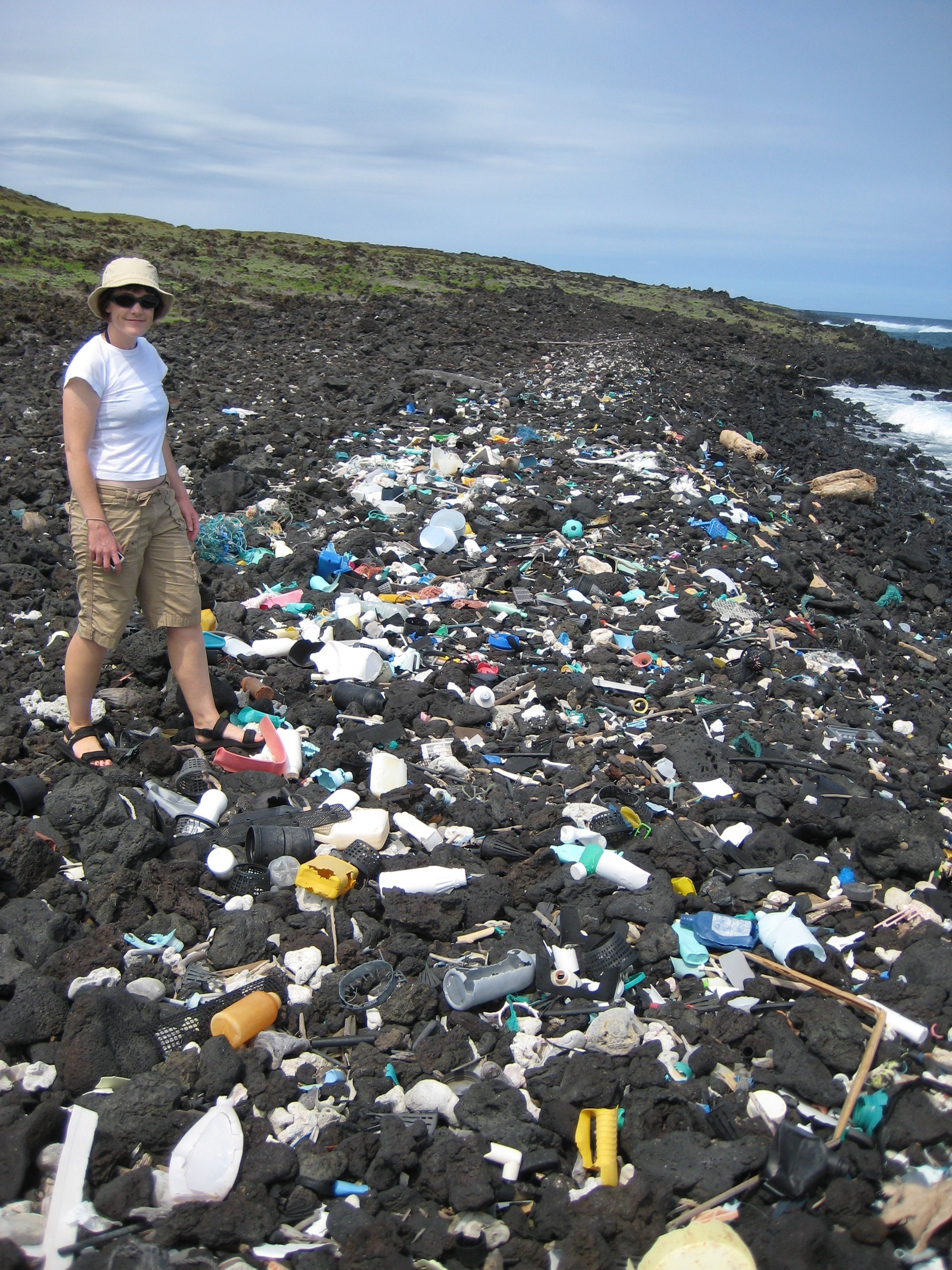
Plastic ocean debris littering Hawaiian shoreline. Hawaii is located near the center of the North Pacific gyre where debris tends to concentrate. (NOAA)

A team of volunteers, sailing in a flotilla of some thirty vessels, has successfully completed its month long research expedition through the western portion of the infamous Great Pacific Ocean Garbage Patch.

The first group of boats from the 30 vessel fleet, along with the Ocean Starr, a former NOAA research vehicle which served as the expedition’s “mother ship”, ended their journey when they sailed into in the port of San Francisco on Sunday, 8/23/15.

The Dutch environmental organization founded by Boylan Slat, called the Ocean Cleanup conducted its Mega Expedition Reconnaissance Mission through the massive collection of marine debris so that it could gather data to find out how much plastic is actually floating in the Pacific Ocean.

Nearly 8 million tons of plastic, mostly from land enters the ocean every year said a recent study.

Researchers say that portions of this huge collection of plastic, along with other forms of marine debris, gathers in five areas of the world’s oceans where the currents meet called the gyres.

A 2014 study found that currently there are at least 5.25 trillion pieces of plastic floating in the oceans with about third of it concentrated in the Great Pacific Garbage Patch.

The impacts of plastic pollution include harm to the environment, economy and human health.
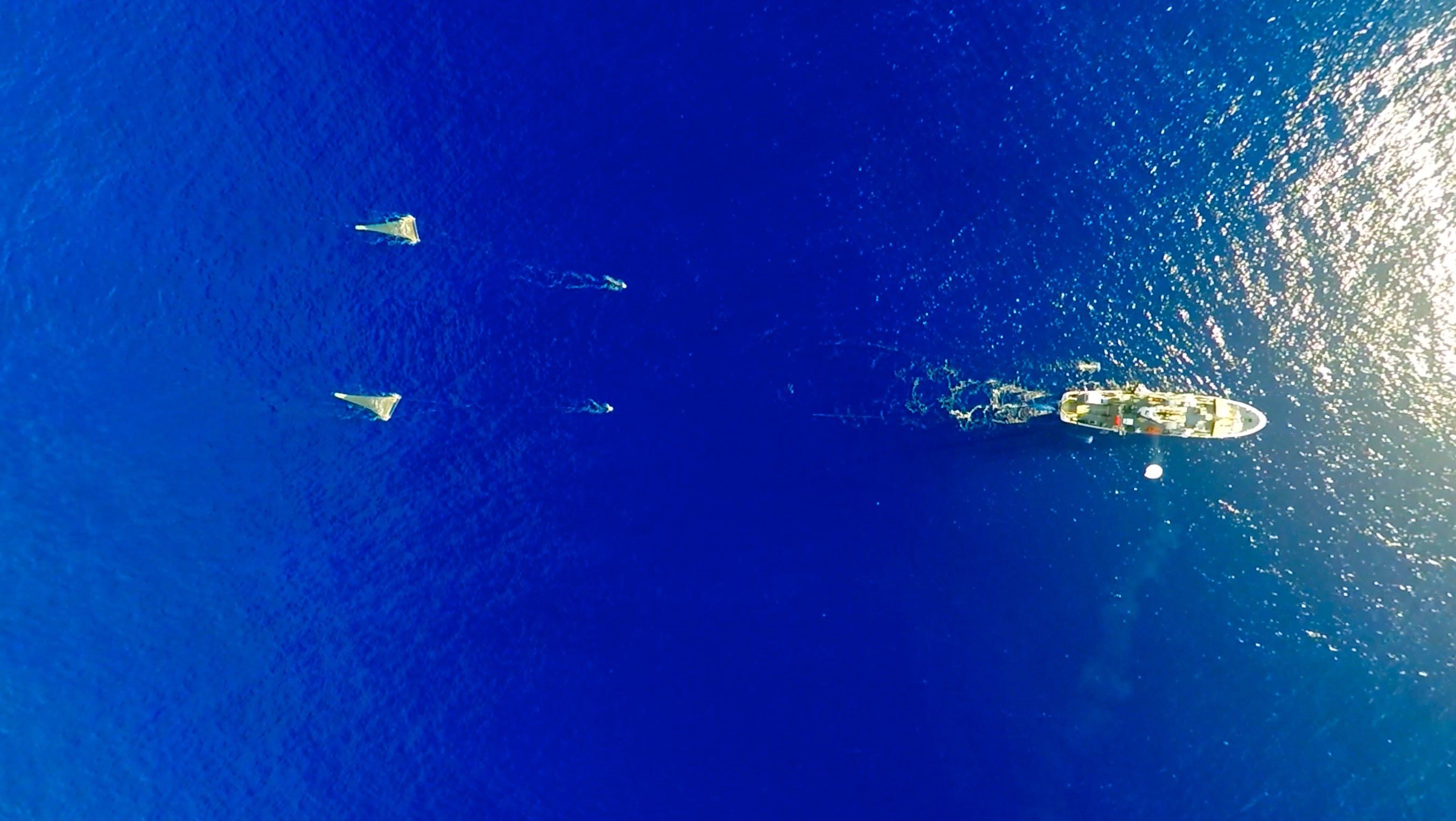
The Ocean Cleanup's Mega Expedition mothership R/V Ocean Starr is shown here deploying the two 6 meter-wide ‘mega nets’, two ‘manta trawls’, and its survey balloon with camera at the center of the Great Pacific Garbage Patch. ((C) The Ocean Cleanup/Skyframes)
The Ocean Cleanup’s Mega Expedition mothership R/V Ocean Starr is shown here deploying the two 6 meter-wide ‘mega nets’, two ‘manta trawls’, and its survey balloon with camera at the center of the Great Pacific Garbage Patch. ((C) The Ocean Cleanup/Skyframes)

About one million seabirds and one-hundred thousand marine mammals die every year due to plastic pollution, according to a 1997 study.

Toxic chemicals that are found in and can be amplified by the plastic pollutants enter the human daily diet through fish and other edible sea creatures who consume plastic polluted food.

Health effects that have been tied to these food borne chemicals include cancer, birth defects, immune system problems, and childhood developmental issues.

The Ocean Cleanup group plans to use the gathered data to create the first high-resolution map of plastic in the Pacific as well as to help in the preparation for the organization’s large scale ocean cleanup project that’s planned for 2020.

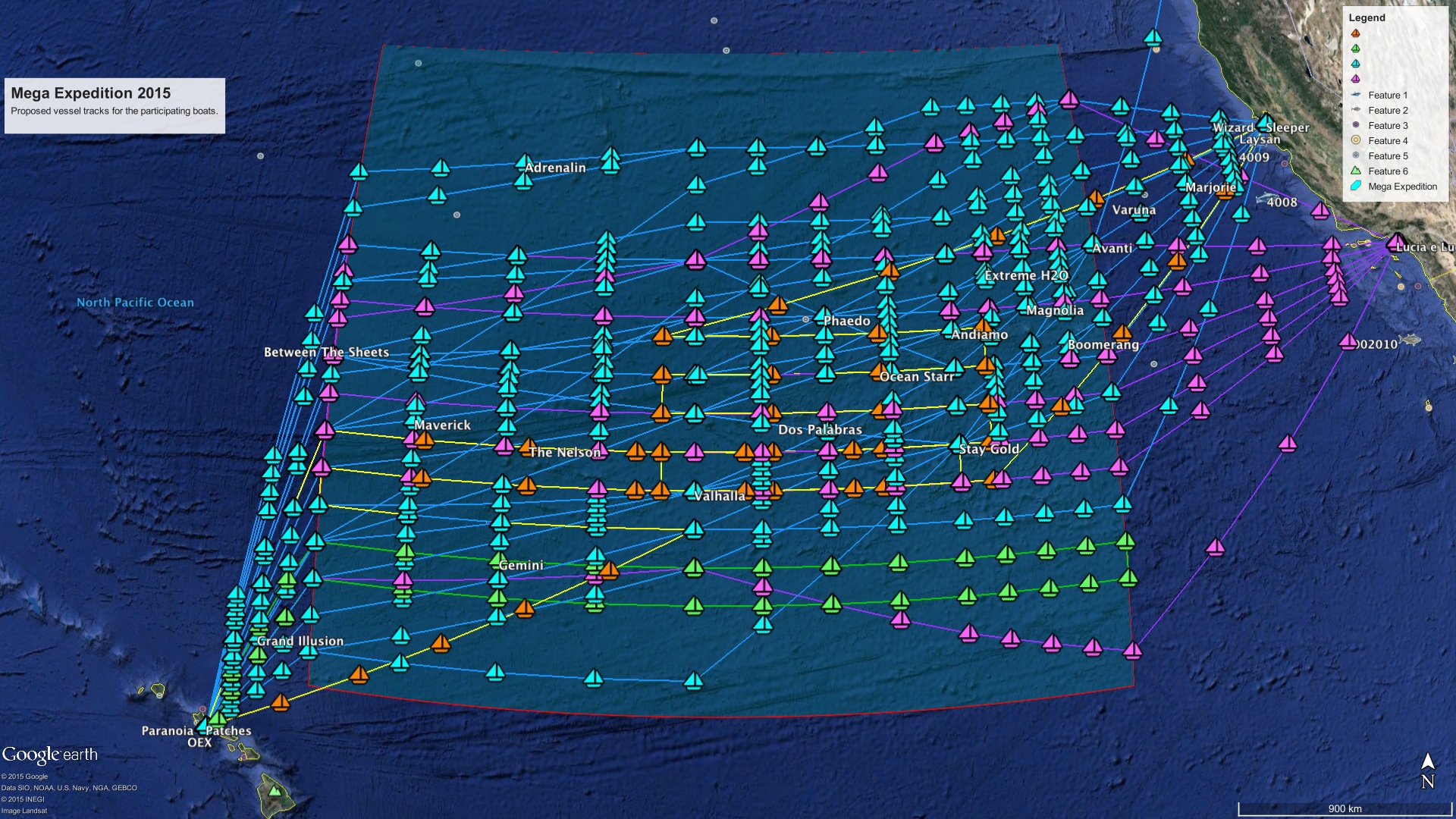
The thirty vessels sailed in parallel with each other over a 3.6 million square kilometer course in the Pacific Ocean. Over the month long period, the boats made around fifty crossings between the U.S. West Coast and Hawaii to conduct surveys on the amount of plastic they came across.
Map showing the 50 transects the Mega Expedition will perform based on routing information provided by the skippers before they left port.   Copyright: The Ocean Cleanup ((C) The Ocean Cleanup/Lys-Anne Sirks)
Map showing the 50 transects the Mega Expedition will perform based on routing information provided by the skippers before they left port.

Copyright: The Ocean Cleanup ((C) The Ocean Cleanup/Lys-Anne Sirks)

The expedition used a variety of measurement techniques to gather data.  Each of the boats towed a trawling net so that they could sample some of the smaller debris floating in the ocean. They tallied the larger pieces of debris with a special smart phone application called “The Ocean Cleanup survey app.”

To study large objects like ghost nets – fishing nets lost or left in the ocean – and debris from the 2011 Japanese Tsunami, the researchers also used an aerial camera system and giant nets that were aboard the Ocean Starr mothership.

According to a report from the Associated Press, most of the trash found by the expedition, including a one ton fishing net, were in medium to large pieces.

Rick Pantaleo
Rick Pantaleo maintains the Science World blog and writes stories for VOA’s web and radio on a variety of science, technology and health topics. He also occasionally appears on various VOA programs to talk about the latest scientific news. Rick joined VOA in 1992 after a 20 year career in commercial broadcasting.

Tuesday, August 25, 2015

Ship returns after monthlong study of plastic garbage in Pacific Ocean

Published on mlive by The Associated Press on August 24, 2015 
 
SAN FRANCISCO — Far away from California's coast, where the Pacific Ocean currents swirl, the blue of the sea was replaced by fishing nets, buckets, buoys, laundry baskets and unidentifiable pieces of plastic that floated past the Ocean Starr, a ship carrying a team of scientists and volunteers gathering data on plastic garbage.
 
"We were surrounded by an endless layer of garbage," sad Serena Cunsolo, an Italian marine biologist who works for The Ocean Cleanup. "It was devastating to see."
 
Cunsolo, 28, was one of a team of 15 researchers and volunteers aboard the Ocean Starr who a month ago set out from San Francisco to study the plastic waste as part of the "Mega Expedition," a major step in the organization's effort to eventually clean up what's known as the Great Pacific Garbage Patch.
 
The 171-foot mother ship, carrying massive white bags filled with plastic garbage, returned on Sunday to San Francisco along with two sailing boats with volunteers who helped collect the garbage samples.
 
Most of the trash they found, including a 1-ton fishing net, is medium to large-sized pieces, as opposed to confetti-like plastic shards that can easily enter the food chain after being eaten by small fish and birds and are extremely difficult to clean up, said Boyan Slat, who founded The Ocean Cleanup and has developed a technology that he says can start removing the garbage by 2020.
 
"It was a good illustration of why it is such an urgent thing to clean up because if we don't clean it up soon then we'll give the big plastic time to break into smaller and smaller pieces," Slat said.

Volunteer crews on 30 boats have been measuring the size and mapping the location of tons of plastic waste floating between the West Coast and Hawaii that according to some estimates covers an area twice the size of Texas.

Slat said the group will publish a report of its findings by mid-2016 and after that they hope to test out a 1-mile barrier to collect garbage near Japan. The ultimate goal is the construction of a 60-mile barrier in the middle of the Pacific.

The expedition was sponsored by The Ocean Cleanup, an organization founded by Slat, a 21-year-old innovator from the Netherlands who has envisioned using long-distance floating barriers that will attach to the seabed with an anchoring system used by oil-drilling rigs. The devices will target ocean currents full of waste and skim garbage from the surface while aquatic life and the currents themselves pass underneath.

He first became passionate about cleaning the oceans of plastic while diving in the Mediterranean Sea five years ago. "I was diving in Greece and realized that there were more plastic bags than fish, and I wondered why can't we clean this up," Slat said.

After dropping out of university after his first six months, Slat dedicated his life to developing the technology the group will start testing next year.

He decided to launch a kickstarter campaign and raised 2 million euros (about $ 2.27 million) that helped to launch his organization thanks to the success of a 2012 Ted Talk he gave about his idea that was viewed more than 2 million times. Soon, his innovative solution got the attention of major philanthropists in Europe and Silicon Valley, including Salesforce.com CEO Marc Benioff, who are helping pay for the data-gathering efforts and the technology's development.

The Pacific expedition, which will end in mid-September, will gather data that will be more extensive than what has been collected in the past 40 years. It also will give a better estimate of the how much plastic waste is in the Pacific Ocean, Slat said.

The boaters are using GPS and a smartphone app to search for and record the plastic. They take samples and ship them to the Netherlands, where the plastics are counted and recorded.

The Great Pacific Garbage Patch was discovered by Charles J. Moore in 1997 as he returned home from the Transpacific Yacht Race, which starts in Los Angeles and ends in Honolulu.

Monday, June 8, 2015

6 Reasons That Floating Ocean Plastic Cleanup Gizmo is a Horrible Idea

It's all over the internet these days: a floating boom to be set out in 2016 between Korea and Japan to collect improperly discarded plastics. The two-kilometer float, to be deployed off Tsushima Island in the Korea Strait, is a bit of a test run for much larger versions the creators hope to moor in open oceans around the world within the next five years.

The team behind the project, The Ocean Cleanup, claims that their floating booms will be able to rid the oceans of plastic pollution such as found in the Great Pacific Garbage Patch, at minimal cost and effort, without posing undue risk to wildlife, within a few years. But since young inventor Boyan Slat first began, at about age 18, to get attention for his idea, marine biologists and oceanographers have been fairly pulling their hair out at the Ocean Cleanup's huge social media popularity.

It makes sense that Slat's idea has become popular. Vague but persuasive sales pitches that promise to solve problems without us having to change our behavior? They're always popular. But here's what's got those scientists in a cranky mood: Slat's idea almost certainly won't make enough of a dent in the ocean plastic pollution to be worth the effort, it will almost certainly injure wildlife already struggling from an ocean with too much of our stuff in it, and the rigs may end up becoming more shredded pieces of plastic in an ocean already literally awash in plastic.

One of the most disheartening things about the response to those scientific second thoughts is a common public response along the lines of "at least Slat is doing something about the problem, unlike these scientists who can't do anything but tear down his good idea instead of helping." That's being said about people who have, in some cases, been sounding the alarm about plastic pollution since before Slat was born. Some groups critical of Slat's idea, such as the organization 5 Gyres (about whom more in a moment), have been working feverishly to come up with workable solutions to the ocean plastics problem. Many of the critics have lauded Slat's enthusiasm, merely suggesting that it be tempered by a bit of real-world thinking.

That's not to say that big ideas might not be perfectly appropriate tools with which to tackle the problem of plastics pollution in the ocean. It's a big problem. There are five distinct "garbage patches" in the world's oceans, where discarded plastic has accumulated as a result of finding relatively stable spots between oceans' currents. The largest known of these, dubbed the "Great Pacific Garbage Patch," is usually compared in area to the state of Texas.

And that's a problem, because that plastic doesn't just sit there and float around. It gets eaten by marine life, and can cause them serious health problems -- including starvation from having a belly full of indigestible plastic. It leaches chemicals into the ocean water, and can disrupt the normal ecological functions of the open ocean, blocking sunlight that plankton depend on for photosynthesis, among other things.

In order to remedy this, Slat and his crew say they want to place as many as 24 floating booms about 1,000 kilometers long (621 miles) at strategic spots in the ocean. The booms would be designed to funnel pieces of floating plastic into collectors, from which it would be hauled elsewhere for recycling.

Slat says that his boom designs could rid the world's oceans of plastic garbage in five years, while posing minimal risk to the oceans' wildlife.

That's got a lot of people who may not have much experience with actual conditions on the open ocean pretty excited. Marine biologists, oceanographers, and engineers with experience with offshore infrastructure aren't jumping on the bandwagon quite as enthusiastically. It's great to chase bold visions, but the devil, as they say, is in the details.

Here are some of those details.

1. Ocean plastic doesn't behave the way the project's backers say it does.
Technical details of The Ocean Cleanup's design are sparse, but it looks as though the group plans to funnel plastic into collectors using long baffles that extend three meters below the ocean surface. Their contention is that the majority of plastic debris will be floating in the top three meters of ocean.

The Ocean Cleanup conducted a study of the water column in an area in the Atlantic that they say backs up this contention. That study found that the amount of plastic dropped off "exponentially" deeper than three meters below the surface.

But as oceanographers Kim Martini and Miriam Goldstein pointed out in their review of that study, The Ocean Cleanup's team did no sampling deeper than five meters below the surface. That despite the fact that winds have been proven to mix surface ocean waters as deep as 100 meters, with plastic documented at least that deep.

Martini and Goldstein also point out that the project's June 2014 feasibility study mentions that the array won't be able to collect pieces of plastic smaller than two centimeters across. If your impression of the oceans' plastic contamination is that it's all intact grocery bags and water bottles, that may not seem like a big deal. But the vast majority of plastic in the ocean is made up of particles one centimeter and smaller, remnants of larger pieces broken up by ultraviolet light, the corrosive effects of seawater, and physical abuse from wave action and marine creatures.

In fact, as the ocean pollution activist group 5 Gyres Institute suggests, The Ocean Cleanup's plans seems to be based on a notion of ocean plastic that just isn't true. As the group's Anna Cummins wrote in January:
The idea that there are "patches" of trash in the oceans is a myth created 15 years ago that should be abandoned in favor of "clouds" of microplastics that emanate out of the 5 subtropical gyres. Our recent publication in the journal Plos One estimates 269,000 tons of plastic from 5.25 trillion particles, but more alarming than that is it's mostly microplastic (>92 percent in our study) and most of the plastic in the ocean is likely not on the sea surface. Recent research has shown microplastics in ice cores, across the seafloor, vertically throughout the ocean, and on every beach worldwide. The little stuff is everywhere.

If you follow the life of plastic in the oceans, as we have done for 50,000 miles since 2009, you find the large items leaving coastlines in droves, then it rapidly shreds as it migrates toward the calmer waters of the subtropical gyres where sunlight, waves and nibbling fish rip it to micro-size particles smaller than a grain of rice. Microplastic then flow [s] through the bodies of billions of organisms, making their way out of the gyres to deeper currents, and ultimately the seafloor. That's the end-life of plastic.
Included in the burgeoning world of microplastic: microbeads, an arguably useless gimmick included in personal care products now entering the world's oceans in alarming amounts. KCET's "SoCal Connected" looked at microbeads in a segment earlier this year. 5 Gyres and others are working to ban microbeads jurisdictions worldwide.

In other words, if 98 percent of the problem plastics in our oceans are the size of grains of rice or smaller, building a plastic collector that takes only pieces larger than 2 centimeters from the top three meters of the ocean would seem a fairly useless exercise.

2. The collectors will break really, really quickly.
It's hard to imagine a better description of actual conditions in the oceans' gyres than this one, written by veteran ocean conservation activist Stiv Wilson, Policy Director for 5 Gyres Institute, in 2013:
So far, we've taken one gyre cleanup advocate across the South Atlantic, from Brazil to South Africa. We had 22 days of storms with seas in excess of 30 feet at times. By the time we got to the other side, some 30-plus days later, he'd abandoned his hope of cleaning the gyres once he realized how big a "place" we're talking about... the sea is one giant corrosive force. Even on just a month-long sail across The South Atlantic, we tore our sails twice, broke some rigging, and utterly destroyed a wind-powered generator -- all due to the force of nature. Any blue water sailor will tell you about how destructive the sea is to anything with moving parts. That's why sailors say, "a boat is a hole you fill with money." Heck, outer space is less corrosive to machines than the ocean is.
Promotional photos offered by the Ocean Cleanup folks show the booms floating on a nearly flat, glassy sea, where it's easy to imagine them remaining intact for months on end. In 30-foot seas, how long would those booms last before breaking apart? Martini and Goldstein, in their review of the project's June 2004 feasibility study, express serious doubts whether the structures would withstand bluewater stresses for very long.

In that review, Martini and Goldstein pointed out that the study "severely underestimated" the stresses to which the booms would be subject under typical ocean storm conditions. The designers modeled their study on average ocean currents rather than likely peak currents, raising the possibility that the booms would be exposed to tougher currents than they could handle as much as half the time. (It's the extremes, not the averages, that break equipment.)

In order to keep the booms stably placed within the currents they're intended to clean, they'd need to be securely moored. Slat and company say that some of the booms would be deployed in water as much as 4,000 meters deep. That's twice the current maximum depth at which ships or other structures have ever been moored.

And when the currents in which the booms are moored shift, point out Martini and Goldstein, the booms could deform, seriously reducing their ability to collect plastic -- or even spilling collected plastics back into the ocean.

And then there's the issue of "biofouling," the term of art used to mean "marine critters using your expensive equipment as a place to live." Place a rigid object in the ocean and within 24 hours, bacteria and diatoms will have attached to it, creating a "biofilm" that then provides habitat for algae and protozoans. That in turn provides a place for larger organisms like tunicates, sponges, mollusks, and crustaceans -- barnacles being the most familiar example of the latter.

And that adds weight to the structure. The Ocean Cleanup's feasibility study itself says that biofouling could add tens to hundreds of kilograms of extra weight per square meter of submerged surface. That could sink the booms. It would change the way currents flow along that three-meter-deep skirt beneath the booms, altering the efficiency with which the booms funnel plastic into the collection area.

There's also potential for damage from a very specific kind of biofouling: larger fish "vandalizing" the structures. "Fish bite" damage to submerged equipment, from sensors to mooring lines, is a real thing.

Slat's test next year will deploy a boom that's one five-hundredth the length of the proposed booms that are his ultimate goals. It remains to be seen how well that far shorter model holds up in the relatively protected waters of the Korea Strait. As currently described, it seems likely that the larger versions would, after the first winter storm, become part of the floating ocean plastic problem -- 600 miles of plastic per boom.

3. The project will harm wildlife.
Slat's team says in its feasibility study that they don't have a workable solution to the biofouling issue, saying that mechanical cleaning of 24,000 kilometers of boom floating in the open ocean would be too expensive. Martini and Goldstein point out that the only other approach that's even close to workable would be for The Ocean Cleanup to use so-called anti-biofouling coatings on their equipment, to slow down the rate at which the structures are colonized by marine life.

Though research is being done into new surfaces that are resistant to biofouling, using nanomaterials technology, the standard anti-biofouling coatings in use these days are chemical treatments that contain "biocides." Biocides are pretty much what they sound like: substances that kill living things. The idea is that biocides incorporated into the coatings will deter organisms from forming that biofilm that starts the biofouling process.

The problem is, anti-biofouling coatings have a finite effective lifespan. And that's in part because the biocides leach out of the coatings.

Imagine 24,000 kilometers of boom coated with anti-biofouling coatings leaching biocides into the ocean -- from a project intended to benefit marine life.

The most effective biocidal coatings, and the most widely used, are compounds in the tributyltin family, which are known to leach into seawater and pose documented risks to microorganisms and larger marine life. Some governments have moved to phase out tributyltin, but there aren't many economical alternatives.

The booms pose physical threats to marine life as well. The designers claim that neutrally buoyant microorganisms such as plankton will merely flow beneath the three-meter skirts. That may be true for some species, but marine biologists point out that the North Pacific gyre (for instance) has planktonic organisms that don't stray from the highly oxygenated waters found right at the surface of the ocean, and that such species would likely be swept up in large numbers. Any plankton that's swept up into the collectors will be separated out by centrifuge, the effects of which Miriam Goldstein described thusly in a marine scientists' email list server conversation:
Most zooplankton don't survive being caught in a standard manta net, never mind being spun in a centrifuge. They might still be twitching, but they have lost a lot of their important parts, like antennae and feeding apparatus. When we want to capture live zooplankton, we use special live-collection nets and are very, very careful. For gelatinous zooplankton like salps, the only way to bring them up in good condition is to individually capture them in glass jars on SCUBA. I am highly skeptical that any significant proportion of zooplankton are viable after caught in a net and spun at 50 RPM.
As for larger organisms, the feasibility study itself says this:
Highly migratory species will be highly affected by this project. Swordfish, marlin, sailfish, sharks, tuna-like species are all highly susceptible to being caught in the holding tanks, and possibility diverted by the booms into the platform.
The Ocean Cleanup makes much of the fact that their booms are unlikely to directly ensnare large wildlife due to the skirt's smooth surfaces. Due to biofouling, those smooth surfaces may not last long. Among the pieces of plastic floating in the ocean are "ghost nets," discarded pieces of fishing net sometimes hundreds of meters long. With 24 1,000-kilometer booms scattered across the oceans, the possibility that such ghost nets would get hung up on patches of barnacles growing on the skirts is significant. And since the boom would be moored and the ghost nets would suddenly stop moving with the current, animals that do move with the current would face greater threats from those nets.

As mentioned above, the public image of plastic pollution in the oceans differs greatly from reality: only a tiny percentage of discarded plastic is found in large floating pieces that would be easily swept up by Slat's booms. Ironically, such floating plastic is highly likely to have itself been "biofouled," adopted as a home by marine organisms that would be injured or killed during the collection process.

In 2014, Charles Moore -- original discoverer of the "Great Pacific Garbage Patch" -- found a floating island in the North Pacific thought to mainly consist of trash washed out to sea by the 2011 Japanese tsunami. The 50-foot island was home to an apparently permanent population of sea anemones, algae, clams, and mussels. That's just an indication of how readily wildlife will colonize every available surface in the ocean -- including floating plastic. And that means that the plastic Slat's design can collect is the plastic most likely to have wildlife stowaways.

One wonders just how much help from The Ocean Cleanup the oceanic wildlife of the world can withstand.

4. Recyclers don't want the plastic.
Slat and his colleagues say that the end destination of the collected plastic is land-based plastics recyclers. This is unlikely to turn out to be the case. Unlike glass and aluminum and high-quality paper, which can be recycled a number of times into products similar to the original.

But when you put your plastic water bottle in the recycling bin, you won't be getting a recycled plastic water bottle at the other end of the process. Plastics' polymer chains break down too readily when melted, meaning that your water bottle becomes a lower-grade plastic product, and usually not a disposable one.

That means that plastics recycling is actually better called "downcycling," and it's not a solution to the problem of disposable plastics. And that's assuming that plastics recyclers have access to a supply of clean, sorted, high-quality discarded plastic, such as you might find in a residential or office recycling bin.

Slat's machines, on the other hand, will be collecting plastic that's been drifting in the ocean for who knows how long, its polymer chains under attack from dissolved salts and ultraviolet light, and absorbing environmental contaminants from random industrial harbors. Instead of being readily sortable bottles and bags, much of the collected plastic will be in small pieces, and that means recyclers would need to use spectrographs to determine whether the salvaged plastic is polyethylene, polyproplylene, polystyrene, or something else altogether.

Plastic recycling is a completely marginal industry, with supply of scrap plastic far outstripping demand. It's only a de facto subsidy by recycling collection programs, which provide a mostly clean, mostly sorted source of scrap plastic at low cost, that makes plastic recycling even slightly feasible. Offer to truck hundreds of tons of contaminated mixed plastic to those recycling facilities, and it's doubtful you'd get a polite response.

5. There's a far more effective way to clean large plastic pieces from the ocean's gyres.
It's called "beach cleanup." Current thinking (no pun intended) has it that as much as half the plastic in a gyre is jettisoned in each rotation, where it then follows ocean currents wherever they lead. often enough, those currents lead to beaches, where the plastic can be removed by volunteer labor with minimal harm to wildlife. If it's not picked up off the beach, the next storm can wash it back out to sea, where it may eventually rejoin a gyre.

That makes our beaches a very accessible part of the ocean plastic garbage cycle, and it just makes sense to focus our ocean plastic cleanup efforts on that low-hanging fruit.
In 2014 on one Beach Cleanup Day in California alone, 66,292 volunteers collected 564 tons of trash, some 80 percent of which was single-use disposable plastic items. That's 564 tons of trash that won't be joining the Garbage Patch.

You can find the next beach cleanup event near you at The Ocean Conservancy's website.

6. It's far more efficient, cheaper, and safer to keep the plastic out of the ocean in the first place.
In a way, it's ironic that supporters of Slat's project in social media have been accusing critics of not contributing to solutions to the issue of plastic pollution, because the net effect of The Ocean Cleanup may well be to persuade regular folks that the problem has been solved, and they don't need to take action to limit the amount of plastic that goes into the world's waterways.

There are initiatives already taking place that promise to significantly reduce the amount of plastic trash making its way into our oceans. More and more places are enacting bans on disposable plastic grocery bags, a major component of plastic pollution. Single-use plastic water bottles are another bit of low-hanging fruit just asking to be banned, a move some national parks have already taken.

As mentioned above, bills to ban plastic microbeads are advancing, including Assembly Bill 888, which passed the California Assembly in May and is now being considered by the California State Senate.

We're not discounting the importance of clever technological approaches; they just don't belong on the ocean. Some municipalities have had good results from putting screens on strom drains and collecting the accumulated plastic. Baltimore operates a "Water Wheel" where the river Jones Falls flows into the city's Inner Harbor. In the last year, that device has filled dumpsters with almost 200 tons of trash that would have flowed into Chesapeake Bay.

But the ultimate solution to the problem of ocean plastics is to stop using so much single-use, disposable plastic in the first place, whether as packaging or in single use items such as drinking straws. Once that plastic gets to the ocean, there's no technological quick fix, no matter how much we might want there to be one. We've got to stop counting on some bright young inventor to save the planet and start doing it ourselves.