A blog set out to explore, archive & relate plastic pollution happening world-wide, while learning about on-going efforts and solutions to help break free of our addiction to single-use plastics & sharing this awareness with a community of clean water lovers everywhere!
Showing posts with label PET bottles. Show all posts

Monday, August 12, 2013

Plastic Water Bottles Causing Flood of Harm to Our Environment.

Posted in the Huffington Post on 07/29/2013 by Norm Schriever

2013-07-18-images4.jpgI remember the first time I saw a bottle of water for sale, thinking it was the most ridiculous thing I'd ever encountered. Who the heck would actually PAY to drink water when they could get it for free at home? That's just crazy! I drank out of the faucet every single day, or the garden hose in a pinch, and there was obviously nothing wrong with me (other than mentally).

But there they were, plastic bottles of water lined up in a cooler next to the Fantas and Tabs, happily purchased by the same screwy people who were walking around yelling into those new huge Walkie Talkie things called "cellphones." It was sometime in the 1980s, in the midst of a generation that was itself defined by ridiculousness -- fads like the Rubik's Cube, specialty Nike running shoes for a whopping $50, and Atari's Miss Pacman, an introduction to the new religion of consumerism for its own sake.

Back then, even the most optimistic capitalist couldn't have guessed where the water bottle industry was heading. Thirty years later it's not just a luxury item for those driving Porsche 911s with their salmon-colored collars up, but a stalwart of regular American life. Yes, me too -- I became one of those screwy people who bought bottled water by the case and yapped into his "cellphone" non -top (sometimes even when another person was on the line.)

But the damage from the bottled water industry isn't just to our intelligence and our wallets; it's also to the world we live in. Our environment is being impacted, not just the image of a nice sunny far-off meadow that word conjures but the actual surroundings that we depend on to sustain our lives. Our human fish tank is getting terrifically cloudy because of the plastic water bottles we buy and discard so thoughtlessly.

How big is the bottled water industry?
There are 50 billion water bottles consumed every year, about 30 billion of them in the US (which means we consume roughly 60 percent of the world's water bottles, even though we're about 4.5 percent of the world population).

There are 1,500 water bottles consumed per SECOND in the U.S.
2011 was a high point for bottle water sales, where 9.1 billion gallons were sold, or 29.1 gallons per person per year, the highest in sales and volume in history.

What does it take to manufacture the water bottles?
It takes three times the volume of water to manufacture one bottle of water than it does to fill it, and because of the chemical production of plastics that water is mostly unusable.

We use 17 million barrels of oil each year just to produce all of those water bottles.
To put it in perspective, that's enough oil to keep a million cars fueled for a whole year! (Or your Hummer to Ikea and back.)

The Earth Policy Institute factors the energy used to pump, process, transport and refrigerate our bottled water as over 50 million barrels of oil every year. That's an insane amount of resources for something that is a completely unneeded.

Another way to think of it: when you pick up a water bottle at the supermarket, hold it up and imagine it filled ¼ with oil. That's how much in fossil fuels it took just to manufacture it!
Even the environmental impact of delivering all that bottled water is profound, both from overseas (Fiji Water, Pellegrino) and distribution to stores in the US. It takes a fleet of 40,000 18-wheelers just to deliver our bottle water every week!
2013-07-18-t600TappedBottleOcean.jpgWhat's the environmental impact?
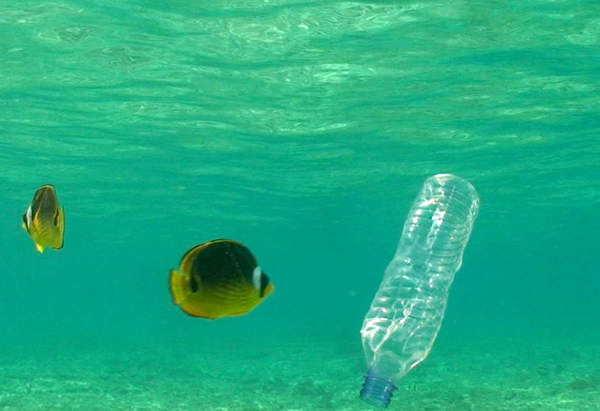
Water bottles are made of completely recyclable polyethylene terephthalate (PET) plastics, but PETs don't biodegrade they photodegrade, which means they break down into smaller fragments over time. Those fragments absorb toxins that pollute our waterways, contaminate our soil, and sicken animals (which we then eat). Plastic trash also absorbs organic pollutants like BPA and PCBs. They may take centuries to decompose while sitting in landfills, amounting to endless billions of little environmentally poisonous time bombs.

According to the Ocean Conservatory, plastic bottles and plastic bags are the most prevalent form of pollution found on our beaches and in our oceans -- every square mile of the ocean has over 46,000 pieces of floating plastic in it.

Ten percent of the plastic manufactured worldwide ends up in the ocean, the majority of that settling on the ocean floor where it will never degrade.

But don't we recycle?
Eighty percent of the water bottles we buy end up in landfills, the absolute worst place for them to be. That means roughly for every 10 bottles we drink, only two end up in the recycle bin.

Our national recycle rate for PET's is only 23 percent, which means we throw 38 billion water bottles into landfills a year.

That's $1 billion worth of plastic that should end up in the "recycling stream" where they can be reused as carpeting, synthetic decking, playground equipment, and new bottles and containers.

Isn't bottled water safer and cleaner?
No. In fact, all the majority of evidence shows that it's worse for you. Plastic leaches into the water it holds, which has been linked to health issues like reproductive problems and different types of cancer. Harmful hormone-disrupting phthalates leach into the bottled water we drink after as little as 10 weeks of storage, or much faster once the bottles have been left in the sun (like in the car.)

Tap water isn't perfect either because the purity varies depending on where you live, but the same could be said for bottled water. The National Resources Defense Council conducted an intensive study of bottled water and ascertained that 22 percent of the water tested contained contaminant levels that exceeded the state health limits.

New York city has the safest, cleanest tap water in the whole country, and San Francisco draws its public drinking water supply from nearby Yosemite National Park, so pure they don't even require it to be filtered.

If you wanted to check out how your local water system rates, click here.

Does it taste better?
In blind taste tests people have trouble differentiating between tap water and bottled water, and it's virtually indistinguishable once poured through a simple filter.

Your best bet is using tap water run through a good filter on your kitchen tap or drinking container, which will yield you the cheapest, cleanest, most convenient water source.

Is bottled water a rip off?
You know how you pay $3 + for a cup of coffee that probably costs 20 cents to make? You look like a financial genius making that purchase compared to the economics of bottled water. Bottled water costs well in excess of 1,000 times that of tap water, even with a filter.

Eight glasses of water, the recommended daily amount costs about $0.50 cents out of the tap, but about $1,400 if you bought bottles!

To put it in scale, if all of the water you used around the house for showers, dishwashing, watering the plants, etc. was bottled water your monthly H20 bill would be about $9,000.

Did you know that up to 47.8 percent of the bottled water we buy is actually just repackaged tap water? Yeah, and the mega-beverage conglomerates Coke, Pepsi and Nestle hold most of the market share. Can you spell "S-U-C-K-E-R?"

We complain incessantly about gas prices at $3.89 a gallon, but the same amount of San Pellegrino bottled water would cost close to $10. But I'm not trying to stop you from flushing your money down the toilet (so to speak,) however there is a greater cost to all of us as a society, country, and interconnected world community.

2013-07-17-imagesw.jpgWhat is the ripple effect?
780 million people around the world, more than twice the population of the United States, don't have access to clean, safe drinking water.

Of course the water bottle you don't buy isn't going to end up with them, but everything is interconnected, from trade policies and use of fossil fuels, to environmental impact and irrigation, and ultimately damage to food-producing industries like agriculture and fisheries.

Already, pollution is estimated to be one of the biggest causes of death around the world, affecting more than 100 million people per year, more than epidemics like Malaria and HIV.

The U.S. consumes natural resources, like fossil fuels, and pollutes the environment at an alarming rate. Though less than five percent of the world's population, we consume more than 25 percent of the resources and produce 30 percent of the trash and environmental pollutants. 

Not only are we severely harming the land, air and water around us, but the rest of the world has to pay the price for our thoughtless over-consumption, and soon our children and generations to come will be tirelessly cleaning up our mess.

However, it's not all doom and gloom -- just like the water bottle phenomenon took off within a short time, as did cell phones and other trends, a cultural shift can start creating solutions with lightning efficiency.

So please stay tuned for part 2, What We Can do TODAY to Fix The Water Bottle Problem, and
part 3, Creative And Functional Uses For Empty Water Bottles.

Wednesday, January 16, 2013

Better Bring Your Own: University Of Vermont Bans Bottled Water

by on NPR
A student walks past a sculpture made of empty water bottles on the University of Vermont campus. UVM has banned the sale of bottled water. Toby Talbot/AP
 
When students at the University of Vermont resume classes on the snow-covered Burlington campus Monday, something will be missing: bottled water. UVM is the latest university to ban on-campus sales of bottled water.

At one of UVM's recently retrofitted refill stations, students fill up their reusable bottles with tap water. For many of the 14,000 students and staff on this campus, topping off their refillable bottles is an old habit.
"It's much more convenient to fill up your water bottle at a water fountain than to buy bottled water," says Mikayla McDonald, a recent graduate, who a few years ago helped to launch the campaign that led to UVM's ban. McDonald hopes it will reduce waste. But for her, it's not just about changing behavior on campus.

"Bottled water is a symbol of our culture's obsession with commodifying things that should be public trust resources," she says.

In that spirit, a few other American colleges have restricted or banned the sale of bottled water to promote sustainability. But the University of Vermont is the largest public institution to do so, and that development disappoints beverage companies.

"I think they're concerned because it's such a radical step," says lobbyist Andrew MacLean, who represents local water and soft drink distributors in Vermont. He agrees with the students' environmental goals, but he thinks an outright ban restricts free choice and will ultimately fail.

"The factors that will result in more materials getting out of landfills is going to be a cooperative effort promoting strong recycling," he argues.

But at least one New England town says recycling isn't enough to keep plastic bottles out of its waste stream. Concord, Mass. — perhaps best known for its role in the American Revolution — joined the student movement this month, outlawing the sale of single-serve plastic water bottles in its stores.

Tuesday, June 19, 2012

We Need Your Bottles... All 23 Billion of Them!

posted 12/6/2012 by Closed Loop Recycling Co. in the UK


BORIS JOHNSON BACKS NEW CAMPAIGN AHEAD OF NATIONAL RECYCLE WEEK (18-24 JUNE)

The UK is sitting on top of 1.4 million tonnes of untapped resource in the form of post consumer plastic that could drive the UK recycling industry to the next level. That’s according to pioneering plastic bottle recycler, Closed Loop Recycling which is launching a brand new campaign, backed by the Mayor of London, Boris Johnson in support of the British recycling industry, aimed at encouraging all aspects of the supply loop to collect and recycle more plastic bottles here in the UK.

1.8 million tonnes of post-consumer plastics are generated every year in the UK, nearly a third (580,000 tonnes) being plastic bottles – that’s 23.2 billion bottles.  However 300,000 tonnes of good quality plastic is still sent to landfill each year and a large percentage of what is collected - 70 per cent in the case of bottles - is shipped abroad, stifling the UK recycling industry which relies upon this valuable resource.

Boris Johnson, Mayor of London, said: “Taking time to chuck your unwanted plastic bottles into the recycling bin, rather than your rubbish bin, is not only good for the environment, but great for our wallets too. Recycling saves Londoners money, with the added bonus of creating jobs in London.”
Unveiling a specially designed logo, Closed Loop Recycling is launching its campaign with a hard-hitting ‘We Need Your Bottles’ message to coincide with National Recycle Week (18-24 June 2012), which is focusing specifically on plastic bottle recycling.

At a time when there is a huge national focus on all things ‘British’ thanks to last weekend’s Diamond Jubilee celebrations and the upcoming London 2012 Olympics, Closed Loop Recycling is urging the British public to remember to place their used plastic bottles in available recycling bins – whether at home or out in public places – in order that they can be collected for recycling into new food and drink packaging.

An example of this is in the London borough of Westminster, which was at the heart of nationwide Diamond Jubilee celebrations last week, Closed Loop Recycling took receipt of all plastic bottles that were collected by waste company Veolia from streets and recycling bins, carefully sorting, washing and super-cleaning them into material for companies such as Marks & Spencer, Britvic and Solo Cup.  Plus throughout the busy Olympics period Closed Loop Recycling will be receiving plastic bottles collected on the London Tube network thanks to its contract with Bywaters.

Closed Loop Recycling CEO Chris Dow explains: “’We Need Your Bottles’ is all about educating people about the importance of mining Britain’s urban forest.  Used plastic bottles are a valuable resource to the UK recycling industry, which has the knowledge and technology to recycle them for the future.

“By encouraging consumers to recycle more than they are doing already, asking waste firms to support UK recyclers rather than shipping overseas and incentivising UK brands to use UK-sourced recyclate in their packaging, companies like ours will be able to grow further, create more green jobs and boost Britain’s low carbon economy.

“Recycling plastic bottles in the UK is best for the environment, for British businesses and for British jobs.” 

As part of its campaign, Closed Loop Recycling is urging the government to review the current PRN/PERN system so that it no longer favours overseas waste shipments versus domestic recycling.

The company is asking for a more level playing field.

Wednesday, May 23, 2012

Plastic Oceans (Plastic in our playground!) Part 2 - Plastic bottles

posted on www.sail-world.com by Ian Thomson on May 20, 2012


'Plastics in our oceans'    . ©    Click Here to view large photo

In part one, we looked at plastic bags. We went through the numbers and quantified how much one million and one billion is in reality. Let's revisit that before we move onto Plastic water bottles.

To count straight through from one to 1,000,000 will take you 11 days and it will take 32 years to count to one billion. You cannot count to one trillion in your lifetime. In grains of rice, to get one million grains you need 25 litres (6.5 gallons). For one billion you need 25,000 litres of rice (6,500 gallons).

The world now consumes 200 billion litres of bottled water every year. The majority of this is in plastic bottles. You can pretty much equate each litre into one bottle. So that makes 200 billion water bottles that we need to dispose of or recycle every year.

How did we get to drinking this much water out of bottles when we have perfectly good water out of the taps? Well you can blame the big soda drink manufacturers. Back in the 80's they realised that we can only drink so much soda.

In order to keep growing they needed to create a new market. They decided to bottle water. They then went on a campaign to sell us, saying that bottled water is way better for us than water out of the tap. We fell for it and today it is a multi-billion dollar market. We now ship water from Fiji to Italy, Italy to USA and Paris to Australia!

So is it better for us or not? Well 40% of bottled water is actually filtered tap water. Some are known to be better, some worse. No matter what water brand you buy though, there is one key that should give us the answer.

Plastic breaking up through photo-degradation - Ocean Crusaders -  Ian Thomson  
It is called a 'Used by date'. Water does not go off in rivers and lakes or in our taps so why does it have a used by date? It is because plastic water bottles contain toxins that leach into the water, contaminating it and also affecting the taste. It's that plastic taste you get occasionally. It's actually killing you slowly. What are these toxins? The big one is Bisphenol A (BPA).

There are more and more studies these days on this toxin and it has been proven to cause breast cancer, ADHD, autism and the list continues to grow. To put it bluntly, toxins in plastic consumed during pregnancy is a major issue. Heating kids drinks and food in plastic just adds to the issue.

So it's not healthy for us so how do they get away with it. It is all in the name of convenience. We are too lazy to take our own bottle and refill it. Tonight I saw the most crazy advert on TV. Coca Cola's brand of water here in Australia 'Mount Franklin' is promoting that their water is in bottles that are made of just 30% of the plastic of other brands and that they crush down really easily.

Initially I thought that at least it is less plastic but then I thought about it. They use less plastic which costs them less. Win to Coca Cola. Oh and you can't reuse it as it crushes too easy so you have to buy another bottle. Win to Coca Cola.

World Cartoon - Ocean Crusaders -  Ian Thomson  
Around the world only 30% of plastic is recycled so that means 66.6 billion of these bottles will go into landfill or worse still, into the oceans. The caps on water bottles are still not recyclable so that means 200 billion bottle caps in our world that won't break down, they'll last forever.

So as a boater, what can you do? Simple, buy S/S water bottles and refill them. If you want to buy water, buy it in large containers or filter it from the tap at home. S/S bottles may cost a bit but the savings you will make in not buying water will pay for this bottle countless times. It means you create less waste, you save money and the environment will love you for it. Everybody wins.

If you're in a yacht club or corner store, purchase or lease a water vending machine. You can even get flavoured water dispensed. If every shop replaced the fridge they store bottled water in with a water vending machine, they still make money but don't kill the environment. Oh and it would be cheaper for you too.

Bottled Water - Ocean Crusaders -  Ian Thomson   Click Here to view large photo


I don't want to sail on an ocean of plastic and I'm sure you don't want to either. We need to change our habits today. It is the little things that count towards making our oceans safe for the future.

Say no to plastic water bottles.

Reduce, Resuse, Recycle.

Ocean Crusaders was founded by Ian Thomson in June 2010 after setting the world record for the fastest solo circumnavigation of Australia. He is on a crusade to educate the world of the issues our oceans are facing. An online education program is available for primary school teachers to present to their students or for parents to present to their children. Visit the Ocean Crusaders website for more details.

Click here to view part one of Plastic Oceans.
by Ian Thomson

Monday, August 22, 2011

Polar set to fight bottle bill expansion

posted August 20, 2011 in the TELEGRAM & GAZETTE By John J. Monahan


Polar set to fight bottle bill expansion
BOTTLER FEARS INCREASED COSTS

Picture

With the advent of curbside recycling in many communities and other public recycling programs for home waste available in almost every city and town, the deposit return system has become an inefficient collection system by comparison, Mr. Crowley said.

WORCESTER —  Polar Beverages, the local bottling company that prides itself on environmental responsibility, has found itself lined up against environmental groups from across the state as those groups try to bring the long-running debate over an expanded bottle bill into the voting booth.

The nation's largest independent soft drink bottler, Polar, which produces up to 80 million cases of soda, seltzer, juice, teas and other drinks each year, has joined up with a large group of bottlers, retailers, labor unions and other businesses to stop the effort.

At stake is the inclusion of water and juice bottles in the state's 5-cent return deposit program, a proposal that for more than a decade has been unable to draw majority support in the Legislature but has been revived year after year for reconsideration.

Critics point out the water bottles, juice bottles and other containers that would be added represent a minuscule percentage of the state's solid waste stream, as little as 0.12 percent. But where industry sees a waste stream molehill, environmentalists, adding up the 1 billion water and juice bottles used in the state each year, see a mountain of recycling potential.

Advocates, who include almost every environmental group in the state, more than 50 lawmakers and the governor, say the expanded deposit system will increase bottle recycling rates, provide millions in new revenue for local recycling and trash reduction programs, and reduce litter in parks, sport fields, streets and sidewalks around the state.

Earlier this month, groups backing the bottle bill expansion filed a petition with the attorney general's office to put the issue on the 2012 ballot. They would rather see the Legislature adopt the bill by May, but unless that body acts, the groups intend to press on with the ballot question, assuming they can get 69,811 signatures for the measure by mid-November.

Among the 16 people signing the initial petition notice was Fitchburg Mayor Lisa A. Wong, Boston Mayor Thomas M. Menino and former Gov. Michael Dukakis.

To Polar Executive Vice President Christopher J. Crowley, the proposal, which opponents say will increase costs for bottling companies and boost the price of soft drinks, would compound an already inefficient recycling system.

Back when there was no recycling in the state, he said, the current bottle bill, adopted 30 years ago after a fierce battle in the Legislature, made more sense. “It did a decent job, because there was no recycling then,” he said. “It's a good anti-litter bill, but it's not efficient.”

With the advent of curbside recycling in many communities and other public recycling programs for home waste available in almost every city and town, he said, the deposit return system has become an inefficient collection system by comparison. “It's been a pain in the neck and an expense all along,” Mr. Crowley said of the system, as he warned that expansion would increase costs and inefficiencies that would add to consumer drink prices.

“It costs about $50 a ton to pick up curbside,” he said, compared to the more than $500 per ton being spent collecting and processing bottles and cans. Distributors like Polar are required to cover the cost, which includes paying retailers a handling fee of 2.25 cents per container. Mr. Crowley said most of the Polar bottles end up being recycled in Michigan for materials used in making new bottles.

“There is a tremendous amount of energy involved in picking up all those empties,” he said. “It (the bottle bill expansion) would raise the price of all soft drinks and water.”

Under the bill, the handling fee paid to retailers would go up 1 cent to 3.25 cents per container.

Kenneth L. Kimmell, commissioner of the state Department of Environmental Protection, is citing a recent state survey that disputes the cost and efficiency criticisms.

That survey, he said, indicated that the expansion would not require retailers to buy more machines for returns, as the machines are used only at 10 percent capacity.

Moreover, he said, expanding the bottle bill would cut down on water bottle litter, save cities and towns up to $7 million in reduced trash collection costs and increase recycling of water and juice containers, many of which are now dumped in trash for disposal.

Mr. Kimmell said the survey found no discernable higher costs for beverages in New York, Connecticut and Maine, states that include juice and water bottles in their deposit programs. He estimated the expanded bottle bill would capture about 750 million of the 1 billion containers that otherwise may end up in landfills and incinerators in the state each year.

In addition, annual unclaimed deposit money that reverts to the state would increase from $10 million to $15 million, which under the bill would be used on trash reduction and recycling programs.

Mr. Crowley said if the Legislature fails to act, and the environmental groups put the measure before voters, the coalition of opponents is ready to fight it.

“We almost have to defend ourselves because it is going to cost us so much more. From a cost-benefit analysis, it is worth fighting against,” he said.

He said he is hoping for better choices to meet the need for increased recycling of containers that people throwaway.

“Hopefully we can come up with real solutions to the problems of solid waste, not just window dressing,” Mr. Crowley said.

39 comments | Add a comment

Tuesday, June 14, 2011

Coke and Pepsi's plant-based bottles still damage the environment.

Plastic by Any Other Name

Plastic bottles. Click image to expand.First came the press releases: In March, PepsiCo touted the "World's First 100 Percent Plant-Based, Renewably Sourced PET Bottle," prompting CocaCola to stammer, "Odwalla First to Market with up to 100 Percent PlantBottle™ Packaging." The subsequent headlines bumped the hype up a notch: "Pepsi bottles: no more plastic" (Christian Science Monitor), "Pepsi Ups Ante on Plant-Based Bottles with 100% Non-Plastic Bottle" (GreenBiz), "Coca Cola—designing bottles from recycled plastic and plant by-product" (Guardian). Last month, Coca-Cola released a commercial for its Dasani-brand bottled water arguing that its partlyplant-based packaging is "designed to make a difference":

But despite all the buzz, Coca-Cola and PepsiCo's plant-based bottles are still very much plastic.The companies have merely replaced the fossil fuels (petroleum and natural gas) traditionally used to make their plastic bottles with ethanol from renewable sources (plant waste in Pepsi's case and Brazilian sugar cane in Coke's). Though these initial inputs come from renewable, lower-carbon sources, the resulting plastics are chemically identical to the polyethylene terepthalate, or PET,and high-density polyethylene, or HDPE, that regular plastic bottles are made of—a fact the companies acknowledge. And once the inputs become plastic, they carry all the same environmental impacts as plastic made from fossil fuels: They don't biodegrade, they pollute the world's oceans and soils, and still leach potentially harmful chemicals into our food. "They're just using plants to make the same polymers you find in other plastics. It has zero effect on plastic pollution," says Marcus Eriksen, a marine biologist who co-founded the non-profit 5 Gyres a few years ago to study ocean plasticization in areas like the Great Pacific Garbage Patch.

Eriksen and his crew just finished exploring the world's five major oceanic gyres (slow-moving currents that create massive whirlpools where plastic can accumulate). They've found "plastic soup"—water thick with tiny bits of plastic—in all five. Eriksen's team and other researchers have also found larger chunks of plastic on the various islands scattered throughout the gyres, and in the bellies of dead birds, fish, and animals who fill themselves up with plastic bits that they mistake for fish and eventually die because they can't digest the stuff. Likewise, plastic—plant-based or otherwise—harms human health. 


The dangers of chemical additives commonly used in plastic, such as pthalates and bisphenol A, have been widely publicized; the two have been linked to obesity, autism, and various forms of cancer. "Some bioplastics formulations use the same types of additives as petroleum or natural gas-based plastics," acknowledges Melissa Hockstad, a vice president at SPI, a trade association for the industry.


In other words, plant plastics are not necessarily free of BPA and pthalates. There's no way to know whether a particular plant-based plastic bottle includes these chemicals, since all plastic "recipes" are protected as trade secrets. But since traditional PET and HDPE manufacturers tend to use them to produce the right level of pliability and clarity, there's a very good chance that plant-based versions of PET and HDPE contain them, too. Hockstad says "some companies have been working on the development of bio-based" alternatives. But the key phrase is "working on the development of," as in, those additives don't exist yet and may never. That said, there's a kernel of real progress amid the plant-plastic hype. The new bottles reduce the use of fossil fuels and improve recyclability. 


But there's a big difference between "recyclable" and "recycled." While all bioplastics are technically "recyclable," current recycling systems are not set up to recycle those that don't mimic existing plastics. The most common bioplastics include polylactic acid, which is made from corn starch, tapioca, or sugar cane. When these bioplastics arrive at a recycling center, they are separated out as waste. In this sense, Coke and Pepsi opting to create plant-based HDPE and PET instead of other bioplastics is applaudable. 


Unfortunately, people still recycle only a small fraction of the plastic bottles they use, regardless of how those bottles are made. (Manufacturers typically put the recycling rate for PET at 27 percent, while recycling advocates suggest it's more like 21 percent.) Most plant-based bottles, sadly, will end up in landfills or along the side of the road. As such, it's crucial not to misread plant-based as biodegradable. "As a recycler, I'm much happier with the bioresins that we're able to recycle, but I don't want it to turn into something where people think because they're buying a plant bottle, they can be wasteful," says Gerry Fishbeck, vice president of the United Resource Recovery Corp., a large recycling company that has a partnership with Coca-Cola. Pepsi and Coke could do a greater environmental good by focusing on recycling instead of on making plant-based bottles. They could, for instance, finally throw their support behind bottle bills, state legislation that creates a deposit system for beverage containers. In the 10 states where they're enacted, bottle recycling rates range from 60 percent to 80 percent, dramatically higher than the national average. But so far Coca-Cola and Pepsi have balked at bottle bills, claiming they create an unreasonable business cost. (Under the bills, manufacturers are required to set up the deposit systems as well as arrange for the collection and processing of their empty containers.)

They should also commit to using recycled material in their packaging. In 2001, Coca-Cola pledged to use 10 percent recycled plastic in their PET bottles by 2005. It achieved that goal, promptly dropped its commitment to using recycled content, and now evades precise accounting with statements like, "We are working to advance technologies that allow us to use greater amounts of recycled materials in our packaging." The bottles currently produced by major bottling companies use about 4 percent recycled content, according to Susan Collins, executive director of the Container Recycling Institute.


There's no question that setting up collection facilities and integrating recycled material into the production stream is expensive. But several companies are already doing it, Collins says. Naked Juice, Naya Water, Eldorado Water, and Rainbow Light Nutritional Systems, for example, are all using 100 percent recycled plastic in their bottles. Meanwhile, Coke and Pepsi are spending millions on a plant-based version of the same old packaging and touting it as an environmental leap forward. Don't be fooled: It's a sidestep at best.