A blog set out to explore, archive & relate plastic pollution happening world-wide, while learning about on-going efforts and solutions to help break free of our addiction to single-use plastics & sharing this awareness with a community of clean water lovers everywhere!
Showing posts with label Captain Charles Moore. Show all posts

Tuesday, August 11, 2015

5 Gyres - Not Just Skimming the Surface

A couple’s crusade against ocean plastic attacks a vast problem from multiple angles.

Not just skimming the surface
Anna Cummins and Marcus Eriksen, co-founders of 5 Gyres, search the world for plastic particles the size of a grain of sand. [Image credit: JoAnna Klein]
 
Published in Science Line by JoAnna Klein | August 9, 2015
 
In 1997, Captain Charles Moore was sailing from Hawaii back to the mainland when he found himself in a sea of floating debris the size of Texas. Some of the bobbing plastic was so big that Moore could spot it from the deck of his boat, though most was much smaller. The Great Pacific Garbage Patch, as it became known, was the consequence of a gyre — a vortex of swirling ocean currents that sucked floating debris into its core.


Soon, that same gyre would seduce Marcus Eriksen and Anna Cummins.

Eriksen and Cummins met at a birthday party for Captain Moore in 2007 and got engaged while cruising the Garbage Patch with him. They turned their growing fascination with plastic into a crusade to remove it from the world’s oceans.

They used cash gifts from their 2009 wedding — he wore a recycled plastic tux, she a plastic gown — to incorporate 5 Gyres, a small non-profit that has since grown into a well-funded group with partners around the world that embarks on research expeditions across four oceans.

Today, the group focuses on correcting public misunderstanding about the diffuse nature of the problem — they prefer to call it plastic smog instead of a garbage patch — and promoting innovative solutions, such as tougher manufacturing laws and greener products.

“Charlie Moore started it, and they took it to a different level,” says Chelsea Rochman about Eriksen and Cummins, who first brought attention to the ocean plastic problem through Moore’s The Algalita Marine Research Foundation. Now a marine ecologist at The University of California, Davis, Rochman got her research start in 2009 exploring The Great Pacific Garbage Patch.

Eriksen, a Gulf War veteran, became interested in the environment after witnessing hundreds of burning oil wells in Kuwait. He was drifting down the Mississippi River on a handmade raft made of plastic debris when he heard about Moore’s discovery in 2004.

Around the same time, Cummins first heard Moore speak while she was conducting bilingual education and environmental outreach for a California non-profit. Both ended up sailing separately with Algalita.

When the pair finally met, the natural next step was the formation of 5 Gyres, their own non-profit to clean up all of the ocean’s gyres. At first the group focused on understanding the scope of the problem.

“In the beginning, it was just a scrappy NGO doing science,” says Cummins.

Setting sail on its first expedition in January 2010, the group relied in part (and still does) on contributions from donors, or “ambassadors” who each paid up to $8,500 for a spot on the boat. During their trips they survey the ocean for plastic debris, quantify how much they find and sometimes bring on extra people for other research. On occasion, Cummins plays the fiddle.

5 Gyres had split from Algalita to take its environmental advocacy global. And after a few well-publicized trips, Eriksen and Cummins started attracting corporate sponsors such as Patagonia, Kleen Kanteen, and even the American Chemistry Council, which lobbies for the chemical industry.

Today, 5 Gyres is deeply involved in advocacy as well as science. They now have a $600,000 annual budget supported by 32 corporate backers and a small army of grassroots activists. Prominent climate activist Bill McKibben is one of the group’s scientific advisors.

By 2014, 5 Gyres had made 16 global expeditions and collected data from 1,571 locations. Based on the data from those voyages, Eriksen concluded in a 2014 PLOS-One study that there are at least 5.65 billion pieces of plastic floating atop the Earth’s oceans. He says that’s more than 250,000 metric tons of plastic, roughly equivalent to a stack of waster bottles stretching all the way to the moon and back — twice.
cummins2
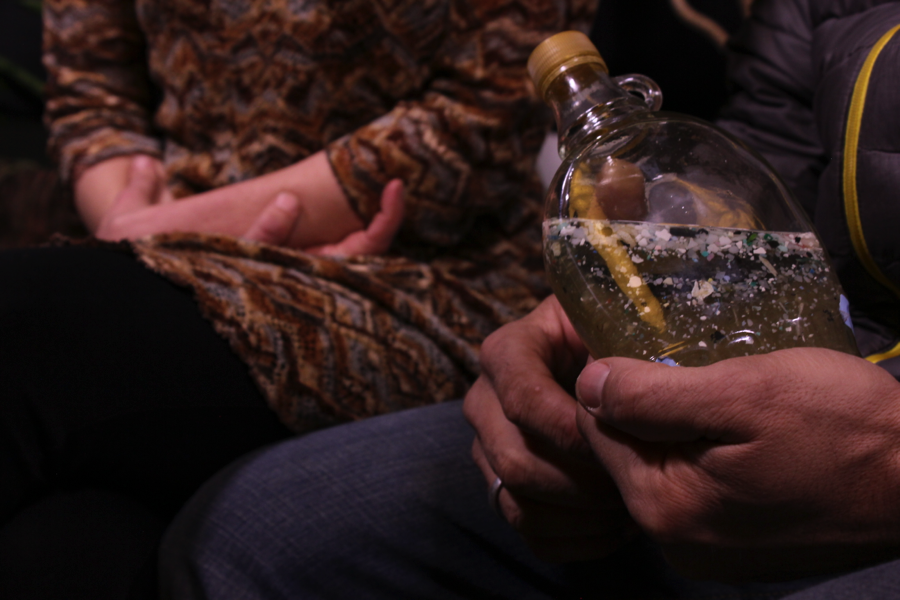
Marcus Eriksen holds a bottle of microplastics skimmed off the ocean surface. Each sample takes hours to collect and contains thousands of tiny plastic particles. [Image credit: JoAnna Klein]

Ranging from the size of a boat to the size of a grain of sand, these pieces of plastic degrade, fragment, sink or collect in ocean currents and travel the world as tiny, toxic particles. “There are no patches of trash sitting in the ocean,” according to Eriksen. “I think its more appropriate to call it a smog, where you get this fine, particulate substance that becomes globally distributed throughout the water column in all dimensions.”

He thinks that California’s experience with airborne smog may be instructive in fighting microplastic pollution. In the 1970’s, some of the early ideas for addressing smog in California focused on sucking it up with vacuums. But soon attention shifted to the source of the emissions, and engineers designed better mufflers and cleaner smokestacks.

Eriksen and Cummins hope that reframing the “garbage patch” as a “plastic smog” will convince people to focus on land-based preventative solutions rather than trying to clean up debris after it’s in the ocean.

With 288 million tons of plastic produced worldwide in 2012, and 4.8 to 12.7 million tons entering the ocean in 2010, trying to remove plastics from the world’s oceans would be like mopping up water from an eternally gushing faucet.

The problem is so vast that Eriksen acknowledges “there is no silver bullet.” But he thinks progress is possible by hitting three targets: individuals, companies and government.

Individuals, he says, can reduce consumption, recycle what they can and clean up plastic before it reaches the ocean. Industries can design marine biodegradable products and encourage the use of glass alternatives with return programs where bottles serve as discount coupons for the consumer’s next purchase.

As for government, pressure from 5 Gyres and other groups has led 18 states to pass or propose legislation limiting the use of microbeads, the granular particles found in some cosmetics and cleaning products.

These tiny plastics are small enough to pass through filters in the water system, flush into waterways and ultimately end up in the bellies of marine animals. Concern over microplastic toxicity and its potential harm throughout the food chain is gaining momentum in research groups and environmental agencies around the world.

The smaller the plastic, the bigger the concern, explained Anna-Marie Cook of the U.S. Environmental Protection Agency. She says the tiny bits act like sponges, sopping up environmental chemicals such as flame retardants and pesticides.

Rochman, the UC-Davis ecologist, says she’s found microplastics in all sorts of marine life. Animals eat them and their tissues absorb the chemicals — in some cases, causing signs of endocrine disruption and behavior problems.

As concern about the problem spreads, 5 Gyres plans to expand its 16-member staff of scientists, educators, writers and artists. “We are growing our reach to be a citizen science hub for plastic pollution activists worldwide,” says Eriksen.

5 Gyres is collaborating with artist Alejandro Duran, who has attracted attention for his plastic installations on the Yucatan coast. Eriksen, also a sculptor, joined Moore at the Atlanta Science Festival on a panel about plastic, art and advocacy this March.

After their daughter Avani (whose name means Earth in Italian) was born in 2012, Eriksen and Cummins have been focusing on educating children. Their most recent expedition culminated in an international youth summit in the Bahamas.

Friday, January 30, 2015

Plastic: It's What's for Dinner

Published in the Huffington Post by Belinda Waymouth January 27, 2015

The day of ecological reckoning looms over us. I am not talking about whether the Keystone XL Pipeline gets rammed through our backyards. I am down the rabbit hole of environmental concern with another problematic petrochemical -- plastic.

We get plastic from oil, and have ingeniously transformed this hydrocarbon polymer into a multitude of plastic things, giving our lives a facade of durable-but-lightweight convenience.

Meantime there's mounting evidence the dark side of plastic is much more than we bargained for, or can cope with.

First off, the wholesale recyclability of plastic is a happy ending environmental types -- such as your author -- want to believe. But in the U.S less than 10 percent of plastic gets recycled. And, even when it is recycled, the amount has become overwhelming. Globally there'll be 45 million tons of plastic scrap looking to be recycled this year.

Most scrapped plastic ends up in China, bound for the Wen'an region. Once a bucolic piece of countryside, Wen'an is now a toxic cesspit, where people are paralyzed by off-the-chart blood pressure problems, after enduring horrendous work conditions in a bid to recycle -- or otherwise dispose of -- all the plastic.

What can't be recycled is burnt, releasing dioxins -- the worst of the worst toxins. Dioxins are carcinogenic, linked to developmental and reproductive impairment, heart disease, diabetes, and in extreme cases of exposure a nasty skin ailment - chloracne.

Next inconvenient truth -- a huge amount of our plastic debris ends up in the ocean. Last months first scientific accounting of total ocean plastic pollution estimates the amount at a mind boggling 5.25 trillion pieces. Plastic only started becoming a household item in the 1950's, so this amount of trashed plastic happened in 60 odd years.

Almost as worrisome, these researchers found 100 times fewer micro-sized plastic particles than expected. Because that's another pesky thing about plastic, it does NOT biodegrade, it photodegrades -- meaning in sunlight plastic simply breaks into smaller and smaller pieces, which are nearly impossible to detect but have huge and brutal consequences as they enter the food chain.

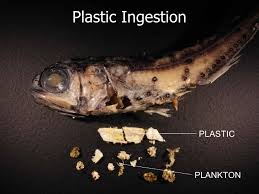
Which brings us to one of the worlds tiniest but most significant fish species: Myctophids, aka Lanternfish, account for over half of the oceans fishy biomass, and are apparently scoffing down plastic like there's no tomorrow.
2015-01-22-images1.jpg
Myctophid with plankton and plastic particles
Iddy biddy fish ingesting miniscule particles of plastic might not sound too awful. Until now these four to five centimeters long, two to five grams fishes were seen as inferior to our other little finned friends - the sardine or anchovy. Myctophids were ground into fodder for industrial fish farms. However the line from plastic-gobbling Myctophids to your next meal is about to get a lot more direct.

Some in the fishing industry see huge potential for this "untouched resource" and are developing methods to convert this plentiful, but low value fish, into a high value-added product. Ungutted Myctophids will be processed into surimi (the Japanese term for mechanically deboned fish mince) with uses ranging from fish products, to meat substitutes, and dessert dishes.

It would seem ecological folly to mess with a fish species that is the very basis of important marine food webs - swordfish, tuna, dolphins and seals eat Myctophids.

Not to mention the risk taken if we ingest plastic -- a possibility that is in the news more and more these days. Last fall scientists discovered there are microplastics in two-dozen German beers and European shellfish lovers ingest 11,000 pieces of plastic a year in their pursuit of gastronomic nirvana.

Apart from how unappetizing eating or drinking plastic sounds, it's all the nasty chemicals in plastic (phthalates - known endocrine disruptors - are used to soften plastic) and that adhere to plastic so eagerly in the marine environment (POPs, DDT and flame retardants) that make it highly toxic.
But now for the good news: with this growing pile of evidence about the pervasiveness of plastic pollution, we can take action.

This is the moment to change our reliance on the not-so-disposable-after-all polymer. If we can move beyond a single-use throw-away mentality, and incentivize the plastics industry to design effective end-game recyclability into their products - the size of the problem will begin to diminish.

Which is precisely what's needed to assist less discerning species cope with our plastic mess.

Captain Charles Moore of Algalita Marine Research and Education, describes himself as the ocean's "voluntary public defender" - The Lorax who speaks for the seas, if you will. He says organisms can't cope with plastic because it's happened too quickly, "people think stupid myctophids to eat plastic, but evolutionarily speaking they have no selection process to avoid to it."
2015-01-20-IMG_9147.JPG
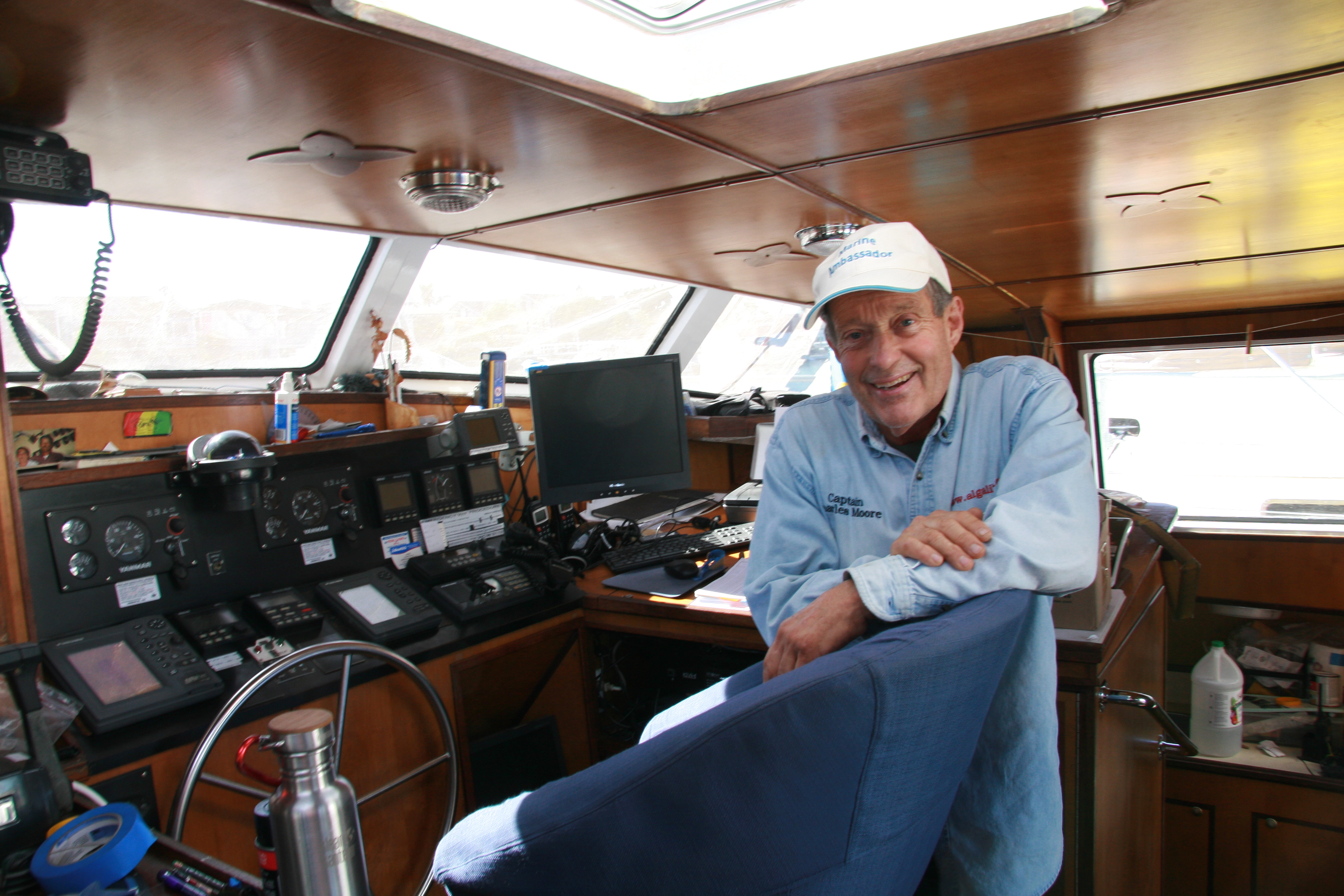
Captain Charles Moore, on board oceanographic research vessel, Alguita, November 2014 
 
Myctophids are Captain Moore's "Humming-Fish" but unlike the fictional Lorax he can't send them away to an ocean without plastic -- that ocean no longer exists.

Crafty little guys, Myctophids, stay low in the water column during daylight avoiding predation, then rise to feed on zooplankton at the ocean surface during the darkest hours of night.

To aid in this diel migration, Myctophids have swim bladders that alter their buoyancy as required. But what will happen to this mechanism in a fish that has a belly full of flotation devices - plastic particles.

If it hasn't been incinerated, every piece of plastic ever produced is still with us. There is no time for any species to biologically adapt to cope with plastic, including us. We have to make an effort to culturally evolve with way less plastic.

Put another way: think long and hard about what you want to be eating and gazing upon in the days to come.
2015-01-21-MM8071_20130321_23622_2048.jpg
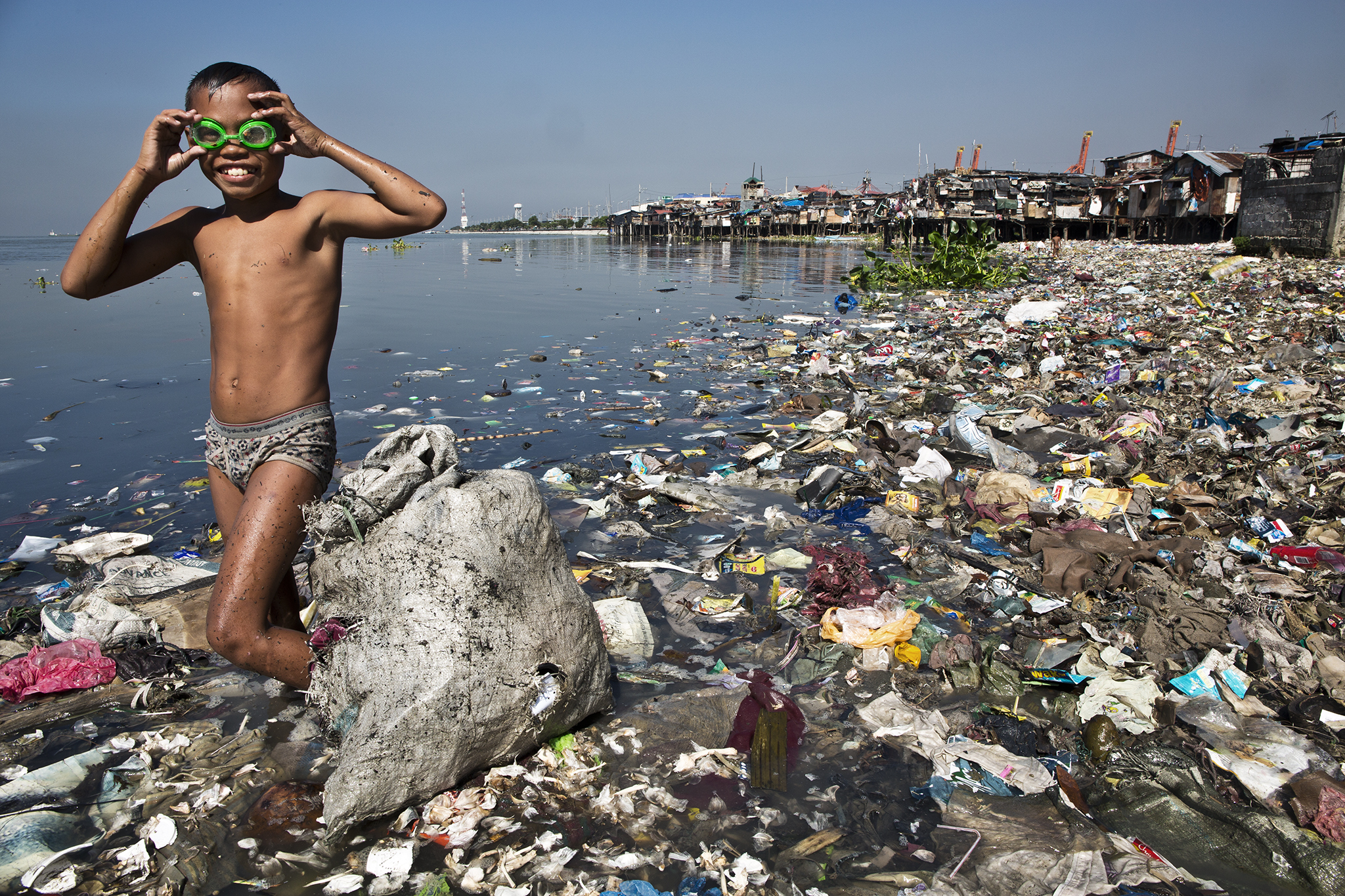
Thirteen-year-old plastic picker in Manilla, 2013

Monday, January 5, 2015

A quarter-million tons of plastic pollution found in oceans


The 5 Gyres Institute compiles six years and 500,000 nautical miles worth of information to provide a global estimate of plastic pollution in the world’s oceans.  


The first global estimate of plastic pollution of both micro- and macroplastic floating in every ocean on earth has led researchers to conclude that the smallest and most insidious particles are present throughout the world’s oceans. The new report, published in the PLOS ONE scientific journal, culminates more than six years and 50,000 nautical miles of pelagic plastics research.

“When The 5 Gyres Institute formed in 2008, we set out to answer a basic question: How much plastic is out there? There was no data from the Southern Hemisphere, Western Pacific, or Eastern Atlantic. After six long years and a wide-reaching collaboration, we have completed the most comprehensive plastic pollution study to date,” says Marcus Eriksen, PhD, Director of Research for the 5 Gyres Institute. “We’ve found microplastic ocean pollution, in varying concentrations, everywhere in the world.”

The report estimates that some 5.25 trillion plastic particles weighing about 269,000 tons are floating in the world’s oceans. Previous reports only looked at one size class and thus reported much lower plastic densities in the world’s oceans.

The new research also demonstrated some unexpected findings, namely a dramatic loss of microplastic from the sea surface in the garbage patches of the five subtropical gyres—large areas of rotating currents where the fragments tend to accumulate. In addition, the survey found a wide distribution of the smallest microplastics in remote regions of the ocean. Though concentrations in the gyres are lower than previously reported, plastics occur nearly everywhere, often far outside of the garbage patches.

Eriksen led a team of nine researchers from six different countries including Capt. Charles Moore, who found the first garbage patch in the North Pacific. The researchers contributed data from 24 expeditions studying plastic floating on the sea surface. Microplastics were collected with nets, while floating macroplastics were counted by systematic observations.

These data were used to populate a model that assumes plastic enters the oceans from rivers, shipping lanes, and densely populated coastlines. The data and model show that large plastics are abundant near coastlines and degrade in the five subtropical gyres into microplastics, the smallest of which are, surprisingly, present in more remote regions such as the subpolar gyres.

The garbage patches should thus be characterized not as repositories or final resting places, but as shredders and redistributors of trash, where sunlight (UV), oxidation, embrittlement, breakage by waves, and fragmentation by grazing fish all degrade large plastic pieces to tiny fragments. These microplastics are then ejected from the garbage patches through various mechanisms such as foraging and filter-feeding by marine organisms, and subsurface currents.

“Our findings show that that the garbage patches in the middle of the five subtropical gyres are not final resting places for floating plastic trash,” Eriksen says. “Unfortunately, the endgame for microplastic is dangerous interaction with entire ocean ecosystems. We should begin to see the garbage patches as shredders, not stagnant repositories.”

The new research categorized plastic into four size classes, from roughly equivalent to a grain of sand, to a grain of rice, to a water bottle, and finally anything larger. Using conservative fragmentation rates, the researchers expected to find more small particles than larger ones.

Surprisingly, their model showed that the smallest fragments are less abundant than the next larger size, but more small particles are found outside of the garbage patches.

“One would expect an exponential increase in the number of plastic particles due to fragmentation,” says Martin Thiel, a co-author on the study. “But this was not the case. Although the two smallest sizes combined accounted for more than 90 percent of the total count, there were more than 100-times fewer of the smallest particles than expected.”

A worldwide distribution of microplastic is more problematic because smaller particles have a greater surface for the absorption of pollutants than larger pieces. Plastics act like sponges, absorbing toxins such as PCBs, DDT and other pesticides, flame retardants, and other persistent organic pollutants found in our oceans. Other research has established that some marine organisms, including seabirds and fish, ingest these toxic plastics and may de-sorb these toxicants.

“The garbage patches could be a frightfully efficient mechanism for corrupting our food chain with toxic microplastics,” says Eriksen.

The 5 Gyres Institute, which uses research to motivate change, contends that companies must take responsibility for the entire life-cycle of the products they create. Working in collaboration with multiple government agencies, NGOs and responsible corporations, the 5 Gyres Institute will continue to support campaigns such as its ongoing effort to replace plastic microbeads in cosmetics and toothpastes with biodegradable alternatives.

“Knowing that plastic pollution becomes hazardous waste in the ocean, it is essential that innovative products and packaging designed for recovery replace the single-use, throwaway culture of the past,” Eriksen says. “It’s time to focus our mitigation strategies upstream from production to disposal. The status quo is not acceptable. Our goal is to vanquish the idea that oceans can bear our waste and to usher in an age of restoration and responsibility.”

Learn more about the project in this video.

Wednesday, September 10, 2014

Has A 20-Year-Old Found A Cheap Way To Clean The Planet's Oceans?

Dutch aerospace student Boyan Slat, 20, has an idea that could conceivably remove millions of tons of toxic trash from the world's waters. It even has a revenue model. But will it work?


Published in WorldCrunch.com by Josephine Pabst Sept. 4, 2014
Article illustrative image  
 Boyan Slat next to a drawing of his Ocean Cleanup project 
 
BERLIN — Twenty-year-old Boyan Slat studies aerospace engineering in the Netherlands, enjoys diving, doesn't bother much with haircuts, and prefers to spend his vacations in Greece. A fairly normal profile for a European student.

But in one crucial respect, Slat differs from thousands of his peers: He has an idea that 100 scientists worldwide find convincing — indeed some of them regard it as groundbreaking — and that could save billions, if it works.

Slat's brainchild aims to rid millions of tons of plastic garbage from the world's oceans. Exactly how much of it there is can only be estimated, and experts have differing views. The figures vary from 100 to 142 million tons. And the amount is constantly growing.

According to the United Nations, some 225 million tons of plastic is produced annually. Of that, 6.4 million tons wind up in the oceans and tend to stay there for decades without decomposing. Instead, they disintegrate into smaller and smaller particles.

Studies have shown that it takes less than a year for ultraviolet light, salt water and mechanical forces to jump-start the disintegration process. The problem is that this process releases toxic chemicals that even in modest quantities can cause severe damage to both ocean life and human beings. And they can end up in humans with astonishing ease — via fish, mussels and other seafood that take in the bits of plastic because they confuse them with plankton or other food.


Birds and garbage on Midway Atoll in the North Pacific Ocean — Forest & Kim Starr

And that's not all: The plastic garbage itself leads to the mass deaths of sea birds, fish and sea mammals. A two-year study conducted by Dutch research group Alterra had researchers performing autopsies on 600 fulmars — gull-like birds — that had washed up on the North Sea coast. They concluded that 90% of them had consumed indigestible trash, on average 44 plastic bits per bird.

The silver bullet?
Of course, Boyan Slat is not the first person to try to solve the problem. But unlike most concepts suggested so far, his has significant advantages. It is far less costly and holds the promise of markedly higher efficiency than the usual methods — for example, sending fishermen out with nets to trawl for trash.

Measures taken up to now in the Asia-Pacific region have cost some 967 million euros annually. "The Ocean Cleanup," as Slat's model is called, would require only two million and would be a good deal more effective.

"The amount of garbage retrieved by such projects is extremely slight compared to the entire amount in the oceans," says marine biologist Lars Gutow, who works for the Alfred Wegener Institute, Helmholtz Centre for Polar and Marine Research in Bremerhaven, Germany. You only have to look at overfished regions in comparison to total ocean size to see that, he adds.

To deal with the problem more efficiently, the oceans' natural dumping grounds need to be researched. These are trash vortexes called ocean gyres in which plastic garbage amass naturally.

Charles Moore, an American marine researcher, was the first person to see the gigantic rotating currents when his ship ended up in the middle of one in 1997 on the way back to California from Hawaii. In the meantime, researchers say there are a total of five such massive vortexes. The largest one runs clockwise between Asia and North America.


The phenomenon is called the "North Pacific Gyre," and the area is more informally known as the Great Pacific garbage patch. This, the largest, is the subject of Slat's focus. Within five years, if his ambitious plan works, it should be history.

The model itself looks like a bird's-eye view of a gigantic V. Its two hose-like arms, each 50 kilometers (31 miles), would lie on the ocean's surface. Every 4 kilometers (2.5 miles), they would be weighted and attached to the ocean floor. Filters would be attached to the hoses that would catch garbage but pose no danger to marine creatures.

There's even a revenue model
The debris would be housed in tower-like containers that would be emptied by ship every 45 days. Then the garbage would be recycled. If the system works, it would be worth good money: A ton of plastic debris sells on average for 50 euros. Recycled, according to estimates from the German Council for Sustainable Development, it would be worth more like 300 to 400 euros. That would mean that cleaning plastic debris from the ocean could create 56.8 billion euros in revenue.

While most of the plastic garbage lies on the top three meters of the ocean, the concept would allow for most of the existing garbage to be collected. The model stocks energy in solar panels. Because no nets would be used, no harm would come to marine wildlife, according to documentation of the project, on which 100 researchers, scientists and engineers have worked.


The ambitious plan is due to be financed through crowdfunding. Slat raised $800,000 for a trial run. He and fellow researchers have already established that the idea works, at least on a small scale.

Overall, marine biologist Lars Gutow sees the project critically. "I’m no engineer," he stresses. "But I believe that a vehicle as big as this one, that spans several hundred meters, is unworkable."

There has never been a project this large that works reliably under conditions that can include storms, meter-high waves and inconceivable forces. If there should be damage, what then? Who would be in a position so far away from land to responsibly manage the system and repair it if necessary?

Gutow also sees other problems. "If half the world now thinks that a construction like this makes it possible to fish all the plastic garbage out of the world's oceans, then there is hardly any incentive for researchers to keep working on making sure no further plastic is produced, and if so, that it doesn't end up in the oceans," he says. "And that would be disastrous."


Thursday, September 4, 2014

Choking the Oceans With Plastic

Published in the New York Times by Charles Moore August 25, 2014


LOS ANGELES — The world is awash in plastic. It’s in our cars and our carpets, we wrap it around the food we eat and virtually every other product we consume; it has become a key lubricant of globalization — but it’s choking our future in ways that most of us are barely aware.

I have just returned with a team of scientists from six weeks at sea conducting research in the Great Pacific Garbage Patch — one of five major garbage patches drifting in the oceans north and south of the Equator at the latitude of our great terrestrial deserts. 

Although it was my 10th voyage to the area, I was utterly shocked to see the enormous increase in the quantity of plastic waste since my last trip in 2009. Plastics of every description, from toothbrushes to tires to unidentifiable fragments too numerous to count floated past our marine research vessel Alguita for hundreds of miles without end. We even came upon a floating island bolstered by dozens of plastic buoys used in oyster aquaculture that had solid areas you could walk on.

Plastics are now one of the most common pollutants of ocean waters worldwide. Pushed by winds, tides and currents, plastic particles form with other debris into large swirling glutinous accumulation zones, known to oceanographers as gyres, which comprise as much as 40 percent of the planet’s ocean surface — roughly 25 percent of the entire earth.

No scientist, environmentalist, entrepreneur, national or international government agency has yet been able to establish a comprehensive way of recycling the plastic trash that covers our land and inevitably blows and washes down to the sea. In a 2010 study of the Los Angeles and San Gabriel Rivers, my colleagues and I estimated that some 2.3 billion pieces of plastic — from polystyrene foam to tiny fragments and pellets — had flowed from Southern California’s urban centers into its coastal waters in just three days of sampling.

The deleterious consequences of humanity’s “plastic footprint” are many, some known and some yet to be discovered. We know that plastics biodegrade exceptionally slowly, breaking into tiny fragments in a centuries-long process. 

We know that plastic debris entangles and slowly kills millions of sea creatures; that hundreds of species mistake plastics for their natural food, ingesting toxicants that cause liver and stomach abnormalities in fish and birds, often choking them to death. We know that one of the main bait fish in the ocean, the lantern fish, eats copious quantities of plastic fragments, threatening their future as a nutritious food source to the tuna, salmon, and other pelagic fish we consume, adding to the increasing amount of synthetic chemicals unknown before 1950 that we now carry in our bodies.

We suspect that more animals are killed by vagrant plastic waste than by even climate change — a hypothesis that needs to be seriously tested. During our most recent voyage, we studied the effects of pollution, taking blood and liver samples from fish as we searched for invasive species and plastic-linked pollutants that cause protein and hormone abnormalities. While we hope our studies will yield important contributions to scientific knowledge, they address but a small part of a broader issue.

The reality is that only by preventing synthetic debris  — most of which is disposable plastic — from getting into the ocean in the first place will a measurable reduction in the ocean’s plastic load be accomplished. Clean-up schemes are legion, but have never been put into practice in the garbage patches.

The National Oceanic and Atmospheric Administration in the United States supports environmentalist groups that remove debris from beaches. But the sieve-like skimmers they use, no matter how technologically sophisticated, will never be able to clean up remote garbage gyres: There’s too much turbulent ocean dispersing and mixing up the mess.

The problem is compounded by the aquaculture industry, which uses enormous amounts of plastic in its floats, nets, lines and tubes. The most common floats and tubes I’ve found in the deep ocean and on Hawaiian beaches come from huge sea-urchin and oyster farms like the one that created the oyster-buoy island we discovered. Those buoys were torn from their moorings by the tsunami that walloped Japan on March 11, 2011. 

But no regulatory remedies exist to deal with tons of plastic equipment lost accidentally and in storms. Government and industry organizations purporting to certify sustainably farmed seafood, despite their dozens of pages of standards, fail to mention gear that is lost and floats away. Governments, which are rightly concerned with depletion of marine food sources, should ensure that plastic from cages, buoys and other equipment used for aquaculture does not escape into the waters.

But, in the end, the real challenge is to combat an economic model that thrives on wasteful products and packaging, and leaves the associated problem of clean-up costs. Changing the way we produce and consume plastics is a challenge greater than reining in our production of carbon dioxide.

Plastics are a nightmare to recycle. They are very hard to clean. They can melt at low temperatures, so impurities are not vaporized. It makes no difference whether a synthetic polymer like polyethylene is derived from petroleum or plants; it is still a persistent pollutant. Biodegradable plastics exist, but manufacturers are quick to point out that marine degradable does not mean “marine disposable.”

Scientists in Britain and the Netherlands have proposed to cut plastic pollution by the institution of a “circular economy.” The basic concept is that products must be designed with end-of-life recovery in mind. They propose a precycling premium to provide incentives to eliminate the possibility that a product will become waste.

In the United States, especially in California, the focus has been on so-called structural controls, such as covering gutters and catch basins with screens. This has reduced the amount of debris flowing down rivers to the sea. Activists around the world are lobbying for bans on the most polluting plastics — the bottles, bags and containers that deliver food and drink. Many have been successful. In California, nearly 100 municipalities have passed ordinances banning throwaway plastic bags and the Senate is considering a statewide ban.

Until we shut off the flow of plastic to the sea, the newest global threat to our Anthropocene age will only get worse.

Charles J. Moore is a captain in the U.S. merchant marine and founder of the Algalita Marine Research and Education Institute in Long Beach, California.

Garbage Patches Make Up As Much As 40 Percent of Ocean Surface

Garbage in water

Charles J. Moore, a captain in the US merchant marines and founder of the Algalita Marine Research and Education Institute, recently returned from a six-week research trip at the Great Pacific Garbage Patch. He wrote in the New York Times that what he saw during his voyage shocked him.

Moore, who has made ten of these trips to the Great Pacific, one of five major garbage patches drifting in ocean waters near the equator, said the increase in the quantity of plastic waste since his last trip in 2009 was “enormous.”

“Plastics of every description,” Moore said, “from toothbrushes to tires to unidentifiable fragments too numerous to count floated past our marine research vessel Alguita for hundreds of miles without end.” He said there was even a floating island of plastic buoys used in oyster aquaculture “that had solid areas you could walk on.”

Plastic is ubiquitous in everyday life. It can be found in some form in nearly every product that we use, and it is now one of the most widely found pollutants of ocean waters worldwide.
“Pushed by winds, tides and currents, plastic particles form with other debris into large swirling glutinous accumulation zones, known to oceanographers as gyres, which comprise as much as 40 percent of the planet’s ocean surface — roughly 25 percent of the entire earth.”
The currently exists no comprehensive way of recycling the plastic garbage that makes its way out to sea, and there is a lot of it.

“In a 2010 study of the Los Angeles and San Gabriel Rivers,” said Moore, “my colleagues and I estimated that some 2.3 billion pieces of plastic — from polystyrene foam to tiny fragments and pellets — had flowed from Southern California’s urban centers into its coastal waters in just three days of sampling.

Moore said that he and his team “suspect that more animals are killed by vagrant plastic waste than by even climate change,” and that “only by preventing synthetic debris … from getting into the ocean in the first place will a measurable reduction in the ocean’s plastic load be accomplished.”
He applauded efforts by environment and conservation workers to clean up debris from beaches, but said that no matter how technologically advanced their “sieve-like skimmers they use” will not be able to clean up the giant garbage gyres.

“The real challenge is to combat an economic model that thrives on wasteful products and packaging, and leaves the associated problem of cleanup costs,” Moore said. “Changing the way we produce and consume plastics is a challenge greater than reining in our production of carbon dioxide.”

Nearly 100 municipalities in California have banned throwaway plastic bags, and a statewide ban is currently under consideration by the state Senate. But Moore concluded by saying that until “we shut off the flow of plastics to the sea, the newest global threat to our Anthropocene age will only get worse.”

Amy is a writer and researcher with Ring of Fire. You can follow her on Twitter @AEddings31.

Friday, April 11, 2014

Plane Search Shows World's Oceans Are Full of Trash

Photo of a plastic bag floating in the sea.
A plastic bag floats underwater at Pulau Bunaken, Indonesia; marine life ingests such debris, with catastrophic consequences. Photograph by Paul Kennedy, Getty Laura Parker

Before Malaysia Airlines Flight 370 went missing, sea trash was not a global headliner.

But as hundreds of objects sighted off the Australian coast as possible aircraft debris turn out to be discarded fishing equipment, cargo container parts, or plastic shopping bags, a new narrative is emerging in the hunt for the missing plane: There's more garbage out there than you think. Most of it is plastic. And marine life ingests it, with catastrophic consequences.

"This is the first time the whole world is watching, and so it's a good time for people to understand that our oceans are garbage dumps," says Kathleen Dohan, a scientist at Earth and Space Research in Seattle, Washington, who maps ocean surface currents. "This is a problem in every ocean basin."

Dohan plotted the movement of debris in a time-lapse video that shows where objects dropped into the ocean will end up in ten years. The objects migrate to regions known as garbage patches. The Pacific and Atlantic Oceans have two patches each, north and south. The Indian Ocean's garbage patch is centered roughly halfway between Africa and Australia.

The term "patch" suggests this floating detritus is packed together in an oceanic version of a landfill. Instead, these "patches" are actually huge zones where debris accumulates but floats free, circulating continuously. So it's possible for sailing ships and other small boats to inadvertently sail into a garbage patch region and encounter rubbish.

Great Pacific Garbage Patch the Largest
That was the case in last summer's Transpacific Yacht Race from Los Angeles, California, to Honolulu, Hawaii, when logs, telephone poles, and other wood debris from the 2011 Japanese earthquake and tsunami drifted into the Texas-size Great Pacific Garbage Patch halfway between Hawaii and California.

"There were a dozen or more reports about collisions, and some of the boats were damaged by this floating wood," says Nikolai Maximenko, an oceanographer at the International Pacific Research Center at the University of Hawaii in Honolulu, who has been studying the earthquake debris' drift across the Pacific.

Maximenko estimates that 100,000 to one million large wood objects, including timber and beams from houses, are still floating in the area.

"There is an analogy between that and the Malaysian plane," he says. "In both cases, we were not able to find anything identifiable on satellite images. We do not have an observation system to track individual objects. This system needs to be built."

Although the formation of the Great Pacific Garbage Patch was predicted in the 1970s by scientists from the Woods Hole Oceanographic Institution in Woods Hole, Massachusetts, it wasn't documented until 1999 by a sailor named Charles Moore, who competed in the Transpacific race.

Plastics Ingested by Birds, Turtles, Whales
About 90 percent of the debris in all five garbage patches is plastic, says Marcus Eriksen, a marine scientist and founder of the 5 Gyres Institute, which works to reduce pollution from disposable plastics. "This is relatively new if you think about plastic. 

Only since the 1950s [have] consumers [used] plastics. Now, a half-century later, we are seeing an abundant accumulation of microplastics from all single-use, throwaway plastics like bags, bottles, bottle caps, kitchen utensils. I have pulled cigarette lighters from hundreds of bird skeletons."

He says sea turtles and California gray whales are also big unintentional consumers of plastic.

"You can see fish bites, so gradually, the plastic breaks into smaller and smaller pieces," says Maximenko. "After it reaches certain sizes, it can be ingested and then it quickly disappears."

The highest concentration of plastics can be found in the North Atlantic garbage patch, which receives most of its content from the United States, Canada, Mexico, and Europe.

Indian Ocean Garbage Patch a Mystery
Because of its remoteness, the Indian Ocean garbage patch remains more of a mystery. It was discovered in 2010 by Eriksen and his crew, who sailed west from Perth, Australia, toward Africa to document it. Eriksen says it comprises a massive area, at least two million square miles (about five million square kilometers) in size, but with no clear boundaries.

"It's very fluid and changes with the season," Eriksen says. "You could drag nets in one spot and come back the next day and it's different."

It also has gaps near Indonesia with very little debris. Maximenko theorizes that much of the marine debris generated by the 2004 Indian Ocean earthquake and tsunami has been salvaged by people living along the Indonesian coastline.

The contents of the garbage patch circulate constantly, riding the current known as the Indian Ocean gyre from the Australian side to the African side, down the African coast and back to Australia, Eriksen says. The full rotation takes about six years, unless the debris gets stuck in the center of the patch, where it could remain indefinitely.

If the Malaysian Boeing 777 crashed into the zone off the west coast of Australia where searchers are now looking, and if some of that debris remains undiscovered, it is already on its journey west toward Madagascar to join the rest of the junk in the Indian Ocean garbage patch, arriving in about a year.

106 comments

Tuesday, April 8, 2014

Search for Missing Malaysian Jet Brings Attention to Trash in the Ocean

Published Wednesday, April 02, 2014 in AllGov.com
 
Plastic debris from the Atlantic Ocean (photo: 5gyres.org via AP)
 
If there’s any good to come from the frustrating search for the missing Malaysian Airlines flight, it’s this: Each time debris spotted in the ocean turns out not to be from the aircraft, it demonstrates to the millions of people following the story that’s there another important one to know about: garbage.

Scientists have been trying for years to draw attention to the growing problem of trash, big and small, floating throughout the world’s oceans. Inadvertently, the search for Flight 370 has brought this environmental issue front and center each time objects spotted west of Australia have had nothing to do with the plane, but everything to do with how mankind has treated the ocean as a dumping ground.

The debris spotted on several occasions are part of a swirling mass, or gyre, in the southern Indian Ocean, one of five such gyres churning on the high seas.

The largest gyre, according to experts, is located between Hawaii and California. It’s about 270,000 square miles in size, making it about as big as Texas.

These gyres contain mostly tiny pieces of plastic, the result of larger items gradually broken down over time by the sun and waves. But there are also larger items—like refrigerators and lost shipping containers—which can be found bobbing along the surface, kept afloat due to the air pockets trapped inside them.

The number of steel shipping containers that fall overboard off of cargo ships each year is staggering: from 700 to 10,000. With them go their contents, be it computers, toys, clothing, appliances and more.

One container released a seemingly endless supply of Legos into the sea, another dumped 2,000 computer monitors, and yet another unloaded thousands of Nike sneakers into the ocean, according to one oceanographer.

Natural disasters also contribute to the garbage problem. The 2011 tsunami that struck Japan swept 10 million tons of debris—including homes, cars and trees—into the Pacific.

“The ocean is like a plastic soup, bulked up with the croutons of these larger items,” Los Angeles captain Charles Moore told the Associated Press. “It’s like a toilet bowl that swirls but doesn’t flush,” added Moore, whose environmental activism has brought attention to the northern Pacific gyre.

Appropriately, perhaps, he has found toilet seats in the ocean, along with light bulbs, fishing paraphernalia, and defrosted orange juice preserved inside a floating fridge.

Denise Hardesty, a research scientist for Australian science agency CSIRO, says the non-biodegradable items will remain in the ocean for centuries.

“It takes 400 or 500 years for lots of types of plastics to completely break down,” Hardesty told the AP. “It just goes into smaller and smaller bits. You even find plastics in plankton — that's how small it gets.”
These small items are dangerous to aquatic life, noted Hardesty.

Two-thirds of the sea birds she has examined had ingested plastic. One bird had swallowed a glow stick that was several inches long, and another bird was found to have consumed 175 plastic pieces.
-Noel Brinkerhoff
To Learn More:
What is the Great Pacific Ocean Garbage Patch? (by Russell McLendon, Mother Nature Network)
Natural and Plastic Flotsam Stranding in the Indian Ocean (by David K.A. Barnes, The Effects of Human Transport on Ecosystems: Cars and Planes, Boats and Trains) (pdf)
Plastic Pollution in the Atlantic Ocean (by David Wallechinsky and Noel Brinkerhoff, AllGov)


Comments

Talia 4 days ago
Why don’t we stop looking at this plastic soup as only an ecological problem, but start looking at this as a huge source of (free) manufacturing materials? Two Lehigh grads are doing this, with their company. Check their story out here. >>> http://www.lehigh.edu/engineering/news/alumni/alum_20131112_sustainability_bureo.html

Thursday, January 9, 2014

July Algalita Expedition Heading for ‘Garbage Patch’

 Published January 7, 2014 in Maui TV News

LONG BEACH, CA – Captain Charles Moore, the man who discovered the swirling vortex of plastic trash widely known as the “Great Pacific Garbage Patch,” will once again sail to one of the most polluted areas of the world-the North Pacific Central Gyre. Moore and the Algalita Marine Research Institute have assembled a highly qualified team of scientists who will live amid the debris for 30 days and study the region beginning in July.  The ultimate goal is to evaluate long-term trends and changes in the Gyre by merging data collected over the past 15 years with new 2014 data.

The persistence and increasing quantity of plastic debris, including new arrivals from the Japanese tsunami, have created artificial habitats in the North Pacific Gyre-essentially building “plastic reefs” where sea creatures have made their homes. How have the marine ecosystems impacted the area since Algalita’s first expedition 15 years ago? What have they done to the various species that live there? How are toxic contaminants from plastic transferred to marine life, and what are the consequences for human health?

Algalita’s researchers will investigate the area to find answers. This voyage will result in new and repeat monitoring data needed to make scientific conclusions about the scope and effects of plastic marine pollution.

Since 1999, Algalita has conducted eight research expeditions and produced the longest running data set for the region. The organization, which has participated in similar expeditions in the North and South Atlantic Gyres, South Pacific Gyre, Indian Ocean Gyre and in Antarctic waters, was the first to develop a standard methodology for sampling and analyzing micro-plastic debris from the ocean.

The expedition will also launch the latest live Ship-2-Shore<http://www.algalita.org/ship2shore/> educational program, which uses satellite communications systems to connect students with researchers at sea.

The Algalita Marine Research Institute is a nonprofit organization committed to solving the plastic pollution crisis in our oceans. In 1997, our founder, Captain Charles Moore discovered an area of plastic debris in the North Pacific Ocean known by many as the ‘Great Pacific Garbage Patch.’ Since then, the Long Beach, CA-based organization has been studying the devastating impact of plastic on our oceans and educating the public. To date, Algalita has collected and analyzed more than 1,114 plastic debris samples from five oceans. The organization reaches thousands of students worldwide every year. For more information, please visit www.algalita.org .

Monday, October 28, 2013

Plastic Ocean - book review

Published October 28th, 2013 by Elizabeth Claire Alberts in the ecologist.org
 
Elizabeth Claire Alberts discovers how a sea captain's chance discovery launched a mission to clear up the
Great Pacific Garbage Patch ...


In 1997, Captain Charles Moore steered his catamaran into the doldrums of the mid-Pacific Ocean, hoping to catch winds further south that would push his boat back to California. While sailing through this stretch of water, Moore made a shocking discovery - the ocean was filled with plastic.

Mainstream media has often referred to this accumulation of plastic as a "floating island" or a "mountain of trash". In Plastic Ocean, Moore sets the record straight, describing it as "plastic soup ... lightly seasoned with plastic flakes, bulked out here and there with ‘dumplings': buoys, net clumps, floats, crates, and other ‘macro debris'".

In his hometown of Alamitos Bay, south of Los Angeles, Moore had founded the Algalita Marine Research Institute in 1994 to help clean up the coastal waters. But he couldn't believe he had found plastic in the middle of the Pacific Ocean. His determination to do something about it shaped his path for the next 15 years.

Plastic Ocean chronicles Moore's journey as he evolves into a citizen-scientist intent on curbing plastic pollution. Shortly after returning to California, Moore organised a research expedition back to the rubbish zone in the Pacific, an area now called the Great Pacific Garbage Patch.

He and his crew trawled for plastic samples, yielding alarming results. Plastic outnumbers life-giving zooplankton by a factor of six to one. Filter feeders appear to ingest more plastic than plankton, suggesting that plastic has the potential to disrupt the entire marine food chain.

While much of his journey takes place in the rough waters of the ocean, Moore embarks on an equally rough ride on land. To obtain the best exposure for his research, he set his sights on publication in a peer-reviewed scientific journal.

With humour and humility, he describes the challenges of navigating his way to scientific acceptance. First he has to learn the ropes of writing a research paper. Then he has to fight for his voice to be heard at scientific conferences, often sponsored by the very corporations responsible for plastic proliferation.

None of these obstacles deters Moore. In fact, they impassion him further. He sails his catamaran back to the mid-Pacific to collect additional samples. He co-authors more research papers. He spreads awareness about plastic pollution in conferences, films and news segments, and on late-night talk shows.

Spliced with Moore's own story is the story of plastic itself. As grandson of a past president of Hancock Oil, Moore speaks with authority about converting oil into different types of plastic. Plastic consumption burgeoned after World War II with the invention of disposable products.

Although Moore acknowledges the many benefits of plastic, he argues that single-use plastics like shopping bags and drink bottles have contributed to the degradation of our natural world. On one voyage, he paints an eerie scene of crisp-looking plastic bags fluttering across the seascape. "We're in the middle of the ocean, surrounded by a sea of plastic shopping bags," he says. "It's as if a tornado tore the roof off a floating shopping mall just beyond the horizon line."

Yet, as Moore illustrates, the problem of plastic pollution is much more than aesthetic. In the chapter Bad Chemistry, he explains how new research shows that plastic acts like a sponge, soaking up other contaminants present in the ocean. Plastic is already toxic in itself, poisoning the filter feeders that ingest it. But as plastic works its way up the oceanic food chain, toxicity escalates.

Plastic Ocean is an incredibly important book, explaining the urgency of the plastic pollution problem. Ocean conservation efforts tend to focus only on issues like overfishing, acidification, and sea-level rise. Yet plastic pollution poses another big threat, and we had better start paying more attention right now.

While the hard-hitting facts in this book can feel a little depressing, Moore provides plenty of hope in possible solutions. For instance, he endorses "chemical recycling", a process that cracks plastic polymer back to its monomers for reuse. (However, he notes that this process is "not perfect by closed-loop standards".)

He also advocates marine-biodegradable plastic that aquatic bacteria can break down. The most effective path to change, Moore suggests, is a consumer groundswell against plastics: "In my decade and a half in the trenches," he writes, "I've seen tremendous growth in awareness."

Plastic Ocean will generate and increase this awareness about plastic pollution. I certainly feel different about plastic - and about the changes I could make to help save the oceans.

Elizabeth Claire Alberts is a writer and environmental activist based in Australia. www.elizabethclairealberts.com

For more information and to purchase the book visit here:

http://www.plasticoceanthebook.com/plasticoceanthebook.html


Monday, July 29, 2013

Stephanie Carrow: In the waters of Trash Creek

Published in CT Post, Friday, July 19, 2013 by Stephanie Carrow
0
 
Summer is a time of abundance, and most of it -- the blossoms, sunshine and songbirds -- we welcome appreciatively. But it's also the time for a proliferation of another sort -- that of plastic garbage in our waters. This plastic endangers marine wildlife and human health, both locally and as it makes its way out to sea. 
 
I've been paddling the lower Connecticut coastline for 16 years, and every day in the season that I go out on my kayak, I come back in a mini garbage scow.

After every trip, the back well of my sit-on-top holds a variety of balloons (latex and Mylar), shopping bags, food wrappers, Styrofoam cups, plastic bottles, bottle caps, lighters, beer cans, yards of monofilament line with floaters and hooks, and empty No. 2 bottles for cleansers, motor oil and other toxic fluids. I've also picked up basketballs, soccer balls, beach balls, a good pair of men's sneakers, two-gallon buckets, a bright pink Croc shoe, and countless neon green tennis balls, apparently used in forfeited games of fetch with dogs. And I'm retrieving only a small part of what's out there.

While I've observed -- and picked up -- plastic refuse throughout my kayaking excursions, I'm sad to note that Ash Creek, between Fairfield and Bridgeport, has by far the highest concentration of garbage I've seen in waters along the coast -- so much so, that on my first or second paddling trip there, I dubbed it "Trash Creek."

It's a shame, too, because Ash Creek is also a place of sublime summer beauty: I don't think I've seen more of a range of shorebird species in one discrete patch of this coastline as I've seen while paddling Ash Creek. But the herons, egrets, osprey, cormorants, belted kingfishers and others there must wade and fish amidst garbage.

Knowing the damage that plastic refuse can do to marine life, I can't in good conscience pass it by -- I feel compelled to pick it up. I think of sea turtles choking on plastic bags and balloons they mistake for jellyfish, and of albatross chicks dying with bellies full of bottle caps and other plastic debris mistaken by their parents for lookalike zooplankton. I imagine all this local refuse drifting seaward and choking marine animals; or adding to the toxic Atlantic Garbage Patch, cousin to the now infamous Great Pacific Garbage Patch.

But this plastic does its damage even here in local waters. I myself came upon a lifeless cormorant who, tangled in snagged plastic fishing line, had drowned just inches below the water's surface. I met a man who'd saved an osprey from a similar fate -- both birds dive for their fish. And I met a couple who similarly saved a horseshoe crab -- not a cuddly animal, but vital to the ecosystem and even to human health (its blood is used in pharmaceuticals).

A reading of the book Plastic Ocean, by Capt. Charles Moore (with Cassandra Phillips), provides an even more vivid picture of the magnitude of the problem, some of which begins in coastal waters. Capt. Moore is credited with having discovered the Great Pacific Garbage Patch -- which he describes as actually a soup of microplastic fragments and whole objects that swirl in two vast gyres in the remote North Pacific Ocean.

The fragments occur when plastics, which never biodegrade, become brittle and break into pieces that mix with and mimic plankton, the oceans' food base. These fragments are accumulating in the oceans in such tonnage that they have been found to outweigh plankton by a ratio of six to one -- or greater in some places.

Since his discovery in 1997, Moore and others have engaged in rigorous scientific samplings of the plastic soup and its multiple consequences, among them: well over 140,000 marine animals -- birds, sea turtles, whales, dolphins, otters and seals -- die each year from plastics ingestion, entanglement or strangulation. Much of the plastics involved are bottle caps, shopping bags, balloons and fishing lines -- among the very items we can find in abundance along our shoreline and floating in our local waters.

The largest animal ever to roam the earth, the blue whale, lives solely on tiny plankton -- meaning that it is now ingesting large quantities of plastic with every giant gulp.

Another consequence is to our own health, since the toxic microplastics are also eaten by the fish that we consume. Plastics leech toxins into our waters, and they also attract other pollutants such as PCBs and pesticides -- which means that anything consuming plastics becomes contaminated. It's been determined that our favorite food fish -- including tuna and salmon -- consume plastic, or eat the fish that eat the plastic.

It doesn't require a kayak trip to see our contribution to the problem. On any given day in this season, many of our beaches are strewn with plastic, ready to be washed out into the Sound and the sea beyond in the next high tide.

A stroll by the shoreline could fill multiple garbage bags with plastic bottles, bags, cups and utensils, food wrappers, straws, cigarette butts (also plastic), lighters, a plethora of bottle caps, and the occasional tampon applicator or condom. There are also perfectly usable plastic beach toys -- pails, shovels, sand molds -- and shoes left for the tide to take them.

It's as though they were easily disposable, and they are: the cheapness of plastic has made them so. We live in a throwaway culture; but in the process, we might be throwing away the very health of our waters that makes coastline living so appealing.

The solutions to the problem are multilateral -- and a few beach cleanups per season aren't enough to tackle this scourge. Along with Moore's book (a lively, compelling and absorbing summer read), the website 5gyres.org provides clear steps we all can take to stem the plastic tide. Moore's website, algalita.org, also provides further information on the problem and solutions. We can begin by steering clear of single-use, disposable plastics; and by recognizing that everything we leave behind has a consequence.

It's a conundrum that our most disposable products are made from the least destructible, longest-lasting material.

For my part, I will continue to pick up garbage as I walk the shoreline or paddle the waters, with this vision in mind: My most astonishing sighting in Ash Creek was of an American white pelican, on the day after Hurricane Irene.

 Unheard of in this part of the world, it had been blown perhaps a thousand miles north of its home, as had dozens of other non-indigenous species, according to local birding groups. That dazzling survivor embodied for me the essence of Ash Creek, and our Sound beyond, as a haven of beauty and wonder -- not a careless dumping ground. Our efforts together as a coastal community can, for all our sakes, set things right again.

Stephanie Carrow, of Fairfield, is a writer, psychotherapist and avid kayaker, and has been published in Fairfield Magazine and other local publications.

California coastline hosts ‘Great Pacific Garbage Patch’

Millions of pieces of trash are floating in the world’s oceans and fundamentally changing the makeup of Earth’s food chain.

Tons of plastic have accumulated in an area between Hawaii and California, and the convergence of currents swirls the trash into what is now known as the Great Pacific Garbage Patch.

Bottle caps, trash bags and broken plastic are now part of the diet of many birds and sea creatures around the world.

“It’s very depressing, initially, to realize the extent of the problem,” said Captain Charles Moore, founder of Alagalita Marine Research Institute.

One of the largest concentrations of marine debris is in the Pacific Ocean, halfway between Hawaii and California. It’s called the Great Pacific Garbage Patch.

Moore accidentally found the garbage patch in 1997 while sailing through a gyre, where ocean currents circulate and accumulate trash.

“It’s a piece here, a piece there. It’s not a solid island. In general what we see is a soup of plastic. Not really an island of plastic,” said Moore.

Next year, Captain Moore is planning to spend a month at the Garbage Patch to research its effects on the food chain.

It is difficult to see the collection of trash from above because it’s made up of pieces of plastic the size of a finger nail. Researchers believe that there could be 2 million of these little pieces of plastic per square mile.

“Millions of creatures are dying every year, tangled in plastic,” said Moore.

“It’s not just the wildlife that is being fooled into eating this stuff and getting tangled in it, it’s we ourselves that are changing our biological being with these chemicals in this hyper-consumptive world that we live in,” Moore added.

Scientists at the Scripps Institution of Oceanography in San Diego have also been trying to figure out how the marine debris is changing the world. A Scripps study estimated that fish in the intermediate ocean depths of the North Pacific Ocean ingest plastic at a rate of roughly 12,000 to 24,000 tons per year.

Cleaning up the mess that’s already been made is likely impossible, but experts believe the problem could potentially be saved with a radical change in economic and social culture.

“When you hear politicians talk about growth, you would think it’s one of the 10 Commandments,” said Moore.

“Our very being is consumers of products. This defines us these days. The type of car we have, the type of shoes we wear. The type of hair gel we do. The band of clothing we have. This is how we get our identity,” Moore added.

Moore argues that consumption habits and our creature comforts have led to an earth shattering problem: where to put all of the trash we generate.

“We have to really redefine ourselves as human beings, as something other than a consumer in order to beat this problem,” said Moore.

New shorelines created of trash are appearing in all oceans, and even in America’s Great Lakes.
As world economies continue to thrive on mass consumption, Captain Moore will continue to sail and study the plastic oceans.

Thursday, January 10, 2013

Trash Islands

By Michelle Simon - 15 Dec 2012 posted in earthtimes.org

Trash Islands
Oceanic Conveyor Belt; Credit: UNEP
 
Think island, think nature, think ocean, think tranquillity and think pristine. Natural islands have always been escape destinations from the concrete jungle chaos and pollution. Now think again, think unnatural islands, think strewn litter over the ocean, which eventually accumulate as floating marine trash. Who would have thought we could create whole human-made waste catastrophes in the far-off ocean? Plastic discarded in America may be carried for many kilometres over the oceans.

Oceanic Conveyor Belt
Like our atmospheric currents, our oceans function as conveyor belts. The conveyor belt work done by the oceans regulates our climatic control. This role has been diminished by human-induced climate change, this affects human, marine and land life-forms. Adding trash conveyance to the equation, with extensive garbage being recklessly disposed of, we are suffocating the oceans and inhibiting their role on the planet.

Trash Conveyance
The ocean currents move in certain patterns across the globe. Five grand oceans, the Atlantic, Pacific, Indian, Southern and Arctic, they keep the planet cool yet warm enough for our existence and move with strength in an eight-shaped pattern, mixing, blending and moving things along. Atmospheric convection (unequal solar heating causing horizontal and vertical flows) and the earth's rotation are the major forces working on ocean movement producing belts of wind that dominant the planet. Two main wind-forms over the ocean are the trade winds and westerly winds. The friction caused over the ocean surface results in ocean currents.

Coriolis Effect

Source: geography.com
 
The Earth's rotation (Coriolis Effect) and the presence of scattered continental landmasses, create a secondary wind-induced surface movement, the Gyre Currents. There are five main Gyres working either westward, eastward, poleward or equatorwards.

Gyres

Source: geography.com
 
Gyres may be seen as the secondary current force but they substantial impacts over coastal temperatures, currents and wind storms. In addition, gyres result in the slow movement of water allowing the trash to collect. The points of convergence are where the deposition of trash occurs and eventually build up to form floating trash islands.

Floating Waste Dumps
An area of concentration for waste over the ocean has been the 'Great Pacific Garbage Patch' located between California and Hawaii. This patch arises from the North Pacific Gyre. There other trash collection zones such as the Sargasso Sea waste hotspot (in the Atlantic Ocean), the Western Pacific Garbage Patch (off Japan's coastline) and the Indian Ocean Garbage Patch (only discovered in 2010).

7 billion throw-away humans
We stand at a growing global population of 7 billion. Not only have we overpopulated, but we have created a global society of waste generators, unnecessary tonnage of fossil-fuel created plastic is demanded in almost every product in our daily life, then we cast them aside instead of reusing and recycling. Landfill sites are out of capacity, land space for toxic dumps destroy wild-lands, vast quantities of domestic garbage are disposed of along rivers, eventually finding their way to the oceans and the obvious direct illegal disposals from sea vessels.

Plastic Flotsam
Captain Charles Moore heading up a team of oceanic researchers discovered that 90% of the floatsam in the Great Pacific Garbage Patch is plastic. Plastic is a generic term referring to a range of human-made petrochemical products. Plastic refers to bottled water containers, caps on sodas drinks, plastic bags, bin-bags, take out containers, etc. Plastics in general take a long time to degrade and therefore are burden, but over land they degrade faster as opposed to in the ocean due to temperature and algal growth on the plastic shielding solar rays. However, plastics never fully degrade, they only become smaller microplastics.

Threats to Marine Life
Plastic and other human generated solid waste are not only pollutants based on their chemical composition but they are physical hazards to wildlife. These hazards become evident when either ingested (choking hazard) or physically debilitating a bird's movement. The consumed pollutant also breaks down releasing toxic PCBs into the sea animal's body. In addition to plastic, fish nets also trap marine life. Marine animals become entangled in the nets and this can lead to injury, starvation and death. Marine life-forms also suffer from life-long disabilities from ocean garbage, namely, plastic bands fitting over baby marine turtles that cause huge physiological deformity as the animal grows (see image below).

 plastic bands fitting over baby marine turtles

Source: Conservation Report, 2009
 
If we change our wasteful consumption, unnecessary production of new plastic products, dumping waste, we may save innumerable lives, they may not all be human, but we are responsible for them and all things living on the planet.