A blog set out to explore, archive & relate plastic pollution happening world-wide, while learning about on-going efforts and solutions to help break free of our addiction to single-use plastics & sharing this awareness with a community of clean water lovers everywhere!
Showing posts with label 5 Gyres. Show all posts

Monday, July 4, 2016

5 Frequently Asked Questions about Plastic Pollution


FAQs from Recent 5 Gyres Webinar
June 15, 2016 -for better reading quality, go directly to the 5 Gyres blog.


On June 2nd 5 Gyres held our most recent Webinar. Founders Anna Cummins and Marcus Eriksen spoke about plastic pollution in our oceans and focused on the latest research and policy on the issue, the importance of having a circular economy, and how community is essential to this problem as they have the power to demand change. The Webinar ended with a 15-minute Q/A session where audience members asked some very thoughtful questions and received passionate and insightful answers.

Unfortunately, we weren’t able to address all of the questions, so Marcus has answered a few below that seem to be popular questions that we hope will clarify some doubts you might have.

WHY IS PLASTIC SO CHEAP? IS IT BECAUSE OIL COMPANIES ARE SUBSIDIZED?

Plastic is coupled with the price of oil, so it fluctuates equally. Right now, recycled plastic is too expensive, so virgin plastic is what's dominating the market. So, as suggested, subsidizing oil doesn't help recycling efforts.

CALIFORNIA WAS THE FIRST STATE TO PASS A LAW THAT BANS SINGLE-USE PLASTIC BAGS…BUT THE PLASTICS INDUSTRY AND BAG MANUFACTURERS HAVE COLLECTED ENOUGH SIGNATURES TO PUT THE BAN TO A REFERENDUM IN NOVEMBER 2016. HOW CAN WE EFFECTIVELY FIGHT THIS? 

Good question. It takes constant pressure over time, and alignment of organizations toward a common goal. That's how we won on microbeads. The bag ban took 10 years to win, and industry hired outside signature gatherers to make it a referendum. You can join Californians Against Waste, Surfrider Foundation, and other NGO's to fight the referendum in CA and get the word out.

HOW MANY TIMES CAN PLASTICS BE RECYCLED AS A TECHNICAL INGREDIENT IN THE CIRCULAR ECONOMY? IS IT POSSIBLE FOR IT TO BE CONTINUALLY RECYCLED?

From what I know, the polymer gets continually degraded over time, so you don't typically see products with 100% PRC (Post-consumer recycled content). So, technically you can't reused the same plastic material perpetually, as you can with Aluminum, which is a single element (Al). Plastic is made of 100 or 1000's of molecular bonds, and they don't last forever.

WHAT IS THE ORGANIZATION'S POSITION IS ON BIOPLASTICS, ESPECIALLY WHEN CONSIDERING THEIR LIFECYCLE IMPACTS? IS THERE SUFFICIENT EVIDENCE TO SUPPORT OR CERTIFY THEM AS "MARINE DEGRADABLE?"

It depends on the polymer. Here's something I wrote recently on bioplastic:

Bioplastic has been around a while. Henry Ford produced the first soybean car in the 1930s, with bioplastic fenders and door panels made from soy-based phenolic resin. He demonstrated its resilience by bashing it with a sledgehammer without a dent. Petroleum plastics were cheaper and better performing and eventually edged bioplastic out.

But today, with the inconsistency of the fossil fuel market, companies like Proctor & Gamble, CocaCola and PepsiCo have explored plant-based plastics as a means to create a more reliable and consistently valued resource. In September 2015 the Brazilian company Braskem began production of polyethylene, the exact same chemical structure as polyethylene made from fossil fuels, but derived entirely from sugar cane fiber, called ‘bagasse’..

Poly-lactic Acid (PLA) is another common plant-based polymer, the one you see advertised as ‘corn cups’ or utensils called ‘spud ware’. Or Poly-hydroxy-alkanoate (PHA), made from the off-gassing of bacteria. Soy, bagasse, PLA or PHA, are all very different and create confusion, sometimes intentionally, over their actual biodegradability. PLA needs a large industrial composting facility that’s hot, wet, and full of compost-eating microbes. If you put a bunch of paper plates, napkins and PLA utensils in your backyard compost for a year, you’ll end up with rich soil and a bunch of forks and knives. On the JUNKraft we filled a nylon mesh laundry bag with 20 different PLA products. The result after the voyage was a laundry bag filled with unscathed products. PHA is the only marine degradable bioplastic, with ASTM standards that describe a 30% loss of material in the ocean in 6 months, but only in warm tropic waters, not higher latitudes or deeper waters.

There’s plenty of confusion and green-washing in advertising the value of bioplastic. While the label “biodegradable” has a relatively strict definition called ASTM standards, and strict guidelines for usage in advertising, the terms bioplastic, plant-based, bio-based do not. Bioplastic is the loosely-defined catch-all phrase that describes plastic from recent biological materials, which includes true biodegradable materials and non-biodegradable polymers that are plant-based. These definitions leave a lot of room for advertisers to manipulate public perception.

When CocaCola unveiled the PET PlantBottle a week before the 2009 Sustainability Summit in Copenhagen (COP15), with green leaves and circular arrows on labels, many NGOs and government agencies, like the Danish Consumer Ombudsman, took CocaCola to court for greenwashing, resulting in label modifications. Despite all of the leafy greenery, it’s the same PET bottle you’ll find floating across the ocean, despite being “plant-based”. The saving grace is the withdrawal from fossil fuels, but otherwise the same bottle.

WHAT DO YOU DO WITH PEOPLE FROM YOUR OWN SOCIAL CIRCLE WHO ARE DEEPLY INGRAINED INTO THE DISPOSABLE CULTURE, BUT ARE UNINTERESTED OR UNWILLING TO CHANGE THEIR BEHAVIOR?

Keep pushing. Continuous pressure over time. We love the people in our social circle, so we keep sharing our values. I have family that still haven't kicked the plastic habit. I just keep pushing without compromising my values.

BUT, if they are jerks about it and want to criticize your choices, then you have to decide for yourself if you're compatible. It's like any other relationship, i suppose. Breaking up is hard to do.

WE HOPE THESE RESPONSES WERE HELPFUL. IF YOU HAVE ANY MORE QUESTIONS, FEEL FREE TO CONTACT US AT INFO@5GYRES.ORG. IF YOU WANT TO JOIN OUR NEXT WEBINAR, PLEASE SIGN FOR OUR UPDATES ON OUR WEBSITE.

Monday, December 21, 2015

World’s Most Comprehensive Study Shows More Plastic in Our Oceans Than Scientists Thought

Published in Eco Watch by Marcus Eriksen - Dec. 15, 2015

The 5 Gyres Institute co-authored this study which is the most comprehensive estimate of small plastics in the world’s oceans. There were two other papers published earlier, one by Cozar (2014) and Eriksen (2014) using separate data sets.

The paper published last week in Environmental Research Letters, A Global Inventory of Small Floating Plastic Debris, uses three ocean models and every dataset published since the 1970s. With 10 authors contributing to it, it’s the best so far. This new study suggests there are 15 to 51 trillion microplastic particles in the world’s oceans, weighing somewhere between 93 and 236,000 metric tons. This is roughly seven times more than what we thought before.
Figure3
Photo credit: 5 Gyres
Why is it more? It has more data and more recent data. It combines the efforts of three different ocean models, so the resolution is a lot better. There’s also a lot more plastic in the ocean. Consider that in 2013 the plastics industry reported 300 million metric tons of new plastic produced in that year and a lot of it used for single-use throw away products sent to countries that have poor waste management. That combo is a recipe for trashed seas.

What is the end game for all of the plastic out there? Research shows that if we can turn off the tap, most of it will sink or wash ashore. The ocean is very dynamic and turbulent, constantly throwing things out, tearing it apart and sinking it. Humanity will have to live with this geologic layer on the ocean floor and beaches worldwide. Call it the Plasticene. Plastic is the index fossil that marks in geologic time that humans were here.

What can we do about it? We’ve got to turn off the tap using two big ideas.
1. Waste management around the world must improve and that means getting away from burning and burying our waste. Diverging waste to responsible management schemes, like compost facilities and recovery and recycling, must improve.

2. Product design is a mandatory part of the solution. The single use throwaway product concept is trashing our oceans. No waste management scheme is going to effectively clean up the proliferation of poorly designed products and packaging, like plastic bags, plastic straws, microbeads, water bottles, etc. Go to our microbeads campaign to see how we’re holding companies accountable for putting millions of microplastic fragments in your facial cleansers and toothpastes.

These two solutions—waste management and product design—must happen simultaneously. We cannot expect countries to take out huge loans to pay to improve their waste management. It would be grossly unfair to create that economic burden, while the poorly designed products and packaging continue to trash our land and sea. We need the plastics industries that make and manufacture single-use throw away products to step up and design for a better future.

The Ocean Is Contaminated by Trillions More Pieces of Plastic Than Thought

Published in Take Part by Taylor Hill - Dec. 15, 2015
New research shows that the plastic problem is growing, but the full impact on marine life remains unknown.

(Photo: Rosemary Calvert/Getty Images)
Somewhere between 15 trillion and 51 trillions pieces of plastic litters the world’s oceans, a new study has found. That’s three to 10 times more plastic than scientists had previously estimated.

The study, led by climate scientist Erik van Sebille at London’s Imperial College and coauthored by researchers at nonprofit group 5 Gyres, built on the findings of two papers published last year. The scientists tapped every data set on plastic pollution published since the 1970s and ran the numbers through three computer models
The total weight of small plastic pieces that accumulated in 2014 alone is estimated to be between 93,000 and 236,000 metric tons, “which is only approximately one percent of global plastic waste estimated to enter the ocean” annually, the researchers wrote.

The study only focused on microplastics (those less than 200 millimeters in size) that could be captured by trawling nets pulled along the ocean surface. Thus the researchers’ estimates do not count plastic waste that ends up sinking to the ocean floor or is ingested by fish and other marine species.

Each American throws away as much as 185 pounds of plastic a year. In the last decade, the total weight of plastic products entering the market has risen from 225 million tons in 2004 to 311 million tons in 2014, according to industry group association Plastics Europe.


“These estimates are larger than previous global estimates, but vary widely because the scarcity of data in most of the world ocean,” the researchers wrote. Studies estimate that large amounts of plastic go undetected because they sink to the ocean floor or are eaten by fish.

In one study, deep-sea fish in the North Pacific gyre were estimated to have ingested between 12,000 and 24,000 metric tons of microplastics annually.

According to the new study, the wide range in the estimated amount of plastic entering the world’s oceans every year “reveals a fundamental gap in understanding.”

But the data available shows that the North Pacific Ocean, often referred to as the “Great Pacific Garbage Patch,” has the highest density of plastic thanks in part to the region’s circular ocean currents and wind patterns.


Monday, August 17, 2015

After Sailing 3,000 Miles … It’s Official Microplastics Are Everywhere

 Published in EcoWatch by
 
The 5 Gyres Institute sailed 3,000 miles in June—from Miami to the Bahamas to Bermuda and ending in New York City—sampling the sea surface along the entire voyage for plastic pollution. Sadly, our research once again demonstrates how prolific and widespread plastic is in our oceans. We found microplastics, pieces smaller than a grain of rice, dominating each of the 38 samples taken during the three week-expedition through the North Atlantic Subtropical Gyre, a series of clockwise rotating currents between the U.S. and Europe.

What we found in our samples, confirms our understanding that plastics quickly shred in the open sea due to UV sunlight. We have dubbed this abundance of fragments, which are being consumed by sea life as well as slowly settling to the seafloor, as plastic smog. This plastic smog that overwhelmingly pollutes our oceans has gone global, emanating from our densely populated coastlines.
mystic650
Consider the smog that hovers in the air above our major cities. It is composed of fine particles of carbon swirled by atmospheric currents and sometimes adrift for hundreds of miles before settling to the ground. The plastic smog in our oceans is a particulate of hydrocarbons swirled by ocean currents and drifting for thousands of miles before possibly settling to the seafloor. If you can imagine a plastic smog in our oceans, then you can imagine our cities are the horizontal smokestacks pumping plastic into the ocean.

On June 23, the 5-Gyres’ ship the Mystic, a 172 foot three-masted schooner, sailed into the New York Harbor. Our surface nets dragged up and down the Hudson River and the bay, and we were shocked by what we found.

Our last sample collected south of Manhattan was the most polluted of them all, with nearly 500 bits of plastic filling our tiny net in just one hour. New York City is pumping millions of particles of plastic into the Atlantic Ocean every day. The objects found included cigar tips, tampon applicators, condoms, straws, fragments of plastic bags, preproduction plastic pellets and hundreds of unidentifiable plastic fragments. New York City is feeding the plastic smog.
5gyres2
A small sampling of plastic found while dragging
5gyres3
The situation may seem hopeless, but there is tremendous ambition in the resilience of environmental organizations throughout the state of New York that are working to reduce plastic waste entering New York waterways. More than 40 organizations from every corner of the state are working together to stem the tide of plastic into New York’s waters.

This coalition worked tirelessly throughout the 2015 New York state legislative session to pass a ban on plastic microbeads in personal care products. Tiny plastic microbeads in products such as facial scrubs and toothpastes (yes, some toothpastes leave plastic particles between your teeth and in our gums) are designed to be washed down the drain, where they often escape sewage treatment and pollute our waters.

While the bill passed the Assembly and enjoyed overwhelming support in the Senate, it fell victim to Albany dysfunction, and did not pass into law this year. Fortunately, our neighbors in Connecticut successfully passed a ban on microbeads this year and we are poised to win the fight in New York next year.

Therefore, it is essential that residents of New York remain vigilant and aware of our plastic consumption. The reduction of plastic bags, foamed polystyrene and microbeads in personal care products will collectively have a meaningful and positive effect on the quality of the waters surrounding New York and beyond.

Individual, voluntary efforts are a great start. However, legislation is undeniably needed to solve our plastic problem once and for all. All of us, including the industries that make plastic products, are responsible for the problem, and through smart and fair legislation we can be the solution.
Signed,

Marcus Eriksen, Ph.D. director of research at The 5 Gyres Institute; Sandra Meola, communications and outreach at NY/NJ Baykeeper; Brian Smith, associate executive director at Citizens Campaign for the Environment; Sherri A. Mason, Ph.D. professor of chemistry. at SUNY Fredonia; Reece Paecheo at Surfrider, New York City; and David T. Conover, education director at Hudson River Sloop Clearwater, Inc.

How much plastic is in our oceans? Ask the woman trying to clean it up


When Carolynn Box left for her first 5 Gyres research expedition in 2011, it was Christmas Eve. She talked her way onto the organization’s trip, and had been peppering the ship’s captain with safety questions for weeks. She traveled with a friend from San Francisco to Namibia to meet up with the 5 Gyres boat, which was set to comb the vast South Atlantic Ocean gyre for plastic waste. She was abuzz with nervousness.
“I’m not a professional sailor … I was scared of sinking, or things going wrong during a really big storm. I didn’t want to die,” says Box. 

“My first trip was 33 days. We had a problem with our engine. The engine broke a thousand miles from anywhere. It was crazy. … So then we had to sail home. I remember my captain, Clyde, said ‘Well, this is a sailboat. We’re going to sail to Uruguay.’ And that’s what we did. It took a lot longer than we expected because we had to wait for wind. So that was startling,” Box says.
Carolynn Box
Carolynn Box
Sergio Izquierdo
5 Gyres is a nonprofit that organizes plastic pollution research expeditions at sea. In addition to trawling for plastic garbage, 5 Gyres and their volunteers have restored beaches through international citizen science programs and developed laws banning plastic microbeads from cosmetics.

Unfortunately, there’s no shortage of source material: In 2010 alone, an estimated 10.5 billion to 28 billion pounds of plastic waste entered the oceans. When Box returned from the 5 Gyres trip, she went back to her coastal management job in California, but the weight of all that plastic junk wore heavily on her mind.
In 2012, Box joined 5 Gyres as the org’s environment and education programs director. (The nonprofit’s name refers to ocean gyres, in which currents swirl together with the help of wind. These water systems notoriously attract tons of marine trash.)

Today, Box helps train expedition volunteers and supports a new wave of first-time sailors. We talked to Box about what she’s learned from life on the deck of 5 Gyres’ research vessels. Here’s an edited and condensed version of what she had to say:

Q. How do you prepare newbies for being out on the ocean?

A. Most of the people that come with us are very well prepped for the experience. If they’ve never sailed, some have tried out sailing just to get a sense of it. But I don’t think you can prepare yourself for being so remote.

Most people can handle it. We’ve had people get scared, but you just talk them through. Most people don’t show that they’re scared. The [first couple days] can be very rough because people get really seasick.

Q. Are people seeking out these expeditions? Why do they want to do it?

A. On all of our expeditions, we’ve had students, activists, surfers, sailors, partnering scientists with their own projects, artists, musicians, and other nonprofit partners.

I think many people who work in the field of plastic pollution are looking to have first-hand knowledge. You can really speak to the issue stronger when you can say, “I’ve been out there. I’ve seen this firsthand.”
What’s so great getting people from different communities [is that] you reach more people.

Q. You’re basically a seasoned sailor at this point. How do you prepare for these long expeditions? 

A. On this last expedition, I was made fun of because I had been exercising quite a bit beforehand. Many of the people [running] the boat are used to being sailors, they have a lot of strength. When I’m on the boat, I want to be as strong as I can be and I want to pull my weight. I don’t like to sit back and just let the guys do it.

Q. Some of your trips can last for more than three weeks. What’s it like, being on the water for that long?

A. You know that feeling you get when you watch the sunset? It’s almost overwhelmingly beautiful. When you’re on a sailboat, at least for me, even when it’s a wild and crazy ocean, it’s this really amazing and exciting world that’s all around you. I love it. I love being out there engulfed in all of it. When you see whales or dolphins around the boat. It’s so exciting and so meaningful. It’s kind of like, “Hey guys, we’re here to help you!”

Q. That being said, how does it make you and your fellow sailors feel when you are trawling for plastic?

A. It’s terrifying and you’re in the middle of nowhere and it’s clear that what you’re pulling in [isn’t] natural. It’s clear that it’s plastic.

I’ve been on six oceans trips and it’s very rare that we pull up a sample that’s plastic-free. For the most part, every single sample we collect has plastic fragments in it. That’s really powerful when you’re on a trip in the middle of the South Atlantic. 

Seeing all the [pollution] samples … lights a fire under you. Something needs to change.

Q. Terrifying amounts of plastic aside, what is your most memorable moment at sea?

A. I made eye contact with a humpback whale as I left Honolulu to head out to the North Pacific Gyre. The whale followed our boat for a few minutes and leaned over and looked up at us — she just stayed on her side looking at us — she was very curious. I like to think she understood we were working to keep her ocean healthier.

Tuesday, August 11, 2015

5 Gyres - Not Just Skimming the Surface

A couple’s crusade against ocean plastic attacks a vast problem from multiple angles.

Not just skimming the surface
Anna Cummins and Marcus Eriksen, co-founders of 5 Gyres, search the world for plastic particles the size of a grain of sand. [Image credit: JoAnna Klein]
 
Published in Science Line by JoAnna Klein | August 9, 2015
 
In 1997, Captain Charles Moore was sailing from Hawaii back to the mainland when he found himself in a sea of floating debris the size of Texas. Some of the bobbing plastic was so big that Moore could spot it from the deck of his boat, though most was much smaller. The Great Pacific Garbage Patch, as it became known, was the consequence of a gyre — a vortex of swirling ocean currents that sucked floating debris into its core.


Soon, that same gyre would seduce Marcus Eriksen and Anna Cummins.

Eriksen and Cummins met at a birthday party for Captain Moore in 2007 and got engaged while cruising the Garbage Patch with him. They turned their growing fascination with plastic into a crusade to remove it from the world’s oceans.

They used cash gifts from their 2009 wedding — he wore a recycled plastic tux, she a plastic gown — to incorporate 5 Gyres, a small non-profit that has since grown into a well-funded group with partners around the world that embarks on research expeditions across four oceans.

Today, the group focuses on correcting public misunderstanding about the diffuse nature of the problem — they prefer to call it plastic smog instead of a garbage patch — and promoting innovative solutions, such as tougher manufacturing laws and greener products.

“Charlie Moore started it, and they took it to a different level,” says Chelsea Rochman about Eriksen and Cummins, who first brought attention to the ocean plastic problem through Moore’s The Algalita Marine Research Foundation. Now a marine ecologist at The University of California, Davis, Rochman got her research start in 2009 exploring The Great Pacific Garbage Patch.

Eriksen, a Gulf War veteran, became interested in the environment after witnessing hundreds of burning oil wells in Kuwait. He was drifting down the Mississippi River on a handmade raft made of plastic debris when he heard about Moore’s discovery in 2004.

Around the same time, Cummins first heard Moore speak while she was conducting bilingual education and environmental outreach for a California non-profit. Both ended up sailing separately with Algalita.

When the pair finally met, the natural next step was the formation of 5 Gyres, their own non-profit to clean up all of the ocean’s gyres. At first the group focused on understanding the scope of the problem.

“In the beginning, it was just a scrappy NGO doing science,” says Cummins.

Setting sail on its first expedition in January 2010, the group relied in part (and still does) on contributions from donors, or “ambassadors” who each paid up to $8,500 for a spot on the boat. During their trips they survey the ocean for plastic debris, quantify how much they find and sometimes bring on extra people for other research. On occasion, Cummins plays the fiddle.

5 Gyres had split from Algalita to take its environmental advocacy global. And after a few well-publicized trips, Eriksen and Cummins started attracting corporate sponsors such as Patagonia, Kleen Kanteen, and even the American Chemistry Council, which lobbies for the chemical industry.

Today, 5 Gyres is deeply involved in advocacy as well as science. They now have a $600,000 annual budget supported by 32 corporate backers and a small army of grassroots activists. Prominent climate activist Bill McKibben is one of the group’s scientific advisors.

By 2014, 5 Gyres had made 16 global expeditions and collected data from 1,571 locations. Based on the data from those voyages, Eriksen concluded in a 2014 PLOS-One study that there are at least 5.65 billion pieces of plastic floating atop the Earth’s oceans. He says that’s more than 250,000 metric tons of plastic, roughly equivalent to a stack of waster bottles stretching all the way to the moon and back — twice.
cummins2
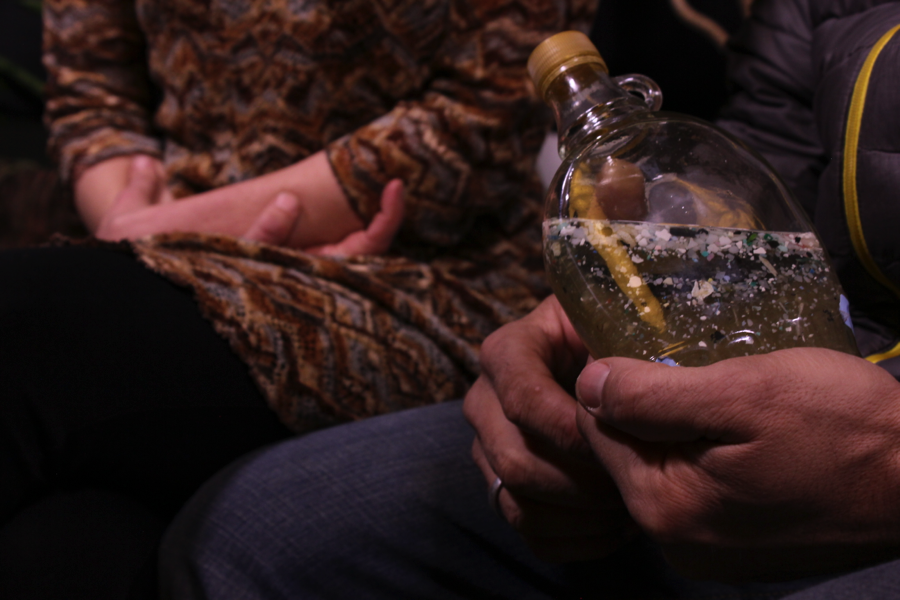
Marcus Eriksen holds a bottle of microplastics skimmed off the ocean surface. Each sample takes hours to collect and contains thousands of tiny plastic particles. [Image credit: JoAnna Klein]

Ranging from the size of a boat to the size of a grain of sand, these pieces of plastic degrade, fragment, sink or collect in ocean currents and travel the world as tiny, toxic particles. “There are no patches of trash sitting in the ocean,” according to Eriksen. “I think its more appropriate to call it a smog, where you get this fine, particulate substance that becomes globally distributed throughout the water column in all dimensions.”

He thinks that California’s experience with airborne smog may be instructive in fighting microplastic pollution. In the 1970’s, some of the early ideas for addressing smog in California focused on sucking it up with vacuums. But soon attention shifted to the source of the emissions, and engineers designed better mufflers and cleaner smokestacks.

Eriksen and Cummins hope that reframing the “garbage patch” as a “plastic smog” will convince people to focus on land-based preventative solutions rather than trying to clean up debris after it’s in the ocean.

With 288 million tons of plastic produced worldwide in 2012, and 4.8 to 12.7 million tons entering the ocean in 2010, trying to remove plastics from the world’s oceans would be like mopping up water from an eternally gushing faucet.

The problem is so vast that Eriksen acknowledges “there is no silver bullet.” But he thinks progress is possible by hitting three targets: individuals, companies and government.

Individuals, he says, can reduce consumption, recycle what they can and clean up plastic before it reaches the ocean. Industries can design marine biodegradable products and encourage the use of glass alternatives with return programs where bottles serve as discount coupons for the consumer’s next purchase.

As for government, pressure from 5 Gyres and other groups has led 18 states to pass or propose legislation limiting the use of microbeads, the granular particles found in some cosmetics and cleaning products.

These tiny plastics are small enough to pass through filters in the water system, flush into waterways and ultimately end up in the bellies of marine animals. Concern over microplastic toxicity and its potential harm throughout the food chain is gaining momentum in research groups and environmental agencies around the world.

The smaller the plastic, the bigger the concern, explained Anna-Marie Cook of the U.S. Environmental Protection Agency. She says the tiny bits act like sponges, sopping up environmental chemicals such as flame retardants and pesticides.

Rochman, the UC-Davis ecologist, says she’s found microplastics in all sorts of marine life. Animals eat them and their tissues absorb the chemicals — in some cases, causing signs of endocrine disruption and behavior problems.

As concern about the problem spreads, 5 Gyres plans to expand its 16-member staff of scientists, educators, writers and artists. “We are growing our reach to be a citizen science hub for plastic pollution activists worldwide,” says Eriksen.

5 Gyres is collaborating with artist Alejandro Duran, who has attracted attention for his plastic installations on the Yucatan coast. Eriksen, also a sculptor, joined Moore at the Atlanta Science Festival on a panel about plastic, art and advocacy this March.

After their daughter Avani (whose name means Earth in Italian) was born in 2012, Eriksen and Cummins have been focusing on educating children. Their most recent expedition culminated in an international youth summit in the Bahamas.

Thursday, August 6, 2015

I Sea Change: Youth Action Island Summit with Jack Johnson

 Posted from the Island School, August 30 2015


I Sea Change: Youth Action Island Summit with Jack Johnson from The Island School on Vimeo.

The Youth Island Action Summit was a collaborative effort between The Island School, The Cape Eleuthera Institute, Center for Sustainable Development, The Deep Creek Middle School, The 5 Gyres Institute and All at Once. These organizations partnered to bring together activists, artist, scientists, educators and Bahamian youth to explore and generate solutions to plastic pollution for islands and nations around the world. 

In addition to the Youth Island Action Summit, The Island School had the opportunity to host UNEP as they officially awarded Jack Johnson with the Goodwill Ambassador title for his work as philanthropist and advocate for the oceans.

Thursday, July 2, 2015

Jack Johnson Takes Out Trash to Beat Plastic Pollution


2015-06-10-1433959250-1082970-JackJohnsonandBagMonster.jpg
published 06/15/2015 in Huffington Post  by Lisa Kaas Boyle

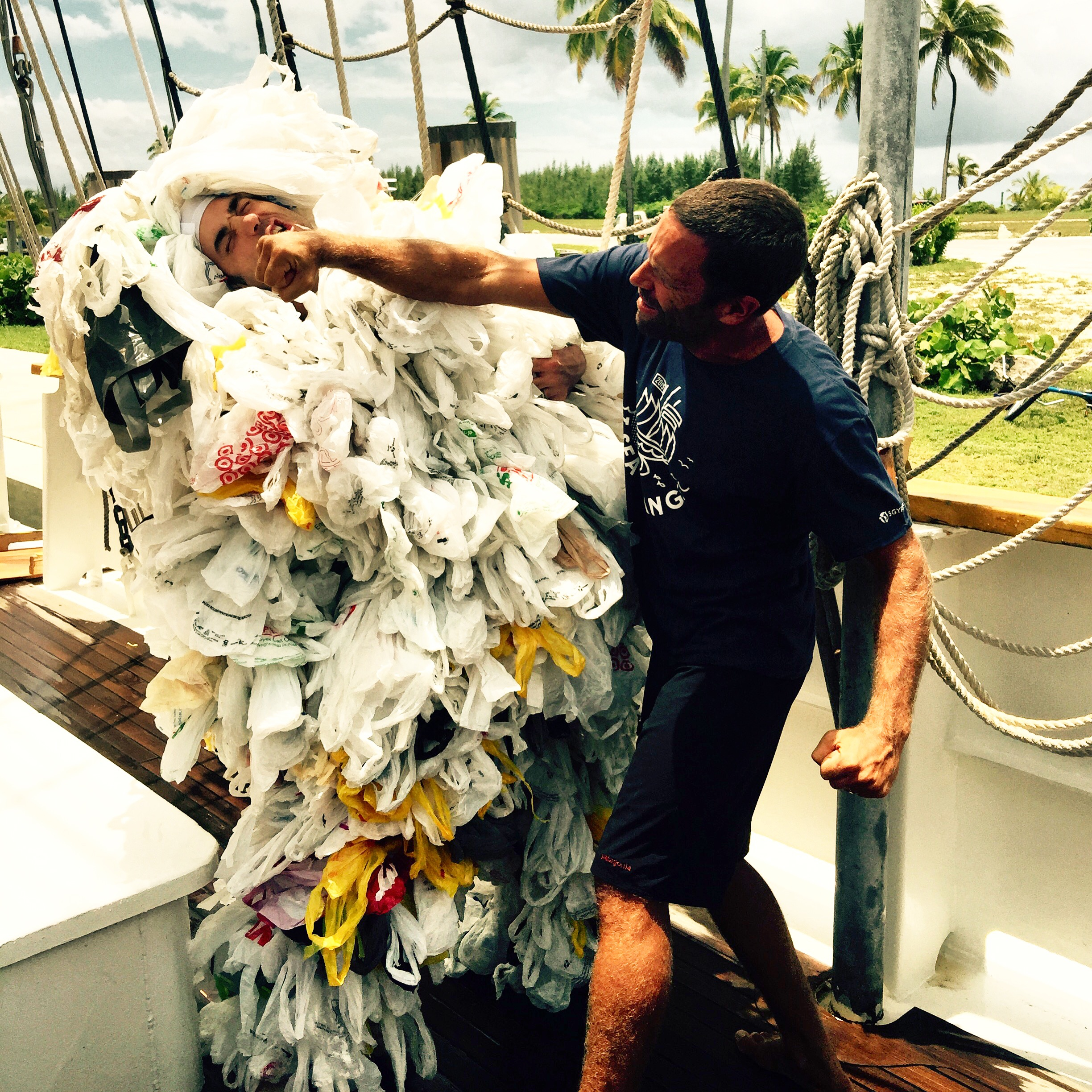
Musician and surfer Jack Johnson may seem laid back, but not when it comes to fighting plastic pollution. Aboard the Mystic Schooner on a research expedition with plastic pollution experts The 5 Gyres Institute, Johnson took a hard jab at The Bag Monster, alter-ego of Andy Keller, founder and president of Chico Bags.

Keller, who invented a reusable bag that folds into its own pocket, becomes The Bag Monster when he dons a costume made of 500 plastic shopping bags, the average number of bags used annually by a shopper who accepts plastic shopping bags. Johnson and Keller are both part of the 5 Gyres 2015 SEA (Science, Education, Action) Change Research Expedition which set sail from Miami with stops in Eleuthera, Bahamas and Bermuda before voyaging across the Atlantic to New York City. The explorers aboard the Mystic are trawling the seas to collect and study microplastics, fragments of our plastic civilization that are not contained and have spilled into our environment with significant impacts on sea creatures and our food chain.

Johnson lives in Hawaii, the first American state to ban plastic bags. His Johnson Ohana Charitable Foundation supports 5 Gyres, a research, education and policy institution committed to stopping plastic pollution. 5 Gyres is located in California, where Governor Jerry Brown signed a plastic bag ban this year.

Citizen Scientists aboard the Mystic Tall Sail Ship with 5 Gyres conduct hourly trawls for microplastics and keep a visual check for larger floating pieces of plastic pollution on the ocean surface. Jack Johnson was shocked at what he saw on his shift. As reported to the students of a local Bahamian school, The Island School, he saw 47 pieces of plastic go by during the first ten minutes of his hour watch, well outside the Atlantic Gyre.

Also contributing to the voyage, participating in research, and giving presentations aboard the vessel are Celine Cousteau, Dan and Keith Malloy, champion surfers and filmmakers; Kimi Werner, champion spearfisher and freediver; Mark Cunningham, legendary body boarder and subject of the Malloy brothers' film Come Hell or High Water, which was screened at The Island School to students who participated in a 5 Gyres produced Youth Summit on plastic pollution. Students shared their own research projects including a study of plastic pollution chemical impacts on fish flesh in the Bahamas.
5 Gyres co-founder and research director Marcus Eriksen is the lead author of recent research on the amount of microplastics in world oceans.

The amount, more than 5 Trillion Plastic Pieces weighing over 250,000 Tons afloat at sea, is surprising because subtracting the amount of plastic that is recycled, landfilled and burned leaves a huge amount of plastic unaccounted for by the global estimate in our ocean's surface waters. One study estimates the amount of plastic waste lost at sea at 8 million metric tons: the equivalent of "five plastic grocery bags filled with plastic for every foot of coastline in the world."

Eriksen hypothesizes that the lost plastic has entered the food chain as it is consumed by marine life and is also settling to the benthos at the bottom of the ocean. 5 Gyres' research shows that 95% of the marine plastics at the surface of the ocean are smaller than a grain of rice, and thus enter the food chain as easily as plankton. The small pieces of plastics have been tested and found to adsorb oily chemicals persistent in the aquatic environment such as petroleum, flame retardants, and even PCBs and DDT that persist even though banned decades ago. The microplastics have been shown to accumulate these toxins in percentages a million times higher than the surrounding waters.

The Mystic Schooner is set to dock in New York City on June 23rd. All the participants of the Sea Change Expedition have direct evidence of humankind's impact on the 70 percent of the earth's surface that is ocean. The explorers know for certain now that there is no "away" in our "throw away" culture of single use plastics. Used for brief moments, our disposable plastics persist in our environment indefinitely.

But there is great hope as more voters and consumers are educated about plastic pollution through organizations like 5 Gyres, Johnson's own Plastic Free Hawaii program, and other groups such as the Bahamas Plastic Movement and the Plastic Pollution Coalition. Next on the Agenda for 5 Gyres: linking more research to policy solutions as with recent successes banning plastic microbeads in personal care products in numerous states.

Monday, March 23, 2015

Ban Microbeads in California

Take Action to Tip The Scales
Let's Ban Microbeads in California!
The 5 Gyres Institute has come a long way since we began sailing the high seas on a mission to document the emerging global plastic crisis.  In the last 5 years, we have sailed over 50,000 miles, collected more than four hundred ocean surface samples, published several peer reviewed scientific papers documenting our findings, and helped launch a national movement to ban microbeads from personal care products like facial scrubs and toothpaste. 

Your support right now will help 5 Gyres tip the scales in favor of the planet and win the battle to Ban Microbeads in California. A win against microbeads in California will help pave the way toward legislative wins across the country.


The movement has caught fire. In the last few months, 18 states across the country - from Hawaii to Maine - have introduced legislation to ban microbeads. Were building upon the tremendous efforts of our partners at The Plastic Soup Foundation, who first galvanized European audiences to take this issue on. Just last week, a federal bill was introduced in congress. But major players in the cosmetics industry are spending big bucks to introduce language that allows bioplastics to replace current plastic beads. Without adequate testing and oversight, 5 Gyres and our coalition partners are wary of bioplastics - unless they are proven beyond any shadow of doubt to break down into before they reach the ocean.   

With research emerging daily highlighting the devastating effects of plastic on marine life - from starving coral reefs to poisoning fish that humans consume - it's clear that we need to act now to stop plastic pollution at the source, before it ever has a chance to reach the oceans.

That's why in California we have teamed up with Assembly Member Richard Bloom (D - Santa Monica) and a coalition of leading environmental groups to introduce the most comprehensive ban in the country. Over the next several months, 5 Gyres will be working to educate lawmakers and citizens about the dangers of microplastic pollution, build grassroots support in key districts, and pass responsible policies with one objective: to keep plastic off of our faces and out of our oceans.

We have a momentous battle ahead - and the stakes could not be higher. What happens in 2015 in legislatures across the country will determine the fate of billions of microbeads and accordingly, our oceans. Join us in our last stand to ban the bead and protect the oceans that we cherish, and the marine life that calls them home.

Support our work to protect the oceans from microplastic pollution by making a contribution today.

Sincerely,
The 5 Gyres Team
donate button

Wednesday, March 18, 2015

Environmentalists pan microbead ban pushed by beauty industry

The push is on in Washington state to ban synthetic plastic microbeads, the tiny pieces of plastic sometimes used in face washes and bath products as an exfoliant.

But in a twist, an environmental group working to curb plastic pollution is critical of the plan, while manufacturers of microbead-laden beauty products are pushing it.

The small plastic beads, commonly used in facial scrubs and body washes, are known to pollute waterways and can end up in the bellies of fish and other marine animals, according to the state Department of Ecology.

A proposal in the Legislature would phase out products containing the synthetic microbeads by 2020. House Bill 1378 will receive a public hearing at 8 a.m. Thursday (Jan. 29) before the House Environment Committee.

As written, though, the legislation would only ban microbeads that are made out of plastic that isn’t biodegradable, which one environmental group said wouldn’t solve the problem.

The biodegradable plastics now on the market don’t break down in cold environments such as the ocean, according to 5 Gyres, a nonprofit working to reduce plastic pollution in the world’s oceans. Instead, the currently available biodegradable plastics need to be composted in a high-heat industrial compost facility, said Anna Cummins, executive director of the group.

5 Gyres has been critical of a similar law passed in Illinois last year that also targets only non-biodegradable plastic microbeads.

“The whole point is to prevent these toxic plastic pellets from entering our oceans,” Cummins said. “Replacing plastic microbeads with compostable plastic microbeads would be a huge loss for the environment.”

Yet the Personal Care Products Council, a national trade group representing about 600 companies, is supporting the legislation. So is the state Department of Ecology.

Karin Ross, director of government affairs for the Personal Care Products Council, said there aren’t many scientific studies yet showing that microbeads have become a large pollution problem, but manufacturers want to get ahead of the issue.

She said manufacturers of personal care products are already switching voluntarily to alternatives to plastic microbeads, which she said may include natural exfoliants such as ground seeds.

“The industry has taken the worries about them possibly ending up in waterways very seriously,” Ross said.

Ross made no mention of biodegradable plastics being used as an alternative, but said she couldn’t speak to all the products in development by companies represented by her organization.

The proposal the House committee will hear Thursday would phase out products containing non-biodegradable plastic microbeads over a five-year period. Under the bill, it would be illegal for anyone in Washington to manufacture or knowingly sell any products containing synthetic microbeads starting in January 2020.

Violators could be fined between $1,000 and $10,000.

Microbeads are defined in the legislation as plastic particles less than 5 millimeters in diameter that are used for exfoliation.

An identical bill has been introduced in the Senate, and both bills have a mix of Republican and Democratic supporters.

State Rep. Joan McBride, D-Kirkland, said her intention in sponsoring the House version of the legislation is to stop microbead pollution in waterways.

She said Wednesday that she hadn’t heard of any opposition to the bill until a reporter told her of 5 Gyres’ concerns. She said she is open to amending the the bill to apply to all products with plastic microbeads, regardless of whether they are made of biodegradable or non-biodegradable plastic.
McBride said the plastic microbeads are particularly problematic because they are often too small to be caught by water filtration systems.

She said that she’s worried about plastic microbeads contaminating the state’s food supply and damaging aquatic ecosystems.

“They’re not meant to be ingested,” McBride said. “They work at exfoliation — they don’t work as food for fish.”

Monday, January 5, 2015

A quarter-million tons of plastic pollution found in oceans


The 5 Gyres Institute compiles six years and 500,000 nautical miles worth of information to provide a global estimate of plastic pollution in the world’s oceans.  


The first global estimate of plastic pollution of both micro- and macroplastic floating in every ocean on earth has led researchers to conclude that the smallest and most insidious particles are present throughout the world’s oceans. The new report, published in the PLOS ONE scientific journal, culminates more than six years and 50,000 nautical miles of pelagic plastics research.

“When The 5 Gyres Institute formed in 2008, we set out to answer a basic question: How much plastic is out there? There was no data from the Southern Hemisphere, Western Pacific, or Eastern Atlantic. After six long years and a wide-reaching collaboration, we have completed the most comprehensive plastic pollution study to date,” says Marcus Eriksen, PhD, Director of Research for the 5 Gyres Institute. “We’ve found microplastic ocean pollution, in varying concentrations, everywhere in the world.”

The report estimates that some 5.25 trillion plastic particles weighing about 269,000 tons are floating in the world’s oceans. Previous reports only looked at one size class and thus reported much lower plastic densities in the world’s oceans.

The new research also demonstrated some unexpected findings, namely a dramatic loss of microplastic from the sea surface in the garbage patches of the five subtropical gyres—large areas of rotating currents where the fragments tend to accumulate. In addition, the survey found a wide distribution of the smallest microplastics in remote regions of the ocean. Though concentrations in the gyres are lower than previously reported, plastics occur nearly everywhere, often far outside of the garbage patches.

Eriksen led a team of nine researchers from six different countries including Capt. Charles Moore, who found the first garbage patch in the North Pacific. The researchers contributed data from 24 expeditions studying plastic floating on the sea surface. Microplastics were collected with nets, while floating macroplastics were counted by systematic observations.

These data were used to populate a model that assumes plastic enters the oceans from rivers, shipping lanes, and densely populated coastlines. The data and model show that large plastics are abundant near coastlines and degrade in the five subtropical gyres into microplastics, the smallest of which are, surprisingly, present in more remote regions such as the subpolar gyres.

The garbage patches should thus be characterized not as repositories or final resting places, but as shredders and redistributors of trash, where sunlight (UV), oxidation, embrittlement, breakage by waves, and fragmentation by grazing fish all degrade large plastic pieces to tiny fragments. These microplastics are then ejected from the garbage patches through various mechanisms such as foraging and filter-feeding by marine organisms, and subsurface currents.

“Our findings show that that the garbage patches in the middle of the five subtropical gyres are not final resting places for floating plastic trash,” Eriksen says. “Unfortunately, the endgame for microplastic is dangerous interaction with entire ocean ecosystems. We should begin to see the garbage patches as shredders, not stagnant repositories.”

The new research categorized plastic into four size classes, from roughly equivalent to a grain of sand, to a grain of rice, to a water bottle, and finally anything larger. Using conservative fragmentation rates, the researchers expected to find more small particles than larger ones.

Surprisingly, their model showed that the smallest fragments are less abundant than the next larger size, but more small particles are found outside of the garbage patches.

“One would expect an exponential increase in the number of plastic particles due to fragmentation,” says Martin Thiel, a co-author on the study. “But this was not the case. Although the two smallest sizes combined accounted for more than 90 percent of the total count, there were more than 100-times fewer of the smallest particles than expected.”

A worldwide distribution of microplastic is more problematic because smaller particles have a greater surface for the absorption of pollutants than larger pieces. Plastics act like sponges, absorbing toxins such as PCBs, DDT and other pesticides, flame retardants, and other persistent organic pollutants found in our oceans. Other research has established that some marine organisms, including seabirds and fish, ingest these toxic plastics and may de-sorb these toxicants.

“The garbage patches could be a frightfully efficient mechanism for corrupting our food chain with toxic microplastics,” says Eriksen.

The 5 Gyres Institute, which uses research to motivate change, contends that companies must take responsibility for the entire life-cycle of the products they create. Working in collaboration with multiple government agencies, NGOs and responsible corporations, the 5 Gyres Institute will continue to support campaigns such as its ongoing effort to replace plastic microbeads in cosmetics and toothpastes with biodegradable alternatives.

“Knowing that plastic pollution becomes hazardous waste in the ocean, it is essential that innovative products and packaging designed for recovery replace the single-use, throwaway culture of the past,” Eriksen says. “It’s time to focus our mitigation strategies upstream from production to disposal. The status quo is not acceptable. Our goal is to vanquish the idea that oceans can bear our waste and to usher in an age of restoration and responsibility.”

Learn more about the project in this video.

Wednesday, December 17, 2014

Study Gauges Plastic Levels in Oceans


Plastic debris washed up on a beach in Azores, Portugal. Credit Marcus Eriksen
It is no secret that the world’s oceans are swimming with plastic debris — the first floating masses of trash were discovered in the 1990s. But researchers are starting to get a better sense of the size and scope of the problem.

A study published Wednesday in the journal PLOS One estimated that 5.25 trillion pieces of plastic, large and small, weighing 269,000 tons, could be found throughout the world’s oceans, even in the most remote reaches.

The ships conducting the research traveled the seas collecting small bits of plastic with nets and estimated worldwide figures from their samples using computer models. 

The largest source of plastic by weight comes from discarded fishing nets and buoys, said Marcus Eriksen, the leader of the effort and co-founder of the 5 Gyres Institute, a nonprofit group that combines scientific research with antipollution activism.

Dr. Eriksen suggested that an international program that paid fishing vessels for reclaimed nets could help address that issue. But that would do nothing to solve the problem of bottles, toothbrushes, bags, toys and other debris that float across the seas and gather at “gyres” where currents converge. 

The pieces of garbage collide against one another because of the currents and wave action, and sunlight makes them brittle, turning these floating junkyards into “shredders,” he said, producing smaller and smaller bits of plastic that spread far and wide.

When the survey teams looked for plastics floating in the water that were the size of grains of sand, however, they were surprised to find far fewer samples than expected — one-hundredth as many particles as their models predicted. That, Dr. Eriksen said, suggests that the smaller bits may be swept deeper into the sea or consumed by marine organisms.

The result echoed that of a paper published this year in Proceedings of the National Academy of Sciences that found a surprisingly low amount of small plastic debris. Those researchers estimated as much as 35,000 tons of the smaller debris were spread across the world’s oceans, but they had expected to find millions of tons.

Andrés Cózar, a researcher from the University of Cadiz who headed that study, said in an email that he and Dr. Eriksen came to different conclusions about the amount of plastic afloat, but that “it is evident that there is too much plastic in the ocean,” adding, “The current model of management of plastic materials is (economically and ecologically) unsustainable.”

The fact that the small plastics are disappearing is hardly good news. In fact, it could be far more troubling than the unsightly mess the plastics cause. Plastics attract and become coated with toxic substances like PCBs and other pollutants. Researchers are concerned that fish and other organisms that consume the plastics could reabsorb the toxic substances and pass them along to other predators when they are eaten.

“Plastics are like a cocktail of contaminants floating around in the aquatic habitat,” said Chelsea M. Rochman, a marine ecologist at the University of California, Davis. “These contaminants may be magnifying up the food chain.”

The ocean studies make an important contribution to the understanding of the floating waste problem, said Nancy Wallace, director of the marine debris program for the National Oceanic and Atmospheric Administration.
Further research should look beyond the surface to test where the smaller plastic bits might have gone: into the deeper ocean depths, along the shoreline or settled on the seafloor. “It’s premature to say there is less plastic in the ocean than we thought,” she said. “There may just be less where we’re looking.”

Dr. Eriksen said the scope of the problem makes floating garbage collection impractical. His group has had some success with campaigns to get manufacturers of health and beauty aids to stop using small scrubbing beads of plastic in their products.

Manufacturers of other products, he said, must be urged to change their practices as well. “We’ve got to put some onus on producers,” he said. “If you make it, take it back, or make sure the ocean can deal with it in an environmentally harmless way.”

Dr. Wallace agreed. “Unless we can stop the flow — turn off the tap of these pieces of debris going into the ocean all the time — we’re not going to be able to stop the problem.”

The American Chemistry Council, which speaks for the plastics industries, issued a statement saying that its members “wholeheartedly agree that littered plastics of any kind do not belong in the marine environment,” and it cited industry efforts to combat the problem, including the 2011 Declaration of the Global Plastics Associations for Solutions on Marine Litter, which has led to 185 projects around the world.

Monday, June 2, 2014

5 Gyres To Study Ocean Plastics Off Bermuda

Published in Bernews May 29, 2014 | 1 Comment
 
On the heels of a successful plastic microbead campaign and four years of sailing the world’s oceans to complete the first global assessment of microplastics, the 5 Gyres Institute is returning to Bermuda to embark on a new mission to survey microplastics in the North Atlantic Subtropical Gyre and the subpolar ‘Viking Gyre’, yet to be studied for plastics.

A spokesperson said, “The expedition will embark on June 8, 2014 from St. George’s, Bermuda, sailing with a crew of 14 professional sailors, scientists, advocates, artists, filmmakers, photographers, and journalists northeast to Iceland. 5 Gyres co-founder and Research Director Dr. Marcus Eriksen will serve as expedition leader and principle investigator.

Dr. Eriksen said, “5 Gyres is on the frontier of oceanic plastic pollution, reaching beyond the North Pacific to discover garbage patches around the world. We’re always striving to learn more about how plastics affect ocean ecosystems, which brings us to monitor remote seas, like the area south of Iceland. These waters are where microplastics, including the microbeads we found in the Great Lakes, likely find their final resting place. We’re going there to find out.”

“5 Gyres has already seen positive change occur from their unique approach of utilizing scientific data to drive solutions to plastic pollution. On other expeditions to the Great Lakes, 5 Gyres discovered high concentrations of plastic microbeads traced back to personal care products that use beads as exfoliants, such as facial scrubs and other cosmetics. This data, published in the journal Marine Pollution Bulletin, is the basis for 5 Gyres’ advocacy campaign to ‘Ban The Bead.’

Carolynn Box, a 5 Gyres Research Coordinator who will also join the expedition, said, “These products are designed to be washed down the drain, often escaping sewage treatment, which means they’ll eventually find their way to the ocean. We’ll be on the lookout for microbead pollution as well as the typical, photo-degraded plastic that blights our oceans.”

“Thus far, armed with irrefutable data, 5 Gyres has successfully worked with several of the companies that manufacture these products to agree to a voluntary phase out.”

Stiv Wilson, the 5 Gyres Associate Director who has headed the ‘Ban The Bead’ campaign, said,

“Though voluntary phase-out is a good first step, we realized that we needed to take a legislative approach to ensure that these plastic beads are eliminated from commerce. We’d love to see Bermuda merchants voluntarily phase out products that contain these beads, as a model for other island nations.”

“5 Gyres has successfully introduced legislation in several American states, and the policy is on the way to passage.

“In addition to searching for microbeads, 5 Gyres will be researching the subsurface distribution of microplastics and the impact of plastics on foraging fish, and testing new collection equipment at sea.

Dr. Eriksen said, “We’ll be studying the water column to look at plastics below the waves, as well looking at the toxins this plastic absorbs, what kind of fish are eating them, and how this might affect a major food source for humans worldwide.”

Dr. Eriksen said, “Research is costly at sea. When we have the opportunity to do our work, I seek collaborations with the global scientific network, collecting samples for my colleagues who concentrate on related fields of study to plastic pollution. With this partnerships, we can further our scientific understanding of plastic pollution while managing the costs associated with data collection in the most remote parts of the world.”

“There will be several opportunities for the public in Bermuda to join the 5 Gyres team and crew to learn more about plastic pollution:
  • On June 5, 5 Gyres will work with Bermudian scientists and volunteers at Keep America Beautiful, a long time collaborator of 5 Gyres, to conduct beach surveys at various locations around the island.
  • On the evening of June 5, 5 Gyres will give a lecture at BIOS from 4.00pm through 6.30pm that will be free and open to the public.
  • On June 6, the team will conduct more beach surveys and will host an evening fundraiser/cocktail party at BUEI [please contact 5 Gyres for details].
  • On June 8, The Viking Gyre Expedition will embark from St. George’s, sailing for three weeks and conducting research as they sail for Iceland, hoping to arrive by the end of June.
“For details on events or to get involved with our beach survey, interviews, and high-resolution images please contact Stiv Wilson, Associate Director, 5 Gyres, via email at stiv@5gyres.org or via telephone at 503-913-7381.

“For information on how to participate in beach surveys, please contact Anne Hyde, Executive Director, Keep Bermuda Beautiful, via email at kbb@northrock.bm.”