A blog set out to explore, archive & relate plastic pollution happening world-wide, while learning about on-going efforts and solutions to help break free of our addiction to single-use plastics & sharing this awareness with a community of clean water lovers everywhere!
Showing posts with label Bio-accumulation. Show all posts

Tuesday, December 17, 2013

How Plastic In The Ocean Is Contaminating Your Seafood


published December 16, 2013 on NPR by Eliza Barclay

We've long known that the fish we eat are exposed to toxic chemicals in the rivers, bays and oceans they inhabit. The substance that's gotten the most attention — because it has shown up at disturbingly high levels in some fish — is mercury.

But mercury is just one of a slew of synthetic and organic pollutants that fish can ingest and absorb into their tissue. Sometimes it's because we're dumping chemicals right into the ocean. But as a study published recently in Nature, Scientific Reports helps illuminate, sometimes fish get chemicals from the plastic debris they ingest.

"The ocean is basically a toilet bowl for all of our chemical pollutants and waste in general," says Chelsea Rochman, a postdoctoral researcher at the University of California, Davis, who authored the study.

"Eventually, we start to see those contaminants high up in the food chain, in seafood and wildlife."
For many years, scientists have known that chemicals will move up the food chain as predators absorb the chemicals consumed by their prey. That's why the biggest, fattiest fish, like tuna and swordfish, tend to have the highest levels of mercury, polychlorinated biphenyls (PCBs) and other dioxins. (And that's concerning, given that canned tuna was the second most popular fish consumed in the U.S. in 2012, according to the National Fisheries Institute.)

What scientists didn't know was exactly what role plastics played in transferring these chemicals into the food chain. To find out, Rochman and her co-authors fed medaka, a fish species often used in experiments, three different diets.

One group of medaka got regular fish food, one group got a diet that was 10 percent "clean" plastic (with no pollutants) and a third group got a diet with 10 percent plastic that had been soaking in the San Diego Bay for several months. When they tested the fish two months later, they found that the ones on the marine plastic diet had much higher levels of persistent organic pollutants.

"Plastics — when they end up in the ocean — are a sponge for chemicals already out there," says Rochman. "We found that when the plastic interacts with the juices in the [fish's] stomach, the chemicals come off of plastic and are transferred into the bloodstream or tissue." The fish on the marine plastic diet were also more likely to have tumors and liver problems.

While it's impossible to know whether any given fish you buy at the seafood counter has consumed this much plastic, Rochman's findings do have implications for human health, she notes. "A lot of people are eating seafood all the time, and fish are eating plastic all the time, so I think that's a problem."

And there's a lot of plastic out there in the open ocean. As Edward Humes, author of Garbology, told Fresh Air's Terry Gross in 2012, the weight of plastic finding its way into the sea each year is estimated to be equivalent to the weight of 40 aircraft carriers.

Consider the five massive gyres of trash particles swirling around in the Indian, Atlantic and Pacific oceans alone. Those gyres, Hume told Gross, contain "plastic that has been weathered and broken down by the elements into these little bits, and it's getting into the food chain."

One of those gyres is the infamous Great Pacific Garbage Patch. Fish could encounter the plastic in those gyres, but also much closer to shore, says Rochman.

Even so, the consensus in the public health community still seems to be that the benefits of eating fish — because of their omega-3 fatty acids, among other assets — exceed the potential risks. And many researchers advocating for Americans to increase their fish consumption argue that the levels of dioxins, PCBs and other toxic chemicals in fish are generally too low to be of concern.

The Environmental Protection Agency does put out advisories to warn consumers when fish get contaminated with chemicals in local U.S. waters. But a lot of our seafood now comes from foreign waters, which the EPA does not monitor. Just a tiny fraction of imported fish get tested for contaminants.

As for Rochman, she says her research in marine toxicology has persuaded her to eat seafood no more than twice per week. And she now avoids swordfish altogether.

Copyright 2013 NPR. To see more, visit http://www.npr.org/.

Monday, February 4, 2013

What are long term threats of plastic in our seas?


Albatross parent and chick  
Albatross parents feed their young chicks plastics and unwittingly kill them
Last summer, when filming for a series to be broadcast next year, a team from the BBC's Natural History Unit saw first-hand how discarded plastic can end up thousands of miles away from where people live when they visited French Frigate Shoals, an island north west of Hawaii.

There they found turtles nesting amongst plastic bottles, cigarette lighters and toys. And they discovered dead and dying albatross chicks, unwittingly killed when their parents fed them plastic carried in as they foraged for food in the sea.

Some of the chicks die when sharp edges puncture their bodies, others from starvation as their stomachs fill with plastic they cannot digest.
Turtle in amongst rubbish  
On the remote beaches of the French Frigate Shoals, turtles nests among plastic debris
 
We have known for a while that plastic is a threat to the albatross, but how dangerous is discarded plastic for other wildlife and could it affect us?

Some of the plastic in our oceans has been illegally tipped at sea, or is litter from fishing, most comes from the land, from poorly run landfill sites and industrial waste.

Floating debris is carried to the Hawaiian archipelago by giant rotating ocean systems, or gyres, partly driven by air currents.

Hawaii sits in the midst of a gyre known as the North Pacific Sub-tropical High. The North Pacific gyre is one of five gigantic interconnected systems of ocean currents. Each spirals around a central point, drawing material inwards.

These spirals can also eject material, out towards the Arctic and Antarctic, spreading plastic across the globe over time.

Gyre graphic
Plastic is made to last, so it decays only very slowly in the oceans, breaking down into ever smaller fragments. These tiny fragments are known as micro-plastic.

Hormonal changes
 
Dr Simon Boxall is an expert in marine pollution based at the National Oceanography Centre in Southampton, on Britain's south coast. We took a boat trip with him in the sea near his research centre.

Using a simple net and bottle system, the boat filtered roughly 400 tonnes of water in 10 minutes. With the naked eye we could see mud, twigs and a few feathers, but when we looked at the sample under the microscope in Dr Boxall's laboratory tiny pieces of plastic became clear.

The sample included small pieces of plastic rope and plastic bag, some fragments were distinctly coloured and some had sharp edges. There were pieces less than a millimetre across, similar in size to the living things in our sample - the phytoplankton, or tiny plants, and zooplankton, or tiny animals.

Marine pollution expert, Dr Simon Boxall, shows Susan Watts some of the micro-plastic found in the waters near Southampton

"There's been a lot of research in the United States looking at how the plastic gets into the food chain, and certainly it's been shown that it gets into bi-valves, mussels and oysters on the seabed, and it does have an effect on them," Dr Boxall said.

"They bio-accumulate the plastic as they filter the water. That concentrates the plastic and effectively turns some of those molluscs into hermaphrodites. Some years ago it was assumed that it was like roughage, and didn't have a major impact, but we know now that those very small plastic particles can mimic certain things like oestrogen," he added.

Chemical adsorption?
 
However, he said the true effects are not yet known:

"These plastic particles are like sponges, they're a bit like magnets for other contaminants, things like Tributyltin, the anti-fouling material. The tiny plastic particles absorb these materials and effectively become quite toxic. We don't know yet whether that then has an impact on the human food chain. It's still very early days to find out how far up the food chains these plastic particles go."

Plastic fragments under microscope  
Tiny fragments of plastic in sea water can be seen under a microscope
 
At the Marine Biology and Ecology centre of Plymouth University they study the impact of pollutants on our oceans and rivers, and the creatures that live in them. Marine scientist Professor Richard Thompson was the first to describe the tiny fragments of broken plastics as micro-plastics back in 2004.

"There are two concerns from a toxicological point of view. There's the issue that plastics are known to sorb and concentrate chemicals from sea water," he explained.

"And the secondary question is about chemicals that have been introduced into plastics from the time of manufacture, in order to achieve specific qualities of the plastic, its flexibility, or flame retardants or anti-microbials.

"When we've now got plastic not as whole intact items but as small fragments in the environment, is there the potential for any of those chemicals from manufacture to also be released?"

'More work needed'
 
Prof Thompson's team has been examining fish in the English Channel, 500 or so across 10 species - including mackerel, whiting, poor cod and gurnard.

His results have just been published in Marine Pollution Bulletin (Lusher et al, MPB, December 2012). The team found microscopic plastic in the guts of all of the species tested.

Mackerel  
Scientists found plastic fragments in the guts of 10 fish species in the English Channel
 
"It's showing that micro-plastics are quite widespread in the environment, not just in the water columns and the beaches, but actually in the creatures that live in those environments," he said.

Prof Thompson said the plastics had been found "in relatively low quantities - one or two pieces per fish - so this is certainly not a risk from the point of view of the human population, people eating those fish, because of course we don't eat the guts normally".

"The question we do want to address is is that a problem from the point of view of the animals concerned, in individuals that are eating plastic, either from the point of view of the physical presence of the plastic, or the potential for chemical transport?"

I asked if that means there is a concern for people who eat the flesh of the fish, if those chemicals have found their way into the animal.

"It's really an unknown," Prof Thompson said.

"The next step is to take the information like that from fish and other creatures to understand how much plastic, what are the chemicals that might be of concern... what are the concentrations of those chemicals, what are the quantities of plastic, and how does that vary from species to species in order to understand which particular combinations might create the greatest potential for hazard...

"That's what our work is trying to establish at the moment - what potential is there for these micro-plastics to actually cause harm in the real world."

Watch Susan Watts' full Newsnight report on plastics polluting our seas in a video posted alongside this article:  http://www.bbc.co.uk/news/science-environment-21236477

More on This Story

Related Stories

Saturday, September 29, 2012

Invisible Plastic Soup is Harming Ocean Animals

Posted by Environmental News Service on September 26, 2012

WAGENINGEN, The Netherlands, September 26, 2012 (ENS) – Plastic nanoparticles released when plastic debris decomposes in seawater can have an adverse effect on sea animals, Dutch scientists have found. 

Nanoparticles of plastic measuring just thirty millionths of a millimeter, invisible to the naked eye, are responsible for inhibiting feeding and growth in mussels, according to new research by Professor Bart Koelmans of Wageningen University and his research team.

They published a report of their investigations in the most recent issue of the journal “Environmental Toxicology and Chemistry.”

“The presence of plastic soup in the oceans is regarded as a big problem,” says Koelmans, a professor of water and sediment quality who is associated with IMARES, the Institute for Marine Resources and Ecosystem Studies, at Wageningen University.
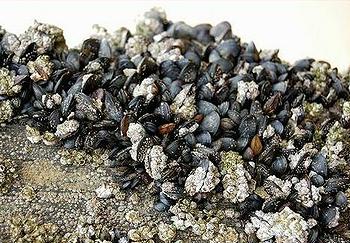
mussels
Mussels on Dutch shore ( (Photo by Paul Boag)

The plastic soup is formed when plastic debris decomposes in seawater. “Such particles are probably also released from cosmetics and from clothes in the wash, subsequently entering the sewage system and surface waters and eventually reaching the sea,” Koelmans explains.

Koelmans and his team exposed mussels to various concentrations of nanoplastic in order to discover the concentration at which an effect was noticeable. 

They found that the exposed mussels eat less of their normal food, algae, than mussels that have not been exposed to plastic nanoparticles, and they grow less well.

By giving the plastic nanoparticles color, and by measuring them using dynamic light scattering, it was possible to determine the particle concentration that exerted an effect on the test mussels. 

The researchers write that the extent to which the tiny plastic particles clump together is extremely important for understanding particle uptake and the resulting effects in marine organisms. 

“It means that those effects are not easy to predict because the biological availability of the particles can differ enormously from one organism to another, and because variation in water quality also plays a role,” says Koelmans.

Very little is known about the effects plastic nanoparticles have on sea life. The effects revealed by this study do not yet prove that plastic in the North Sea is a big problem, but they do suggest that further research is extremely important, Koelmans said.

This study is the first of four by Wageningen University and IMARES that will investigate the effects of plastic in the North Sea. 

The next will focus on the effect of plastic on lugworms, which lose weight due to uptake of plastic particles. The scientists have already found that as a result of their exposure to nanoplastics the worms take in more toxic substances such as polychlorinated biphenyls (PCBs), which bind to plastics, than worms that have not been exposed.

Koelmans sees the need for research into other toxic substances that bind to plastic in seawater. 

In order to analyse the interaction of plastic and other toxic substances in the food web, Koelmans’ group has created a detailed computer model to estimate the risks posed by plastics in the sea. 

The final study in this series investigates the effects of plastic debris in the stomachs of fish. The analysis of hundreds of fish shows that 12 percent of them have debris in their stomachs and roughly half of that debris is plastic.

Koelmans says the European Union and the Dutch government recognize the problem and the need to monitor the existence of plastics in the seas in order to learn more about present and future concentrations of plastic micro-particles and nanoparticles in marine environments. 


Environment News Service (http://s.tt/1oqgg)

Wednesday, August 29, 2012

Ocean Plastics Soak Up Pollutants

ACS Meeting News: Some marine plastic debris attracts more pollutants than lab studies suggest
 
Photo of Chelsea Rochman deploying plastic samples in San Diego Bay.
 
PLASTIC PLUNGE
Rochman deploys plastic samples in San Diego Bay.
Credit: Sarah Wheeler
 
Some plastic debris in the ocean continues to absorb organic pollutants for months after reaching marine environments, according to a field study presented at the American Chemical Society national meeting in Philadelphia on Sunday. The findings, which contrast with earlier laboratory studies, could change how researchers assess the effect of plastics on marine animals.

When fish and other marine creatures eat plastic debris, they consume a cocktail of multiple stressors, including the plastic itself and the pollutants it absorbs, said Chelsea Rochman, a graduate student at San Diego State University, who presented the study in the Division of Environmental Chemistry.

Rochman and colleagues deployed pellets used to make six types of common plastics in San Diego Bay for up to a year. They retrieved samples at monthly intervals and used gas chromatography/mass spectrometry to measure concentrations of more than 50 persistent organic pollutants, including polycyclic aromatic hydrocarbons and polychlorinated biphenyls.

Some plastics continued to accumulate these pollutants for months, in contrast with earlier lab studies showing that plastics come to equilibrium with these pollutants over several days.

The researchers also found that some types of plastic absorbed 10-fold higher concentrations of organic pollutants than others, suggesting that some plastics could be more hazardous to fish than others.

This is one of the first field experiments to follow plastic debris over time to assess how it interacts with pollutants in natural waters, commented Mark Anthony Browne, an ecologist at the National Center for Ecological Analysis & Synthesis at University of California, Santa Barbara. “It provides our most accurate understanding yet of this phenomena and challenges several theories developed from more simple laboratory studies,” he told C&EN.

Chemical & Engineering News
ISSN 0009-2347
Copyright © 2012 American Chemical Society

Wednesday, May 9, 2012

'Garbology': How our everyday trash eventually becomes our food

In his book, 'Garbology: Our Dirty Love Affair with Trash,' author Edward Humes tracks the journey of garbage around the world and back into the food chain.

Posted Fri, May 04 2012 on www.mnn.com by Bryan Nelson

Landfill heap Photo: Alex Proimos/Flickr
You've probably heard the saying, "you are what you eat." Soon it may have to be rephrased as, "you are what you throw away."
 
That's one eerie consequence of our modern-day culture of waste. Not only do Americans generate more trash than any other society in the history of Earth, but growing evidence now suggests that our garbage — plastic waste in particular — is re-entering the food chain. In a roundabout way, we are quite literally eating what we throw away.
 
In his new book, "Garbology: Our Dirty Love Affair with Trash," Pulitzer Prize-winning journalist Edward Humes chronicles the long journey that our trash takes around the world, and eventually back into what we eat. In a recent interview with NPR, he discusses some of the shocking findings detailed in the book.
 
According to Humes, Americans produce about 7 pounds of trash per person each day, the vast majority of which is packaging and containers — mostly plastics. About 69 percent of our trash ends up in landfills (the rest is either recycled or, in some cases, left blowing in the wind). What you may not realize, is that those landfills are not always local. In fact, there is a growing export industry for our trash. A lot of it ends up as far away as China.
 
"They're finding value in material we're not able to find value in and paying relatively little for it — shipping it immense distances with enormous environmental impact involved in that, and then using it to manufacture products they're shipping back to us. And we're buying and basically turning it into trash again, and then it's an endless cycle," Humes told NPR.
 
That endless cycle just increases the likelihood that trash will escape and contaminate the environment. Much of what gets discarded eventually ends up in the ocean.
 
"What we're actually seeing in the ocean is this kind of chowder of plastic — these tiny particles that are the size of plankton," said Humes. "It's plastic that has been weathered and broken down by the elements into these little bits, and it's getting into the food chain."
 
Humes is referring specifically to the world's 5 massive ocean gyres — stirring ocean currents which trap our trash like a giant pot of murky soup. The gyres become both a depository for our trash and a means for breaking it down into plankton-sized bits. Those bits are then consumed by fish and other organisms that mistake them for food. It's in this way that our trash re-enters the food chain. In fact, about 35 percent of fish in the north Pacific Ocean are now found with plastic in their stomachs. We then eat the fish that ate the fish that ate the plastic, etc., thus ultimately consuming our own waste through bio-accumulation.
 
"The scarier part is that these little bits of plastic become sponges for some potentially dangerous chemicals that are released into the marine environment, and we may be ingesting that, too," said Humes.
 
Perhaps the biggest tragedy of this poisonous cycle is that most of the waste that we throw away can be recycled and reused, but we are either too lazy to recycle it, or our recycling programs are not efficient enough to account for it all.
 
Of course, if we don't recycle it, nature eventually finds its own means to recycle. Unfortunately for us, that means as our food.