A blog set out to explore, archive & relate plastic pollution happening world-wide, while learning about on-going efforts and solutions to help break free of our addiction to single-use plastics & sharing this awareness with a community of clean water lovers everywhere!
Showing posts with label Endocrine Disruptors. Show all posts

Tuesday, February 23, 2016

More Plastic, Fewer Oysters?

Posted by Carl Safina of The Safina Center on February 23, 2016
published on NationalGeographic.com , Co-authored by Erica Cirino

2016 started off with a dire prediction for the world’s oceans: By 2050, the seas will contain more plastic—by weight—than fish. There’s an estimated 8 -12 million metric tons of plastic making its way into the oceans each year. And as the plastic mess in the oceans grows, so do concerns over the health of the marine creatures living in it.

While it’s known that plastic bags and bottles pose a risk to sea creatures, a lesser-known threat is now coming to light, one that’s created when ocean waves and wind pulverize the plastic bags, bottles and other trash that ends up in the seas: “microplastics.”

These tiny plastic pieces are about the same size and shape as the algae eaten by some marine animals. How microplastics affect marine animals is not well understood.
microplastic
Microplastic poses a growing concern in oceans and other aquatic habitats. (Image by 5Gyres, courtesy of Oregon State University)
But in recent years scientists have found that crustaceans that consume microplastics have a hard time reproducing. Going off a hunch that microplastics may affect the fertility of other filter feeders, researchers at the French Institute for the Exploitation of the Sea started feeding oysters microplastics.

The researchers observed two groups of oysters: one fed a normal diet of algae and another fed a mix of algae and microplastics. The oysters fed the mixed diet swiftly sucked up the microplastics as easily as they did algae. After two months the researchers have found microplastics take a toll on both oyster digestion and reproduction.

Oysters that consume microplastics eat more algae and absorb it more efficiently, says Arnaud Huvet, marine physiologist at the French research center and lead author of the study. This is because oysters expend extra energy to pass plastic through their digestive systems, increasing the rate at which they digest algae.

While the digestion of microplastics diverts some energy away from reproduction, oysters’ ability to reproduce is almost halved: Female oysters produce fewer and smaller eggs while male oysters produce slower-swimming sperm. Offspring produce more slowly. The cause? Blame the chemicals that make up microplastics.

During digestion microplastics appear to leach hormone-disrupting chemicals into oysters’ bodies, says Huvet. These chemicals, also called “endocrine disruptors,” are known to lead to diminished fertility and an increased cancer rate in laboratory animals, wildlife and humans. They’re found in all kinds of everyday products, including cosmetics, pesticides and plastics.

Can the microplastics accumulating in oysters’ bodies harm the animals or humans that eat them? Right now, Huvet says, that’s unclear. But he points out his study adds to a slowly growing body of evidence highlighting the health impacts of plastic pollution in the oceans.

Safina Center Sustainable Seafood Program Director Elizabeth Brown-Hornstein agrees: “This study provides further evidence that plastic litter has far-reaching effects on the oceans and that there is an urgent need to take meaningful action to tackle this issue.”

Learn more about plastic and other marine pollution, and what you can do to help, here.

To rethink the future of plastics, start with packaging

Conrad MacKerron
More plastic than fish in the ocean (by weight) by 2050. 95 percent of plastic packaging’s potential value lost after its first use. Only 14 percent of plastic packaging collected for recycling. Global waste disposal systems so challenged that nearly a third of plastic waste doesn’t even make it to the landfill, and instead is littered on land or swept into the ocean.
 
These are some sobering findings of "The New Plastics Economy: Rethinking the Future of Plastics," a report released last month by the Ellen MacArthur Foundation in partnership with the World Economic Forum intended to move the circular economy a step closer from theory to practice.
The enormous waste of embedded value in plastic packaging has been going on for generations with scant attention often paid as landfills overflowed with discarded single use bottles, bags, plates and wrappers. 

The emerging awareness of the scope of ocean plastic debris and the potential for plastics to concentrate and transfer toxic chemicals into the marine food web and human diets finally may provoke enough concern from companies and policy makers to make ubiquitous plastic packaging a pilot program for the circular economy where it never becomes waste, but serves as nutrients for new products.

The report charts a path for transition to a circular path by first focusing on fostering a robust after-use economy through improving the economics and yield of recycling, reuse and composting. Reducing the dumping of waste onto land and oceans and decoupling plastics from fossil fuels are also important factors, but the report emphasizes that drastically improving the quality and economics of recycling, reuse and composting, is the cornerstone and first priority for a new plastics economy.

A five-point plan is proposed: engaging value chain players; forming a global plastics protocol to agree on design guidelines for optimal material use and processing systems; focusing technological innovation on projects with the most potential to improve materials sorting and processing at scale; promoting stronger secondary markets for collected materials; and exploring "the enabling role of policy" such as material, landfill or incineration bans and producer responsibility laws.

This effort by the Ellen MacArthur Foundation and its allies has a number of encouraging elements going for it, but the path is also fraught with challenges. Much of this has been proposed before in various forms. 

On the hopeful side, Europe seems primed to move. In December, the European Commission approved a circular economy package including $6.08 billion for improved waste management.

Greenhouse gas emissions by the plastics sector are expected to grow to 15 percent of the global annual carbon budget by 2050 so recycling can play a key role helping governments and global brands with GHG reduction. Increased recycling can reduce GHG emissions. Incineration and energy recovery, often promoted as alternatives to recycling, release the carbon embedded in plastics. 

The new data showing far more plastic waste is eluding collection and being swept into oceans than previously believed is elevating public concern about it from nuisance to potential global threat. About 8 million metric tons of plastic are estimated end up in the ocean each year, much of it packaging. Without significant intervention, that will result in a ton of plastic for every three tons of fish by 2025, and more plastic than fish by weight by 2050. 

A few big consumer brands and value chain players are beginning to show interest. Ikea, Kimberly Clark, Marks & Spencer and Unilever were involved in the New Plastic Economy report, as were other critical parts of the packaging life cycle, such as Dow and Dupont, who make polymer packaging resins; packaging producer Amcor; and Suez and Veolia, which provide waste collection and recycling services.

It’s an appealing vision of potential new business opportunities for companies that could unlock job growth through advanced repair and manufacturing, and enhanced waste management and secondary materials production.

However, there are just as many challenges. The apparent energy seems centered mostly around European governments and retailers so far. In the U.S. there’s no evidence of strong promotion of a circular agenda by the EPA or federal policy makers equivalent to the EU’s action. U.S. retailers outside of the beverage sector remain largely silent on responsibility for the ocean debris mess, packaging waste and low recycling rates. 

The report’s proposed answer is ambitious — a global plastics protocol, where business and governments align around the best materials and practices. But is it realistic? It’s hard enough to get cities in the same county to collect and process the same materials, let along most countries.
But beneath polite phrases such as "alignment" lie hard choices such as banning certain plastic materials, which the plastics industry has opposed. 

While some municipalities and nations have banned various plastics, reaching global agreement on preferred materials is likely too much to expect. Many developing nations are preoccupied with providing basics such as food and shelter and lack post-consumer collection and recycling systems, or the resources to carry out existing laws.

A better approach might be one track for developed nations willing to move now and finance workable regional circular economy models; and a separate urgent effort aimed at using multilateral aid and producer fees to help developing nations build basic waste collection systems to stem the ocean plastics tide.  

This is where the big global brands need to step up on both accounts. Unilever, Procter & Gamble and others are using increasing amounts of non-recyclable plastic packaging in developing markets, much of which ends up in waterways. They need to acknowledge the impacts of their products as negative environmental externalities and factor those costs into future operations. Then need to start paying fees or providing significant aid, likely billions of dollars, aid to help developing countries where they sell products build recycling and waste collection systems.

Even developed nations are struggling with the economics of packaging recycling. These recommendations come at an especially challenging time for the U.S. recycling industry, where plummeting commodity prices for packaging materials such as plastic, glass and metals have slashed and often erased recyclers’ profits.

Yet there’s a silver lining — this crisis could force a much needed reality check for brands that commodity prices will continue to be volatile and that recyclers cannot build a business model based primarily on the value of recovered materials. Brands need to step up and pay their fair share to cover the added costs of processing their materials.

U.S. citizens historically have sent a strong message that recycling is a social good they want pursued and they are paying the cost for recycling not covered by commodities, not the big producer brands. In recent years, big U.S. consumer brands have avoided acknowledging responsibility, or taken only baby steps. The Closed Loop Fund makes more capital available for fixing infrastructure and market development, but avoids the key question of what ongoing financial commitment brands should be responsible for to relieve the costs of recycling and landfilling for taxpayers who have shouldered it for generations. 

There is room for optimism that the prospect of wise conservation of resources, job growth and reduction of GHG emissions afforded by the new plastics economy vision will attract a critical mass of global brands to support efforts to optimize the value of the materials they place on the market. This effort is badly needed to develop 21st-century caliber systems that will move plastic packaging from a one-way trip to the landfill to many useful round-trips protecting consumer goods.

Tuesday, August 11, 2015

5 Gyres - Not Just Skimming the Surface

A couple’s crusade against ocean plastic attacks a vast problem from multiple angles.

Not just skimming the surface
Anna Cummins and Marcus Eriksen, co-founders of 5 Gyres, search the world for plastic particles the size of a grain of sand. [Image credit: JoAnna Klein]
 
Published in Science Line by JoAnna Klein | August 9, 2015
 
In 1997, Captain Charles Moore was sailing from Hawaii back to the mainland when he found himself in a sea of floating debris the size of Texas. Some of the bobbing plastic was so big that Moore could spot it from the deck of his boat, though most was much smaller. The Great Pacific Garbage Patch, as it became known, was the consequence of a gyre — a vortex of swirling ocean currents that sucked floating debris into its core.


Soon, that same gyre would seduce Marcus Eriksen and Anna Cummins.

Eriksen and Cummins met at a birthday party for Captain Moore in 2007 and got engaged while cruising the Garbage Patch with him. They turned their growing fascination with plastic into a crusade to remove it from the world’s oceans.

They used cash gifts from their 2009 wedding — he wore a recycled plastic tux, she a plastic gown — to incorporate 5 Gyres, a small non-profit that has since grown into a well-funded group with partners around the world that embarks on research expeditions across four oceans.

Today, the group focuses on correcting public misunderstanding about the diffuse nature of the problem — they prefer to call it plastic smog instead of a garbage patch — and promoting innovative solutions, such as tougher manufacturing laws and greener products.

“Charlie Moore started it, and they took it to a different level,” says Chelsea Rochman about Eriksen and Cummins, who first brought attention to the ocean plastic problem through Moore’s The Algalita Marine Research Foundation. Now a marine ecologist at The University of California, Davis, Rochman got her research start in 2009 exploring The Great Pacific Garbage Patch.

Eriksen, a Gulf War veteran, became interested in the environment after witnessing hundreds of burning oil wells in Kuwait. He was drifting down the Mississippi River on a handmade raft made of plastic debris when he heard about Moore’s discovery in 2004.

Around the same time, Cummins first heard Moore speak while she was conducting bilingual education and environmental outreach for a California non-profit. Both ended up sailing separately with Algalita.

When the pair finally met, the natural next step was the formation of 5 Gyres, their own non-profit to clean up all of the ocean’s gyres. At first the group focused on understanding the scope of the problem.

“In the beginning, it was just a scrappy NGO doing science,” says Cummins.

Setting sail on its first expedition in January 2010, the group relied in part (and still does) on contributions from donors, or “ambassadors” who each paid up to $8,500 for a spot on the boat. During their trips they survey the ocean for plastic debris, quantify how much they find and sometimes bring on extra people for other research. On occasion, Cummins plays the fiddle.

5 Gyres had split from Algalita to take its environmental advocacy global. And after a few well-publicized trips, Eriksen and Cummins started attracting corporate sponsors such as Patagonia, Kleen Kanteen, and even the American Chemistry Council, which lobbies for the chemical industry.

Today, 5 Gyres is deeply involved in advocacy as well as science. They now have a $600,000 annual budget supported by 32 corporate backers and a small army of grassroots activists. Prominent climate activist Bill McKibben is one of the group’s scientific advisors.

By 2014, 5 Gyres had made 16 global expeditions and collected data from 1,571 locations. Based on the data from those voyages, Eriksen concluded in a 2014 PLOS-One study that there are at least 5.65 billion pieces of plastic floating atop the Earth’s oceans. He says that’s more than 250,000 metric tons of plastic, roughly equivalent to a stack of waster bottles stretching all the way to the moon and back — twice.
cummins2
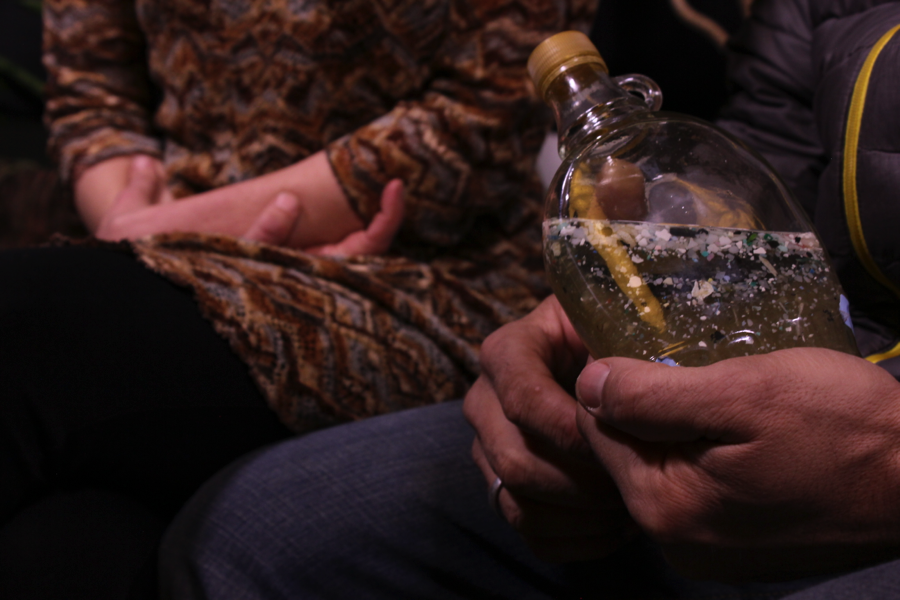
Marcus Eriksen holds a bottle of microplastics skimmed off the ocean surface. Each sample takes hours to collect and contains thousands of tiny plastic particles. [Image credit: JoAnna Klein]

Ranging from the size of a boat to the size of a grain of sand, these pieces of plastic degrade, fragment, sink or collect in ocean currents and travel the world as tiny, toxic particles. “There are no patches of trash sitting in the ocean,” according to Eriksen. “I think its more appropriate to call it a smog, where you get this fine, particulate substance that becomes globally distributed throughout the water column in all dimensions.”

He thinks that California’s experience with airborne smog may be instructive in fighting microplastic pollution. In the 1970’s, some of the early ideas for addressing smog in California focused on sucking it up with vacuums. But soon attention shifted to the source of the emissions, and engineers designed better mufflers and cleaner smokestacks.

Eriksen and Cummins hope that reframing the “garbage patch” as a “plastic smog” will convince people to focus on land-based preventative solutions rather than trying to clean up debris after it’s in the ocean.

With 288 million tons of plastic produced worldwide in 2012, and 4.8 to 12.7 million tons entering the ocean in 2010, trying to remove plastics from the world’s oceans would be like mopping up water from an eternally gushing faucet.

The problem is so vast that Eriksen acknowledges “there is no silver bullet.” But he thinks progress is possible by hitting three targets: individuals, companies and government.

Individuals, he says, can reduce consumption, recycle what they can and clean up plastic before it reaches the ocean. Industries can design marine biodegradable products and encourage the use of glass alternatives with return programs where bottles serve as discount coupons for the consumer’s next purchase.

As for government, pressure from 5 Gyres and other groups has led 18 states to pass or propose legislation limiting the use of microbeads, the granular particles found in some cosmetics and cleaning products.

These tiny plastics are small enough to pass through filters in the water system, flush into waterways and ultimately end up in the bellies of marine animals. Concern over microplastic toxicity and its potential harm throughout the food chain is gaining momentum in research groups and environmental agencies around the world.

The smaller the plastic, the bigger the concern, explained Anna-Marie Cook of the U.S. Environmental Protection Agency. She says the tiny bits act like sponges, sopping up environmental chemicals such as flame retardants and pesticides.

Rochman, the UC-Davis ecologist, says she’s found microplastics in all sorts of marine life. Animals eat them and their tissues absorb the chemicals — in some cases, causing signs of endocrine disruption and behavior problems.

As concern about the problem spreads, 5 Gyres plans to expand its 16-member staff of scientists, educators, writers and artists. “We are growing our reach to be a citizen science hub for plastic pollution activists worldwide,” says Eriksen.

5 Gyres is collaborating with artist Alejandro Duran, who has attracted attention for his plastic installations on the Yucatan coast. Eriksen, also a sculptorjoined Moore at the Atlanta Science Festival on a panel about plastic, art and advocacy this March.

After their daughter Avani (whose name means Earth in Italian) was born in 2012, Eriksen and Cummins have been focusing on educating children. Their most recent expedition culminated in an international youth summit in the Bahamas.

Thursday, February 5, 2015

New Link in the Food Chain? Marine Plastic Pollution and Seafood Safety


Published in Environmental Health Perspectives | February 2015 by Nate Seltenrich

Nate Seltenrich covers science and the environment from Petaluma, CA. His work has appeared in High Country News, Sierra, Yale Environment 360, Earth Island Journal, and other regional and national publications.


PDF icon PDF Version (4.4 MB)
In recent years plastic pollution in the ocean has become a significant environmental concern for governments, scientists, nongovernmental organizations, and members of the public worldwide. A December 2014 study derived from six years of research by the 5 Gyres Institute estimated that 5.25 trillion plastic particles weighing some 269,000 tons are floating on the surface of the sea.1

At the same time, plastics in consumer products have become subject to increasing scrutiny regarding their potential effects on human health. Bisphenol A (BPA),2 a component of polycarbonate plastics and suspected endocrine disruptor, is one of the most widely known chemicals of interest. But BPA is only one of many monomers, plasticizers, flame retardants, antimicrobials, and other chemicals used in plastics manufacturing3 that are able to migrate into the environment.

At the junction of these two lines of inquiry is an emerging third field that is in many ways even more complex and less well understood: investigating human exposures to and potential health effects of plastics that have entered the marine food chain. Studies have demonstrated plastics’ tendency to sorb (take up) persistent, bioaccumulative, and toxic substances, which are present in trace quantities in almost all water bodies.4

The constituents of plastics, as well as the chemicals and metals they sorb, can travel into the bodies of marine organisms upon consumption,5,6,7,8,9 where they may concentrate and climb the food chain, ultimately into humans. This topic has attracted interest and funding from the U.S.

Environmental Protection Agency (EPA), the National Oceanic and Atmospheric Administration (NOAA), and the National Academy of Sciences (NAS), as well as researchers, nonprofit groups, and institutions around the world.

At this point “there are more questions than answers,” says Richard Thompson, a professor of marine science and engineering at England’s Plymouth University. Thompson coined the term “microplastics” in 200410 and later undertook a three-year study of these particles in the marine environment for the UK’s Department of Environment, Food, and Rural Affairs.11,12,13 “From a human perspective,” he says, “at the moment I think there’s cause for concern rather than cause for alarm.”

Viewpoints on the human health risks of marine debris are nearly as complex as the underlying science, as was evident at an inaugural EPA and NAS symposium on the topic held in Washington, DC, in April 2014.

In addition to myriad small details, the researchers in attendance considered an overarching question: Within the context of limited oceanographic research funding, the variety of other problems affecting ocean health (including overfishing and acidification), and the extent of humans’ daily and direct exposures to potentially harmful chemicals from consumer plastics and other sources—how concerned should we be about marine plastics as far as human health goes?

Researchers don’t yet have an answer, even if they believe they’re asking the right question. As EPA chemist Richard Engler concluded in a 2012 review, “While current research cannot quantify the amount, plastic in the ocean does appear to contribute to [persistent, bioaccumulative, and toxic substances] in the human diet.”14


Plastic Vectors

The path from plastic pollution to chemical exposure through seafood is a long one, figuratively and often literally, and tracing all the individual steps in that theoretical journey is not the same as identifying human health effects, researchers say. Actual exposures, which are determined by innumerable variables along the way, including seafood consumption, still need to be quantified. Then these levels must be evaluated within broader contexts of consumer plastic use and environmental pollutant levels.

Exposures to plastic debris have been clearly documented for marine organisms at all trophic levels (i.e., positions within the food chain), says Bradley Clarke, a lecturer at RMIT University in Melbourne, Australia. “What remains to be determined is whether this exposure increases the body burden of … marine organisms in the natural environment and if it does, by what magnitude,” Clarke says.

There is a lack of controlled experimental work completed on the topic, Clarke adds, and it’s very difficult to disentangle pollutant exposures and bioaccumulation via plastic versus food and environmental sources. Uncertainties also surround the transfer of plastic additives to marine organisms and resultant human exposures through seafood.

We do know that plastic has become nearly ubiquitous on the planet. It has washed up on the most remote beaches, amassed in distant gyres, and been discovered in the bodies of dead organisms from fish to birds to whales.15,16

Numerous efforts have sought to quantify the amount of plastics floating on or present throughout the ocean environment, and they’ve arrived at vastly different numbers. The 5 Gyres paper1 was preceded in July 2014 by a similar study suggesting that between 7,000 and 35,000 tons of plastic are floating on the ocean’s surface.17

Anna-Marie Cook, one of two EPA lead scientists investigating the potential health effects of marine plastics, believes that estimates calculated through the use of surface trawl nets, including both of the recent global studies, vastly underestimate the scope of the problem. “Slightly more than half of all plastic is negatively buoyant, meaning that it will sink upon reaching the ocean, either into the near-shore sediment environment or to the ocean floor,” she explains. “Surface trawls do not account for the fraction of plastic in sediments, on the ocean floor, or suspended past the top few feet of the water column.”

World plastics production has experienced almost constant growth for more than half a century, rising from approximately 1.9 tons in 195018 to approximately 330 million tons in 2013.19 The World Bank estimates that 1.4 billion tons of trash are generated globally each year, 10% of it plastic.20 The International Maritime Organization has banned the dumping of plastic waste (and most other garbage) at sea.21 However, an unknown portion of the plastic produced each year escapes into the environment—instead of being landfilled, incinerated, or recycled20—and at least some of it eventually makes its way to sea.

Plastics that reach the ocean will gradually break down into ever-smaller pieces due to sunlight exposure, oxidation, and the physical action of waves, currents, and grazing by fish and birds.22 So-called microplastics—variably defined in the scientific literature and popular press as smaller than 1 or 5 mm in diameter—are understood to be the most abundant type of plastic in the ocean.

The 5 Gyres authors found microplastics almost everywhere they sampled, from near-shore environments to the open ocean, in varying concentrations, and they estimated that particles 4.75 mm or smaller—about the size of a lentil—made up roughly 90% of the total plastic pieces they collected.1

But the degradation of larger pieces of plastic is not the only way microplastics end up in the ocean. Nurdles—the plastic pellets used as a feedstock for producing plastic goods—can spill from ships or land-based sources,23 and “microbeads” used as scrubbing agents in personal care products such as skin cleansers, toothpastes, and shampoos, can escape water-treatment facilities and pass into watersheds with treated water.24 (In June 2014, Illinois became the first U.S. state to ban the manufacture and sale of products containing microbeads,25 which have been documented in the Great Lakes26 and Chicago’s North Shore Channel.27)

Due to their hydrophobic nature, persistent organic chemicals—including polycyclic aromatic hydrocarbons (PAHs),28 polychlorinated biphenyls (PCBs),29 polybrominated diphenyl ethers (PBDEs),30 dioxins,31 and DDT32—have been shown to preferentially sorb to plastics when they encounter them in the ocean.33,34

Potentially thousands of such chemicals exist in the environment,35 but researchers are limited to screening for compounds they can actually identify, Bradley says.

The extent and rate of sorption can vary widely depending on the chemical, plastic type, and other variables, but plastic particles recovered from the ocean have been found to contain pollutant concentrations orders of magnitude higher than the water from which they were collected.14,36,37

Marine organisms throughout the food chain commonly consume plastics of various sizes.38,39 The tiniest microplastics are small enough to be mistaken for food by zooplankton,40 allowing them to enter the food chain at very low trophic levels. Some larger predators are thought to confuse nurdles (which typically measure less than 5 mm in diameter) with fish eggs or other food sources.41

Once plastics have been consumed, laboratory tests show that chemical additives and adsorbed pollutants and metals on their surface can desorb (leach out) and transfer into the guts and tissues of marine organisms.14

Some researchers speculate that chemicals already present in the organism may also be able to travel in the opposite direction by sorbing to plastics in the gut, depending on the concentration gradients. Yet neither process has been proven to occur in the natural environment.

We already know that many chemicals of concern are present in the seafood we eat, particularly in higher-level predators such as tuna and swordfish.42 Research has shown that harmful and persistent substances can both bioaccumulate (or increase in concentration as exposures persist) and biomagnify (or increase in concentration at higher trophic levels) within organisms as they assume some of the chemical burden of their prey or environment. Yet again, no research has yet demonstrated the bioaccumulation of sorbed pollutants in the environment.

Three key questions remain to be determined. To what extent do plastics transfer pollutants and additives to organisms upon ingestion? What contribution are plastics making to the contaminant burden in organisms above and beyond their exposures through water, sediments, and food? And, finally, what proportion of humans’ exposure to plastic ingredients and environmental pollutants occurs through seafood? Researchers are moving carefully in the direction of answers to these questions.


Human Health Questions

Among U.S. agencies, the EPA is delving into the science to answer key questions around marine plastics and human health. In addition to convening the April meeting and producing a forthcoming white paper on its findings, the agency collaborates with and directly funds researchers in the field. Staff from the EPA and the U.S. Fish and Wildlife Service are currently developing a risk assessment to quantify the chemical loading effects of plastic litter on marine life.43 And by 2016, the EPA plans to launch a similar long-term inquiry into effects on human health, including an evaluation of outcomes such as fetal formation, says Cook.

Any study of human health effects will likely depend on the cooperation of a subject community where many types of seafood are heavily consumed. “We have to have a potential threat and a potential receptor present in a location and a community who is willing to work with us on it,” Cook says. “There are a lot of repercussions to a community to find out that their food supply is potentially contaminated.” The agency also expects to award a new four-year marine debris research contract designed to gain a better understanding of the movement, distribution, and quantity of plastics off the remote northwestern Hawaiian islands.

Researcher Chelsea Rochman of the University of California, Davis, collaborated with Cook and the EPA on a 2014 study that showed an association between concentrations of certain PBDEs in fish and levels of plastic debris accumulation in the South Atlantic Ocean.44 However, no such association was seen for concentrations of BPA, alkylphenols, alkylphenol ethoxylates, or PCBs in fish.44

Rochman is also working on a separate study funded through NOAA’s Marine Debris program. The aim of the NOAA study is to demonstrate for the first time the biomagnification in marine organisms of chemicals introduced via plastics. This highly controlled laboratory experiment involves feeding contaminated plastic pellets to mussels, feeding the mussels to sturgeon, and then testing levels of PCBs within the bodies of the sturgeon. Results are still awaiting analysis and publication.

One of Rochman’s collaborators on the project, researcher Mark Browne of the University of California, Santa Barbara, recently received a grant from the Australian Research Council for a three-year program addressing another question in the field: Beyond leaching chemicals, what do plastic particles do when they enter an organism?

Browne showed in 2008 that microplastics sized 3.0 and 9.6 µm in diameter can travel beyond a mussel’s gut and into its circulatory system and hemocytes (immune cells), where they may remain for a relatively long period of time—in his study, more than 48 days.45 A 2012 study by another group showed that microplastics taken up by mussels resulted in a strong inflammatory response.46

The implications of these findings for humans that consume organisms containing microplastics are not yet understood. Browne says his team is currently working to develop a method to test human tissues for microplastics. “We think that’s going to be a big turning point,” he says.

Ecotoxicologist Heather Leslie of VU University Amsterdam is among those concerned about the particle toxicity of microplastics themselves. Even without chemical hitchhikers, she says, plastic particles can induce immunotoxicological responses, alter gene expression, and cause cell death, among other adverse effects. “Exposed organisms then deal not only with chemical stress through multiple exposure routes, but also particle stress,” she explains. Leslie is currently studying the distribution and environmental fate of microplastics from cosmetics and other sources and potential toxicological effects on marine organisms in Europe’s multinational CleanSea Project.

A large body of literature about the mobility of nanoparticles offers a glimpse at how nano-size plastic particles may behave in the human body, Leslie says. “They can pass through the placenta and the blood–brain barrier and can be taken up in the gastrointestinal tract and lungs, potential sites where harm can occur,” she says. “There is a lot to learn about microplastics from the fields of particle toxicity and drug delivery technologies that apply to polymeric nanoparticles.”

In another example of ongoing research, Robert Hale, a professor at the Virginia Institute of Marine Science, has funding from both the EPA and NOAA to investigate how particle size, weathering, biofouling (the accumulation of living organisms on wet surfaces), and water characteristics including temperature, salinity, and organic carbon content influence both the sorption of organic contaminants to and the release of various additives from different types of microplastics.47

“You look at these simple parameters together, and it can get very complex,” Hale says. The EPA is particularly interested in evaluating the release of flame retardant additives from plastics, he notes, and may pursue development of a protocol to be used by manufacturers to provide data on chemical migration.


A Matter of Perspective?

Government, academic, and independent sources interviewed for this article almost unanimously expressed a mix of skepticism and concern toward the thought of ocean plastics posing a human health risk. Without exception, they also advocated for further research. A common viewpoint is that although definitive evidence does not yet exist for real-world human health impacts tied to marine plastic debris, this doesn’t prove the hypothesis null, nor does it mean there aren’t other valid reasons to address the long-lived plastic litter that washes into the world’s oceans every year.

Many researchers pointed to the need to maintain perspective on the issue. Human exposure to microplastics and plastic additives is more likely to stem from intact goods prior to disposal than from seafood, Thompson says. Clothing fibers make up a large proportion of the microplastic found worldwide, says Browne,48 and even drinking water and foods such as honey can be contaminated with microplastics, according to Leslie.

Kara Lavender Law, a research professor of oceanography with the Sea Education Association in Woods Hole, Massachusetts, who collaborated with Richard Thompson on a recent summary of current knowledge about microplastics,49 says that while overfishing and direct exposure to consumer plastics concern her more than the marine-plastic pathway, the latter still warrants investigation. “I think it’s something worth working on,” she says. “Just because we don’t see it doesn’t mean it’s not there.”

In the case of plastic constituents thought to affect the human endocrine system, any level of exposure, no matter the route, may be potentially harmful, says Carol Kwiatkowski, executive director of The Endocrine Disruption Exchange. Endocrine disruptors have shown evidence of a nonlinear or nonmonotonic dose response,50 meaning tiny doses may have larger effects than mid-level doses.

“Anything that interferes with hormone action potentially has an effect at a very low dose, because the endocrine system is designed to function at very small doses,” Kwiatkowski says. “So it’s possible this pathway could bring some exposure. You’d have to find some evidence that the chemicals were being carried through marine organisms and making it into people.”

From there, she says, researchers would still need to learn how any such exposures relate to or interact with other exposures to endocrine disruptors, including rapidly metabolized chemicals such as BPA and phthalates, and longer-lived additives such as flame retardants. In other words, to what extent do all these exposures add up, and how does that cumulative exposure translate to health outcomes? “It’s difficult to study additive effects,” Kwiatkowski says. “But it’s very important research to conduct.”

Nonetheless, the end goal, sources say, is not to abandon the use of plastic. “The benefits of plastics can be realized without the need for emission [to the ocean], ” Thompson says. “And for me that’s the tipping point for taking policy action.” New laws, for example, could require handling plastics more responsibly at the end of their useful life through recycling, proper disposal, and extended producer responsibility.

Rolf Halden, director of the Center for Environmental Security at the Biodesign Institute at Arizona State University, advocates for another solution: manufacturing more sustainable plastics from the start.51 “We need to design the next generation of plastics to make them more biodegradable so that they don’t have a long half-life, they don’t accumulate in the oceans, and they don’t have the opportunity to collect chemicals long-term,” he says. “There’s just no way we can shield people from all exposures that could occur. Let’s design safer chemicals and make the whole problem moot.”


References

1. Eriksen M, et al. Plastic pollution in the world’s oceans: more than 5 trillion plastic pieces weighing over 250,000 tons afloat at sea. PLoS ONE 9(12):e111913 (2014); doi: 10.1371/journal.pone.0111913.

2. EPA. Bisphenol A (BPA) Action Plan Summary [website]. Washington, DC:U.S. Environmental Protection Agency (updated 29 January 2014). Available: http://www.epa.gov/oppt/existingchemical​s/pubs/actionplans/bpa.html [accessed 28 January 2015].

3. Deanin RD. Additives in plastics. Environ Health Perspect 11:35–39 (1975); http://www.ncbi.nlm.nih.gov/pmc/articles/PMC1475198/.

4. Rochman CM, et al. Long-term field measurement of sorption of organic contaminants to five types of plastic pellets: implications for plastic marine debris. Environ Sci Technol 47(3):1646–1654 (2013); doi: 10.1021/es303700s.

5. Rochman CM, et al. Ingested plastic transfers hazardous chemicals to fish and induces hepatic stress. Sci Rep 3:3263 (2013); doi: 10.1038/srep03263.

6. Browne MA, et al. Microplastic moves pollutants and additives to worms, reducing functions linked to health and biodiversity. Curr Biol 23(23):2388–2392 (2013); doi: 10.1016/j.cub.2013.10.012.

7. Chua EM, et al. Assimilation of polybrominated diphenyl ethers from microplastics by the marine amphipod, Allorchestes compressa. Environ Sci Technol 48(14):8127–8134 (2014); doi: 10.1021/es405717z.

8. Tanaka K, et al. Accumulation of plastic-derived chemicals in tissues of seabirds ingesting marine plastics. Mar Pollut Bull 69(1–2):219–222 (2013); doi: 10.1016/j.marpolbul.2012.12.010.

9. Besseling E, et al. Effects of microplastic on fitness and PCB bioaccumulation by the lugworm Arenicola marina (L.). Environ Sci Technol 47(1):593–600 (2013); 10.1021/es302763x.

10. Thompson RC, et al. Lost at sea: where is all the plastic? Science 304(5672):838 (2004); doi: 10.1126/science.1094559.

11. Bakir A, et al. Competitive sorption of persistent organic pollutants onto microplastics in the marine environment. Mar Pollut Bull 64(12):2782–2789 (2012); doi: 10.1016/j.marpolbul.2012.09.010.

12. Bakir A, et al. Transport of persistent organic pollutants by microplastics in estuarine conditions. Estuar Coast Shelf Sci 140:14–21 (2014); doi: 10.1016/j.ecss.2014.01.004.

13. Bakir A, et al. Enhanced desorption of persistent organic pollutants from microplastics under simulated physiological conditions. Environ Pollut 185:16–23 (2014); doi: 10.1016/j.envpol.2013.10.007.

14. Engler RE. The complex interaction between marine debris and toxic chemicals in the ocean. Environ Sci Technol 46(22):12302–12315 (2012); doi: 10.1021/es3027105.

15. Safina C. No refuge: tons of trash covers the remote shores of Alaska. Yale Environment 360, Opinion section (1 July 2013). Available: http://e360.yale.edu/feature/carl_safina​_gyre_tons_of_trash_covers_shores_alaska​/2668/ [accessed 28 January 2015].

16. de Stephanis R, et al. As main meal for sperm whales: plastics debris. Mar Pollut Bull 69(1–2):206–214 (2013); doi: 10.1016/j.marpolbul.2013.01.033.

17. Cózar A, et al. Plastic debris in the open ocean. Proc Natl Acad Sci USA 111(28):10239–10244 (2014); doi: 10.1073/pnas.1314705111.

18. PlasticsEurope. Plastics—The Facts 2013: An Analysis of European Latest Plastics Production, Demand and Waste Data. Brussels, Belgium:PlasticsEurope AISBL (2013). Available: http://www.plasticseurope.org/Document/p​lastics-the-facts-2013.aspx [accessed 28 January 2015].

19. PlasticsEurope. China Leads Global Plastics Production while Europe Ranks Second [press release]. Brussels, Belgium:PlasticsEurope AISBL (12 June 2014). Available: http://goo.gl/Xgx5Is [accessed 28 January 2015].

20. Hoornweg D, Bhada-Tata P. What a Waste: A Global Review of Solid Waste Management. Washington, DC:Urban Development and Local Government Unit, World Bank (March 2012). Available: http://goo.gl/GZec84 [accessed 28 January 2015].

21. IMO. Prevention of Pollution by Garbage from Ships [website]. London, United Kingdom:International Maritime Organization (2015). Available: http://www.imo.org/OurWork/Environment/P​ollutionPrevention/Garbage/Pages/Default​.aspx [accessed 28 January 2015].

22. Zettler ER, et al. Life in the “plastisphere”: microbial communities on plastic marine debris. Environ Sci Technol 47(13):7137–7146 (2013); doi: 10.1021/es401288x.

23. Thompson RC, et al. Plastics, the environment and human health: current consensus and future trends. Philos Trans R Soc Lond B Biol Soc 364(1526):2153–2166 (2009); doi: 10.1098/rstb.2009.0053.

24. Fendall LS, Sewell MA. Contributing to marine pollution by washing your face: microplastics in facial cleaners. Mar Pollut Bull 58(8):1225–1228 (2009); doi: 10.1016/j.marpolbul.2009.04.025.

25. State of Illinois. Governor Quinn Signs Bill to Ban Microbeads, Protect Illinois Waterways [press release]. Chicago, IL:Office of the Governor, State of Illinois (8 June 2014). Available: http://www3.illinois.gov/PressReleases/S​howPressRelease.cfm?SubjectID=3&RecNum=1​2313 [accessed 28 January 2015].

26. Eriksen M, et al. Microplastic pollution in the surface waters of the Laurentian Great Lakes. Mar Pollut Bull 77(1–2):177–182 (2013); doi: 10.1016/j.marpolbul.2013.10.007.

27. McCormick A, et al. Microplastic is an abundant and distinct microbial habitat in an urban river. Environ Sci Technol 48(20):11863–11871 (2014); doi: 10.1021/es503610r.

28. ATSDR. Polycyclic Aromatic Hydrocarbons (PAHs) [website]. Atlanta, GA:Agency for Toxic Substances and Disease Registry, U.S. Centers for Disease Control and Prevention (updated 3 March 2011). Available: http://www.atsdr.cdc.gov/substances/toxs​ubstance.asp?toxid=25 [accessed 28 January 2015].

29. EPA. Health Effects of PCBs [website]. Washington, DC:U.S. Environmental Protection Agency (updated 13 June 2013). Available: http://www.epa.gov/wastes/hazard/tsd/pcb​s/pubs/effects.htm [accessed 28 January 2015].

30. EPA. Polybrominated Diphenyl Ethers (PBDEs) Action Plan Summary [website]. Washington, DC:U.S. Environmental Protection Agency (updated 8 January 2015). Available: http://www.epa.gov/oppt/existingchemical​s/pubs/actionplans/pbde.html [accessed 28 January 2015].

31. EPA. Environmental Assessment: Dioxin [website]. Washington, DC:U.S. Environmental Protection Agency (updated 12 August 2010). Available: http://cfpub.epa.gov/ncea/CFM/nceaQFind.​cfm?keyword=Dioxin [accessed 28 January 2015].

32. EPA. DDT [website]. Washington, DC:U.S. Environmental Protection Agency (updated 18 April 2011). Available: http://www.epa.gov/pbt/pubs/ddt.htm [accessed 28 January 2015].

33. Müller JF, et al. Partitioning of polycyclic aromatic hydrocarbons in the polyethylene/ water system. Fresenius J Anal Chem 371(6):816–822 (2001); doi: 10.1007/s002160101025.

34. Pascall MA, et al. Uptake of polychlorinated biphenyls (PCBs) from an aqueous medium by polyethylene, polyvinyl chloride, and polystyrene films. J Agric Food Chem 53(1):164–169 (2005); doi: 10.1021/jf048978t.

35. EPA. Persistent Organic Pollutants: A Global Issue, A Global Response [website]. Washington, DC:U.S. Environmental Protection Agency (updated 12 June 2014). Available: http://goo.gl/Pn5p7u [accessed 28 January 2015].

36. Rochman CM, et al. Long-term sorption of metals is similar among plastic types: implications for plastic debris in aquatic environments. PLoS ONE 9(1):e85433 (2014); doi: 10.1371/journal.pone.0085433.

37. Mato Y, et al. Plastic resin pellets as a transport medium for toxic chemicals in the marine environment. Environ Sci Technol 35(2):318–324 (2001); doi: 10.1021/es0010498.

38. Davison P, Asch RG. Plastic ingestion by mesopelagic fishes in the North Pacific Subtropical Gyre. Mar Ecol Prog Ser 432:173–180 (2011); doi: 10.3354/meps09142.

39. Murray F, Cowie P. Plastic contamination in the decapod crustacean Nephrops norvegicus (Linnaeus, 1758). Mar Pollut Bull 62(6):1207–1217 (2011); doi: 10.1016/j.marpolbul.2011.03.032.
40. Cole M, et al. Microplastic ingestion by zooplankton. Environ Sci Technol 47(12):6646–6655 (2013); doi: 10.1021/es400663f.

41. Ellison K. The trouble with nurdles. Front Ecol Environ 5(7):396 (2007).

42. Gassel M, et al. Detection of nonylphenol and persistent organic pollutants in fish from the North Pacific Central Gyre. Mar Pollut Bull 73(1):231–242 (2013); doi: 10.1016/j.marpolbul.2013.05.014.

43. EPA. EPA and U.S. Fish and Widlife Service Partner to Protect Wildlife at Hawaii’s Tern Island [press release]. San Francisco, CA:U.S. Environmental Protection Agency, Region 9 (9 September 2014). Available: http://www.epa.gov/region9/mediacenter/t​ern-island/ [accessed 28 January 2015].

44. Rochman CM, et al. Polybrominated diphenyl ethers (PBDEs) in fish tissue may be an indicator of plastic contamination in marine habitats. Sci Total Environ 476–477:622–633 (2014); doi: 10.1016/j.scitotenv.2014.01.058.

45. Browne MA, et al. Ingested microscopic plastic translocates to the circulatory system of the mussel, Mytilus edulis (L.). Environ Sci Technol 42(13):5026–5031 (2008); doi: 10.1021/es800249a.

46. von Moos N, et al. Uptake and effect of microplastics on cells and tissue of the blue mussel Mytilus edulis L. after an experimental exposure. Environ Sci Technol 46(20):11327–11335 (2012); doi: 10.1021/es302332w.

47. Hale RC, et al. Ghosts in the Machine: Releases of Flame Retardants from Microplastics and Recycled Materials [abstract]. Presented at: Society of Environmental Toxicology and Chemistry North America 35th Annual Meeting, Vancouver, British Columbia, Canada, 9–13 November 2014. Brussels, Belgium, and Pensacola, FL:Society of Environmental Toxicology and Chemistry (2014). Available: http://vancouver.setac.org/wp-content/up​loads/2014/10/SETAC-Vancouver-Abstracts.​pdf [accessed 28 January 2015].

48. Browne MA, et al. Accumulation of microplastic on shorelines worldwide: sources and sinks. Environ Sci Technol 45(21):9175–9179 (2011); doi: 10.1021/es201811s.
49. Law KL, Thompson RC. Microplastics in the seas. Science 345(6193):144–145 (2014); doi: 10.1126/science.1254065.

50. Welshons WV, et al. Large effects from small exposures. I. Mechanisms for endocrine-disrupting chemicals with estrogenic activity. Environ Health Perspect 111(8):994–1006 (2003); http://www.ncbi.nlm.nih.gov/pubmed/12826473.

51. Halden RU. Plastics and health risks. Annu Rev Public Health 31:179–194 (2010); doi: 10.1146/annurev.publhealth.012809.103714.

52. Obbard RW, et al. Global warming releases microplastic legacy frozen in Arctic Sea ice. Earth’s Future 2(6):315–320 (2014); doi: 10.1002/2014EF000240.

53. Chan K. Hong Kong plastic pellets spill: Sinopec vows to clean up beaches. Huffington Post, Green section (9 August 2012). Available: http://www.huffingtonpost.com/2012/08/10​/hong-kong-plastic-pellets-spill_n_17591​19.html [accessed 28 January 2015].

Wednesday, December 17, 2014

Remembering the genius who got BPA out of your water bottles, and so much more

Published in Grist.org


It was the late 1970s and Theo Colborn was, like pretty much everyone else in the ’70s, getting divorced. She was in her 50s and already retired from a career as a pharmacist.

She’d moved to a hobby farm that was close to the Rocky Mountain Biological Laboratory in Colorado and volunteered as a field researcher, sampling water and insects for signs that they were picking up toxins released by mining operations in the area. When she thought about what she should do next with her life, the answer that came to her was “become an expert in water sampling techniques.”

So Colborn went back to school. In 1985, at 58, she graduated from the University of Wisconsin-Madison with a Ph.D. in zoology and minors in epidemiology, toxicology, and water chemistry. “I wanted to get the education,” she said, in a 1988 Frontline interview, “so that I could maybe undo some of the things that my generation basically foisted on society.”

By the time Colborn died on Sunday, at the age of 87, she had immersed herself in decades of research — and inspired even more research — that sought to do just that. The many, many proposed BPA bans? Go back to the very beginning, and you’ll find Colborn. The concern over dwindling sperm counts? Same thing.

After she graduated, Colborn went to work in Washington, D.C., first as a Congressional Fellow and then as an analyst, researching industrial emissions and ozone for the Clean Air Act. When those projects ended, she was hired by two conservation organizations, the World Wildlife Fund and The Conservation Foundation, to put together an overview of Great Lakes water quality with another researcher, Richard Liroff. In the Frontline interview, she talked about what happened next:

I was working on a book on the state of the environment of the Great Lakes. And I pulled all this literature together, lots of papers, you know: fellows working in Canada, people working in the United States, one out on Lake Superior, others over, way over on Lake Ontario had done some work, written their papers, had them published in a number of different journals. None of them knew what the other was doing.

And basically, I sat in a wonderful position where I pulled all this information together. And looking at it I said, “There is something wrong here.” And the easiest thing for me to do is to use — thank goodness for computers — use a spreadsheet at a computer and start producing these spreadsheets.

And as I plotted those names of the animals in the column on the left-hand side, this is called the “Y” column, and then on the “X” column I plotted the effects that were seen in the animals, it began to fall out that there were serious problems and actually population declines, population crashes, actually extirpation of some populations. They disappeared in some places.

What Colborn was seeing was the result of a wide variety of synthetic chemicals that had come into being in the 1950s and ’60s. Even though they were present in the water at very low concentrations, they were subtly changing how the animals in that system developed — how their genes were programmed, how their cells differentiated and spread out through their bodies, and, ultimately, how they were able to survive and reproduce into the next generation.

The healthy wildlife around the Great Lakes, often, were those animals that had grown up elsewhere and migrated as adults. When their offspring failed to reach adulthood, or couldn’t reproduce, they were replaced by a fresh fleet of new arrivals. The lakes looked healthy, in other words, but they were a death trap.

Colborn credited this breakthrough, in part, to her unconventional scientific background.
I looked at it from an entirely different perspective. I looked at endocrinology differently. I began to look at toxicology. I was not trained in toxicology. I was trained in pharmacology until I went back to college to get my Ph.D. in my old age. Only then did I begin to sit in on toxicology courses.

There is a reductionism in scientists, in the scientific community. I have never been a reductionist. I am always thinking about the big picture. My thesis committee for my Ph.D. will tell you that. They had trouble with me.

At the time, Colborn said, scientists working on environmental issues had primarily been looking for cancer, which she described as “the big bugaboo.” Cancer was a rare event: In order to emerge, it had to circumvent the body’s defenses, and in a polluted community, not everyone would come down with it.

What Colborn found was different: To a developing organism, even an infinitesimally small exposure could alter fetal development and the possible effects — lower IQ, organ damage, trouble reproducing — could be spread out across a community like jam on toast. The concept was so new there wasn’t even a term for it. In 1991, Colborn and a team of 21 international scientists working on the issue came up with one: endocrine disruption.

Unlike a lot of scientists, Colborn was not shy about becoming a public figure. She co-authored a popular science book with the dramatic title of Our Stolen Future. She founded a nonprofit called the Endocrine Disruption Exchange, which, among other things, helped fund and cheerlead more research into endocrine disruption and its causes.

Colborn continued to do solid research and she also went pretty far out on quite a few limbs, blaming chemicals derived from fossil fuels for everything from Parkinson’s to Alzheimer’s to obesity to autism spectrum disorder.

“Governments must take heed immediately,” she wrote, earlier this year, “or there will be too few healthy, intelligent individuals left to preserve our humanitarian society and create some semblance of world peace.” (As if we don’t have a pretty significant historical record showing that humans were more than eager to be complete jerks to each other long before anyone started messing with the benzene ring.)

Still, her big message was incontestable — that over 60 years ago, we began to introduce all of these chemicals into the environment, and we still have no idea what most of them do to us. In raising these questions, Colburn got us closer to looking for answers.

Tuesday, December 2, 2014

That Takeout Coffee Cup May Be Messing With Your Hormones

A new study suggests that whole classes of BPA-free plastics—including the kind in styrofoam—release estrogenic chemicals.


Most people know that some plastics additives, such as bisphenol A (BPA), may be harmful to their health. But an upcoming study in the journal Environmental Health finds that entire classes of plastics—including the type commonly referred to as styrofoam and a type used in many baby products—may wreak havoc on your hormones regardless of what additives are in them.
The study's authors tested 14 different BPA-free plastic resins, the raw materials used to make plastic products, and found that four of them released chemicals that mimic the female hormone estrogen. That's not surprising. As Mother Jones reported earlier this year, many BPA-free plastic goods—from baby bottles and sippy cups to food-storage containers—leach potentially harmful estrogenlike chemicals.

But until now, it wasn't clear what role the resins played. The new study suggests that sometimes the resins themselves are part of the problem, though additives such as dyes and antioxidants can make it worse.

In the case of polystyrene, the resin used in styrofoam and similar products, the authors tested 11 samples and consistently found estrogen seepage after exposure to intense steam or ultraviolet rays.

Styrofoam is a registered trademark of Dow. The company stresses that its product is used for crafts and building insulation, not food and beverage containers. ("There isn't a coffee cup, cooler, or packaging material in the world made from actual Styrofoam," according to Dow's website.)

But generic polystyrene foam, which most people call styrofoam anyway, is ubiquitous in the food services industry, where its found in everything from meat trays to takeout containers. Polystyrene resin—which the Environmental Protection Agency has labeled a suspected carcinogen—is also used to make hard plastic items, including utensils and toothbrushes.

The study also looked at three different types of Tritan—a novel plastic marketed as a safe, estrogen-free alternative to BPA-laden polycarbonate—and found that all of them leached estrogen-like chemicals.

That's bad news for consumers, given that hundreds of household products are made from Tritan. Below are some examples, with the caveat that not all of these finished products have been specifically tested for estrogenic effects:
  • CamelBak Eddy Kid's BPA-free water bottle
  • CamelBak Relay water filtering pitcher
  • Foogo by Thermos sippy cups
  • Hamilton Beach Multi-Blend blender
  • Nalgene BPA-free water bottles (color matters; see the chart below)
  • OXO Good Grips LockTop food-storage containers
  • Rubbermaid Hydration Chug bottles
  • Rubbermaid carafes
  • Rubbermaid Premier food-storage containers
  • Thermos Under Armour water bottles
  • Weil Baby bottles
  • Weil Baby sippy cups
  • Whole Foods bulk bins
The new paper was authored by University of California-Davis toxicologist Michael Denison, who coinvented a common cell-based test for estrogen-mimicking compounds, and by scientists from CertiChem, a commercial lab in Austin, Texas.

As part of the study, researchers  soaked plastics resins in a variety of common solvents and tested the chemicals that seeped out using a line of breast cancer cells (MCF-7) that proliferates in the presence of estrogen and a line of ovarian cancer cells (BG-1) that lights up when exposed to the female hormone.

The 200-plus samples of Tritan resins that were tested consistently leached estrogenlike chemicals after being exposed to a type of ultraviolet ray found in sunlight (UVA) and another kind that some parents use to sterilize baby bottles (UVC). In some cases, samples that hadn't even been exposed to UV light also seeped estrogenic compounds.

While the authors didn't identify the specific hormone-mimicking chemical (or chemicals) that leached from the resin, they tested one Tritan component—triphenyl phosphate (TPP)—and found it was estrogenic.

These findings are consistent with data collected by Tritan's manufacturer, Tennessee-based Eastman Chemical. In 2008, the company commissioned a study that used computer modeling to predict whether various Tritan ingredients could imitate estrogens, based on their chemical structures. It found that TPP was likely to be more estrogenic than BPA. As we previously reported:
Eastman, which never disclosed these findings to its customers, later commissioned another study, this one involving breast cancer cells. Again, the initial results appeared positive for estrogenic activity. In an email to colleagues, Eastman's senior toxicologist, James Deyo, called this an "oh shit moment."
The company now says that additional testing has determined that Tritan is not estrogenic, and insists that there is little risk of TPP leaching from Tritan containers because it breaks down during the manufacturing process. "We have no reason to expect TPP to be present in the product as supplied by Eastman," says Maranda Demuth, an Eastman spokeswoman.

But confidential documents the company filed with the US Food and Drug Administration list TPP as one of the "substances that may be present in food after contact with Tritan."

While the specific health effects of TPP are unknown, a 2012 literature review by a dozen prominent scientists found "substantial evidence" that estrogen-mimicking chemicals are harmful even at minute doses. BPA, the most studied of the lot, has been linked to myriad problems, including asthma, cancer, infertility, low sperm count, heart disease, and attention-deficit/hyperactivity disorder (ADHD).

In some cases, the effects appear to be handed down to the offspring of the person exposed.
Questions about Tritan's safety first arose in 2011, when CertiChem scientists and V. Craig Jordan, a well-known pharmacologist and Georgetown University professor, published a study in the National Institutes of Health journal Environmental Health Perspectives.

The group tested a wide variety of plastic products—including many made from Tritan—and found that most leached estrogenic compounds when exposed to conditions such as UV rays or heat from a microwave. These findings touched off a fierce battle pitting the $375 billion plastics industry against CertiChem and its founder, George Bittner, who is also a neurobiology professor at the University of Texas-Austin. From our earlier report:
The month after Bittner's study appeared, the American Chemistry Council contacted Chris Borgert, the former tobacco industry scientist who stymied the EPA's Endocrine Disruptor Screening Program. According to internal emails, the council and the Society of the Plastics Industry offered to pay him $15,000 to write a brief letter to the journal's editor refuting CertiChem's study…
At the same time, Eastman laid plans to sue CertiChem and PlastiPure for false advertising. Expecting that Bittner would lash out after being served papers, the company launched a preemptive PR blitz.
"By proactively promoting Tritan safety," an internal memo noted, "it will put PlastiPure in a position to have to prove Eastman wrong." The company also paid a scientist named Thomas Osimitz $10,000 to author a research paper on Tritan.
While Osimitz was ostensibly working independently, Deyo, the Eastman toxicologist, micromanaged the process, from designing the study to writing the introduction. Deyo's study design virtually guaranteed estrogenic activity wouldn't be found.
Specifically, Deyo chose a breed of rat that doesn't readily respond to synthetic estrogen. He also instructed the researchers to test only select Tritan ingredients, as opposed to Tritan itself. TPP, the chemical that had raised red flags, was not tested.

After publishing its findings in the summer of 2012, Eastman sued CertiChem and its sister company PlastiPure for false advertising, alleging that they were spreading false information to generate demand for their own services.

Despite evidence that the manufacturer's own studies found that Tritan may be estrogenic, Eastman won. A federal judge barred the labs from discussing their Tritan findings, except in scientific settings.

CertiChem has made good use of that exception. Earlier this year, it released a second study focusing on hard, clear, reusable plastic products—most of which leached estrogenic compounds after exposure to UV rays. And some Tritan products did so even before they were exposed to these stressors. The chart below shows the company's results for a sampling of products.

Are There Hormone-Altering Chemicals in Your Plastic Bottle?

Estrogenic activity before and after UV exposure
Product Type of plastic Before UV exposure After UV exposure
Baby bottles        
AVENT Polyethersulfone (PES) Not tested Positive
Born Free Polyethersulfone (PES) Not tested Positive
Green to Grow Polyethersulfone (PES) Negative Positive
Evenflo Tritan Not tested Positive
Weil Baby Tritan Negative Positive
Sippy cups        
CamelBak, blue* Tritan Positive Positive
Weil Baby Tritan Negative Positive
Water bottles        
CamelBak, black Tritan Not tested Positive
CamelBak, blue Tritan Not tested Positive
Nalgene, blue* Tritan Negative Positive
Nalgene, green* Tritan Negative Negative
Topas Cyclic Olefin Copolymer (COC) Negative Negative
Zeonor Cyclic Olefin Polymer (COP) Negative Negative
Other products        
Crate & Barrel wine glasses, red* Acrylic Positive Positive
Disposable cup Polystyrene (PS) Positive Not tested
Lock & Lock food containers Tritan Positive Positive
Clamshell takeout container* Polystyrene (PS) Positive Not tested

*Tested using BG-1 cells
Read about the methodology behind this chart.
Source: George D. Bittner, et al, Environmental Health
Chart by Jaeah Lee

The most recent study shows that the Tritan resin itself leaches estrogenlike chemicals, at least in a laboratory setting.

It's not all bad news, though. The paper also names a number of resins the authors found to be free of estrogenic compounds. These include PETG (polyethylene terephthalate, glycol-modified), which is sometimes used in food and beverage packaging, and two relatively new resins, COC (cyclic olefin copolymer) and COP (cyclo olefin polymer), which are often used by the medical industry.

But Bittner, the study's lead author, warns that even products made of those plastics aren't guaranteed to be safe, since many plastic additives are also estrogenic. "Manufacturers don't tell the public what additives they're using," he says. "And in most cases they're not testing them for estrogenic activity because they don't have to. This is a case in which the consumers are going to have to demand safer products. If they take a stand, they can produce a very quick change in the market. "