A blog set out to explore, archive & relate plastic pollution happening world-wide, while learning about on-going efforts and solutions to help break free of our addiction to single-use plastics & sharing this awareness with a community of clean water lovers everywhere!
Published in the Huffington Post by Belinda Waymouth January 27, 2015
The day of ecological reckoning looms over us. I am not talking about
whether the Keystone XL Pipeline gets rammed through our backyards. I
am down the rabbit hole of environmental concern with another
problematic petrochemical -- plastic.
We get plastic from oil,
and have ingeniously transformed this hydrocarbon polymer into a
multitude of plastic things, giving our lives a facade of
durable-but-lightweight convenience.
Meantime there's mounting evidence the dark side of plastic is much more than we bargained for, or can cope with.
First
off, the wholesale recyclability of plastic is a happy ending
environmental types -- such as your author -- want to believe. But in
the U.S less than 10 percent of plastic gets recycled. And, even when it is recycled, the amount has become overwhelming. Globally there'll be 45 million tons of plastic scrap looking to be recycled this year.
Most
scrapped plastic ends up in China, bound for the Wen'an region. Once a
bucolic piece of countryside, Wen'an is now a toxic cesspit, where
people are paralyzed by off-the-chart blood pressure problems, after
enduring horrendous work conditions in a bid to recycle -- or otherwise
dispose of -- all the plastic.
What can't be recycled is burnt, releasing dioxins -- the worst of the worst toxins. Dioxins
are carcinogenic, linked to developmental and reproductive impairment,
heart disease, diabetes, and in extreme cases of exposure a nasty skin
ailment - chloracne.
Next inconvenient truth -- a huge amount of
our plastic debris ends up in the ocean. Last months first scientific
accounting of total ocean plastic pollution estimates the amount at a
mind boggling 5.25 trillion pieces. Plastic only started becoming a household item in the 1950's, so this amount of trashed plastic happened in 60 odd years.
Almost
as worrisome, these researchers found 100 times fewer micro-sized
plastic particles than expected. Because that's another pesky thing
about plastic, it does NOT biodegrade, it photodegrades -- meaning in sunlight plastic simply breaks
into smaller and smaller pieces, which are nearly impossible to detect
but have huge and brutal consequences as they enter the food chain.
Which brings us to one of the worlds tiniest but most significant fish species: Myctophids, aka Lanternfish, account for over half of the oceans fishy biomass, and are apparently scoffing down plastic like there's no tomorrow.
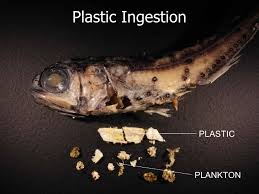
Myctophid with plankton and plastic particles
Iddy
biddy fish ingesting miniscule particles of plastic might not sound too
awful. Until now these four to five centimeters long, two to five grams
fishes were seen as inferior to our other little finned friends - the
sardine or anchovy. Myctophids were ground into fodder for industrial
fish farms. However the line from plastic-gobbling Myctophids to your
next meal is about to get a lot more direct.
Some in the fishing industry see huge potential
for this "untouched resource" and are developing methods to convert
this plentiful, but low value fish, into a high value-added product.
Ungutted Myctophids will be processed into surimi (the Japanese
term for mechanically deboned fish mince) with uses ranging from fish
products, to meat substitutes, and dessert dishes.
It would seem ecological folly to mess with a fish species that is the very basis of important marine food webs - swordfish, tuna, dolphins and seals eat Myctophids.
Not
to mention the risk taken if we ingest plastic -- a possibility that is
in the news more and more these days. Last fall scientists discovered
there are microplastics in two-dozen German beers and European shellfish lovers ingest 11,000 pieces of plastic a year in their pursuit of gastronomic nirvana.
Apart
from how unappetizing eating or drinking plastic sounds, it's all the
nasty chemicals in plastic (phthalates - known endocrine disruptors -
are used to soften plastic) and that adhere to plastic so eagerly in the
marine environment (POPs, DDT and flame retardants) that make it highly toxic.
But now for the good news: with this growing pile of evidence about the pervasiveness of plastic pollution, we can take action.
This
is the moment to change our reliance on the not-so-disposable-after-all
polymer. If we can move beyond a single-use throw-away mentality, and
incentivize the plastics industry to design effective end-game
recyclability into their products - the size of the problem will begin
to diminish.
Which is precisely what's needed to assist less discerning species cope with our plastic mess.
Captain Charles Moore of Algalita Marine Research and Education, describes himself as the ocean's "voluntary public defender" - The Lorax
who speaks for the seas, if you will. He says organisms can't cope with
plastic because it's happened too quickly, "people think stupid
myctophids to eat plastic, but evolutionarily speaking they have no
selection process to avoid to it."
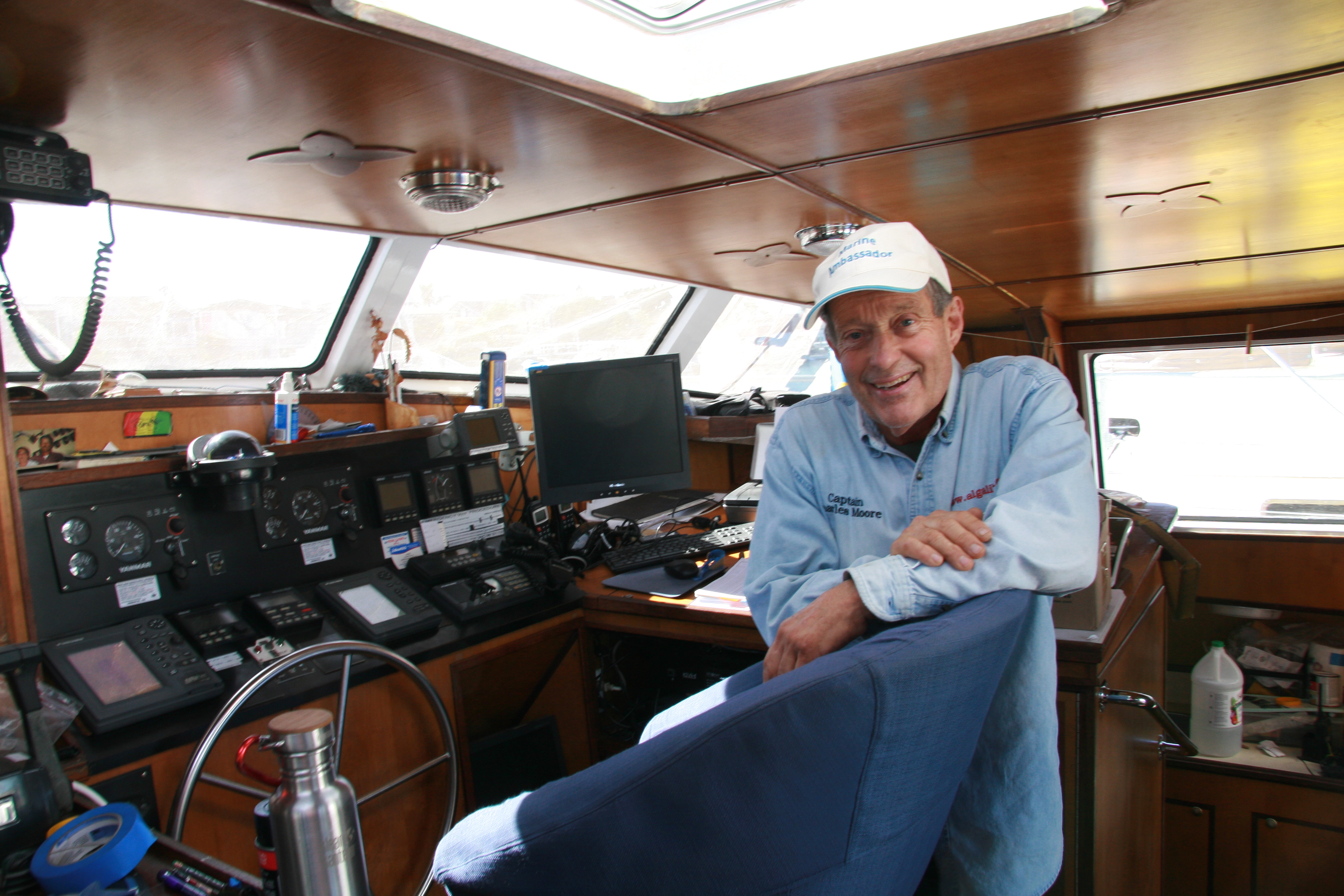
Captain Charles Moore, on board oceanographic research vessel, Alguita, November 2014
Myctophids
are Captain Moore's "Humming-Fish" but unlike the fictional Lorax he
can't send them away to an ocean without plastic -- that ocean no longer
exists.
Crafty little guys, Myctophids, stay low in the water
column during daylight avoiding predation, then rise to feed on
zooplankton at the ocean surface during the darkest hours of night.
To aid in this diel migration, Myctophids have swim bladders
that alter their buoyancy as required. But what will happen to this
mechanism in a fish that has a belly full of flotation devices - plastic
particles.
If it hasn't been incinerated, every piece of plastic
ever produced is still with us. There is no time for any species to
biologically adapt to cope with plastic, including us. We have to make
an effort to culturally evolve with way less plastic.
Put another way: think long and hard about what you want to be eating and gazing upon in the days to come.
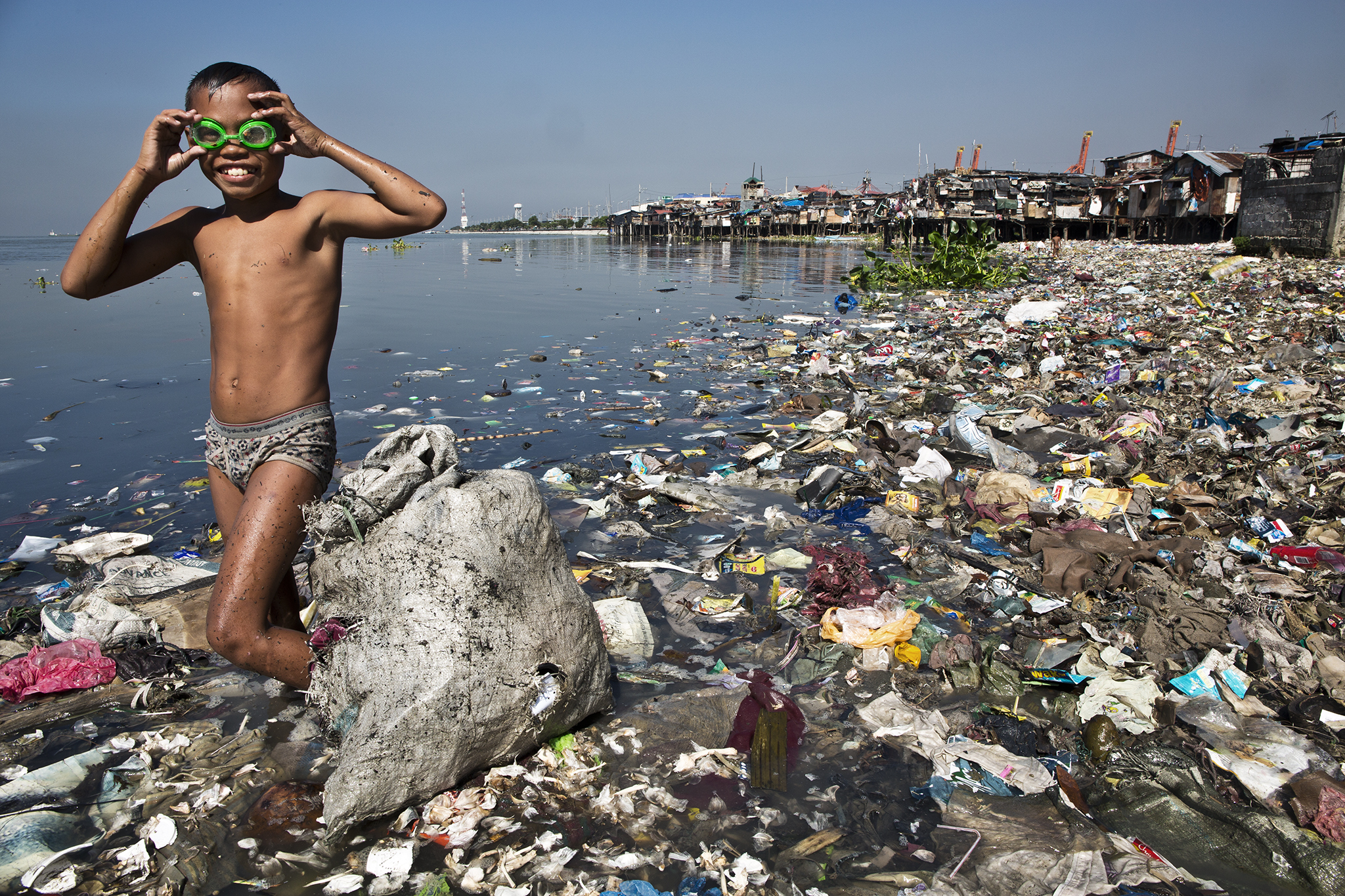
There is currently an estimated 3.5 million tons of trash floating around the Pacific Ocean, in what's called the Great Pacific Garbage Patch. It's believed the patch spans roughly twice the size of the continental U.S.
Also known as the Pacific Trash Vortex, the Great Pacific Garbage Patch is not an island or land mass necessarily visible to the naked eye, like many assume.
Instead, the patch is made up largely of broken down microplastics - small particles of non-biodegradable material drawn together at the convergence of different ocean currents - which appear as a kind of cloudy soup.
There are at least 260 known species which feed on these microplastic particles, confusing them for plankton. These plastics then travel up the food chain, resting in the stomachs of increasingly larger predators, like tuna or mahi-mahi, for instance.
It takes about 600 years for plastic in the ocean to fully break down. It's then crucial we keep our plastic and litter out of the oceans, or we'll be eating our trash for ages to come.
The
head of Ocean Conservancy says a burgeoning middle class and low
recycling rates could lead to not-even-remotely-acceptable levels of
trash washed out to sea
Published in The Guardian by Jo Confino, January 26, 2015
Fish swim near a plastic bag off of Egypt’s Red Sea coast. Will plastic
some day outweigh fish in our oceans? Photograph: Mike Nelson/Mike
Nelson /epa/Corbis
A failure to address the mountains of waste in the developing world
will result in as much plastic in our oceans as fish, the head of Ocean
Conservancy has warned.
Andreas Merkl, CEO of the Washington-based environmental NGO, said
the combination in the developing world of a burgeoning middle class and
low recycling rates will lead to an exponential rise in the amount of
plastic washed out to sea.
If governments and the private sector fail to solve this problem, “we
end up with an ocean that has an amount of plastic that’s in the same
order of magnitude as the amount of fish, in terms of tonnes”, Merkl
told Guardian Sustainable Business.
“We have enormous uncertainty about what that actually means, but it
is a situation where you cannot call yourself an ocean conservationist
or any person that cares about the ocean and find that even remotely
acceptable.”
There are currently estimated to be around 800m tonnes of fish in the
oceans and 100m to 150m tonnes of plastic. This is increasing by around
20m tonnes a year, but that growth is expected to accelerate as far
greater numbers of people are able to afford to buy products that are
made with, or packaged in, plastic.
Novelli said the problems were becoming particularly
acute in regions – such as parts of Asia – that have a huge middle
class, but trash collection of only around 40%, compared with 95% in the
US.
Pointing to the circular economy – the idea of turning trash into raw
materials for new products – as one of the key solutions, she said: “We
need to have a real economic analysis of the entire supply chain and
target what needs to be done and work with friendly governments and
cities to show what practically can be done. You have to bring it to
reality otherwise everyone despairs.”
It’s important for business leaders and policy makers to come out of
their separate silos and work together on solutions, Novelli said,
adding that there is an opportunity to partner with big and influential
countries like China and India to redesign the world economy.
“We all have the same issues of what is threatening us,” she said.
“There are different perspectives, but that is all to the good.”
In the search for practical solutions, the Trash Free Seas Alliance, a
collaboration between industry and NGOs, is planning to carry out
detailed studies in three or four countries, with a particular emphasis
on Asia.
Merkl says the plan is to “really dig into the economics of
collection and recycling so that people will find it profitable to
collect and to separate. The fact is that even at a scavenger economy
level of daily wages, recycling these types of plastics are currently
not worthwhile, which is why so much just ends up going in the ocean.
The question, then, is how do we fundamentally change that.”
He said it was disingenuous to seek a ban on non-recyclable flexible
plastic, like cellophane, as it is an “enormous accelerator in
lifestyles”. Not only does wrapping food reduce the spread of typhoid,
but single-use containers gives people access to clean water.
Fortunately, Merkl said the issue is starting to rise up the
political agenda, helped by the sight of giant gyres of marine debris
and by people from the developed world going on beach holidays and
finding plastics clinging to their bodies.
There is also growing concern about the toxicity of fish that end up
eating small fragments of plastic, which they mistake for plankton.
It’s a health issue,” Merkl said. “It’s an equity issue. It’s a land pollution issue and it’s an ocean pollution issue.
“For example, between 50m to 60m individual sachets of water are
thrown away every day in Nigeria alone. If you go to Lagos, they’re
drowning in sachets and they are clogging the drainage system.”
While improving collection and recycling is the quickest way to drive
change, Merkl insisted that plastics companies and consumer goods firms
also must act decisively.
“We would love to see a simplification of the plastics used,” he
said. “We’d like to see less colour and an end to gluing sleeves of
advertising around plastic containers. So there’s a bunch of design work
that we can do and is very, very important.”
She is encouraging private companies and cities to collaborate to
ensure that “everything has value to the economy in the future” and does
not just get thrown away.
Bill McDonough, the US designer and author who believes we can design
materials, systems, companies and products that continuously improve
over time, said the Chinese were starting to take the lead in turning
the circular economy from an idea into reality.
McDonough, the co-creator of the cradle-to-cradle design concept,
said the authorities in Beijing are currently moving from “promoting the
circular economy to implementing it”.
We need to design things that are valuable for next use and stop
using the words ‘end of life’,” he said. “Being less bad is not being
good. We need to start from the mindset of what would plastics look like
if the ocean is fabulous.”
The water hub is funded by Grundfos. All content is editorially independent except for pieces labelled “brought to you by”. Find out more here.
The documentary 'Plastic Paradise' explains how this consumer-driven
catastrophe is destroying the oceans and how we can fix it.
Initially mass-produced in the 1940s as the disposable answer to convenience-minded consumers, plastic is the ecological disaster few saw coming.
By 2050, plastic production will quadruple to 2 trillion pounds per
year. The U.S. alone produces 15 billion pounds of plastics a year, and
85 million plastic bottles are used every minute. Most of this plastic
is not recyclable, and much of it ends up in the ocean, where currents
bring it to an area twice the size of Texas known as the Great Pacific
Garbage Patch.
Midway Atoll, four hours by plane from Honolulu, is ground zero for
this aquatic dumping ground, its beaches littered with debris.
Discarded fishing nets strangle wildlife and destroy coral reefs, and
tiny microplastic bits swallowed by birds and fish move up the food
chain, all the way to our tables.
Journalist and filmmaker Angela Sun investigated several aspects of
this complex environmental issue, its ramifications, who is
responsible, and what can be done to fix the problem in her documentary
"Plastic Paradise," a labor of love that was seven years in the making.
Why did you want to make the film?
Angela Sun: Simply because I love the oceans, and I
love storytelling. I have always been fascinated with everything under
the sea, from a young age. Growing up with immigrant Chinese parents,
things like scuba diving, surfing and swimming with sharks were
considered crazy talk. So, naturally, as the middle child I always
wanted to go the less traveled route. As a journalist, I have always
been curious and inquisitive about the world and love to explore and
uncover untold stories. The oceans needed a platform, and as a
journalist, the goal is to give a voice to the voiceless.
I was working for Current TV at the time when a colleague and good
friend of mine were discussing story ideas and this was one of them. We
were pitching it as a story for a news magazine on the network. When it
got cut due to budget and access issues, I couldn't let the story
go. From the inception of the idea to the finished locked picture, it
took about seven years.
What was your approach going into it?
My mission was to make this issue of disposable plastics
interesting to the general public and get the mainstream to understand
the gravity our incessant consumerism and dumping of waste into the
oceans. I have always held true to my mission of reaching viewers in a
landlocked area, for example, the Midwest, to care about something so
far away and seemingly out of sight, out of mind.
What were your biggest challenges?
Financing is almost every independent film's biggest challenge. I
ended up self-financing the project, which is why it took so long to
finish. It was also hard to gain access to Midway as I had applied for
permits during the time it became a national marine sanctuary. I think
the biggest challenge is having the perseverance to see this project
through to fruition. I would take breaks here and there, and people who
were helping out on the film would come and go, but it took a lot of
focus and determination to get this done. A lot of people see the glitz
and glamour of film festivals, awards and accolades, but behind all of
that, many times I have felt the lonely road.
What were the most shocking things that you learned?
The most shocking thing I learned was simply seeing those birds
with bellies full of plastic in real life. The smell too: On Midway
Atoll there is an area where they would pile up all the dead birds and
the rancid smell of decomposed remains almost made me throw up.
Additionally the thought that almost every single piece of plastic is
still somewhere on our planet is crazy! If it never goes away, and we
don't see it, it's got to be somewhere, and those albatross on Midway
are canaries in the coal mine. I was also shocked to learn that plastic
was made for war just a few decades ago, and we are just at the tip of
the iceberg with shocking statistics and findings of really how much
plastic is in our oceans.
What are the most important messages you wanted to convey?
My hope is to educate and shed light on this under-reported issue
of our plastic trash and its effects, not just on wildlife but how harmful single-use plastics truly are to our waterways and how they are rapidly making their way up the food chain and into our bodies.
We, the general public, do have influence and can be the change we
wish to see. If every single person just even did something as simple as
saying 'no' to single disposable drinks, that would have a massive
impact and save so much unnecessary waste in our environment. Where
there is a will, there is a way. The journey of making this film and
sharing it is testament to that.
I hear it took three years to get access to Midway. Why was it so difficult to get cooperation?
There was a lot of red tape gaining access initially as it was
switching to a national marine monument status, so the governmental
agencies would play ping-pong sending us back and forth. It was
difficult to get the elusive plastic industry to agree to speak. You
will have to watch the film to find out what happens!
A pile of garbage on the Midway Atoll. The trash, from the Great Pacific Garbage Patch, washes up on Midway's shore.
Where has the film been shown and where can it be seen now?
We have been to over 30 film festivals, garnered eight awards, and
is now airing on Pivot TV network as well as iTunes, Amazon, Hulu,
GooglePlay, Vudu, Target Ticket. The DVD is available at our website.
It will be release on SBS TV Network in Australia in February. We are
working with BullFrog Films for educational distribution.
What has the reaction been to date?
Great reactions, and I usually get frustrated texts and messages
from friends who decide to take our two-week pledge to say no to
single-use plastics after watching the film. It's hard! But many people
have joined us and told me they have changed their lifestyle because of
the film. For more information on joining others worldwide, we have a pledge on our website.
Do you think it will make a difference? Can this problem be fixed? What will it take?
I can only hope. This problem is not going away anytime soon. It is
just going to continue to grow. With every unfortunate search for
missing planes, plastic trash in our oceans comes back into the news
cycle. As China and other nations become more industrialized, following
western ideologies of consumption, a precarious future is on the
horizon.
I think simple consumer changes can help pave the way and encourage
industry to become more innovative. However, for real sweeping change,
there needs to be legislation to keep the plastic industries in check.
An example: I was fortunate to be presented an award from a California
assemblymember who helped usher the historic SB-270 bill [prohibiting
plastic grocery bags] through. He mentioned that he showed the film to
others in the state legislature before the vote, and it helped explain
the situation and what a burden it has been on taxpayers and the state
of California. That was a tangible piece of evidence that this film can
make a difference, little by little. Every day we can all be doing
something quite simple. Practice the 4th R — REFUSE — then reduce,
reuse, recycle. Say no to that straw, or bag, or coffee cup lid that
will stay on for less than five minutes. Be aware and a conscious
consumer. It starts with lowering our own consumption.
What do you hope audiences take away — and do?
I hope they take away a respect for the oceans and are moved to
taking action along with understanding the urgency for change before we
ruin ourselves just quietly. Just say no and refuse single-use plastics.
A dead whale in Rotterdam, the Netherlands, in 2011. As container ships multiply, more whales are being harmed, a study said.Credit
Marco De Swart/Agence France-Presse — Getty Images
A
team of scientists, in a groundbreaking analysis of data from hundreds
of sources, has concluded that humans are on the verge of causing
unprecedented damage to the oceans and the animals living in them.
“We
may be sitting on a precipice of a major extinction event,” said
Douglas J. McCauley, an ecologist at the University of California, Santa
Barbara, and an author of the new research, which was published on Thursday in the journal Science.
But
there is still time to avert catastrophe, Dr. McCauley and his
colleagues also found. Compared with the continents, the oceans are
mostly intact, still wild enough to bounce back to ecological health.
“We’re
lucky in many ways,” said Malin L. Pinsky, a marine biologist at
Rutgers University and another author of the new report. “The impacts
are accelerating, but they’re not so bad we can’t reverse them.”
Scientific
assessments of the oceans’ health are dogged by uncertainty: It’s much
harder for researchers to judge the well-being of a species living
underwater, over thousands of miles, than to track the health of a
species on land. And changes that scientists observe in particular ocean
ecosystems may not reflect trends across the planet.
Transplanted coral off Java
Island, Indonesia. Great damage results from the loss of habitats like
coral reefs, an analysis found.Credit
Aman Rochman/Agence France-Presse — Getty Images
Dr.
Pinsky, Dr. McCauley and their colleagues sought a clearer picture of
the oceans’ health by pulling together data from an enormous range of
sources, from discoveries in the fossil record to statistics on modern
container shipping, fish catches and seabed mining. While many of the
findings already existed, they had never been juxtaposed in such a way.
A number of experts said the result was a remarkable synthesis, along with a nuanced and encouraging prognosis.
“I
see this as a call for action to close the gap between conservation on
land and in the sea,” said Loren McClenachan of Colby College, who was
not involved in the study.
There
are clear signs already that humans are harming the oceans to a
remarkable degree, the scientists found. Some ocean species are
certainly overharvested, but even greater damage results from
large-scale habitat loss, which is likely to accelerate as technology
advances the human footprint, the scientists reported.
Coral reefs, for example, have declined by 40 percent worldwide, partly as a result of climate-change-driven warming.
Some
fish are migrating to cooler waters already. Black sea bass, once most
common off the coast of Virginia, have moved up to New Jersey. Less
fortunate species may not be able to find new ranges. At the same time,
carbon emissions are altering the chemistry of seawater, making it more
acidic.
“If
you cranked up the aquarium heater and dumped some acid in the water,
your fish would not be very happy,” Dr. Pinsky said. “In effect, that’s
what we’re doing to the oceans.”
Fragile
ecosystems like mangroves are being replaced by fish farms, which are
projected to provide most of the fish we consume within 20 years. Bottom
trawlers scraping large nets across the sea floor have already affected
20 million square miles of ocean, turning parts of the continental
shelf to rubble. Whales may no longer be widely hunted, the analysis
noted, but they are now colliding more often as the number of container
ships rises.
Mining
operations, too, are poised to transform the ocean. Contracts for
seabed mining now cover 460,000 square miles underwater, the researchers
found, up from zero in 2000. Seabed mining has the potential to tear up
unique ecosystems and introduce pollution into the deep sea.
The
oceans are so vast that their ecosystems may seem impervious to change.
But Dr. McClenachan warned that the fossil record shows that global
disasters have wrecked the seas before. “Marine species are not immune
to extinction on a large scale,” she said.
Until now, the seas largely have been spared the carnage visited on terrestrial species, the new analysis also found.
The
fossil record indicates that a number of large animal species became
extinct as humans arrived on continents and islands. For example, the
moa, a giant bird that once lived on New Zealand, was wiped out by arriving Polynesians in the 1300s, probably within a century.
But it was only after 1800, with the Industrial Revolution, that extinctions on land really accelerated.
Humans
began to alter the habitat that wildlife depended on, wiping out
forests for timber, plowing under prairie for farmland, and laying down
roads and railroads across continents.
Species
began going extinct at a much faster pace. Over the past five
centuries, researchers have recorded 514 animal extinctions on land. But
the authors of the new study found that documented extinctions are far
rarer in the ocean.
Before
1500, a few species of seabirds are known to have vanished. Since then,
scientists have documented only 15 ocean extinctions, including animals
such as the Caribbean monk seal and the Steller’s sea cow.
While these figures are likely underestimates, Dr. McCauley said that the difference was nonetheless revealing.
“Fundamentally, we’re a terrestrial predator,” he said. “It’s hard for an ape to drive something in the ocean extinct.”
Many
marine species that have become extinct or are endangered depend on
land — seabirds that nest on cliffs, for example, or sea turtles that
lay eggs on beaches.
Still,
there is time for humans to halt the damage, Dr. McCauley said, with
effective programs limiting the exploitation of the oceans. The tiger
may not be salvageable in the wild — but the tiger shark may well be, he
said.
“There are a lot of tools we can use,” he said. “We better pick them up and use them seriously.”
Dr.
McCauley and his colleagues argue that limiting the industrialization
of the oceans to some regions could allow threatened species to recover
in other ones. “I fervently believe that our best partner in saving the
ocean is the ocean itself,” said Stephen R. Palumbi of Stanford
University, an author of the new study.
The
scientists also argued that these reserves had to be designed with
climate change in mind, so that species escaping high temperatures or
low pH would be able to find refuge.
“It’s creating a hopscotch pattern up and down the coasts to help these species adapt,” Dr. Pinsky said.
Ultimately,
Dr. Palumbi warned, slowing extinctions in the oceans will mean cutting
back on carbon emissions, not just adapting to them.
“If
by the end of the century we’re not off the business-as-usual curve we
are now, I honestly feel there’s not much hope for normal ecosystems in
the ocean,” he said. “But in the meantime, we do have a chance to do
what we can. We have a couple decades more than we thought we had, so
let’s please not waste it.”
A version of this article appears in print on January 16, 2015, on page A1 of the New York edition with the headline: Ocean Life Faces Mass Extinction, Broad Study Says.
Douglas J. McCauley, an ecologist at the University of California, Santa Barbara, recently published a study in journal Science that only solidifies this fact. “We may be sitting on a precipice of a major extinction event,” McCauley tell the New York Times.
This is not to say that we are in the clear though, McCauley’s study shows that if we don’t take action soon that this hopeful message will be lost for good. Humans have begun to industrialize
our use of the ocean’s resources and as the result we have seen a great
decrease in the number of large marine species – like whales and sharks
– as well as declines in small marine animals. This causes a
significant imbalance in ocean ecosystems.
McCauley points to bottom trawling
as an example of how humans have industrialized the process of fishing.
In bottom trawling, long, heavy nets are dropped to the depths of the
ocean and dragged along the ocean floor, catching anything and
everything in its path. This practice wipes out fish stocks and lowers
the number of fish available to commercial fisheries.
To make up for
this lack of fish, we’ve created the equivalent of factory fish farms. Seabed mining
is also gaining popularity and the amount of plastic pollution dumped
into the oceans is increasing. The more carbon we emit into the
atmosphere, the more acidic the oceans get.
McCauley stresses that the oceans are vast, but marine species are not impervious to extinction.
We have seen the impact of species extinction on terrestrial ecosystems
… and it isn’t pretty. In the long run, the health of the oceans and
the land environment is important to our own health.
The signs that we failed to learn from in the extinction of land
species are being seen in the oceans and it is up to us to take them
seriously. There are many things you can do to help protect the oceans.
First and foremost, cutting your own carbon footprint is the place
to start. A great way to do this is to leave meat out of your diet. By
doing this one simple thing, you can half your carbon footprint.
Second, seeing the damage commercial fisheries are causing to the
oceans, the logical solution is to limit or completely eliminate your
consumption of fish. If you don’t eat fish for a year, you can save 225 fish and 125 shellfish!
We can all make minor changes to benefit the world’s oceans. There is
still time to change the tide for the future of marine species, but
this time shouldn’t be wasted! Image source: Andrew K/Flickr
Riz boardshorts are already using recycled material in their
current range but the team want to take it to the next level by making
sure that absolutely every element is made from reclaimed materials
including the zips, thread and buttons.
But this is just the half of it, next on the agenda for the company
is the ultimate challenge of cleaning the beach and ocean and
transforming the plastics collected into their end product. You can get
involved and do your bit by supporting their crowdfunding campaign.
Their second, and much bigger challenge, is to take waste
plastics from our beaches and oceans and transform them into new
clothing
Riz Smith, who launched the company, said the idea was born out of a
connection with the ocean. Hailing from Devon, sailing and surfing was a
big part of his childhood. Now all grown up and living in London, Riz
realised how vital the oceans are for the survival of the planet.
“Sadly, our oceans and beaches are littered with waste plastics.
Experts estimate that there are 46,000 pieces of plastic in every square
mile of the ocean. We don’t want our shorts to end up littering
landfills or oceans, so, in an effort to do our part, we’ve developed
the Rizcycling programme.” Riz told Drift
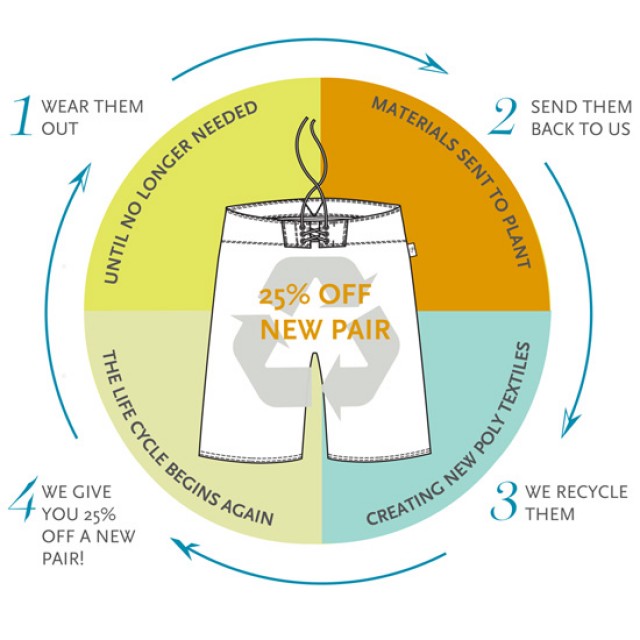
“Rizcycling means working with our customers to create a perpetual
loop that transforms waste and worn out swimwear into beautiful new
products. ” He added
Their second, and much bigger challenge, is to take waste plastics from our beaches and oceans and transform them into new clothing. The company target is to make the first pair of shorts from ocean plastic fabric by 2016.
To find out more and to support the boardshort campaign visit their crowdfunding page or watch the video below