A blog set out to explore, archive & relate plastic pollution happening world-wide, while learning about on-going efforts and solutions to help break free of our addiction to single-use plastics & sharing this awareness with a community of clean water lovers everywhere!

Monday, October 28, 2013

Behind the scenes: plastic-eating barnacles in the North Pacific Gyre

I’ve been temporarily released from my social media silence to talk about my latest paper, which is published in the open-access journal PeerJ. So first of all HAI EVERYONE! Second of all – here’s how I accidentally discovered that gooseneck barnacles are eating plastic, and why it’s so difficult to figure out what effect that is having on the ocean.

On my 2009 expedition to the North Pacific Subtropical Gyre, otherwise known as the “Great Pacific Garbage Patch,” I collected a bunch of barnacles, along with samples of a lot of other organisms that were growing on the debris, because I was interested in seeing what species were there. Gooseneck barnacles look kind of freaky. Like acorn barnacles (the ones that more commonly grow on docks), they’re essentially a little shrimp living upside down in a shell and eating with their feet. Unlike acorn barnacles, gooseneck barnacles have a long, muscular stalk.
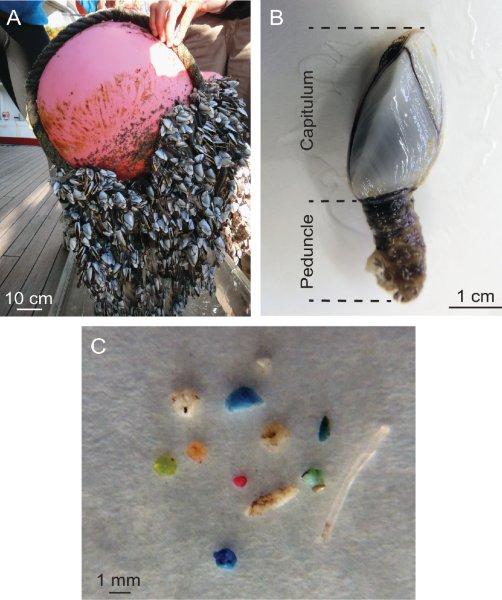
This is a figure from our paper that shows (a) barnacles growing on a buoy; (b) a closeup of an individual barnacle. The body is inside the white shell, and the stalk is just muscle; and (c) Plastic that we pulled out of a single barnacle's guts.
This is a figure from our paper that shows (a) barnacles growing on a buoy; (b) a closeup of an individual barnacle. The body is inside the white shell, and the stalk is just muscle; and (c) Plastic that we pulled out of a single barnacle’s guts.

It took me a couple years to get around to processing those samples, but eventually I found myself in the lab dissecting barnacles in order to identify them. As I sat there, I thought “Well, I’m working on these barnacles anyway – wonder what they’re eating?” So I pulled out the intestine of the barnacle I was working on, cut it open, and a bright blue piece of plastic popped out. I reached into my jar o’ dead barnacles and dissected a few more, and found plastic in their guts as well.

Thinking about it logically, it makes a lot of sense that gooseneck barnacles are eating plastic. They are really hardy, able to live on nearly any floating surface from buoys to turtles, so they’re very common in the high-plastic areas of the gyre. They live right at the surface, where tiny pieces of buoyant plastic float. And they’re extremely non-picky eaters that will shove anything they can grab into their mouth.
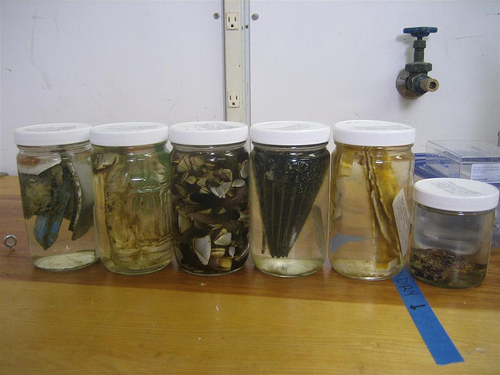
My jars of samples. The original jar o' barnacles is in the middle.
My jars of samples. The original jar o’ barnacles is in the middle.

But, since I didn’t really collect barnacles with this study in mind, I didn’t have enough samples to figure out how widespread this phenomena might be. Fortunately, I’d been lucky enough to collaborate with the wonderful Sea Education Association and one of their chief scientists, Deb Goodwin, for several years. SEA kindly took samples for us, and Deb, once a perfectly respectable remote sensing expert, got deep into some pretty smelly barnacle guts.

After dissecting 385 barnacles, Deb and I found that 33.5% – one-third – had plastic in their guts. Most barnacles had eaten just a few particles, but we found a few that were absolutely filled with plastic, to a maximum of 30 particles, which is a lot of plastic in an animal that is just a couple inches long.  We also analyzed the type of plastic in the barnacle guts, and found that it was approximately representative of plastic on the ocean surface – the barnacles are probably just grabbing whatever they come across and shoving it into their mouths.  Barnacles are perfectly capable of pooping out plastic – I observed plastic packaged up in fecal pellets, ready to be excreted the next time the barnacle had access to a couple minutes and a magazine – so it is very likely that more barnacles are eating plastic than we were able to measure.
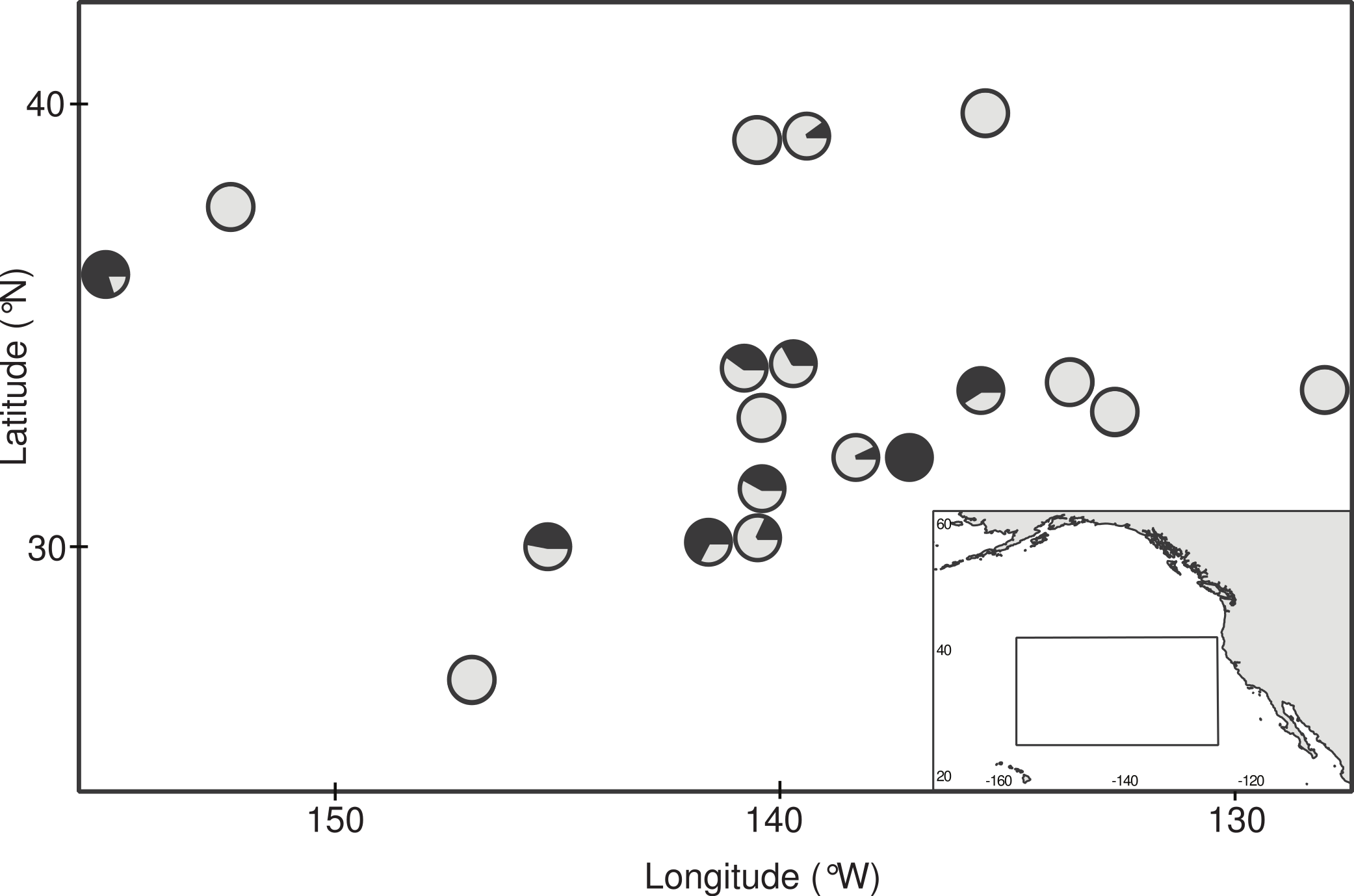
The circles show where we sampled, and the dark part of the circle is the percentage of barnacles that had eaten plastic. The inset shows where we were in the ocean - the rectangle between North American and Hawaii.
The circles show where we sampled, and the dark part of the circle is the percentage of barnacles that had eaten plastic. The inset shows where we were in the ocean – the rectangle between North American and Hawaii.

So, this is disturbing. As I’ve discussed many times, there is a ton of plastic in the North Pacific Subtropical Gyres (but no island!) and it is being eaten by birds, turtles, and fish. And now we’ve documented plastic ingestion in a very common invertebrate – probably the numerous animal living attached to the plastic – as well. But just finding plastic in barnacle guts does not really tell us much about how plastic is impacting the oceanic ecosystem. This is because we don’t really understand how barnacles are interacting with the rest of the ocean.

Gooseneck barnacles aren’t necessarily incredibly central to the North Pacific Gyre ecosystem. The barnacles are voracious predators, but since plastic is so patchy, it’s not clear that they eat enough zooplankton to really affect the ecosystem – and a lot of the food I found in the barnacle guts were their own cyprid babies.

(Barnacles are nasty cannibals, apparently.) They’re eaten by a few predators – a pretty little sea slug and some crabs – but fish don’t seem that interested in barnacles, maybe because those fish didn’t evolve with a ton of floating debris. If barnacles are an important prey item, it is possible that their ingestion of plastic particles could transfer plastic or pollutants through the food web, but it is far from clear this is the case.

However, the most dire effects could be the most subtle. The subtropical gyres are 40% of the entire earth’s surface, and so they are very important to controlling the way that nutrients and carbon move around in the ocean. The microbes and animals that live on plastic debris are not the same as the microbes and animals that float around in the ocean, and may not act in the same way. It’s such a cliché for a scientist to call for more research, but we just don’t understand enough about the way that the ocean works, and enough about the way that plastic affects the ocean, to really say what the effects of barnacles eating plastic might be.

And the North Pacific Subtropical Gyre is a really nice place! Don't think of it as JUST a giant trash pile!
And the North Pacific Subtropical Gyre is a really
nice place! It’s good to know what is going on there!

Of course, none of this uncertainty changes the fact that plastic trash does not belong in the ocean, and we need to be a lot better about preventing it from getting in there in the first place. However, I am skeptical of plastic cleanup schemes, so please read these Open Ocean Cleanup Guidelines (which I co-authored) and Dr. Martini’s post before you suggest that we just clean it up. I think we are probably stuck with the plastic pollution that we have, so understanding what it is doing to the ocean is important.
I’ll be back in a couple weeks to do another behind-the-scenes post on a second debris-related paper! In the meantime, I’m happy to answer your questions about the barnacles.

Barnacles Eating Plastic A Sign Of Our Synthetic Times

Posted: Christian Cotroneo in the Huffington Post Canada

When marine biologist Miriam Goldstein sliced open a barnacle's belly, she saw a tiny plastic bauble.

So she spilled a few hundred more barnacle guts -- and found humanity's synthetic soul.

"I think it speaks to the ubiquity of plastic in the North Pacific," she tells the Huffington Post Canada. "There is a little tiny piece of plastic spread out over thousands upon thousands of miles of the open ocean really far away from land. It is really an enormous problem."

gooseneck barnacle
Goldstein, an oceanographer at UC San Diego’s Scripps Institute of Oceanography plucked the barnacles from the notorious North Pacific Subtropical Gyre.

A vast expanse of plastic in the north Pacific, it's commonly called the Great Pacific Garbage Patch -- a sprawling indictment of our wasteful ways, where coffee cups, bags, toys, and whatever-you-wrapped-your-sandwich-in clumps together in the North Pacific.

And it's increasingly finding its way into the food chain.

"There are whales and sea birds and sea turtles and fish all eating plastic," Goldstein says. "It's not surprising that barnacles are too."

Gooseneck barnacles -- Goldstein describes them as "essentially a little shrimp living upside down in a shell and eating with their feet" -- may be able to handle the plastic better than other marine animals.

"It really appears from looking at their guts that the plastic was just passing through," she adds.

In that case, the barnacles would be doing us no favours, as the plastic isn't broken down.
Sea turtles and birds, on the other hand, show well-documented signs of intestinal blockage after eating plastic. Many simply starve.

Barnacles, on the other hand, are much more likely to serve as quiet, gnawing condemnation of our plastic ways.

"I think we should be concerned that the ocean is actually covered in a sprinkling of plastic particles," she says. "The barnacles are reflecting the fact that there is a tonne of plastic in the open ocean.

"We need to do more to understand what that might mean. We don don't know. This is a pretty new and large-scale and depressing problem. Plastic has only been around as a consumer product since the 1950s."

It all reminds her of an ancient culture that "used to think that the soul was in the stomach"

Only trouble is it's our soul.

Monterey Peninsula's Marine Life Studies fosters love of ocean, whales

Programs focus on education, research

Posted:   10/19/2013 By DENNIS TAYLOR in the Monterey Herald

She was 41 by the time she saw her first whale off the coast of Maui, and Michigan-born Peggy West-Stap says it changed her life.

"I immediately decided I wanted to provide the opportunity for anybody to have the same experience," said Stap, 58, who in 2006 founded Marine Life Studies, a Monterey Peninsula environmental organization specializing in research, education and conservation surrounding the protection of marine wildlife.

Stap and a gaggle of volunteer ocean stewards were hosts Saturday of a five-hour whale-watching cruise on Monterey Bay for "Flip for Whales," a special fundraiser to keep the nonprofit alive and thriving.

The day was a dandy 70 degrees, with placid waters. The crew and passengers of the 60-foot vessel "High Spirits" spotted around 50 whales — mostly humpbacks — plus a variety of other sea life.

"We saw whales breaching, coming up to feed. ... It was just a stellar day," said Jerry Perezchica, the organization's program manager. "We also saw lots of sea lions in mass formations because as the humpbacks were feeding, they also were expelling food, and the surrounding marine life was taking advantage that."

The economic climate for nonprofits is challenging nowadays — grants have diminished or vanished altogether, and donations have largely dried up. But Stap and her staff are determined to battle the tides for their cause.

"My greatest love is the ocean, doing research on whales and dolphins, teaching research techniques to our interns, taking kids, teenagers, college students and adults out on the water so they can experience it personally and develop a love of their own," she said.

"We've educated people from the Midwest, where I'm originally from, about the fact that anything they do there will affect our waterways and oceans. If we can show those people how wonderful our oceans are, and send them back home with that knowledge, maybe we can reduce the amount of plastic use."

Plastic is the ocean's enemy because it never goes away — it only degrades into smaller particles. Plastic and other contaminants from waters like Lake Erie — which has more parts per million of plastic than the infamous stretch of floating debris known as the Great Pacific Garbage Patch — travel downstream to the ocean, where they are ingested by sea life (and, subsequently, ingested by humans).

Marine Life Studies takes a multi-pronged approach to education that includes Stap's own creation, Take It to the Streets, a regular cleanup effort in which volunteers pick up trash before it can reach storm drains, which flow into Monterey Bay.

In bimonthly cleanups since April, plus one in January, they've collected 66,335 items, including 44,844 cigarette butts, 9,493 plastic items and 7,001 paper items, plus metal, foam plastics, household items and medical hygiene items. The collection weighs 900 pounds.

"We don't just collect the trash, we analyze it," Perezchica said. "What we're striving to do is understand the source of the trash so we can better educate the public."

The organization also teaches classes at the Boys and Girls Clubs of Monterey County in Salinas and Seaside, then takes the students whale-watching. A highlight of a recent trip was when Nick Levin, skipper of the Star of Monterey, shot off his engines, then asked his passengers to be completely quiet so they could hear the one-of-a-kind sound of a blue whale expelling a 30-foot spout of water from its blow hole.

Stap and Marine Life Studies also are involved with an effort to track down and free whales that have become entangled in fishing line, fishing nets and other man-made debris.

The organization has attracted interns — who serve as ocean stewards on whale-watching excursions — from as far away as Australia and Ireland.

Sarah Colosimo, an Australian, said she was connected with the organization through a friend who had done humpback whale research with Stap.

"He told me that Peggy also did orca research, and I'm really passionate about orca whales, so I got in touch with her and here I am," Colosimo said. "It's a truly amazing experience. Doing research is totally cool — a dream come true. I had my first experience with an orca last weekend, which was a moment I had waited for my whole life."

Rachael Sutton, a Lake County resident, said part of her pleasure is watching other passengers enjoy their own whale-watching experience.

"We saw a lot of humpbacks today, and a whole bunch of sea lions jumping around, playing with them," she said. "It was so much fun watching other people experience this awesome thing we have here in Monterey. Connecting wildlife and people together is really great."

Twins Ben and Georgia Bence, both Monterey High School sophomores in the school's Marine Animal Ocean Science program, met Stap through a class she taught for the Regional Parks District.

"It's been my dream to have hands-on experiences like this and to really make a difference," Georgia Bence said. "This organization has given me so many amazing opportunities. Whales are so majestic and beautiful, and just being able to witness the power is overwhelming."

Marine Life Studies is a finalist in Toyota's "100 Cars For Good" competition, which will award a new vehicle to the organization that receives the most online votes. Visit www.100carsforgood.com on Nov. 9 to vote.

To donate to the program or learn more, call 901-3833 or see www.marinelifestudies.org.
Dennis Taylor can be reached at 646-4344 or dtaylor@montereyherald.com.


Thursday, October 24, 2013

Great Pacific Garbage Patch - the real story

Posted in Sail-World.com by Sailors for the Sea - Ocean Watch Essay


'Microplastics, picked up from the ocean in a bucket - Photo by Maggie Ostdahl'    .

No doubt you have heard of the so-called Great Pacific Garbage Patch, and thought goodness, that’s terrible, someone should clean up that island of trash.

Here is the real story: There is no island of trash (it’s more of a trashy soup), and the solution is to stop our trash – mostly made of plastic – from getting to the middle of the ocean. Solving the problems of marine debris and plastic pollution is a perfect example of the need to think globally and act locally.


What is marine debris, and why does it end up in gyres?

Marine debris, as defined by NOAA, is 'any persistent solid material that is manufactured or processed and directly or indirectly, intentionally or unintentionally, disposed of or abandoned into the marine environment or the Great Lakes.'

One recent list of Top Ten items found in the ocean -  .. .  
There is a growing body of scientific studies about marine debris, its composition, and its direct and indirect impacts to marine wildlife and us. Some things we do know: most marine debris (60-80%) actually comes from land-based sources (e.g. humans), and that the majority of marine debris – again up to 80% in some studies – is some form of plastic.

Plastic can be a very useful material, but by design it is durable, lightweight, convenient – and now everywhere. These are the very characteristics that help blow it or carry it from our human community out to the ocean.

Let’s take as an example the ubiquitous plastic water bottle bought from a convenience store, or by the case (wrapped in more plastic, of course). When you are done with it, you put it in the recycling bin – but what if it the bottle never gets to the recycling plant? It could easily blow or wash into a nearby stream or river instead, especially if it goes into a storm drain (water through storm drains is not treated at wastewater treatment plants, so all trash that goes into them goes into the watershed and ultimately out to the ocean).

Along the way, sun and water may break the plastic bottle into smaller and smaller plastic pieces, but it will not degrade entirely. If this plastic bottle began in California, chances are it – or its plastic bits - are now in the large ocean currents that contribute to the North Pacific gyre.


Gyre accumulations -  .. .  
A gyre is any vortex in air or water, but the word is most commonly used to refer to natural convergence zones of ocean currents that rotate because of the Coriolis Effect. There are gyres in the five major ocean basins - North Atlantic, South Atlantic, Indian, South Pacific and North Pacific. These gyres are not fixed areas; they shift depending on wind, waves, and currents. Scientists are actively studying the gyres, and how they tend to concentrate marine debris.

In the meantime, our trash continues to drift out to the middle of the ocean. Along the way, marine debris entangles or is eaten by fish, turtles, seabirds, whales, and so on. Plastic particles floating in the ocean can also be small platforms to transport environmental pollutants and invasive species throughout the sea.

And now, the solution:

The good news is that there are many individuals and groups around the world raising awareness and encouraging all of us to help slow and stop our tide of trash before it becomes marine debris. Plastic pollution and marine debris have been topics of a number of TED talks, and ‘trending topics’ in social media.

Local, state and national governments are crafting laws and policies to address marine debris. People and communities are changing trash habits, as we all begin to understand that there is no 'away' in our throwaway culture.

The case study of the San Francisco Bay Area:
What are some specific things going on in the Bay Area as I write this essay?

For one, there are year-round beach and shoreline clean-ups organized by Sea Scavenger Conservancy, Surfrider, Save the Bay, Golden Gate National Parks Conservancy, Aquarium of the Bay, The Marine Mammal Center, and many others.

All of these groups and more also participate in Ocean Conservancy’s International Coastal Clean-up via California Coastal Clean-up Day. Coastal clean-up day is every year on the third Saturday in September – the 2013 Clean-up is around the corner on September 21!

Beyond coastal clean-ups, San Francisco and many surrounding cities and counties are changing our attitude and habits around trash and working towards Zero Waste. Aquarium of the Bay since 2005 has been part of the San Francisco Green Business program, which includes commitments to generate less waste in our daily operations. In fact, as of 2009 in San Francisco, residents and businesses MUST recycle and compost; it’s the law.

While European countries lead the way in reducing single-use plastic bag waste, in 2007 San Francisco was the first city in the United States to ban single-use plastic checkout bags at certain stores.

This bag ordinance was expanded in 2012; it has also been used as a model for cities. San Francisco has also banned the use of polystyrene food containers by all food vendors and restaurants.

Zero Waste rules and behaviours extend to all events taking place in the city, too. A great example is the 34th America’s Cup and their implementation of Clean Regattas Best Practices along with the America’s Cup Healthy Ocean Project, whose many partners have removed over 170 tons of trash and counting from the San Francisco Bay shoreline, keeping it from becoming marine debris.

Take Action:

You CAN make a difference. Follow these steps to create a positive future for the ocean:

1. Pledge to help reduce marine debris and encourage others to do the same. There are a number of good campaigns to clean up the ocean - google them in your area, sign one, or sign them all. If there are none in your area, start one!

2. Follow through: reduce your plastic and trash habit with reusable grocery bags, reusable containers and straws and buying products with less packaging.

3. Join a clean-up near you on any local 'Clean-up Day' in your area

4. Learn more and spread the word. There are some great resources online, which include, referring to the San Francisco area: Plastic Debris in the California Marine Ecosystem, San Francisco Zero Waste, and NOAA's Marine Debris Program.
by Sailors for the Sea - Ocean Watch Essay

BPA Facts

Published in FindLaw.com, the leading and largest online resource for legal information. For basic legal issues to more complex ones, you’ll find thousands of helpful articles, a legal community to get answers to your specific questions, an attorney directory, blogs, news, DIY forms, and much more.

BPA in Plastic and Epoxy Resins
Bisphenol A (BPA) is an organic compound used to manufacture certain kinds of polycarbonate plastics and epoxy resins that frequently appear in baby and water bottles, food packaging and medical and dental devices. Businesses have used BPA in products and packaging since 1957, and still currently use roughly 8 billion pounds of BPA per year as of 2011.

Problems can arise when BPA leaches out of the products that contain it and into the human body, however. Bisphenol A in the human body mimics the function of the female sex hor mone estrogen, and several studies have linked BPA to adverse health effects, especially for infants and children.

Researchers believe that BPA can leach from products when they are filled with hot or acidic materials or cleaned with harsh detergents. Consumers have filed several lawsuits against manufacturers of products containing BPA, and organizations have filed lawsuits to force government regulators to take action on the issue of BPA in food and beverage containers. The Food and Drug Administration (FDA) recently shifted its stance on BPA, stating that exposure to the chemical is of "some concern" for infants and children. Several states have also passed legislation banning the use of BPA in cer tain products, such as baby bottles.

What Products Contain BPA?
After intense media focus on the issue of BPA in consumer products, several manufacturers have ended the use of BPA in their products. Manufacturers still commonly use BPA in a range of products, however. Here are some examples of products that commonly contain, or used to contain, BPA:

• Canned foods, including canned infant for mula
• Aluminum soft drink cans
• Lunch boxes
• Many plastic food containers with recycling labels 3 and 7
• Reusable water bottles (both plastic and metal)
• Hard plastic baby bottles
• Sippy cups for young children

Many, but not all, of the plastic products marked with the recycling codes 3 and 7 contain BPA. Products with other recycling codes generally do not contain BPA.

What Risks Follow Exposure to BPA?
Since BPA mimics the hormone estrogen in the human body, it has the potential to cause a wide range of health problems, especially for young children. Researchers have linked exposure to BPA with numerous issues, but it is important to note that the research into BPA exposure is still at an early stage.

Studies have found connections between BPA exposure and:
• Obesity
• Neurological development issues
• Increased risk of cancer
• Reproductive problems
• Hear t disease
• Sexual difficulties

BPA Lawsuits
Based on the health risks that have researchers have identified, several plaintiffs have filed lawsuits against manufacturers of products containing BPA. Those cases were consolidated into one multidistr ict lawsuit overseen by the Wester n District Court of Missouri. The plaintiffs have asserted several claims, including violation of state consumer protection statutes, fraud, breach of warranty, unjust enrichment, str ict product liability, breach of contract and negligence .

Defendants in the litigation originally included manufacturers of baby and water bottles and infant for mula producers, although the court dismissed the for mula defendants in late 2009.
At least one manufacturer has already settled the lawsuit against it. Philips agreed to offer refunds to purchasers of its Avent brand baby bottles and sippy cups, but continued to argue that it had offered adequate notice concerning the presence of BPA in the products.

In addition to lawsuits by consumers, the Natural Resources Defense Council has filed a lawsuit against the Food and Drug Administration seeking to force the agency to respond to a petition the NRDC submitted requesting a ban on BPA in food packaging.

BPA in Baby Bottles
As mentioned above, researchers studying the effects of BPA believe that exposure to the chemical can have serious impacts on the development of infants and young children. Because of this, the presence of BPA in baby bottles is of major concern to parents and regulators.

Most manufacturers of baby bottles and sippy cups have voluntar ily removed BPA from their products, but several states have gone further and banned BPA from children’s products altogether. While each ban is different, their general intent is to forbid the use of BPA in products meant for children, usually under the age of three years. Some of the products covered by the bans include baby bottles and sippy cups, formula and baby food.

So far, seven states have passed this type of ban - Minnesota, Maryland, Wisconsin, Connecticut, Washington, Ver mont,and New York.  Federal regulation is currently pending in Congress as well.

Conclusion
The science surrounding BPA suggests that exposure to the chemical can have negative impacts on health, especially for infants and children. While many manufacturers have voluntar ily stopped using BPA in their products, BPA was, and remains, present in a wide range of products. Litigation currently underway will determine the liability, if any, that manufacturers will face for their customer’s exposure to BPA.

Tuesday, October 8, 2013

Future Cities Of Floating Villas And Parks, Made From Ocean Plastic


Plastic waste is one of humanity's biggest legacies. Why not live in it?

The Maas river runs through France, Belgium, the Netherlands, and empties into the North Sea. It also carries huge amounts of Europe's trash from its cities into the ocean.

Inspired by what's floating by, Dutch architect Ramon Knoester and his firm WHIM have spent the last four years dreaming up ways to turn one of our greatest environmental ills into built utopias on water. Knoester’s latest vision: Floating parks and villas.

In 2010, Knoester received a grant from the Netherlands Architecture Fund to develop a floating prototype out of hollow blocks of recycled plastic.

His designs contained a prefab foundation that fit together like puzzle pieces, the roofs embedded with solar cells and energy derived from waves. Originally, Knoester intended the project for the North Pacific Gyre, which harbors a massive, swirling convergence of microplastics commonly called the "Great Pacific Garbage Patch," but eventually he realized he'd have to scale down. Harvesting plastic from the middle of the ocean proved too difficult and costly.

"We started really big, but the main problem for the North Pacific Gyre is that the plastics there are really hard to collect. So far this technology hasn’t been developed to our knowledge," Knoester tells Co.Exist.

Knoester has adjusted his vision accordingly: Collaborating with students at Rotterdam University, local government officials, a chemist, a naval architect, and engineers, the Recycled Island project is now working on both housing and recreational areas built on debris collected at the mouth of the Maas in Rotterdam.

“Rotterdam is the last city the river runs through before it ends in the sea,” Knoester explains on the Recycled Island site. “Therefore, Rotterdam has a large potential in extracting the river’s floating waste before it reaches the sea and becomes part [of] the increasing floating oceanic debris.” Much of the city is also below sea level, Knoester adds. He claims that his floating environment is “climate proof and resistant to flood.”

Earlier this summer, Knoester published mock-ups of Re:Villa, a floating family home inspired by yachts. Unlike the luxury boats, Re:Villa aims to be self-sustaining, complete with a garden, compost toilets, and a rainwater filtration system. He also designed a public park on the water and plans to roll out a prototype of the experiment in a year.

"We think if we start with that, it’s a good beginning," Knoester says. "And of course, if we can prove a floating habitat, and the technology for gathering plastic improves in the North Pacific Gyre, then hopefully we can develop it there."

[Images via Recycled Island]

Plastic waste threatens lakes as well as oceans


Lake Garda  
Researchers found levels of plastics in Lake Garda similar to those in marine environments
Pollution with plastic waste is not confined to the oceans but poses a growing threat to lakes as well.

That is the view of researchers who found significant concentrations of the substance in Italy's Lake Garda.

They say the levels are similar to those found in samples taken from marine beach sediments.

They are concerned that these tiny plastic particles are accumulating in freshwater species and are "likely" to get into the food chain.

The research is published in the journal, Current Biology.

"It is, I think, a problem all over Europe and maybe all over the world”  Prof Christian Laforsch University of Bayreuth
 
The problem of large amounts of plastic polluting the world's oceans has been well documented in recent years. 

As well as bigger pieces that can choke sea creatures when ingested, there is an equally serious issue with very small fragments called micro-plastics.

But research on the problems caused by plastic in lakes has been lacking.

Danger on the shore This new study looked at Lake Garda, a large, sub-alpine body of water. The researchers found significant concentrations of plastic in sediment samples. On the north shore they found around 1,000 larger particles per square metre and 450 micro-plastic particles in the same area.

"We were surprised," lead author Prof Christian Laforsch from the University of Bayreuth told BBC News.
particles in crustacean 
Freshwater crustaceans from Lake Garda were found to have micro-plastic particles in their digestive tracts
 
"We have similar amounts of plastic particles in the sediment of the lake's ecosystem as we find in marine ecosystems."

Chemicals found in plastics can be poisonous, can damage endocrine systems or in some cases cause cancers.

They can also transport dangerous organic pollutants into clean environments like lakes.

Landfill to lake Previous research on fish and other marine creatures has shown that these species tend to accumulate tiny plastic fragments into their tissue. Prof Laforsch worries that this is happening in Lake Garda and elsewhere.

"What we show is that filter feeders and sediment feeders and organisms that feed on the surface layer of the lake, all swallow these plastic particles mistaking them for food.

"There might be impacts when it affects the hormone system, they could become sterile for example. It could also be, that when fish are feeding on these organisms they accumulate these particles also in their tissue."

The problem is being caused by human use of plastic materials say the researchers.

Apart from water sports, and tourist and fishing boats, the main sources of waste entering Lake Garda were discarded plastic products and debris which may originate from landfill sites.

plastic art 
An art exhibit made up from pieces of plastic found in the marine environment
 
The scientists are also concerned that the discovery of significant amounts of plastic in lake environments could have implications for human populations as the waters are often used for drinking and for agriculture.

And they argue that, as in the seas, plastic pollution is likely to be widespread in freshwater bodies.

"There is nothing particular about Lake Garda," said Prof Laforsch.

"We are testing in Bavaria and it looks pretty much the same. It is, I think, a problem all over Europe and maybe all over the world."

Follow Matt on Twitter.

More on This Story

Related Stories