A blog set out to explore, archive & relate plastic pollution happening world-wide, while learning about on-going efforts and solutions to help break free of our addiction to single-use plastics & sharing this awareness with a community of clean water lovers everywhere!

Thursday, November 7, 2013

EPA Launches Initiative to Reduce Plastic Pollution in Oceans

Published For Immediate Release, November 6, 2013 on biologicaldiversity.org
Contact: Emily Jeffers, (415) 632-5309, ejeffers@biologicaldiversity.org

EPA Launches Initiative to Reduce Plastic Pollution in Oceans
New Steps Follow Petition to Protect People, Wildlife From Toxic Trash
 
SAN FRANCISCO–- After a petition by the Center for Biological Diversity, the Environmental Protection Agency says it will take steps to cut plastic pollution in oceans, improve monitoring and conduct a scientific review of the human-health effects of eating fish that have ingested plastics and other pollution.

Ocean plastics pollution
Photo courtesy NOAA. Photos are available for media use.
The agency also says it will develop national data on the economic costs of ocean litter to local, state and national governments, and will do more to prevent people and businesses from littering in oceans.

“We’re happy to see the EPA taking plastics pollution seriously,” said Emily Jeffers, an oceans attorney at the Center. “Every year bits of discarded plastic kill thousands of seabirds, sea turtles, seals and other marine mammals. Some choke on plastic, and others are poisoned by it. Still more find themselves swimming through vast patches of toxic litter. It’s an international tragedy that needs to be addressed.”

Billions of pounds of plastic are found in giant, swirling convergences around the world, including the Great Pacific Garbage Patch, twice the size of Texas. The root of the problem is plastic and other garbage that’s dumped into the oceans. In the Los Angeles area alone, 20 tons of plastic fragments — like grocery bags, straws and soda bottles — are carried into the Pacific Ocean every day.

Last year the Center petitioned the EPA to use its authority under the Clean Water Act to develop water-quality standards for plastic pollution and publish information to guide states in monitoring and preventing harm to waters from plastic pollution. Although the EPA declined to develop plastic-specific water-quality criteria, the agency agreed to expand other efforts to protect people and wildlife from litter in oceans and other aquatic environments.

According to the statement granting the Center’s petition, the EPA said it will develop and provide information on reducing plastic pollution at its source — guidance covering, as the Center requested, plastic-pollution threats, monitoring and measurement, best management practices to reduce that pollution, and direction for states and cities to create regulations to prevent plastic pollution.

“Obviously we think the EPA needs to move as aggressively as possible to stem the spread of ocean plastic pollution, including strict limits on discharge,” said Jeffers. “But the agency is moving in the right direction with these new steps. We hope we can begin getting a handle on this crisis before it’s completely out of control.”
Plastics pollution has a direct and deadly effect on wildlife. Curious marine mammals get entangled and drown in plastic garbage, seabirds feed the bright, colorful pieces to their young instead of food, and sea turtles eat plastic bags mistaking them for jellyfish.

Thousands of seabirds and sea turtles, seals and other marine mammals are killed each year after ingesting plastic or becoming entangled in it; many more suffer after ingesting plastic particles that contain toxic substances, which can cause death, injury or reproductive failure.

Endangered wildlife like Hawaiian monk seals and Pacific loggerhead sea turtles are among the nearly 300 species affected by plastic litter.

The Center for Biological Diversity is a national, nonprofit conservation organization with more than 625,000 members and online activists dedicated to the protection of endangered species and wild places.

Tuesday, October 29, 2013

UCLA report urges new global policy effort to tackle crisis of plastic litter in oceans

Published October 29, 2013 in the EIN News

Plastic litter is one of the most significant problems facing the world's marine environments. Yet in the absence of a coordinated global strategy, an estimated 20 million tons of plastic litter enter the ocean each year.

A new report by authors from UCLA School of Law's Emmett Center on Climate Change and the Environment and UCLA's Institute of the Environment and Sustainability explores the sources and impacts of plastic marine litter and offers domestic and international policy recommendations to tackle these growing problems — a targeted, multifaceted approach aimed at protecting ocean wildlife, coastal waters, coastal economies and human health.

"Stemming the Tide of Plastic Marine Litter: A Global Action Agenda," the Emmett Center's most recent Pritzker Environmental Law and Policy Brief, documents the devastating effects of plastic marine litter, detailing how plastic forms a large portion of our waste stream and typically does not biodegrade in marine environments. Plastic marine litter has a wide range of adverse environmental and economic impacts, from wildlife deaths and degraded coral reefs to billions of dollars in cleanup costs, damage to sea vessels, and lost tourism and fisheries revenues. The brief describes the inadequacy of existing international legal mechanisms to resolve this litter crisis, calling on the global community to develop a new international treaty while also urging immediate action to implement regional and local solutions.

"Plastic marine litter is a growing global environmental threat imposing major economic costs on industry and government," said report co-author Mark Gold, an associate director of the Institute of the Environment and Sustainability. Marine plastic pollution slowly degrades and has spread to every corner of the world's oceans, from remote islands to the ocean floor. Voluntary half-measures are not preventing devastating global impacts to marine life, the economy and public health. Although there is no one panacea, we have identified the top 10 plastic pollution–prevention actions that can be implemented now to begin drastically reducing plastic marine litter."


In "Stemming the Tide of Plastic Marine Litter," the authors review the universe of studies, policies and international agreements relevant to the problem and provide a suite of recommendations to achieve meaningful reductions in plastic marine litter. The report's "Top 10" list of recommended actions includes a new international treaty with strong monitoring and enforcement mechanisms; domestic and local regulatory actions, such as bans of the most common and damaging types of plastic litter; extended producer-responsibility programs; and the creation of an "ocean friendly" certification program for plastic products.

"Because global mismanagement of plastic is fueling the growing marine litter problem, policy responses are needed at all levels, from the international community of nations down to national and local communities," said report co-author Cara Horowitz, executive director of the Emmett Center on Climate Change and the Environment. "We can act now to rapidly scale up effective policies and programs to address plastic marine litter. And hopefully, international collaboration to reduce plastic litter will lay a foundation for broader cooperation on other significant issues affecting the health of our oceans."

Plastic marine litter has its origins in both land- and ocean-based sources, from untreated sewage and industrial and manufacturing sites to ships and oil and gas platforms. Pushed by the natural motion of wind and ocean currents — often over long distances — the litter is present in oceans worldwide, as well as in sea floor sediment and coastal sands. As the particles break down and disperse, they have a wide range of adverse environmental, public health and economic consequences with the potential to kill wildlife, destroy natural resources and disrupt the food chain.

The Pritzker Environmental Law and Policy Briefs are published by UCLA School of Law and the Emmett Center on Climate Change and the Environment in conjunction with researchers from a wide range of academic disciplines and the broader environmental law community. They are made possible through a generous donation by Anthony "Tony" Pritzker, managing partner and co-founder of The Pritzker Group. The briefs provide expert analysis to further public dialogue on issues impacting the environment. All papers in the series are available here.

UCLA School of Law, founded in 1949, is the youngest major law school in the nation and has established a tradition of innovation in its approach to teaching, research and scholarship. With approximately 100 faculty and 1,100 students, the school pioneered clinical teaching, is a leader in interdisciplinary research and training, and is at the forefront of efforts to link research to its effects on society and the legal profession.

Monday, October 28, 2013

Plastic Ocean - book review

Published October 28th, 2013 by Elizabeth Claire Alberts in the ecologist.org
 
Elizabeth Claire Alberts discovers how a sea captain's chance discovery launched a mission to clear up the
Great Pacific Garbage Patch ...


In 1997, Captain Charles Moore steered his catamaran into the doldrums of the mid-Pacific Ocean, hoping to catch winds further south that would push his boat back to California. While sailing through this stretch of water, Moore made a shocking discovery - the ocean was filled with plastic.

Mainstream media has often referred to this accumulation of plastic as a "floating island" or a "mountain of trash". In Plastic Ocean, Moore sets the record straight, describing it as "plastic soup ... lightly seasoned with plastic flakes, bulked out here and there with ‘dumplings': buoys, net clumps, floats, crates, and other ‘macro debris'".

In his hometown of Alamitos Bay, south of Los Angeles, Moore had founded the Algalita Marine Research Institute in 1994 to help clean up the coastal waters. But he couldn't believe he had found plastic in the middle of the Pacific Ocean. His determination to do something about it shaped his path for the next 15 years.

Plastic Ocean chronicles Moore's journey as he evolves into a citizen-scientist intent on curbing plastic pollution. Shortly after returning to California, Moore organised a research expedition back to the rubbish zone in the Pacific, an area now called the Great Pacific Garbage Patch.

He and his crew trawled for plastic samples, yielding alarming results. Plastic outnumbers life-giving zooplankton by a factor of six to one. Filter feeders appear to ingest more plastic than plankton, suggesting that plastic has the potential to disrupt the entire marine food chain.

While much of his journey takes place in the rough waters of the ocean, Moore embarks on an equally rough ride on land. To obtain the best exposure for his research, he set his sights on publication in a peer-reviewed scientific journal.

With humour and humility, he describes the challenges of navigating his way to scientific acceptance. First he has to learn the ropes of writing a research paper. Then he has to fight for his voice to be heard at scientific conferences, often sponsored by the very corporations responsible for plastic proliferation.

None of these obstacles deters Moore. In fact, they impassion him further. He sails his catamaran back to the mid-Pacific to collect additional samples. He co-authors more research papers. He spreads awareness about plastic pollution in conferences, films and news segments, and on late-night talk shows.

Spliced with Moore's own story is the story of plastic itself. As grandson of a past president of Hancock Oil, Moore speaks with authority about converting oil into different types of plastic. Plastic consumption burgeoned after World War II with the invention of disposable products.

Although Moore acknowledges the many benefits of plastic, he argues that single-use plastics like shopping bags and drink bottles have contributed to the degradation of our natural world. On one voyage, he paints an eerie scene of crisp-looking plastic bags fluttering across the seascape. "We're in the middle of the ocean, surrounded by a sea of plastic shopping bags," he says. "It's as if a tornado tore the roof off a floating shopping mall just beyond the horizon line."

Yet, as Moore illustrates, the problem of plastic pollution is much more than aesthetic. In the chapter Bad Chemistry, he explains how new research shows that plastic acts like a sponge, soaking up other contaminants present in the ocean. Plastic is already toxic in itself, poisoning the filter feeders that ingest it. But as plastic works its way up the oceanic food chain, toxicity escalates.

Plastic Ocean is an incredibly important book, explaining the urgency of the plastic pollution problem. Ocean conservation efforts tend to focus only on issues like overfishing, acidification, and sea-level rise. Yet plastic pollution poses another big threat, and we had better start paying more attention right now.

While the hard-hitting facts in this book can feel a little depressing, Moore provides plenty of hope in possible solutions. For instance, he endorses "chemical recycling", a process that cracks plastic polymer back to its monomers for reuse. (However, he notes that this process is "not perfect by closed-loop standards".)

He also advocates marine-biodegradable plastic that aquatic bacteria can break down. The most effective path to change, Moore suggests, is a consumer groundswell against plastics: "In my decade and a half in the trenches," he writes, "I've seen tremendous growth in awareness."

Plastic Ocean will generate and increase this awareness about plastic pollution. I certainly feel different about plastic - and about the changes I could make to help save the oceans.

Elizabeth Claire Alberts is a writer and environmental activist based in Australia. www.elizabethclairealberts.com

For more information and to purchase the book visit here:

http://www.plasticoceanthebook.com/plasticoceanthebook.html


Cleaning up plastic litter in remote, open ocean areas: Guidance for prospective inventors of plastic-capture systems

Read the Press Release, Scientists provide first public guidance on array of challenges in cleaning up plastic litter from oceans successfully here.

Distributed by MarineDebris.Info

Introduction
Marine debris, and particularly plastic marine debris, poses a significant global threat to marine life. Growing public awareness of this threat, including the recognition that floating ocean plastics tend to congregate in remote areas of the open ocean (the so-called “garbage patches”), has inspired some individuals and groups to conceive of systems for cleaning up debris at sea. These systems have ranged from simple net-based methods to ambitious giant filtering systems that would stretch hundreds of kilometers across the sea surface, among other ideas.

These ideas are laudable for their goal of removing plastics from the sea. However, the proposed systems typically fail to account for real-world ocean conditions and/or the many ecological and engineering-related challenges that would face any cleanup effort on the open ocean. In fact, the array and scale of challenges involved in any realistic cleanup of remote ocean areas have been cited often by experts as evidence that marine debris management should focus on preventing new litter from entering the ocean, rather than attempting to remove the litter that is already there.1

Still, many seemingly intractable challenges faced by humans over time have been solved by bright ideas. And as long as people are aware of and moved by the problem of ocean plastic debris, there will be attempts to solve it. In this light, we do not want to dissuade potential innovators from examining the issue of marine debris cleanup. Rather, we want to inform and channel their innovation.

Guidance
This document presents general guidance for the cleanup of floating plastic debris in the open ocean. This guidance was produced and edited in June-July 2013 by a team of experienced marine debris researchers (see “Background on this document”) and was shared in July with the global MarineDebris.Info community of marine debris managers, researchers, and conservationists for additional input. This list is intended to evolve and improve over time as further knowledge is gained. We also strongly recommend that all prospective inventors of cleanup systems consult experienced ocean engineers early in their development processes.

Systems for open ocean cleanup of marine plastics should account for, and overcome, the following challenges:
  1. The size and depth of the ocean gyres within which floating marine plastics tend to gather. The North Pacific Subtropical Gyre, the best-known location of a “garbage patch” or trash vortex, has a surface area of approximately 20,000,000 km2 — more than twice the size of the U.S. Thus any system that would tow nets through the gyre to capture debris, for example, must either factor that surface area into its design or determine a way to avoid having to transit the whole area. In addition, in even the most densely polluted regions of the subtropical gyres, microplastics (particles smaller than 5 mm in size) are frequently present at concentrations of less than one piece per square meter, requiring extensive areal coverage to recover just one kilogram of plastic. Furthermore, average water depth of the open ocean is 4,000 meters (2.5 miles); therefore, any cleanup system relying upon moored structures must account for this extreme depth. 
  2. Depth and concentration of microplastics. Floating plastic debris, and particularly microplastics, can be mixed below the surface in even light winds. The depth of the mixing depends on the strength of the wind and the physical structure of the ocean in that particular area. It may range from a few meters depth during typical low wind conditions in summer months to 100-150 meters depth during stormier winter months. Any cleanup system, particularly one that relies on surface-floating mechanisms, must account for subsurface mixing of debris. 
  3. Capturing plastics while not harming marine life that is co-located with the plastics. The goal of ocean plastic removal is ultimately to help sea life. If cleanup systems hurt or kill sea life in the process — such as fish or even plankton — they are counterproductive. Most zooplankton, for example, do not survive being caught in a standard net, never mind spun in a centrifuge where they lose critical appendages like their antennae and feeding apparatus. A system that relies on nets or centrifuges will require engineered solutions to avoid or minimize these effects. In addition, indirect environmental impacts of cleanup systems — such as from fuel use by cleanup vessels scouring the ocean, or from incineration of collected plastics at sea — should be considered and mitigated.  
  4. Potential for entanglement of marine life in the systems. Similar to the above guideline, any cleanup system that poses an indirect entanglement threat to wildlife, such as seabirds or cetaceans, must be reengineered. In the U.S., any activity that might harm protected species is illegal without a permit.  
  5. Strength and stability in extreme sea conditions. Any cleanup system is in danger of becoming marine debris itself if it breaks up, such as from storm action, high waves, or ship collisions. A successful system must be able to avoid extreme weather or be sturdy enough to withstand such conditions, and must be detectable by fast-moving vessels. 
  6. Maintenance and fouling. The reality of operating equipment in extreme environments, of which the open ocean is an example, is that equipment breaks down. There must be a cost-effective means to maintain and repair the cleanup system over time, particularly for systems that involve long-term deployment. Furthermore, there must be a way to account for, and address, the rapid biofouling that occurs when any equipment is placed in the ocean. 
  7. The physical properties of ocean-weathered plastic. Floating marine debris is largely composed of polyethylene and polypropylene — common plastic types with a density less than that of seawater. (Polystyrene, which has a density roughly equal to that of seawater, may also be present but is much less abundant in floating debris.) Ultraviolet light degrades these plastic polymers, making them brittle and difficult to recycle. Cleanup schemes that propose to recycle and/or market the plastic they collect should be aware of the technical issues, and of the actual market value of the plastic they collect, which may be low. Recyclers with the technology to “upcycle” mixed ocean plastic into consumer-quality polymers remain very few (Envision Plastics, which partners with home products manufacturer Method on a recycled ocean plastic bottle, is one). As a result, the market for collected ocean plastic is underdeveloped at best. 
  8. Legal issues. There are extensive laws and regulations governing the deployment of equipment at sea. For example, structures cannot be a hazard to navigation or a threat to protected species. In the U.S., multiple permits from state and/or federal agencies may be required for cleanup devices. The permitting process is lengthy, onerous, and expensive, and may require specialized legal consultation. On the high seas — marine areas beyond national jurisdiction — the applicability and relevance of the United Nations Convention on the Law of the Sea must be evaluated in each case.
Background on this document
This guidance was drafted by:
  • John Davis, M.M.A., of MARE
  • Miriam Goldstein, Ph.D., of California Sea Grant and Scripps Institution of Oceanography at UC San Diego
Editors and contributors included:
  • Courtney Arthur, M.S., Research Specialist, NOAA Marine Debris Program
  • Pete Davison, Ph.D., Postdoctoral Scholar, Scripps Institution of Oceanography
  • Kara Lavender Law, Ph.D., Research Professor, Sea Education Association (SEA)
  • Chelsea Rochman, Ph.D., Aquatic Health Program, School of Veterinary Medicine, University of California, Davis
The guidance was submitted for additional review to the MarineDebris.Info community.
We welcome additional editors and contributors; this guidance is intended to be a living document. To provide input, please contact John Davis, project supervisor of MarineDebris.Info, at jdavis@marineaffairs.org.

Media
For interviews, please contact:
About MarineDebris.Info
MarineDebris.Info is the global knowledge-sharing community for marine debris management and research, with members representing government agencies, research institutions, conservation organizations, industry, and more (www.marinedebris.info).  It consists of a listserv, website, and live chat events allowing members of the MarineDebris.Info community to interact with leaders in the field.

MarineDebris.Info is a project of Marine Affairs Research and Education (MARE), a Seattle-based organization that provides a range of knowledge-sharing services to ocean managers and conservationists worldwide.  These services include the OpenChannels forum on ocean planning (openchannels.org), the MPA News service on marine protected areas (mpanews.org), and the Marine Ecosystems and Management information service (meam.net). MARE collaborates on several of its projects, including MarineDebris.Info, with the University of Washington.

Make packaging from ocean plastic? Yes, we can!

Published in the Press Dispensary 2013-10-25
People would say: there's no way you can take plastic out of the middle of the ocean and make useable, recyclable packaging from it. Well, we've done just that!

The Cradle to Cradle Certified Product Standard provides designers and manufacturers with a unique framework for sustainable innovation, where the aim is to create products that have a positive impact on society and the environment, rather than one that is merely less negative. Method cleaning products, widely available in shops and supermarkets throughout the UK, have more than 60 products Cradle to Cradle Certified. One of their recent breakthroughs is to make product packaging from ocean waste. And if you think you can tell the difference, you’re probably wrong!

The Cradle to Cradle Products Innovation Institute spoke with Adam Lowry, co-founder and 'chief greenskeeper of Method.

Please tell us more about the ‘ocean plastic bottle’. How did the idea come about?

When you study the problem of ocean pollution – which is mostly plastic – what you learn is that the only real solution is prevention. As you and I know, there's no practical way of going there and cleaning up the Great Pacific Garbage Patch. It’s not an island; it's a soup, so the main issue is that any clean-up effort is impractical. The real solution is preventing the plastic from getting into the ocean in the first place. And if you're going to do that, one of the very best ways to do it is simply to use the plastic that's already on the planet.

However, recycling rates in the US and UK are very low. It's estimated that less than half - perhaps as low as 25% - of plastic gets recycled, which means for every pound of plastic that's recycled, three pounds end up in landfill or in the environment somewhere. So what we need to get better at is closing the material loop, and using the plastic that’s already on the planet.

This is something that Method has done for many years. There's no virgin plastic material in any of the PET we make. On its own, this is not something that's very interesting for the mainstream consumer to think about. So what we wanted to achieve through the ocean plastic project was simultaneously raise awareness about this important issue and point to the solution.

Essentially, we have created a product that people said would be impossible. People would say: there's no way you can take plastic out of the middle of the ocean and make useable, recyclable packaging from it. Well, we've done just that, and you can buy it at your regular supermarket. By demonstrating that the impossible is possible, we're removing the excuse that any company has for not using 100% post-consumer recycled plastic, like we do.

How about what's inside? Can that have a positive influence on the environment as well?

There is a general belief - often perpetuated by the media - that only harsh chemicals can remove harsh stains. However, Method is proving that this is not the case.

I have a four year old, so I’m very familiar with the issue of harsh stains! The idea that a product has to be full of 'dirty' chemicals in order to clean something is really an outdated mindset.

I would like to ask consumers simply to challenge their assumptions that only the products with harsh chemicals will get something clean. I would encourage them to give products like Method a try, of course; but it's not just us. There are many other high quality products in many different categories that are sustainably designed and still perform highly.

In time, what would you like Method to be remembered for?

I would like Method to be seen as the company that proved that business can be good for the world. I would also like people to look back and see that we did it in one of the most uninteresting consumer categories there is!

What I mean by that is simply that people don't think about cleaning products very much. But if you can make beautiful, high performance, highly sustainable products in a category as commoditized as household cleaning and be successful, then you can do it anywhere!

Hopefully, 50 years from now, the majority of businesses and in all sorts of categories will have followed our lead, and together we will have created a world where business is the driving force behind sustainable change.

To find out more about Cradle to Cradle products and Cradle to Cradle product certification, visit www.c2c-certified.org.
- ends -

Notes for editors
The Cradle to Cradle Products Innovation Institute, a non-profit organization, administers the Cradle to Cradle Certified Product Standard. It was created to bring about  a new industrial revolution that turns the making of things into a positive force for society, economy, and the planet. The continuous improvement quality standard was gifted to the Institute by William McDonough and Michael Braungart after more than 20 years of development with some of the world’s leading  brands. For more information, visit: http://www.c2c-certified.org.

Founded in 2000, Method is headquartered in San Francisco, Calif. Today, Method is the leading innovator of premium eco-conscious home and personal care products. Method can be found in more than 40,000 retail locations throughout North America, Europe, Australia and Asia. For more information, visit: http://www.methodproducts.co.uk/

FOR FURTHER INFORMATION PLEASE CONTACT
Daan Elffers, Consultant
EMG
Tel: 07833 257028 / 01223 210 560
Email: daan@emg-csr.com
Site: www.emg-csr.com

'Plastic Whale Project' at UM illustrates Great Pacific Garbage Patch problem

 Published October 17
101813 big whale mg.jpg
Heather Higinbotham points out to her daughter Scout, 7, details of a 32-foot-long replica of a gray whale made entirely of plastic bags, bottles and assorted garbage collected from our environment. The sculpture was on display Thursday at the Dennison Theatre at the University of Montana.


In the dark theater, on a dimly lit stage, a 32-foot-long gray whale made of plastic bags looked so lifelike, it seemed to be gliding through the depths of the ocean.

As visitors came to see the one-day exhibit of “The Plastic Whale Project,” the iconic shape and colossal size of the subject prompted the same reaction – no matter what their age.

“When I walked in and saw it I went, ‘Whoa – that’s pretty life-size scale,’ ” said 10-year-old Liam Queneau, who visited the unusual art piece that took center stage at the University of Montana’s Dennison Theatre on Thursday afternoon.

“And then I said, ‘Wow.’ ”

Made from more than 9,000 plastic bags and created by 900 children and adults in Thurston County, Wash., the sculpture was originally part of an outreach program to engage the public in understanding plastics in our environment, explained Carrie Ziegler.

Ziegler spearheaded the project during her professional work with Thurston County Solid Waste, and brought it to completion with her vision and her after-hours life as a studio painter, muralist and sculptor.

“As an artist, it was a logical step for me to incorporate art and creativity into the educational program,” Ziegler said during a rare quiet moment when a viewer wasn’t asking her about the dramatic whale.

“When I thought about how to educate people about plastics in our environment and to reduce the use of plastic bags, I wanted something a lot of different people could be involved with,” she said. “Then I learned about trash in our oceans – and the Gyre.”

What is called the Great Pacific Garbage Patch – or Gyre – is a vortex of human debris, mostly plastic, that collects where currents collide in the central North Pacific.

“It’s more like a garbage soup, where the top 30 meters of ocean is filled with plastics that don’t biodegrade,” Ziegler said. “In size, it’s about as big as two states of Texas.”

With the awful reality of the gyre fresh in her mind, she remembered the story of a gray whale that washed up on a Thurston County beach in 2010.

When biologists did a necropsy on the whale, they found in its stomach a host of disturbing non-biodegradable items, including more than 30 plastic bags, tennis balls and a pair of sweatpants.

Ziegler said connecting the two made artistic sense, which was how she decided the whale would be the subject of her community project, and plastic bags would be the medium.

***
Consider this, Ziegler said as she explained the sculpture to viewers flowing around the whale – which seemed suspended in air, but was actually firmly anchored to the ground by four shopping carts.

“The skin of the whale is made of plastic bags that were braided together by more than 400 schoolchildren,” she said. “And on the skin is a map of the Pacific Ocean and the Great Pacific Gyre.

“In the United States, the average use of a plastic bag is 12 minutes, and each person uses about 300 to 350 bags a year.”

At 32 feet long and weighing about 250 pounds, the sculpture is smaller than its real-life counterpart, but it is made to scale, Zeigler said.

The whale’s eye is made from plastic bottles, its teeth from the handles of plastic forks and spoons. On its right side, the whale’s respiratory system emerges, made from plastic cups and milk jugs.

“I think it is absolutely spectacular,” said Austin Roos, a UM student. “It really incorporates at lot of interesting elements and it definitely inspires discussion about our direct influence on the environment.

“The use of mapping on the side of the whale, showing how plastic leaves land and enters the ocean to amalgamate in the middle of the ocean is really powerful.

“I really, really enjoy this piece.”

Although the exhibit lasted only one day due to an unusual shipping arrangement, the whale’s short visit was worth the undertaking, said Barbara Koostra, who as director of UM’s Montana Museum of Art & Culture was responsible for making the event happen.

“We are thrilled to have this opportunity to offer something that is both an art piece and an education piece,” Koostra said.

“It was kind of a last-minute opportunity, and we knew it was a powerful exhibit, so we wanted to do something different to display it,” she said. “Our galleries are always booked out so far in advance, but the Dennison Theatre wasn’t being used so we thought putting it on stage would be a really theatrical way to present it.”

Behind the scenes: plastic-eating barnacles in the North Pacific Gyre

I’ve been temporarily released from my social media silence to talk about my latest paper, which is published in the open-access journal PeerJ. So first of all HAI EVERYONE! Second of all – here’s how I accidentally discovered that gooseneck barnacles are eating plastic, and why it’s so difficult to figure out what effect that is having on the ocean.

On my 2009 expedition to the North Pacific Subtropical Gyre, otherwise known as the “Great Pacific Garbage Patch,” I collected a bunch of barnacles, along with samples of a lot of other organisms that were growing on the debris, because I was interested in seeing what species were there. Gooseneck barnacles look kind of freaky. Like acorn barnacles (the ones that more commonly grow on docks), they’re essentially a little shrimp living upside down in a shell and eating with their feet. Unlike acorn barnacles, gooseneck barnacles have a long, muscular stalk.

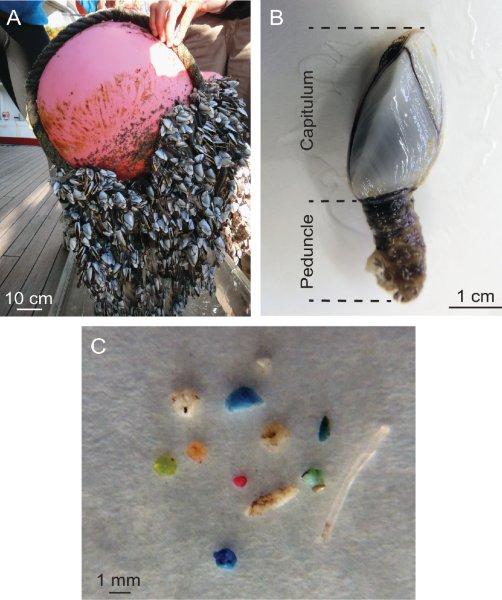
This is a figure from our paper that shows (a) barnacles growing on a buoy; (b) a closeup of an individual barnacle. The body is inside the white shell, and the stalk is just muscle; and (c) Plastic that we pulled out of a single barnacle's guts.
This is a figure from our paper that shows (a) barnacles growing on a buoy; (b) a closeup of an individual barnacle. The body is inside the white shell, and the stalk is just muscle; and (c) Plastic that we pulled out of a single barnacle’s guts.

It took me a couple years to get around to processing those samples, but eventually I found myself in the lab dissecting barnacles in order to identify them. As I sat there, I thought “Well, I’m working on these barnacles anyway – wonder what they’re eating?” So I pulled out the intestine of the barnacle I was working on, cut it open, and a bright blue piece of plastic popped out. I reached into my jar o’ dead barnacles and dissected a few more, and found plastic in their guts as well.

Thinking about it logically, it makes a lot of sense that gooseneck barnacles are eating plastic. They are really hardy, able to live on nearly any floating surface from buoys to turtles, so they’re very common in the high-plastic areas of the gyre. They live right at the surface, where tiny pieces of buoyant plastic float. And they’re extremely non-picky eaters that will shove anything they can grab into their mouth.

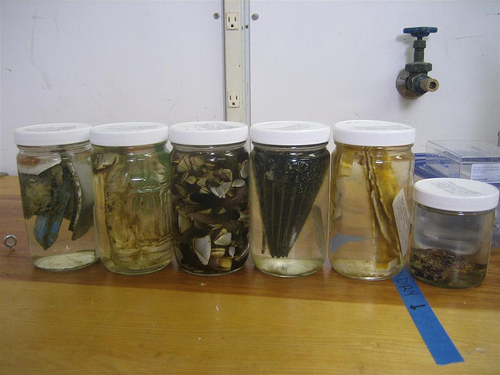
My jars of samples. The original jar o' barnacles is in the middle.
My jars of samples. The original jar o’ barnacles is in the middle.

But, since I didn’t really collect barnacles with this study in mind, I didn’t have enough samples to figure out how widespread this phenomena might be. Fortunately, I’d been lucky enough to collaborate with the wonderful Sea Education Association and one of their chief scientists, Deb Goodwin, for several years. SEA kindly took samples for us, and Deb, once a perfectly respectable remote sensing expert, got deep into some pretty smelly barnacle guts.

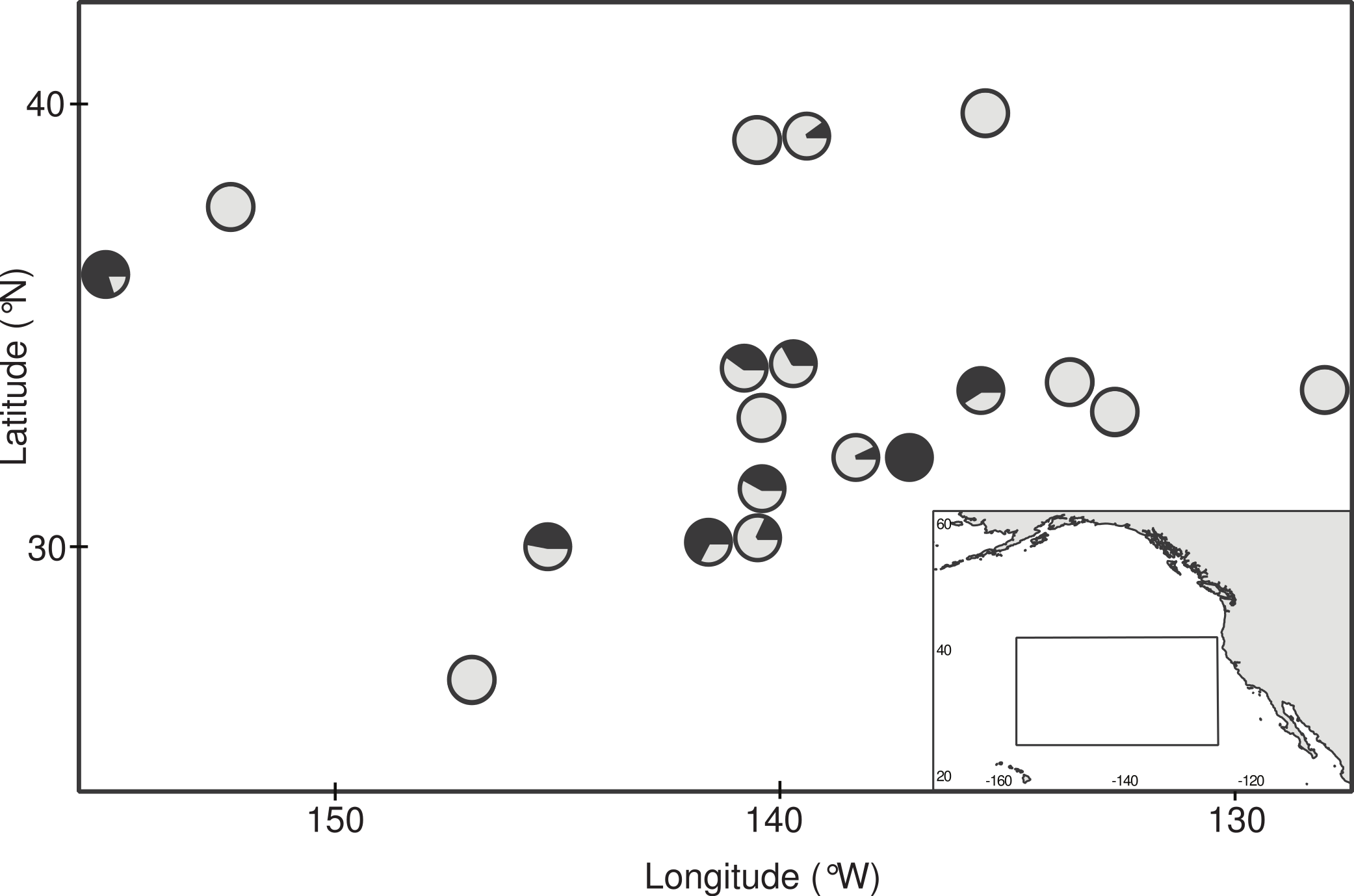
After dissecting 385 barnacles, Deb and I found that 33.5% – one-third – had plastic in their guts. Most barnacles had eaten just a few particles, but we found a few that were absolutely filled with plastic, to a maximum of 30 particles, which is a lot of plastic in an animal that is just a couple inches long.  We also analyzed the type of plastic in the barnacle guts, and found that it was approximately representative of plastic on the ocean surface – the barnacles are probably just grabbing whatever they come across and shoving it into their mouths.  Barnacles are perfectly capable of pooping out plastic – I observed plastic packaged up in fecal pellets, ready to be excreted the next time the barnacle had access to a couple minutes and a magazine – so it is very likely that more barnacles are eating plastic than we were able to measure.

The circles show where we sampled, and the dark part of the circle is the percentage of barnacles that had eaten plastic. The inset shows where we were in the ocean - the rectangle between North American and Hawaii.
The circles show where we sampled, and the dark part of the circle is the percentage of barnacles that had eaten plastic. The inset shows where we were in the ocean – the rectangle between North American and Hawaii.

So, this is disturbing. As I’ve discussed many times, there is a ton of plastic in the North Pacific Subtropical Gyres (but no island!) and it is being eaten by birds, turtles, and fish. And now we’ve documented plastic ingestion in a very common invertebrate – probably the numerous animal living attached to the plastic – as well. But just finding plastic in barnacle guts does not really tell us much about how plastic is impacting the oceanic ecosystem. This is because we don’t really understand how barnacles are interacting with the rest of the ocean.

Gooseneck barnacles aren’t necessarily incredibly central to the North Pacific Gyre ecosystem. The barnacles are voracious predators, but since plastic is so patchy, it’s not clear that they eat enough zooplankton to really affect the ecosystem – and a lot of the food I found in the barnacle guts were their own cyprid babies.

(Barnacles are nasty cannibals, apparently.) They’re eaten by a few predators – a pretty little sea slug and some crabs – but fish don’t seem that interested in barnacles, maybe because those fish didn’t evolve with a ton of floating debris. If barnacles are an important prey item, it is possible that their ingestion of plastic particles could transfer plastic or pollutants through the food web, but it is far from clear this is the case.

However, the most dire effects could be the most subtle. The subtropical gyres are 40% of the entire earth’s surface, and so they are very important to controlling the way that nutrients and carbon move around in the ocean. The microbes and animals that live on plastic debris are not the same as the microbes and animals that float around in the ocean, and may not act in the same way. It’s such a cliché for a scientist to call for more research, but we just don’t understand enough about the way that the ocean works, and enough about the way that plastic affects the ocean, to really say what the effects of barnacles eating plastic might be.

And the North Pacific Subtropical Gyre is a really nice place! Don't think of it as JUST a giant trash pile!
And the North Pacific Subtropical Gyre is a really
nice place! It’s good to know what is going on there!

Of course, none of this uncertainty changes the fact that plastic trash does not belong in the ocean, and we need to be a lot better about preventing it from getting in there in the first place. However, I am skeptical of plastic cleanup schemes, so please read these Open Ocean Cleanup Guidelines (which I co-authored) and Dr. Martini’s post before you suggest that we just clean it up. I think we are probably stuck with the plastic pollution that we have, so understanding what it is doing to the ocean is important.
I’ll be back in a couple weeks to do another behind-the-scenes post on a second debris-related paper! In the meantime, I’m happy to answer your questions about the barnacles.