A blog set out to explore, archive & relate plastic pollution happening world-wide, while learning about on-going efforts and solutions to help break free of our addiction to single-use plastics & sharing this awareness with a community of clean water lovers everywhere!

Monday, August 12, 2013

Plastic Water Bottles Causing Flood of Harm to Our Environment.

Posted in the Huffington Post on 07/29/2013 by Norm Schriever

2013-07-18-images4.jpgI remember the first time I saw a bottle of water for sale, thinking it was the most ridiculous thing I'd ever encountered. Who the heck would actually PAY to drink water when they could get it for free at home? That's just crazy! I drank out of the faucet every single day, or the garden hose in a pinch, and there was obviously nothing wrong with me (other than mentally).

But there they were, plastic bottles of water lined up in a cooler next to the Fantas and Tabs, happily purchased by the same screwy people who were walking around yelling into those new huge Walkie Talkie things called "cellphones." It was sometime in the 1980s, in the midst of a generation that was itself defined by ridiculousness -- fads like the Rubik's Cube, specialty Nike running shoes for a whopping $50, and Atari's Miss Pacman, an introduction to the new religion of consumerism for its own sake.

Back then, even the most optimistic capitalist couldn't have guessed where the water bottle industry was heading. Thirty years later it's not just a luxury item for those driving Porsche 911s with their salmon-colored collars up, but a stalwart of regular American life. Yes, me too -- I became one of those screwy people who bought bottled water by the case and yapped into his "cellphone" non -top (sometimes even when another person was on the line.)

But the damage from the bottled water industry isn't just to our intelligence and our wallets; it's also to the world we live in. Our environment is being impacted, not just the image of a nice sunny far-off meadow that word conjures but the actual surroundings that we depend on to sustain our lives. Our human fish tank is getting terrifically cloudy because of the plastic water bottles we buy and discard so thoughtlessly.

How big is the bottled water industry?
There are 50 billion water bottles consumed every year, about 30 billion of them in the US (which means we consume roughly 60 percent of the world's water bottles, even though we're about 4.5 percent of the world population).

There are 1,500 water bottles consumed per SECOND in the U.S.
2011 was a high point for bottle water sales, where 9.1 billion gallons were sold, or 29.1 gallons per person per year, the highest in sales and volume in history.

What does it take to manufacture the water bottles?
It takes three times the volume of water to manufacture one bottle of water than it does to fill it, and because of the chemical production of plastics that water is mostly unusable.

We use 17 million barrels of oil each year just to produce all of those water bottles.
To put it in perspective, that's enough oil to keep a million cars fueled for a whole year! (Or your Hummer to Ikea and back.)

The Earth Policy Institute factors the energy used to pump, process, transport and refrigerate our bottled water as over 50 million barrels of oil every year. That's an insane amount of resources for something that is a completely unneeded.

Another way to think of it: when you pick up a water bottle at the supermarket, hold it up and imagine it filled ¼ with oil. That's how much in fossil fuels it took just to manufacture it!
Even the environmental impact of delivering all that bottled water is profound, both from overseas (Fiji Water, Pellegrino) and distribution to stores in the US. It takes a fleet of 40,000 18-wheelers just to deliver our bottle water every week!
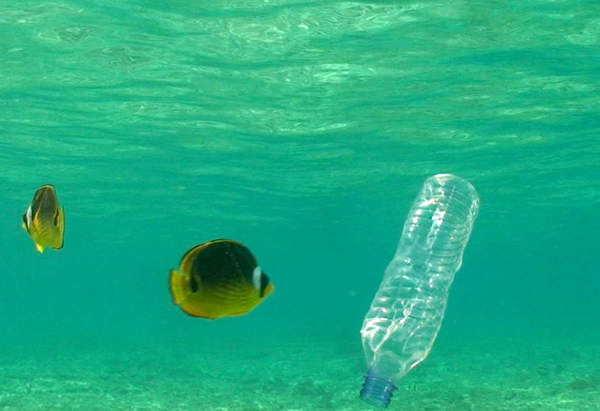
2013-07-18-t600TappedBottleOcean.jpgWhat's the environmental impact?
Water bottles are made of completely recyclable polyethylene terephthalate (PET) plastics, but PETs don't biodegrade they photodegrade, which means they break down into smaller fragments over time. Those fragments absorb toxins that pollute our waterways, contaminate our soil, and sicken animals (which we then eat). Plastic trash also absorbs organic pollutants like BPA and PCBs. They may take centuries to decompose while sitting in landfills, amounting to endless billions of little environmentally poisonous time bombs.

According to the Ocean Conservatory, plastic bottles and plastic bags are the most prevalent form of pollution found on our beaches and in our oceans -- every square mile of the ocean has over 46,000 pieces of floating plastic in it.

Ten percent of the plastic manufactured worldwide ends up in the ocean, the majority of that settling on the ocean floor where it will never degrade.

But don't we recycle?
Eighty percent of the water bottles we buy end up in landfills, the absolute worst place for them to be. That means roughly for every 10 bottles we drink, only two end up in the recycle bin.

Our national recycle rate for PET's is only 23 percent, which means we throw 38 billion water bottles into landfills a year.

That's $1 billion worth of plastic that should end up in the "recycling stream" where they can be reused as carpeting, synthetic decking, playground equipment, and new bottles and containers.

Isn't bottled water safer and cleaner?
No. In fact, all the majority of evidence shows that it's worse for you. Plastic leaches into the water it holds, which has been linked to health issues like reproductive problems and different types of cancer. Harmful hormone-disrupting phthalates leach into the bottled water we drink after as little as 10 weeks of storage, or much faster once the bottles have been left in the sun (like in the car.)

Tap water isn't perfect either because the purity varies depending on where you live, but the same could be said for bottled water. The National Resources Defense Council conducted an intensive study of bottled water and ascertained that 22 percent of the water tested contained contaminant levels that exceeded the state health limits.

New York city has the safest, cleanest tap water in the whole country, and San Francisco draws its public drinking water supply from nearby Yosemite National Park, so pure they don't even require it to be filtered.

If you wanted to check out how your local water system rates, click here.

Does it taste better?
In blind taste tests people have trouble differentiating between tap water and bottled water, and it's virtually indistinguishable once poured through a simple filter.

Your best bet is using tap water run through a good filter on your kitchen tap or drinking container, which will yield you the cheapest, cleanest, most convenient water source.

Is bottled water a rip off?
You know how you pay $3 + for a cup of coffee that probably costs 20 cents to make? You look like a financial genius making that purchase compared to the economics of bottled water. Bottled water costs well in excess of 1,000 times that of tap water, even with a filter.

Eight glasses of water, the recommended daily amount costs about $0.50 cents out of the tap, but about $1,400 if you bought bottles!

To put it in scale, if all of the water you used around the house for showers, dishwashing, watering the plants, etc. was bottled water your monthly H20 bill would be about $9,000.

Did you know that up to 47.8 percent of the bottled water we buy is actually just repackaged tap water? Yeah, and the mega-beverage conglomerates Coke, Pepsi and Nestle hold most of the market share. Can you spell "S-U-C-K-E-R?"

We complain incessantly about gas prices at $3.89 a gallon, but the same amount of San Pellegrino bottled water would cost close to $10. But I'm not trying to stop you from flushing your money down the toilet (so to speak,) however there is a greater cost to all of us as a society, country, and interconnected world community.

2013-07-17-imagesw.jpgWhat is the ripple effect?
780 million people around the world, more than twice the population of the United States, don't have access to clean, safe drinking water.

Of course the water bottle you don't buy isn't going to end up with them, but everything is interconnected, from trade policies and use of fossil fuels, to environmental impact and irrigation, and ultimately damage to food-producing industries like agriculture and fisheries.

Already, pollution is estimated to be one of the biggest causes of death around the world, affecting more than 100 million people per year, more than epidemics like Malaria and HIV.

The U.S. consumes natural resources, like fossil fuels, and pollutes the environment at an alarming rate. Though less than five percent of the world's population, we consume more than 25 percent of the resources and produce 30 percent of the trash and environmental pollutants. 

Not only are we severely harming the land, air and water around us, but the rest of the world has to pay the price for our thoughtless over-consumption, and soon our children and generations to come will be tirelessly cleaning up our mess.

However, it's not all doom and gloom -- just like the water bottle phenomenon took off within a short time, as did cell phones and other trends, a cultural shift can start creating solutions with lightning efficiency.

So please stay tuned for part 2, What We Can do TODAY to Fix The Water Bottle Problem, and
part 3, Creative And Functional Uses For Empty Water Bottles.

Monday, August 5, 2013

Plastics Chemical BPA May Harm Human Fertility Study

Published on Philly.com by Health Day Reporter Steven Reinberg

View the article here:  http://www.philly.com/philly/health/womenshealth/HealthDay678759_20130731_Plastics_Chemical_BPA_May_Harm_Human_Fertility__Study.html
ons showing effects are vastly higher than the concentration of BPA that could be present in the human body," said Steve Hentges, of the Polycarbonate/BPA Global Group of the American Chemistry Coun
Read more at http://www.philly.com/philly/health/womenshealth/HealthDay678759_20130731_Plastics_Chemical_BPA_May_Harm_Human_Fertility__Study.html#feHmAUOI7qDZX8Yl.99
WEDNESDAY, July 31 (HealthDay News) -- A chemical used in everything from food-can linings to store receipts might also pose some risk for infertility and birth defects, a new study suggests. Exposure to bisphenol A, or BPA, may disrupt the human reproductive process and play a role in about 20 percent of unexplained infertility, said researchers from Harvard University. In laboratory experiments, they exposed 352 eggs from 121 consenting patients at a fertility clinic to varying levels of BPA. "Exposure of eggs to BPA decreased the percentage of eggs that matured and increased the percentage of eggs that degenerated," said lead researcher Catherine Racowsky, director of the assisted reproductive technologies laboratory at Brigham and Women's Hospital in Boston. BPA also increased the number of eggs that underwent an abnormal process called "spontaneous activation" that makes eggs act as if they have been fertilized when in fact they haven't been, Racowsky said. Moreover, many eggs exposed to BPA that matured did so abnormally, increasing the odds for infertility and birth defects such as Down syndrome, she said. Eggs exposed to the highest levels of BPA were the most likely to show these ill effects, the researchers found. Their results are similar to earlier research examining the effect of BPA on animal eggs, they said. Racowsky cautioned that these latest results with human eggs were seen in the laboratory, so whether BPA exposure works the same way in real life isn't known. And the research also found only an association between BPA and infertility and birth defects, not necessarily a cause-and-effect link. In addition, the eggs used in the experiment were going to be discarded because they didn't respond normally and thus could be considered damaged to begin with, she said. BPA is known to disrupt the hormonal system, with the chemical acting like an artificial estrogen. "There are many ways it can disrupt the hormonal system," Racowsky said. The chemical is all throughout the environment, Racowsky said, and it's almost impossible to avoid exposure to it. "People need to be aware of the toxins in the environment and try to lead the healthiest life they can possibly lead," she said. The report was published online July 31 in the journal Human Reproduction. Dr. Avner Hershlag, chief of the Center for Human Reproduction at North Shore University Hospital in Manhasset, N.Y., agreed that a laboratory finding does not necessarily mean the same effect will be seen in the real world. "When you make a leap from the lab to patients you have to examine a whole different model," said Hershlag, who was not involved with the study. "To say from [the results] that this might explain part of unexplained infertility is a bit of a stretch. Unexplained infertility remains unexplained." One industry group concurred, pointing out that real-world settings often do not mirror lab experiments. "The physiological relevance of this study is entirely unclear since the BPA concentrations showing effects are vastly higher than the concentration of BPA that could be present in the human body," said Steve Hentges, of the Polycarbonate/BPA Global Group of the American Chemistry Council. Hentges added that numerous animal studies, "consistently have concluded that BPA does not affect fertility or other reproductive parameters at any dose even remotely close to human exposure levels." Hershlag also noted that the plastic equipment used with in vitro fertilization (IVF) may contain BPA and could affect the ability of eggs to mature, so it might be better to use glass. That, he suggested, might even improve the success of IVF. The U.S. Food and Drug Administration has banned the use of BPA in products such as baby bottles and sippy cups, but the chemical continues to be used in many other consumer products. The most prominent continuing use of BPA is in the lining of aluminum and tin cans, where it prevents corrosion. BPA also is found in inkless cash register receipts, which are coated with the chemical, and a study has shown increased BPA levels in the urine of people who have touched a receipt. More information To find out more about BPA, visit the U.S. Centers for Disease Control and Prevention. SOURCES: Catherine Racowsky, Ph.D., director, Assisted Reproductive Technologies Laboratory, Brigham and Women's Hospital, Boston; Avner Hershlag, M.D., chief, Center for Human Reproduction, North Shore University Hospital, Manhasset, N.Y.; Steve Hentges, Ph.D., Polycarbonate/BPA Global Group, American Chemistry Council; July 31, 2013, Human Reproduction, online Health News Copyright © 2013 HealthDay. All rights reserved.
Read more at http://www.philly.com/philly/health/womenshealth/HealthDay678759_20130731_Plastics_Chemical_BPA_May_Harm_Human_Fertility__Study.html#feHmAUOI7qDZX8Yl.99

BPA and Altered Airway Cells: Association Seen in Rhesus Macaques after Third-Trimester Exposure

Environmental Health Perspectives; DOI:10.1289/ehp.121-A254
 
Control and exposed airway epithelial cells
Lindsey Konkel is a Worcester, MA–based journalist who reports on science, health, and the environment. She writes frequently for Environmental Health News and The Daily Climate.
PDF icon PDF Version (614 KB)

See Related EHP Article

Fetal Exposure of Rhesus Macaques to Bisphenol A Alters Cellular Development of the Conducting Airway by Changing Epithelial Secretory Product Expression

Laura S. Van Winkle, Shannon R. Murphy, Miriam V. Boetticher, and Catherine A. VandeVoort
 
Prenatal bisphenol A (BPA) exposure has been shown to alter the development of reproductive organs in animal models,1 although the impacts on development of other organ systems remain largely unknown. Researchers at the University of California, Davis, now report in EHP that BPA exposure late in gestation alters airway cell development in rhesus macaques.2

Previous studies have associated BPA exposure with an experimental model of asthma in mice.3

Epidemiological studies have found evidence of an association between prenatal BPA exposure and wheeze in young children,4 and between postnatal exposure and childhood asthma.5

“This study sheds light on the possible mechanisms by which BPA may affect lung health,” says Kathleen Donohue, an assistant professor of medicine at Columbia University. Donohue was not involved in the current study.

BPA exposure is widespread. One report from the National Health and Nutrition Examination Survey found that more than 90% of urine samples collected from U.S. males and females over age 6 years contained detectable levels of the chemical.6
Figure 5, Van Winkle et al. Late-pregnancy exposure to BPA (B) was associated with a higher number of mucous cells in the airway epithelium of exposed fetuses, compared with exposure in mid-pregnancy (D) and controls (A and C).
Van Winkle et al. DOI:10.1289/ehp.1206064

For the current study, pregnant rhesus macaques received BPA via subcutaneous implant for 50 days during gestational days 50–100 or 100–150 (roughly comparable to the second and third trimesters, respectively, in humans). Control macaques received a corn oil implant or ate corn oil–treated fruit. Treatment groups included at least 6 animals, with histopathologic analyses conducted on smaller subgroups.

“Our goal was to model constant serum levels of BPA that have been measured in humans,” says first author Laura Van Winkle, a toxicologist at the university. “Lung development patterns and cellular abundance in the airways of these animals match humans much more closely than rodent models.”

At the end of each group’s exposure period the researchers collected fetal airway tissue samples. They used only female fetuses, as the study originated from a project designed to examine the effects of BPA on female reproductive development.

They found that BPA exposure in late pregnancy was associated with increased expression of secretory proteins in fetal tissue. The cells that produce these proteins mature late in gestation; the proteins themselves—Clara cell secretory protein (CCSP) and the mucins MUC5AC and MUC5B—are key components of airway mucous secretions.2

Expression of the Muc5B gene was approximately six times higher at 150 days’ gestation in fetuses whose mothers were exposed to BPA late in pregnancy compared with those whose mothers received no BPA exposure. Expression of the Muc5AC gene also was increased. Histological staining of the lung tissue indicated there were more mucous cells in the airway epithelium of exposed fetuses and suggested an increase in the amount of mucous production (however, the researchers did not have a large enough sample size to run statistical analyses).2

There were no significant changes in protein expression after exposure during mid-pregnancy, suggesting that late pregnancy may be a critical period in which BPA exposure may alter airway cell development. This critical window may also apply to human exposures to BPA in the third trimester of pregnancy due to similarities in the timing of cellular development and airway structure between rhesus macaques and humans.2

“Taken together with earlier studies in humans, this study in monkeys is important because it is another link in the chain of evidence [potentially] connecting BPA exposure to lung disease,” says Donohue.

An increase in mucous cell abundance is one of the hallmarks of asthma, the authors report. However, they say, the clinical relevance of this particular study remains to be seen. The researchers examined only fetal airway tissue samples, and it is unknown whether an increase in mucous cell abundance would have resulted in airway disease after birth.

The potential effects of environmental estrogens such as BPA on lung development also are not well known, says Van Winkle. Although estrogen is known to increase the expression of MUC5B in cultured airway epithelium cells from humans,7 and lung tissue does have estrogen receptors,8 it’s not clear how this affects the development of secretory proteins.

Recent experimental studies have suggested that BPA may also disrupt fetal development through epigenetic and nonestrogenic pathways.9,10 Van Winkle suspects a combination of hormonal and nonhormonal effects may be at play. “A third possibility is that BPA affects something else entirely in the body that in turn alters lung development,” she says.

References

1. vom Saal FS, et al. Chapel Hill bisphenol A expert panel consensus statement: integration of mechanisms, effects in animals and potential to impact human health at current levels of exposure. Reprod Toxicol 24(2):131–138 (2007); http://dx.doi.org/.10.1016/j.reprotox.2007.07.005.
2. Van Winkle LS, et al. Fetal exposure of rhesus macaques to bisphenol A alters cellular development of the conducting airway by changing epithelial secretory product expression. Environ Health Perspect 121(8):912–918 (2013); http://dx.doi.org/.10.1289/ehp.1206064.
3. Midoro-Horiuti T, et al. Maternal bisphenol A exposure promotes the development of experimental asthma in mouse pups. Environ Health Perspect 118(2):273–277 (2010); http://dx.doi.org/.10.1289/ehp.0901259.
4. Spanier AJ, et al. Prenatal exposure to bisphenol A and child wheeze from birth to 3 years of age. Environ Health Perspect 120(6):916–920 (2012); http://dx.doi.org/.10.1289/ehp.1104175.
5. Donohue KM, et al. Prenatal and postnatal bisphenol A exposure and asthma development among inner-city children. J Allergy Clin Immunol 131(3):736–742 (2013); http://dx.doi.org/.10.1016/j.jaci.2012.12.1573.
6. Calafat AM, et al. Exposure of the U.S. population to bisphenol A and 4-tertiary-octylphenol: 2003–2004. Environ Health Perspect 116(1):39–44 (2008); http://dx.doi.org/10.1289/ehp.10753.
7. Choi HJ, et al. Signal pathway of 17β-estradiol-induced MUC5B expression in human airway epithelial cells. Am J Respir Cell Mol Biol 40(2):168–178 (2009); http://dx.doi.org/10.1165/rcmb.2007-0377OC.
8. Mollerup S, et al. Expression of estrogen receptors α and β in human lung tissue and cell lines. Lung Cancer 37(2):153–159 (2002); http://dx.doi.org/10.1016/S0169-5002(02)00039-9.
9. Susiarjo M, et al. Bisphenol A exposure disrupts genomic imprinting in the mouse. PLoS Genet 9(4):e1003401 (2013); http://dx.doi.org/10.1371/journal.pgen.1003401.
10. Vandenberg LN, et al. Bisphenol-A and the great divide: a review of controversies in the field of endocrine disruption. Endocr Rev 30(1):75–95 (2009); http://dx.doi.org/10.1210/er.2008-0021.

Friday, August 2, 2013

Scientists find microbes thriving on plastic marine debris

Microbes on marine debris
A scanning electron microscope image shows microbes on a piece of plastic marine debris. (Erik Zettler / Sea Education Assn. / August 1, 2013)

A team of researchers in Woods Hole, Mass., has discovered a novel ecological habitat flourishing in one of the fastest growing segments of civilization's toxic waste stream: plastic marine debris.

Welcome to the Plastisphere, a biological wilderness on microbial reefs of polyethylene and polypropylene in the open ocean teeming with single-celled animals, fungi and bacteria, many of them newly discovered. Some may be pathogens hitching rides on floating junk.

The effects of plastic debris on fish, birds, turtles and marine mammals that ingest it are well documented. But little is known about the effects of these diverse, relatively new and evolving microbial communities on the surrounding marine environment.

“We were surprised to find microbes in such high numbers on these plastics,” said Tracy Mincer,  an associate scientist in marine chemistry and geochemistry at Woods Hole Oceanographic Institution and coauthor of a report on the findings published online in June in Environmental Science and Technology. “Another surprise was that they are distinct from their surrounding marine counterparts.”

Using scanning electron microscopes and gene sequencing techniques, the team found at least 1,000 different types of bacteria, diatoms and algae attached to seaborne rubbish. They also discovered microbes embedded in cracks and pits on plastic surfaces indicating they may be capable of degrading hydrocarbons.

These unique menageries, which arose on plastic debris introduced to the world’s ocean over the last six decades, make up extensive food chains of bacteria and single-celled animals that produce their own food, bacteria that feed on their waste products and predators that feed on all of them.

"Each one of these plastic bits is a circle of life -- one microbe’s waste is another microbe’s dinner,” Mincer said. “We want to know more about how some microbes may be hanging out on plastic trash, just waiting to be eaten by fish so they can get into that environment.”

Of particular concern was a sample of polypropylene -- about the size of the head of a pin -- dominated by members of the genus vibrio, which includes bacteria that cause cholera and gastrointestinal ailments.

Since plastic debris persists far longer than biodegradable flotsam such as feathers and wood, dangerous pathogens could travel long distances by attaching themselves to plastic rafts of debris tinier than salt grains.

Another surprise: Some microbes seem to have acquired a taste for polypropylene. Others, however, prefer polyethylene.

“We still don’t know what they may be getting out of it,” Mincer said. “Not much nutrition there.”

It’s all grist for continuing research in what Mincer described as “a whole new field of study that is unfolding in countless fascinating themes.”

The analyses of marine debris skimmed with fine-scale nets at several locations in the North Atlantic was led by microbial ecologist Erik Zettler of the Sea Education Assn., biologist Linda Amaral-Zettler of the Marine Biological Laboratory, and Mincer -- all in Woods Hole, Mass.

“We’ve only just begun in what I see as a long-term project in our laboratory,” Mincer said.

An estimated 46,000 pieces of plastic trash float in every square mile of ocean. The waste gathers in vast "garbage patches" in ocean gyres --  cyclonic dead spots formed by currents and winds.

The Eastern Garbage Patch, midway between Hawaii and California, is roughly twice the size of Texas.
 louis.sahagun@latimes.com

Campaign against disposable plastic shopping bags finds support with local businesses

Bag Monster appears at Riverfront Park
Bag Monster appears at Riverfront Park: Bag Monster is not happy about the possibility of him not being able to join his friends in the Pacific Ocean by way of the Willamette River.
SAL0801-Bag Ban
The Bag Monster, representing the how many plastic bags each person is estimated to use each year, was on hand Wednesday for the kick off of Environment Oregon's campaign to ban the bags' use. / KOBBI R. BLAIR / Statesman Journal
Twenty-five local businesses are backing a campaign to ban disposable plastic shopping bags in Salem.

The campaign kicked off Wednesday morning with a visit from a “Bag Monster,” representing the 500 plastic bags that bag opponents estimate we each use per year to carry groceries and other purchases.


“Nothing we use for a few minutes should be allowed to pollute our precious waterways, including the Willamette,” said Kelsey White-Davis of Environment Oregon, which is leading the campaign.


Already, White-Davis said, 800 people have signed a petition asking the Salem City Council to pass an ordinance banning plastic shopping bags.


Similar efforts are underway in Bend, Ashland, Lake Oswego, Beaverton and Tigard. The push follows the failure of a statewide bag ban bill in this year’s legislative session.


Portland, Eugene and Corvallis already have plastic bag bans.


Supporters of a bag ban argue that the bags are difficult to recycle, are made from non-renewable resources, and find their way out of recycling containers and garbage trucks.


“We are a testament that you can have a viable, thriving business without using disposable plastic bags,” said Michelle Suess, sustainability coordinator for the LifeSource grocery store in Salem.


But the biggest threat from plastic bags, they say, is to wildlife, especially in the Pacific Ocean.


“Plastic pollution harms thousands of sea birds and marine animals, like sea turtles, every year,” White-Davis said. “Banning single-use plastic bags in Salem will help protect wildlife in the Willamette and Pacific.”


Campaign organizers hope to convince the city council to vote on the issue this fall, White-Davis said.


Monday, July 29, 2013

Stephanie Carrow: In the waters of Trash Creek

Published in CT Post, Friday, July 19, 2013 by Stephanie Carrow
0
 
Summer is a time of abundance, and most of it -- the blossoms, sunshine and songbirds -- we welcome appreciatively. But it's also the time for a proliferation of another sort -- that of plastic garbage in our waters. This plastic endangers marine wildlife and human health, both locally and as it makes its way out to sea. 
 
I've been paddling the lower Connecticut coastline for 16 years, and every day in the season that I go out on my kayak, I come back in a mini garbage scow.

After every trip, the back well of my sit-on-top holds a variety of balloons (latex and Mylar), shopping bags, food wrappers, Styrofoam cups, plastic bottles, bottle caps, lighters, beer cans, yards of monofilament line with floaters and hooks, and empty No. 2 bottles for cleansers, motor oil and other toxic fluids. I've also picked up basketballs, soccer balls, beach balls, a good pair of men's sneakers, two-gallon buckets, a bright pink Croc shoe, and countless neon green tennis balls, apparently used in forfeited games of fetch with dogs. And I'm retrieving only a small part of what's out there.

While I've observed -- and picked up -- plastic refuse throughout my kayaking excursions, I'm sad to note that Ash Creek, between Fairfield and Bridgeport, has by far the highest concentration of garbage I've seen in waters along the coast -- so much so, that on my first or second paddling trip there, I dubbed it "Trash Creek."

It's a shame, too, because Ash Creek is also a place of sublime summer beauty: I don't think I've seen more of a range of shorebird species in one discrete patch of this coastline as I've seen while paddling Ash Creek. But the herons, egrets, osprey, cormorants, belted kingfishers and others there must wade and fish amidst garbage.

Knowing the damage that plastic refuse can do to marine life, I can't in good conscience pass it by -- I feel compelled to pick it up. I think of sea turtles choking on plastic bags and balloons they mistake for jellyfish, and of albatross chicks dying with bellies full of bottle caps and other plastic debris mistaken by their parents for lookalike zooplankton. I imagine all this local refuse drifting seaward and choking marine animals; or adding to the toxic Atlantic Garbage Patch, cousin to the now infamous Great Pacific Garbage Patch.

But this plastic does its damage even here in local waters. I myself came upon a lifeless cormorant who, tangled in snagged plastic fishing line, had drowned just inches below the water's surface. I met a man who'd saved an osprey from a similar fate -- both birds dive for their fish. And I met a couple who similarly saved a horseshoe crab -- not a cuddly animal, but vital to the ecosystem and even to human health (its blood is used in pharmaceuticals).

A reading of the book Plastic Ocean, by Capt. Charles Moore (with Cassandra Phillips), provides an even more vivid picture of the magnitude of the problem, some of which begins in coastal waters. Capt. Moore is credited with having discovered the Great Pacific Garbage Patch -- which he describes as actually a soup of microplastic fragments and whole objects that swirl in two vast gyres in the remote North Pacific Ocean.

The fragments occur when plastics, which never biodegrade, become brittle and break into pieces that mix with and mimic plankton, the oceans' food base. These fragments are accumulating in the oceans in such tonnage that they have been found to outweigh plankton by a ratio of six to one -- or greater in some places.

Since his discovery in 1997, Moore and others have engaged in rigorous scientific samplings of the plastic soup and its multiple consequences, among them: well over 140,000 marine animals -- birds, sea turtles, whales, dolphins, otters and seals -- die each year from plastics ingestion, entanglement or strangulation. Much of the plastics involved are bottle caps, shopping bags, balloons and fishing lines -- among the very items we can find in abundance along our shoreline and floating in our local waters.

The largest animal ever to roam the earth, the blue whale, lives solely on tiny plankton -- meaning that it is now ingesting large quantities of plastic with every giant gulp.

Another consequence is to our own health, since the toxic microplastics are also eaten by the fish that we consume. Plastics leech toxins into our waters, and they also attract other pollutants such as PCBs and pesticides -- which means that anything consuming plastics becomes contaminated. It's been determined that our favorite food fish -- including tuna and salmon -- consume plastic, or eat the fish that eat the plastic.

It doesn't require a kayak trip to see our contribution to the problem. On any given day in this season, many of our beaches are strewn with plastic, ready to be washed out into the Sound and the sea beyond in the next high tide.

A stroll by the shoreline could fill multiple garbage bags with plastic bottles, bags, cups and utensils, food wrappers, straws, cigarette butts (also plastic), lighters, a plethora of bottle caps, and the occasional tampon applicator or condom. There are also perfectly usable plastic beach toys -- pails, shovels, sand molds -- and shoes left for the tide to take them.

It's as though they were easily disposable, and they are: the cheapness of plastic has made them so. We live in a throwaway culture; but in the process, we might be throwing away the very health of our waters that makes coastline living so appealing.

The solutions to the problem are multilateral -- and a few beach cleanups per season aren't enough to tackle this scourge. Along with Moore's book (a lively, compelling and absorbing summer read), the website 5gyres.org provides clear steps we all can take to stem the plastic tide. Moore's website, algalita.org, also provides further information on the problem and solutions. We can begin by steering clear of single-use, disposable plastics; and by recognizing that everything we leave behind has a consequence.

It's a conundrum that our most disposable products are made from the least destructible, longest-lasting material.

For my part, I will continue to pick up garbage as I walk the shoreline or paddle the waters, with this vision in mind: My most astonishing sighting in Ash Creek was of an American white pelican, on the day after Hurricane Irene.

 Unheard of in this part of the world, it had been blown perhaps a thousand miles north of its home, as had dozens of other non-indigenous species, according to local birding groups. That dazzling survivor embodied for me the essence of Ash Creek, and our Sound beyond, as a haven of beauty and wonder -- not a careless dumping ground. Our efforts together as a coastal community can, for all our sakes, set things right again.

Stephanie Carrow, of Fairfield, is a writer, psychotherapist and avid kayaker, and has been published in Fairfield Magazine and other local publications.

California coastline hosts ‘Great Pacific Garbage Patch’

Millions of pieces of trash are floating in the world’s oceans and fundamentally changing the makeup of Earth’s food chain.

Tons of plastic have accumulated in an area between Hawaii and California, and the convergence of currents swirls the trash into what is now known as the Great Pacific Garbage Patch.

Bottle caps, trash bags and broken plastic are now part of the diet of many birds and sea creatures around the world.

It’s very depressing, initially, to realize the extent of the problem,” said Captain Charles Moore, founder of Alagalita Marine Research Institute.

One of the largest concentrations of marine debris is in the Pacific Ocean, halfway between Hawaii and California. It’s called the Great Pacific Garbage Patch.

Moore accidentally found the garbage patch in 1997 while sailing through a gyre, where ocean currents circulate and accumulate trash.

It’s a piece here, a piece there. It’s not a solid island. In general what we see is a soup of plastic. Not really an island of plastic,” said Moore.

Next year, Captain Moore is planning to spend a month at the Garbage Patch to research its effects on the food chain.

It is difficult to see the collection of trash from above because it’s made up of pieces of plastic the size of a finger nail. Researchers believe that there could be 2 million of these little pieces of plastic per square mile.

Millions of creatures are dying every year, tangled in plastic,” said Moore.

It’s not just the wildlife that is being fooled into eating this stuff and getting tangled in it, it’s we ourselves that are changing our biological being with these chemicals in this hyper-consumptive world that we live in,” Moore added.

Scientists at the Scripps Institution of Oceanography in San Diego have also been trying to figure out how the marine debris is changing the world. A Scripps study estimated that fish in the intermediate ocean depths of the North Pacific Ocean ingest plastic at a rate of roughly 12,000 to 24,000 tons per year.

Cleaning up the mess that’s already been made is likely impossible, but experts believe the problem could potentially be saved with a radical change in economic and social culture.

When you hear politicians talk about growth, you would think it’s one of the 10 Commandments,” said Moore.

Our very being is consumers of products. This defines us these days. The type of car we have, the type of shoes we wear. The type of hair gel we do. The band of clothing we have. This is how we get our identity,” Moore added.

Moore argues that consumption habits and our creature comforts have led to an earth shattering problem: where to put all of the trash we generate.

We have to really redefine ourselves as human beings, as something other than a consumer in order to beat this problem,” said Moore.

New shorelines created of trash are appearing in all oceans, and even in America’s Great Lakes.
As world economies continue to thrive on mass consumption, Captain Moore will continue to sail and study the plastic oceans.