A blog set out to explore, archive & relate plastic pollution happening world-wide, while learning about on-going efforts and solutions to help break free of our addiction to single-use plastics & sharing this awareness with a community of clean water lovers everywhere!
Showing posts with label Plastic Infographic. Show all posts

Monday, February 16, 2015

Humans are putting 8 million metric tons of plastic in the oceans — annually

Published in the Washington Post by Chris Mooney - Feb. 12, 2015

Late last  year we learned that, thanks to human beings, the oceans are carrying at least 5 trillion pieces of floating plastic — or nearly 700 pieces per human alive on the planet. In weight, that’s some 250,000 tons of the stuff.

But new research suggests that even that haul is probably a serious underestimate. In a paper published this week in the journal Science, Jenna Jambeck of the University of Georgia and a group of colleagues tried to estimate the total amount of plastic going into the oceans annually from 192 coastal countries, whose total population is 6.4 billion.

People in these countries within 50 kilometers of the coast, the study estimates, produced 99.5 million metric tons of plastic waste in 2010 — and 31.9 of those million tons, the study estimates, were in some way mismanaged.

Thus, the authors calculate, each year about 4.8 million to 12.7 million metric tons of plastic are entering the oceans — for a midpoint figure of around 8 million metric tons. This is vastly higher than the number cited above — and moreover, it’s an annual number.

“It’s much larger than what they’re finding in the water,” says Jambeck. “But of course, as you know, they only can count what they find, and they only can find where they look.”

Here’s an infographic, courtesy of the researchers, that takes you through the process of measuring global plastic production, refining the estimate down to plastic waste in coastal regions, and then eventually estimating how much plastic winds up in the oceans (and how much we measure at the surface):
So what does 8 million metric tons of plastic actually mean? And is there any way to state such a gigantic figure in human terms?

“It’s five bags filled with plastic for every foot of coastline in the world,” says Jambeck.
So, why is so much of this stuff getting into the ocean? The reason, the paper asserts, boils down to a massive global waste management problem.

 The countries estimated to have the greatest mismanagement issues for plastic waste tend to be developing nations — China, Indonesia, the Philippines, Vietnam — with large and growing coastal populations, where waste management hasn’t kept pace with the population explosion.

“Sixteen of the top 20 producers are middle-income countries, where fast economic growth is likely occurring but waste management infrastructure is lacking,” notes the paper.

In other words, this is not just a lot of plastic bags getting swept up by wind and deposited at sea. “You have, from the random plastic bag blows to … they pretty much dispose of it right there on the coastline, right there on the bank of a river,” says Jambeck. “That’s the variability that you might find.”

The United States comes in 20th on the global plastic dumping list. While this country does have advanced waste processing, it also has a very large coastal population. (The top 20 countries contribute 83 percent of the world’s total mismanaged plastic, the study estimates.)

Ocean plastic has many consequences. It can kill fish and birds through entrainment or strangulation and can also be ingested by marine creatures and enter into the food chain, where it may have many unknown effects.

This is not a new issue to the global plastics industry. A group of plastics associations from various countries recently released a declaration on the matter, outlining a number of potential solutions to the problem and noting that “plastics do not belong in the world’s oceans and should not be littered — plastics should be responsibly used, reused, recycled and finally recovered for their energy value.”

The Science paper also has a forward projection: The plastic problem is expected to get worse.  By 2025, U.S. mismanaged plastic waste is expected to grow by 22 percent, and in the five biggest countries for the problem, it’s expected to double.

“We will not reach a global ‘peak waste’ before 2100,” notes the paper.

Friday, January 30, 2015

Why People Are Eating Their Own Trash

Everything You Need to Know About the Great Pacific Ocean Garbage Patch

Published in Greener Ideal.com by  |   


There is currently an estimated 3.5 million tons of trash floating around the Pacific Ocean, in what's called the Great Pacific Garbage Patch.  It's believed the patch spans roughly twice the size of the continental U.S.
 
Also known as the Pacific Trash Vortex, the Great Pacific Garbage Patch is not an island or land mass necessarily visible to the naked eye, like many assume.
 
Instead, the patch is made up largely of broken down microplastics - small particles of non-biodegradable material drawn together at the convergence of different ocean currents - which appear as a kind of cloudy soup.

There are at least 260 known species which feed on these microplastic particles, confusing them for plankton.  These plastics then travel up the food chain, resting in the stomachs of increasingly larger predators, like tuna or mahi-mahi, for instance.

It takes about 600 years for plastic in the ocean to fully break down.  It's then crucial we keep our plastic and litter out of the oceans, or we'll be eating our trash for ages to come.
Pacific Ocean Garbage Patch

Thursday, July 17, 2014

First of Its Kind Map Reveals Extent of Ocean Plastic

 
     Published in National Geographic July 15, 2014 by Laura Parker

When marine ecologist Andres Cozar Cabañas and a team of researchers completed the first ever map of ocean trash, something didn't quite add up.

Their work, published this month in the Proceedings of the National Academy of Sciences, did find millions of pieces of plastic debris floating in five large subtropical gyres in the world's oceans.

But plastic production has quadrupled since the 1980s, and wind, waves, and sun break all that plastic into tiny bits the size of rice grains. So there should have been a lot more plastic floating on the surface than the scientists found.

"Our observations show that large loads of plastic fragments, with sizes from microns to some millimeters, are unaccounted for in the surface loads," says Cozar, who teaches at the University of Cadiz in Spain, by e-mail. "But we don't know what this plastic is doing.

The plastic is somewhere—in the ocean life, in the depths, or broken down into fine particles undetectable by nets."

What effect those plastic fragments will have on the deep ocean—the largest and least explored ecosystem on Earth—is anyone's guess. "Sadly," Cozar says, "the accumulation of plastic in the deep ocean would be modifying this enigmatic ecosystem before we can really know it."

But where exactly is the unaccounted-for plastic? In what amounts? And how did it get there?

"We must learn more about the pathway and ultimate fate of the 'missing' plastic," Cozar says.

Plastic, Plastic Everywhere
One reason so many questions remain unanswered is that the science of marine debris is so young. Plastic was invented in the mid-1800s and has been mass produced since the end of World War II. In contrast, ocean garbage has been studied for slightly more than a decade.

"This is new mainly because people always thought that the solution to pollution was dilution, meaning that we could turn our head, and once it is washed away—out of sight, out of mind," says Douglas Woodring, co-founder of the Ocean Recovery Alliance, a Hong Kong-based charitable group working to reduce the flow of plastic into the oceans.

The North Pacific Garbage Patch, a loose collection of drifting debris that accumulates in the northern Pacific, first drew notice when it was  discovered in 1997 by adventurer Charles Moore as he sailed back to California after competing in a yachting competition.

A turning point came in 2004, when Richard Thompson, a British marine biologist at Plymouth University, concluded that most marine debris was plastic.

Research on marine debris is also complicated by the need to include a multidiscipline group of experts, ranging from oceanographers to solid-waste-management engineers.

"We are at the very early stages of understanding the accounting," says Kara Lavender Law, an oceanographer at the Sea Education Association, based in Cape Cod, Massachusetts.  "If we think ten or a hundred times more plastic is entering the ocean than we can account for, then where is it? We still haven't answered that question.

"And if we don't know where it is or how it is impacting organisms," she adds, "we can't tell the person on the street how big the problem is."

Law, along with Thompson, is one of 22 scientists researching marine debris for the National Center for Ecological Analysis and Synthesis at the University of California, Santa Barbara. The group is grappling with some of these questions and plans to publish a series of papers later this year.
One of the most significant contributions made by Cozar's team, says Law, was data collected in the Southern Hemisphere: "I can't tell you how rare that is."

New Maps Document Floating Plastic Trash

Tens of thousands of tons of plastic garbage float on the surface waters in the world's oceans, according to researchers who mapped giant accumulation zones of trash in all five subtropical ocean gyres. Ocean currents act as "conveyor belts," researchers say, carrying debris into massive convergence zones that are estimated to contain millions of plastic items per square kilometer in their inner cores.
Map shows plastic debris in surface water of world's oceans. Created in-house by Jamie Hawk (Ryan Morris).
NG STAFF, JAMIE HAWK. SOURCE: ANDRÉS COZAR, UNIVERSITY OF CÁDIZ, SPAIN
 
One Answer
Cozar's team was part of the Malaspina expedition of 2010, a nine-month research project led by the Spanish National Research Council to study the effects of global warming on the oceans and the biodiversity of the deep ocean ecosystem. 

Originally Cozar was assigned to study small fauna living on the ocean surface. But when tiny plastic fragments kept turning up in water samples collected by the expedition scientists, Cozar was reassigned to assess the level of plastic pollution.

The two-ship expedition spent nine months circumnavigating the world. But Cozar also used data gathered by four other ships that had traveled to the polar regions, the South Pacific, and the North Atlantic to complete the map.

The team analyzed 3,070 water samples. "One of the most striking observations was the conspicuous presence of plastic in the surface samples, even thousands of kilometers from the continents," he says. "The plastic garbage patch in the South Atlantic Gyre was one of the most striking."

See how scientists and artists have gathered and studied ocean debris to put the problem of trash into perspective.
 
Cozar says that one answer to the missing-plastic mystery is that some of the tiniest bits of plastic are being consumed by small fish, which live in the murky mesopelagic zone, 600 feet to 3,300 feet (180 to 1,000 meters) below the surface. 

Little is known about these mesopelagic fish, Cozar says, other than that they're abundant. They hide in the darkness of the ocean to avoid predators and swim to the surface at night to feed.

"We found plastics in the stomachs of the fishes collected during Malaspina's circumnavigation," he says. "We are working on this now."

One of the most common mesopelagic fish is the lantern fish, which lives in the central ocean gyres and is the main link in the tropical zone between plankton and marine vertebrates. Because lantern fish serve as a primary food source for commercially harvested fish, including tuna and swordfish, any plastic they eat ends up in the food chain.

"There are signs enough to suggest that plankton-eaters, the small fishes, are important conduits for plastic pollution and associated contaminants," Cozar says. "If this assumption is confirmed, the impacts of a man-sustained plastic pollution could extend over the ocean predators on a large scale."

Follow Laura Parker on Twitter

Thursday, May 1, 2014

This Is How Your Plastic Bag Ends Up In Massive Ocean Garbage Patches


Published in the Huffington Post on April 22, 2014 by Alissa Scheller

Ever heard of the Pacific garbage patch? It's one of several swirling trash zones in our oceans, and it's where a lot of our plastic litter ends up. While these debris patches aren't visible piles of floating trash in the water, the reality of what they are and how they got there is just as gross -- and just as harmful to marine life.

Sunday, September 15, 2013

Website map tracks path of ocean pollution, Fukushima radiation plume

Published in KLTV Sep 11, 2013
The radiation plume from the 2011 disaster is expected to reach the U.S. coast by 2014, according to a model. (Source: adrift.au.org) The radiation plume from the 2011 disaster is expected to reach the U.S. coast by 2014, according to a model. (Source: adrift.au.org)
(RNN) - A website map from the University of New South Wales models how pollution moves across oceans, and predicts that the radioactive plume from Japan's 2011 Fukushima nuclear meltdown will make its way across the Pacific to the U.S. West Coast in 2014.

According to Ecowatch, experts said the radiation will be below levels that the World Health Organization considers dangerous by the time it reaches the U.S. coastline next year. Although the level of radiation is expected to have very little effect on human health, the radiation increase will be measurable.

All three Fukushima Daiichi reactor cores at a nuclear power plant largely melted in the aftermath of a 9.0 earthquake and tsunami in the largest nuclear incident since Chernobyl. Radioactive materials and contaminated water were released, and leading to the evacuation of more than 100,000 from a 20-kilometer area around the afflicted plant.

An international expert panel, in a February 2013 initial health assessment, doesn't expect the Fukushima disaster to have significant health effects outside the most affected areas in Fukushima Prefecture, Japan, where the highest radiation doses occurred. In these areas, the population may experience long-term increases in cancer cases, including thyroid cancers, according to the report.

In addition to tracking radioactive plumes, the website Adrift is used to trace the path of plastics and other items, including messages in bottles, released from most places across the globe into the oceans.

Adrift is based on the research into ocean circulation by Dr. Erik Van Sebille, as well as the book Moby-Duck by Donovan Hohn, which tells the story of a 1992 cargo ship incident in the North Pacific that released thousands of plastic toys.

Plastic waste presents a tremendous problem to the health of the world's oceans and the life within it. Marine animals become ensnared in plastic waste or mistake it for food and eat it, introducing harmful chemicals into the food chain.

The nonprofit organization 5 Gyres reported that after one use, roughly 50 percent of the billions of plastic bags and bottles used in the U.S. is buried in landfills. However, much gets lost in the environment, eventually washing out to sea.

Debris is carried by ocean currents to remote areas, circulating in five large gyres, or slow-moving currents.

The largest gyre, the North Pacific Gyre, is about twice the size of the United States, 5 Gyres said. Other major garbage gyres can be found in the Bay of Bengal, the North Atlantic, the Indian Ocean and the South China Sea.

"Designed to last, plastic trash in the gyre will remain for decades or longer, being pushed gently in a slow, clockwise spiral towards the center," 5 Gyres reported.

Adrift stated that there are many ways to cut the amount of plastic that makes it from the coast into the gyres, including keeping beaches clean and reducing the amount of plastic used.

Copyright 2013 Raycom News Network. All rights reserved.

Tuesday, February 5, 2013

How much Plastic is in the Ocean?

Find out though this really cool interactive webpage!

http://prezi.com/vcmpjwa6acyk/plastic-in-the-ocean/

Prezi transcript:

Plastic in our oceans What is the effects of plastic in the oceans The main effect that plastics have on the oceans is one the animals that live in it. Plastic is one of the most dangerous hazards for marine animals. Marine animals are not use to plastic in there natural habitat and often mistake it for food. Like a plastic grocery bag looks a lot like a jelly fish to a sea turtle. When a marine animal eats plastic it either chokes or starves to death. They can starve to death because plastics take a lot longer to decompose in there stomach so they will end up eating so much plastic nothing can fit in there stomach. Also animals can get entangled in plastic objects like six pack soda holders,fish nets, and much more. Entanglement can cause sever injury, impaired movement, and starvation which all those commonly lead to death. Like this seagull which thought these pieces of plastic were fish eggs How much plastic is in the oceans The estimated amount of plastic in the ocean is 48,000 pieces per square mile and its said that 60% to 80% of marine litter is plastic. But Plastic is not randomly floating around in the ocean it is being kept in large ocean currents all around the world which makes huge garbage patches. The biggest garbage patch is called the Great Pacific Garbage Patch which is located west from LA and north from Hawaii. Its so big its the size of two full Texas. Most of the garbage patches are not visible though. Plastic still breaks down to small piece even though it still last for a long time. But when it does this it is even more of a hazard because the main animal in those regions fish confuse those tiny pieces of plastic with food. Solution There are many possible solutions for this issue. But we cant just simply wait it out and let the plastic disappear because it takes up to 400 years for a piece of plastic to fully decompose. We can see here that the recovery rate is way lower than the gaining plastic rate so we have to start doing something. Some of the solutions people have came up with so far is to either switch to a more biodegradable resource than plastic or just try to use reusable products and recycle as much as possible. Switching to a more Biodegradable resource isn't a bad idea Like paper and cornstarch. But it cost a lot more money and energy to use it. My favorite solution is using reusable materials and recycling as much as possible. Which should save money and the planet. But everyone has to do it if this solution were to make a big impact. Who's for it/ Who's against it Well theirs not really anyone that is against helping the oceans and not putting plastic in the ocean. But there are sides on if we should stop making simple plastic appliances anymore. People that are for plastic People that are for plastic are either plastic producers that get a lot of profit out if making plastic appliances. Or as someone who likes the convinces of using plastic plates and cups because there cheap and you don't have to wash them you can just through them away. People that are against plastic An example of people that are against plastic would be the NRDC which is a environment protection organization who thinks we should cut down on simple plastics to protect the environment. My opinion on the Issue I think simple plastic appliances like cups, plates, and bags should stop being used and replaced with a more biodegradable material. I think that because plastic objects like that seem to be most commonly thrown away. And I think we should also start using my solution that I said earlier from now. Works Cited "Google." Google. N.p., n.d. Web. 31 Jan. 2013. "Plastic In Our Oceans by Abbie Barnes - Action For Nature." Action For Nature RSS. N.p., n.d. Web. 31 Jan. 2013. "Plastic Pollution in Our Oceans." NRDC:. N.p., n.d. Web. 31 Jan. 2013. "Plastics in Our Oceans." Plastics in Our Oceans. N.p., n.d. Web. 31 Jan. 2013. "Plastics in Our Oceans." Plastics in Our Oceans. N.p., n.d. Web. 31 Jan. 2013. "Water Matters." State of the Planet Our Oceans A Plastic Soup Comments. N.p., n.d. Web. 31 Jan. 2013. Works Cited The End

Saturday, September 29, 2012

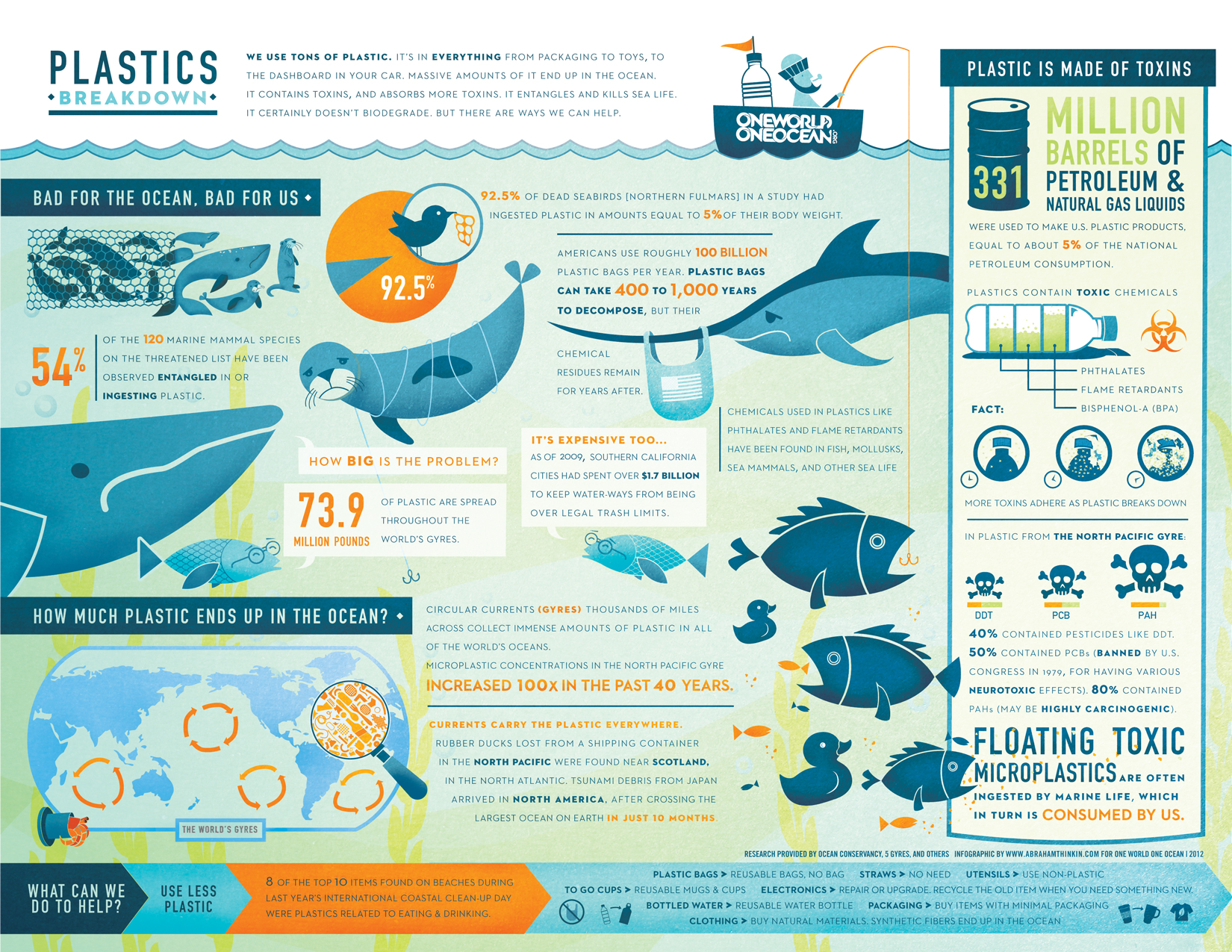
The Plastics Breakdown: An Infographic

Posted by Ted Reckas | September 13 2012 on OneWorldOneOcean.com

We've been posting on plastic ocean pollution all week in advance of International Coastal Cleanup Day, happening tomorrow. It's an amazing event that removes literally tons of plastic from coastlines and waterways around the world every year.

Trash, and specifically plastic, in the ocean is a huge issue and it's fixable if we all tune in to our plastic use.

Many people don't realize how big the problem is, or how harmful plastic is to sea life, so we made an infographic to lay it all out. Click here to download the PDF (10MB) or the image below to view full size.


Wednesday, May 23, 2012

Plastic Oceans (Plastic in our playground!) Part 2 - Plastic bottles

posted on www.sail-world.com by Ian Thomson on May 20, 2012


'Plastics in our oceans'    . ©    Click Here to view large photo

In part one, we looked at plastic bags. We went through the numbers and quantified how much one million and one billion is in reality. Let's revisit that before we move onto Plastic water bottles.

To count straight through from one to 1,000,000 will take you 11 days and it will take 32 years to count to one billion. You cannot count to one trillion in your lifetime. In grains of rice, to get one million grains you need 25 litres (6.5 gallons). For one billion you need 25,000 litres of rice (6,500 gallons).

The world now consumes 200 billion litres of bottled water every year. The majority of this is in plastic bottles. You can pretty much equate each litre into one bottle. So that makes 200 billion water bottles that we need to dispose of or recycle every year.

How did we get to drinking this much water out of bottles when we have perfectly good water out of the taps? Well you can blame the big soda drink manufacturers. Back in the 80's they realised that we can only drink so much soda.

In order to keep growing they needed to create a new market. They decided to bottle water. They then went on a campaign to sell us, saying that bottled water is way better for us than water out of the tap. We fell for it and today it is a multi-billion dollar market. We now ship water from Fiji to Italy, Italy to USA and Paris to Australia!

So is it better for us or not? Well 40% of bottled water is actually filtered tap water. Some are known to be better, some worse. No matter what water brand you buy though, there is one key that should give us the answer.

Plastic breaking up through photo-degradation - Ocean Crusaders -  Ian Thomson  
It is called a 'Used by date'. Water does not go off in rivers and lakes or in our taps so why does it have a used by date? It is because plastic water bottles contain toxins that leach into the water, contaminating it and also affecting the taste. It's that plastic taste you get occasionally. It's actually killing you slowly. What are these toxins? The big one is Bisphenol A (BPA).

There are more and more studies these days on this toxin and it has been proven to cause breast cancer, ADHD, autism and the list continues to grow. To put it bluntly, toxins in plastic consumed during pregnancy is a major issue. Heating kids drinks and food in plastic just adds to the issue.

So it's not healthy for us so how do they get away with it. It is all in the name of convenience. We are too lazy to take our own bottle and refill it. Tonight I saw the most crazy advert on TV. Coca Cola's brand of water here in Australia 'Mount Franklin' is promoting that their water is in bottles that are made of just 30% of the plastic of other brands and that they crush down really easily.

Initially I thought that at least it is less plastic but then I thought about it. They use less plastic which costs them less. Win to Coca Cola. Oh and you can't reuse it as it crushes too easy so you have to buy another bottle. Win to Coca Cola.

World Cartoon - Ocean Crusaders -  Ian Thomson  
Around the world only 30% of plastic is recycled so that means 66.6 billion of these bottles will go into landfill or worse still, into the oceans. The caps on water bottles are still not recyclable so that means 200 billion bottle caps in our world that won't break down, they'll last forever.

So as a boater, what can you do? Simple, buy S/S water bottles and refill them. If you want to buy water, buy it in large containers or filter it from the tap at home. S/S bottles may cost a bit but the savings you will make in not buying water will pay for this bottle countless times. It means you create less waste, you save money and the environment will love you for it. Everybody wins.

If you're in a yacht club or corner store, purchase or lease a water vending machine. You can even get flavoured water dispensed. If every shop replaced the fridge they store bottled water in with a water vending machine, they still make money but don't kill the environment. Oh and it would be cheaper for you too.

Bottled Water - Ocean Crusaders -  Ian Thomson   Click Here to view large photo


I don't want to sail on an ocean of plastic and I'm sure you don't want to either. We need to change our habits today. It is the little things that count towards making our oceans safe for the future.

Say no to plastic water bottles.

Reduce, Resuse, Recycle.

Ocean Crusaders was founded by Ian Thomson in June 2010 after setting the world record for the fastest solo circumnavigation of Australia. He is on a crusade to educate the world of the issues our oceans are facing. An online education program is available for primary school teachers to present to their students or for parents to present to their children. Visit the Ocean Crusaders website for more details.

Click here to view part one of Plastic Oceans.
by Ian Thomson

Thursday, July 28, 2011

Plastic {Infographic}

posted July 27, 2011 by Zachary Shahan on Planet Save.com

Plastic — it is everywhere. While it has helped humanity in some important ways, it is also wreaking havoc on ecosystems and organisms around the world (including humans). Here’s an interesting infographic with some stunning and disturbing information on: how much plastic we use, what problems it’s linked to, plastic in the ocean, BPA, plastic’s ridiculously long lifespan, and how we can cut plastic out of our lives (OK, maybe not how we can do so completely, but how we can do so to a large degree).

The most interesting line of the infographic, in my opinion, is this one: “every piece of plastic made still exists today.” But, really, there’s a ton of interesting info here.

The infographic also does a good job of pointing out the key steps we can take to body-slam our plastic problem:

Use reusable bags
Cut the bottled water out of your life
Say no to single-serve plastic packaging
Use sandwich boxes instead of sandwich bags (cooler anyway!)
Use silverware (.. which actually results in a little more pleasant of an eating experience)
Go digital (forget the old-school plastic CDs & cases)
Use a refillable dispenser
Bring your “to-go” mug with you
Avoid plastic you can’t easily (and probably won’t) recycle
Try to find products not made of plastic (when you have to buy something, that is)

Anyway, here’s the infographic:  (CLICK GRAPHIC TO ENLARGE)